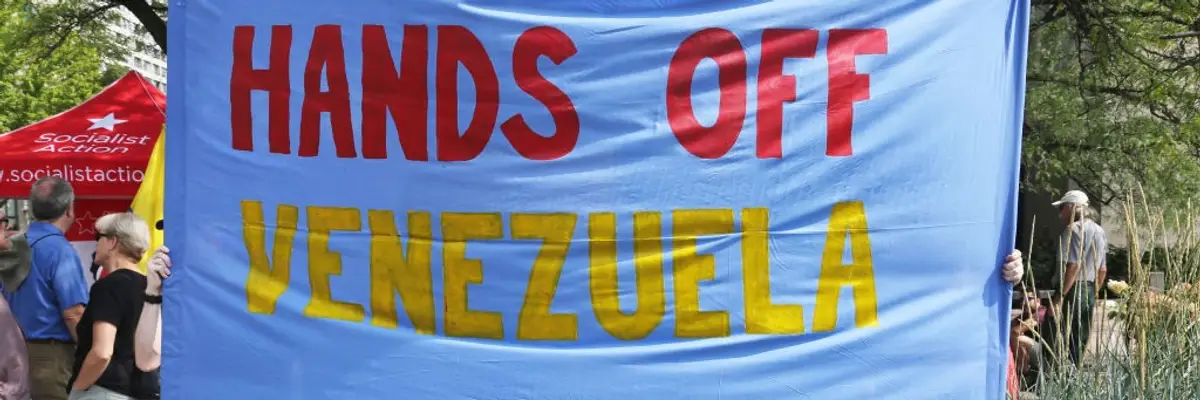
Canadians rally to demand an end to American attempts at a "regime change" in Venezuela and to denounce Canada's complicity to overthrow the government of Venezuela in Toronto, Canada, on September 16, 2017.
Let's Be Very Clear: There's No Legal Basis for Trump to Attack Venezeula
Regardless of the reasons, the US has no right to intervene.
President Donald Trump promised “no new wars,” but his aggression against Venezuela is the exact opposite.
The US military has been blowing up alleged “drug boats” near Venezuela that have killed at least 83 people. The United Nations has condemned these unprovoked strikes as unlawful extrajudicial executions. Yet President Trump has said the US may “very soon” expand this campaign to Venezuelan territory.
Meanwhile, the USS Gerald R. Ford is stationed off the coast of Venezuela and Trump has ordered the CIA to conduct covert operations inside the country. And he declared on November 29 that the airspace “above and surrounding” Venezuela is “to be closed in its entirety.”
It’s unclear if that means Trump plans to impose a no-fly zone on Venezuela. But if so, that would be an act of war—and under the Constitution, illegal without congressional authorization.
Trump’s pressure campaign against Venezuela isn’t about countering traffickers or “bringing democracy” to Venezuela.
We saw this playbook before the 2003 invasion of Iraq. President George W. Bush lied about Iraq’s possession of weapons of destruction and its ties to al-Qaeda in order to sell his regime change war to the American public.
Similarly, the Trump administration is relying on unsupported allegations against Venezuela. Only this time, the allegations are even more bogus and easily disproven.
The US has claimed that it attacked the small boats because they were carrying drugs, despite offering no proof. Even if the boats did carry drugs, the appropriate response would be to lawfully intercept and detain the suspects and afford them due process of law.
Under international law, force is only permitted in self-defense from an armed attack or if authorized by the UN Security Council, neither of which applies here. Congress hasn’t approved military force against alleged traffickers either.
A secret Department of Justice memo has gone so far as to name fentanyl as a “chemical weapon threat” from these “drug boats.” But neither US nor international assessments have found that Venezuela is a primary producer or international shipment point of narcotics, including fentanyl.
Trump has also accused Venezuelan President Nicolás Maduro of controlling the Tren de Aragua criminal gang, a claim contradicted by a US intelligence memo, as well as the “Cartel of the Suns”—an organization many experts doubt even exists but which Trump’s State Department now lists as a “terrorist organization.”
And while Trump alleges that Maduro is flooding the US with drugs, he just pardoned one of the biggest cocaine traffickers—former Honduran president Juan Orlando Hernández, who was sentenced to 45 years last year for creating “a cocaine superhighway to the United States.”
Trump’s pressure campaign against Venezuela isn’t about countering traffickers or “bringing democracy” to Venezuela.
Instead, it’s a continuation of treating Latin America as part of the US “sphere of influence” to justify interventions, as seen with past CIA-orchestrated coups in Guatemala and Chile that ousted democratically elected governments in favor of more US-compliant authoritarian regimes.
The US has been waging economic warfare since 2005 by imposing a range of sanctions on Venezuela under the guise of “promoting democracy.” But far from resolving the country’s political crisis, these sanctions have devastated the economy and increased the suffering of ordinary Venezuelans, forcing nearly 8 million to flee since 2014.
Venezuela also has the world’s largest proven oil reserves—something Trump knows well. “When I left” office in 2021, “Venezuela was ready to collapse,” Trump said in 2023. “We would have taken it over—we would have gotten all that oil.”
Regardless of the reasons, the US has no right to intervene in Venezuela. A war would unleash untold suffering on the Venezuelan people. It’s also the last thing Americans want, as several polls have shown. A November CBS/YouGov poll found that 70% of Americans across party lines oppose the US taking military action against Venezuela.
The evidence is clear. There’s no legal basis for a war and the majority of Americans don’t want it.
We are at a crossroads
This country and this world are at a monumental crossroads. In a few short weeks, US voters will have an opportunity to beat back the forces of fascism and confront the billionaires who are rigging the economy, our media system, and our democracy, making it increasingly impossible for ordinary people to get by. We’re not just talking about the election. We’re talking about what must be done once these fascist elements are vanquished from power. We need a bolder set of solutions than what either major party has so far been willing to offer and a working-class movement ready to fight like hell for it. Trump didn't emerge from nowhere. The conditions that fueled MAGA authoritarianism were created by decades of radical neoliberal economic policies and a corrupt political system dominated by corporate interests. They slashed taxes on the super-rich, promising that the benefits would trickle down. They said giveaways to the corporate titans would make life more affordable for the rest of us. It was all bullshit. And when a bitter, betrayed populace searches for someone to blame, right-wing demagogues have little trouble finding scapegoats. People know when they're being lied to, but you won't hear any of this from the corporate media. Only independent journalism—powered and funded by people who believe in building a better world—can deliver truly trustworthy daily news. Our Fall Campaign is underway, and we need your help. To power our newsroom through the rest of the year, we need to raise $125,000 by midnight on October 31. So if you share our vision, please contribute whatever you can to sustain our work. |
President Donald Trump promised “no new wars,” but his aggression against Venezuela is the exact opposite.
The US military has been blowing up alleged “drug boats” near Venezuela that have killed at least 83 people. The United Nations has condemned these unprovoked strikes as unlawful extrajudicial executions. Yet President Trump has said the US may “very soon” expand this campaign to Venezuelan territory.
Meanwhile, the USS Gerald R. Ford is stationed off the coast of Venezuela and Trump has ordered the CIA to conduct covert operations inside the country. And he declared on November 29 that the airspace “above and surrounding” Venezuela is “to be closed in its entirety.”
It’s unclear if that means Trump plans to impose a no-fly zone on Venezuela. But if so, that would be an act of war—and under the Constitution, illegal without congressional authorization.
Trump’s pressure campaign against Venezuela isn’t about countering traffickers or “bringing democracy” to Venezuela.
We saw this playbook before the 2003 invasion of Iraq. President George W. Bush lied about Iraq’s possession of weapons of destruction and its ties to al-Qaeda in order to sell his regime change war to the American public.
Similarly, the Trump administration is relying on unsupported allegations against Venezuela. Only this time, the allegations are even more bogus and easily disproven.
The US has claimed that it attacked the small boats because they were carrying drugs, despite offering no proof. Even if the boats did carry drugs, the appropriate response would be to lawfully intercept and detain the suspects and afford them due process of law.
Under international law, force is only permitted in self-defense from an armed attack or if authorized by the UN Security Council, neither of which applies here. Congress hasn’t approved military force against alleged traffickers either.
A secret Department of Justice memo has gone so far as to name fentanyl as a “chemical weapon threat” from these “drug boats.” But neither US nor international assessments have found that Venezuela is a primary producer or international shipment point of narcotics, including fentanyl.
Trump has also accused Venezuelan President Nicolás Maduro of controlling the Tren de Aragua criminal gang, a claim contradicted by a US intelligence memo, as well as the “Cartel of the Suns”—an organization many experts doubt even exists but which Trump’s State Department now lists as a “terrorist organization.”
And while Trump alleges that Maduro is flooding the US with drugs, he just pardoned one of the biggest cocaine traffickers—former Honduran president Juan Orlando Hernández, who was sentenced to 45 years last year for creating “a cocaine superhighway to the United States.”
Trump’s pressure campaign against Venezuela isn’t about countering traffickers or “bringing democracy” to Venezuela.
Instead, it’s a continuation of treating Latin America as part of the US “sphere of influence” to justify interventions, as seen with past CIA-orchestrated coups in Guatemala and Chile that ousted democratically elected governments in favor of more US-compliant authoritarian regimes.
The US has been waging economic warfare since 2005 by imposing a range of sanctions on Venezuela under the guise of “promoting democracy.” But far from resolving the country’s political crisis, these sanctions have devastated the economy and increased the suffering of ordinary Venezuelans, forcing nearly 8 million to flee since 2014.
Venezuela also has the world’s largest proven oil reserves—something Trump knows well. “When I left” office in 2021, “Venezuela was ready to collapse,” Trump said in 2023. “We would have taken it over—we would have gotten all that oil.”
Regardless of the reasons, the US has no right to intervene in Venezuela. A war would unleash untold suffering on the Venezuelan people. It’s also the last thing Americans want, as several polls have shown. A November CBS/YouGov poll found that 70% of Americans across party lines oppose the US taking military action against Venezuela.
The evidence is clear. There’s no legal basis for a war and the majority of Americans don’t want it.
- 'No More Endless Wars,' Maduro Says to American People, Calling for 'Peace' in Face of Trump Threats ›
- Trump Administration Has ‘Made the Decision to Attack Military Installations Inside Venezuela’: Report ›
- UN Experts Decry Trump Warmongering Against Venezuela as 'Extremely Dangerous Escalation' ›
- Trump’s Venezuela Drug War Gambit and the Militarization Playbook at Home ›
- More Countries Condemn Trump's 'Imperialist' Saber-Rattling Against Venezuela ›
- Trump Claims Venezuelan Airspace Is Closed in Latest Illegal, 'Dangerous Escalation' ›
- Opinion | From Powell to Venezuela:the High Cost of Evidence-Free Escalation | Common Dreams ›
President Donald Trump promised “no new wars,” but his aggression against Venezuela is the exact opposite.
The US military has been blowing up alleged “drug boats” near Venezuela that have killed at least 83 people. The United Nations has condemned these unprovoked strikes as unlawful extrajudicial executions. Yet President Trump has said the US may “very soon” expand this campaign to Venezuelan territory.
Meanwhile, the USS Gerald R. Ford is stationed off the coast of Venezuela and Trump has ordered the CIA to conduct covert operations inside the country. And he declared on November 29 that the airspace “above and surrounding” Venezuela is “to be closed in its entirety.”
It’s unclear if that means Trump plans to impose a no-fly zone on Venezuela. But if so, that would be an act of war—and under the Constitution, illegal without congressional authorization.
Trump’s pressure campaign against Venezuela isn’t about countering traffickers or “bringing democracy” to Venezuela.
We saw this playbook before the 2003 invasion of Iraq. President George W. Bush lied about Iraq’s possession of weapons of destruction and its ties to al-Qaeda in order to sell his regime change war to the American public.
Similarly, the Trump administration is relying on unsupported allegations against Venezuela. Only this time, the allegations are even more bogus and easily disproven.
The US has claimed that it attacked the small boats because they were carrying drugs, despite offering no proof. Even if the boats did carry drugs, the appropriate response would be to lawfully intercept and detain the suspects and afford them due process of law.
Under international law, force is only permitted in self-defense from an armed attack or if authorized by the UN Security Council, neither of which applies here. Congress hasn’t approved military force against alleged traffickers either.
A secret Department of Justice memo has gone so far as to name fentanyl as a “chemical weapon threat” from these “drug boats.” But neither US nor international assessments have found that Venezuela is a primary producer or international shipment point of narcotics, including fentanyl.
Trump has also accused Venezuelan President Nicolás Maduro of controlling the Tren de Aragua criminal gang, a claim contradicted by a US intelligence memo, as well as the “Cartel of the Suns”—an organization many experts doubt even exists but which Trump’s State Department now lists as a “terrorist organization.”
And while Trump alleges that Maduro is flooding the US with drugs, he just pardoned one of the biggest cocaine traffickers—former Honduran president Juan Orlando Hernández, who was sentenced to 45 years last year for creating “a cocaine superhighway to the United States.”
Trump’s pressure campaign against Venezuela isn’t about countering traffickers or “bringing democracy” to Venezuela.
Instead, it’s a continuation of treating Latin America as part of the US “sphere of influence” to justify interventions, as seen with past CIA-orchestrated coups in Guatemala and Chile that ousted democratically elected governments in favor of more US-compliant authoritarian regimes.
The US has been waging economic warfare since 2005 by imposing a range of sanctions on Venezuela under the guise of “promoting democracy.” But far from resolving the country’s political crisis, these sanctions have devastated the economy and increased the suffering of ordinary Venezuelans, forcing nearly 8 million to flee since 2014.
Venezuela also has the world’s largest proven oil reserves—something Trump knows well. “When I left” office in 2021, “Venezuela was ready to collapse,” Trump said in 2023. “We would have taken it over—we would have gotten all that oil.”
Regardless of the reasons, the US has no right to intervene in Venezuela. A war would unleash untold suffering on the Venezuelan people. It’s also the last thing Americans want, as several polls have shown. A November CBS/YouGov poll found that 70% of Americans across party lines oppose the US taking military action against Venezuela.
The evidence is clear. There’s no legal basis for a war and the majority of Americans don’t want it.
- 'No More Endless Wars,' Maduro Says to American People, Calling for 'Peace' in Face of Trump Threats ›
- Trump Administration Has ‘Made the Decision to Attack Military Installations Inside Venezuela’: Report ›
- UN Experts Decry Trump Warmongering Against Venezuela as 'Extremely Dangerous Escalation' ›
- Trump’s Venezuela Drug War Gambit and the Militarization Playbook at Home ›
- More Countries Condemn Trump's 'Imperialist' Saber-Rattling Against Venezuela ›
- Trump Claims Venezuelan Airspace Is Closed in Latest Illegal, 'Dangerous Escalation' ›
- Opinion | From Powell to Venezuela:the High Cost of Evidence-Free Escalation | Common Dreams ›