SUBSCRIBE TO OUR FREE NEWSLETTER
Daily news & progressive opinion—funded by the people, not the corporations—delivered straight to your inbox.
5
#000000
#FFFFFF
To donate by check, phone, or other method, see our More Ways to Give page.
Daily news & progressive opinion—funded by the people, not the corporations—delivered straight to your inbox.
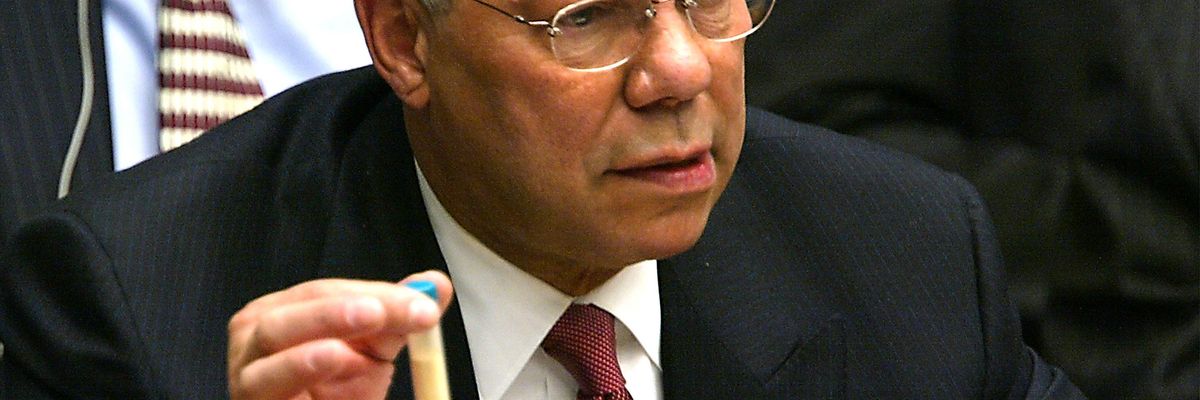
US Secretary of State Colin Powell holds a vial representing the small amount of Anthrax that closed the US Senate in 2002 during his address to the UN Security Council on February 5, 2003 in New York City.
We are witnessing the reemergence of a dangerous repetition: one where the pattern of assertion becomes the prelude to action, and where action can lead to irreversible consequences.
In the annals of modern international relations, few moments carry as heavy a legacy as the speech given by US Secretary of State Colin Powell to the United Nations Security Council on February 5, 2003. With solemn authority, Powell presented what he called “facts and conclusions based on solid intelligence” regarding Iraq’s weapons of mass destruction. The world watched. The Security Council listened. The invasion of Iraq soon followed.
Yet nearly every core assertion Powell made that day collapsed under post-war scrutiny. Iraq, it turned out, had no active WMD program. The biological labs, the chemical weapons, the nuclear revival—none existed. The damage, however, had been done: hundreds of thousands of lives lost, regional instability that persists two decades later, and a critical blow to the credibility of the international system.
The latest fact-checking report on statements made by the US ambassador to the United Nations at the Security Council emergency meeting on December 23, 2025 evokes Powell’s fateful moment with uncomfortable clarity. Assertions regarding Venezuela—about narco-terrorism networks, stolen oil, and naval interdictions—were advanced with the same kind of urgency and confidence that once shaped the Iraq invasion narrative. But just like 2003, these claims are not being matched by publicly verifiable evidence.
At the center of the current controversy is the claim that Venezuelan oil revenues finance a powerful criminal entity known as the “Cartel de los Soles.” Yet no evidentiary chain has been produced to establish this link: no verifiable financial tracing, no adjudicated findings, and no independent corroboration by multilateral investigative bodies. Even UN human-rights experts have questioned the coherence and existence of the cartel as a unified organization.
What the 2003 Iraq experience makes painfully clear is that institutional credibility depends on the ability to separate fact from political fiction.
Equally troubling is the claim that this alleged cartel poses a major narcotics or terrorist threat to the United States. The US Drug Enforcement Administration’s own 2025 National Drug Threat Assessment identifies Mexican transnational criminal organizations—not Venezuelan entities—as the principal threat. The Venezuelan organization does not even appear in the assessment.
Assertions have also been used to justify naval interdictions—military actions that, in legal terms, dangerously approach the definition of a blockade. But UN experts have been clear: Unilateral sanctions do not confer a right to enforce them through armed action. Under Article 2(4) of the UN Charter, the use of force is prohibited unless specifically authorized by the Security Council or justified in self-defense under Article 51. Neither condition has been met.
Finally, the idea that Venezuelan oil is “stolen” US property collapses under legal scrutiny. Venezuela nationalized its oil industry in 1976. While disputes over contractual terms and compensation have existed, these have historically been handled through arbitration and diplomacy—not force. No international court has ruled these oil shipments to be stolen under law.
What the 2003 Iraq experience makes painfully clear is that institutional credibility depends on the ability to separate fact from political fiction. Colin Powell’s posthumous regret—that his speech was a “blot” on his record—remains a chilling reminder that when unverified intelligence is used as justification for coercive action, the cost is not borne by the speaker, but by the people affected on the ground.
The December 2025 Security Council meeting reminds us how dangerous it is when urgency displaces evidence, as happened in Iraq in 2003. Unverified assertions create policy momentum. That momentum can foreclose diplomacy, manufacture inevitability, and normalize coercive actions like blockades or seizures—justified not through law, but through narrative inertia.
For policy analysts and scholars of international relations, this moment demands clarity. We are not debating ideology or even the internal legitimacy of a foreign government. The question is one of process: Do the claims being made meet minimum evidentiary thresholds before they are used to rationalize actions with international consequences?
Especially when coercive measures—economic or military—are on the table, the evidentiary bar must be high, not symbolic.
The UN Security Council’s authority rests not just on its legal charter, but on its credibility as a deliberative body. When that credibility is weakened by unsourced or politically convenient assertions, the council itself becomes a platform for escalation—not prevention.
The lesson from Iraq is not rhetorical—it is institutional. Intelligence must not be permitted to morph into justification before it becomes verification. Assertions, no matter how confidently delivered, are not evidence. When the international system forgets that distinction, the consequences are paid in blood and legitimacy.
It is not enough to feel certain. Policy must be grounded in demonstrable truth. Especially when coercive measures—economic or military—are on the table, the evidentiary bar must be high, not symbolic.
We are witnessing the reemergence of a dangerous repetition: one where the pattern of assertion becomes the prelude to action, and where action can lead to irreversible consequences. Whether in Baghdad or Caracas, this is a pattern we cannot afford to repeat.
Dear Common Dreams reader, It’s been nearly 30 years since I co-founded Common Dreams with my late wife, Lina Newhouser. We had the radical notion that journalism should serve the public good, not corporate profits. It was clear to us from the outset what it would take to build such a project. No paid advertisements. No corporate sponsors. No millionaire publisher telling us what to think or do. Many people said we wouldn't last a year, but we proved those doubters wrong. Together with a tremendous team of journalists and dedicated staff, we built an independent media outlet free from the constraints of profits and corporate control. Our mission has always been simple: To inform. To inspire. To ignite change for the common good. Building Common Dreams was not easy. Our survival was never guaranteed. When you take on the most powerful forces—Wall Street greed, fossil fuel industry destruction, Big Tech lobbyists, and uber-rich oligarchs who have spent billions upon billions rigging the economy and democracy in their favor—the only bulwark you have is supporters who believe in your work. But here’s the urgent message from me today. It's never been this bad out there. And it's never been this hard to keep us going. At the very moment Common Dreams is most needed, the threats we face are intensifying. We need your support now more than ever. We don't accept corporate advertising and never will. We don't have a paywall because we don't think people should be blocked from critical news based on their ability to pay. Everything we do is funded by the donations of readers like you. When everyone does the little they can afford, we are strong. But if that support retreats or dries up, so do we. Will you donate now to make sure Common Dreams not only survives but thrives? —Craig Brown, Co-founder |
In the annals of modern international relations, few moments carry as heavy a legacy as the speech given by US Secretary of State Colin Powell to the United Nations Security Council on February 5, 2003. With solemn authority, Powell presented what he called “facts and conclusions based on solid intelligence” regarding Iraq’s weapons of mass destruction. The world watched. The Security Council listened. The invasion of Iraq soon followed.
Yet nearly every core assertion Powell made that day collapsed under post-war scrutiny. Iraq, it turned out, had no active WMD program. The biological labs, the chemical weapons, the nuclear revival—none existed. The damage, however, had been done: hundreds of thousands of lives lost, regional instability that persists two decades later, and a critical blow to the credibility of the international system.
The latest fact-checking report on statements made by the US ambassador to the United Nations at the Security Council emergency meeting on December 23, 2025 evokes Powell’s fateful moment with uncomfortable clarity. Assertions regarding Venezuela—about narco-terrorism networks, stolen oil, and naval interdictions—were advanced with the same kind of urgency and confidence that once shaped the Iraq invasion narrative. But just like 2003, these claims are not being matched by publicly verifiable evidence.
At the center of the current controversy is the claim that Venezuelan oil revenues finance a powerful criminal entity known as the “Cartel de los Soles.” Yet no evidentiary chain has been produced to establish this link: no verifiable financial tracing, no adjudicated findings, and no independent corroboration by multilateral investigative bodies. Even UN human-rights experts have questioned the coherence and existence of the cartel as a unified organization.
What the 2003 Iraq experience makes painfully clear is that institutional credibility depends on the ability to separate fact from political fiction.
Equally troubling is the claim that this alleged cartel poses a major narcotics or terrorist threat to the United States. The US Drug Enforcement Administration’s own 2025 National Drug Threat Assessment identifies Mexican transnational criminal organizations—not Venezuelan entities—as the principal threat. The Venezuelan organization does not even appear in the assessment.
Assertions have also been used to justify naval interdictions—military actions that, in legal terms, dangerously approach the definition of a blockade. But UN experts have been clear: Unilateral sanctions do not confer a right to enforce them through armed action. Under Article 2(4) of the UN Charter, the use of force is prohibited unless specifically authorized by the Security Council or justified in self-defense under Article 51. Neither condition has been met.
Finally, the idea that Venezuelan oil is “stolen” US property collapses under legal scrutiny. Venezuela nationalized its oil industry in 1976. While disputes over contractual terms and compensation have existed, these have historically been handled through arbitration and diplomacy—not force. No international court has ruled these oil shipments to be stolen under law.
What the 2003 Iraq experience makes painfully clear is that institutional credibility depends on the ability to separate fact from political fiction. Colin Powell’s posthumous regret—that his speech was a “blot” on his record—remains a chilling reminder that when unverified intelligence is used as justification for coercive action, the cost is not borne by the speaker, but by the people affected on the ground.
The December 2025 Security Council meeting reminds us how dangerous it is when urgency displaces evidence, as happened in Iraq in 2003. Unverified assertions create policy momentum. That momentum can foreclose diplomacy, manufacture inevitability, and normalize coercive actions like blockades or seizures—justified not through law, but through narrative inertia.
For policy analysts and scholars of international relations, this moment demands clarity. We are not debating ideology or even the internal legitimacy of a foreign government. The question is one of process: Do the claims being made meet minimum evidentiary thresholds before they are used to rationalize actions with international consequences?
Especially when coercive measures—economic or military—are on the table, the evidentiary bar must be high, not symbolic.
The UN Security Council’s authority rests not just on its legal charter, but on its credibility as a deliberative body. When that credibility is weakened by unsourced or politically convenient assertions, the council itself becomes a platform for escalation—not prevention.
The lesson from Iraq is not rhetorical—it is institutional. Intelligence must not be permitted to morph into justification before it becomes verification. Assertions, no matter how confidently delivered, are not evidence. When the international system forgets that distinction, the consequences are paid in blood and legitimacy.
It is not enough to feel certain. Policy must be grounded in demonstrable truth. Especially when coercive measures—economic or military—are on the table, the evidentiary bar must be high, not symbolic.
We are witnessing the reemergence of a dangerous repetition: one where the pattern of assertion becomes the prelude to action, and where action can lead to irreversible consequences. Whether in Baghdad or Caracas, this is a pattern we cannot afford to repeat.
In the annals of modern international relations, few moments carry as heavy a legacy as the speech given by US Secretary of State Colin Powell to the United Nations Security Council on February 5, 2003. With solemn authority, Powell presented what he called “facts and conclusions based on solid intelligence” regarding Iraq’s weapons of mass destruction. The world watched. The Security Council listened. The invasion of Iraq soon followed.
Yet nearly every core assertion Powell made that day collapsed under post-war scrutiny. Iraq, it turned out, had no active WMD program. The biological labs, the chemical weapons, the nuclear revival—none existed. The damage, however, had been done: hundreds of thousands of lives lost, regional instability that persists two decades later, and a critical blow to the credibility of the international system.
The latest fact-checking report on statements made by the US ambassador to the United Nations at the Security Council emergency meeting on December 23, 2025 evokes Powell’s fateful moment with uncomfortable clarity. Assertions regarding Venezuela—about narco-terrorism networks, stolen oil, and naval interdictions—were advanced with the same kind of urgency and confidence that once shaped the Iraq invasion narrative. But just like 2003, these claims are not being matched by publicly verifiable evidence.
At the center of the current controversy is the claim that Venezuelan oil revenues finance a powerful criminal entity known as the “Cartel de los Soles.” Yet no evidentiary chain has been produced to establish this link: no verifiable financial tracing, no adjudicated findings, and no independent corroboration by multilateral investigative bodies. Even UN human-rights experts have questioned the coherence and existence of the cartel as a unified organization.
What the 2003 Iraq experience makes painfully clear is that institutional credibility depends on the ability to separate fact from political fiction.
Equally troubling is the claim that this alleged cartel poses a major narcotics or terrorist threat to the United States. The US Drug Enforcement Administration’s own 2025 National Drug Threat Assessment identifies Mexican transnational criminal organizations—not Venezuelan entities—as the principal threat. The Venezuelan organization does not even appear in the assessment.
Assertions have also been used to justify naval interdictions—military actions that, in legal terms, dangerously approach the definition of a blockade. But UN experts have been clear: Unilateral sanctions do not confer a right to enforce them through armed action. Under Article 2(4) of the UN Charter, the use of force is prohibited unless specifically authorized by the Security Council or justified in self-defense under Article 51. Neither condition has been met.
Finally, the idea that Venezuelan oil is “stolen” US property collapses under legal scrutiny. Venezuela nationalized its oil industry in 1976. While disputes over contractual terms and compensation have existed, these have historically been handled through arbitration and diplomacy—not force. No international court has ruled these oil shipments to be stolen under law.
What the 2003 Iraq experience makes painfully clear is that institutional credibility depends on the ability to separate fact from political fiction. Colin Powell’s posthumous regret—that his speech was a “blot” on his record—remains a chilling reminder that when unverified intelligence is used as justification for coercive action, the cost is not borne by the speaker, but by the people affected on the ground.
The December 2025 Security Council meeting reminds us how dangerous it is when urgency displaces evidence, as happened in Iraq in 2003. Unverified assertions create policy momentum. That momentum can foreclose diplomacy, manufacture inevitability, and normalize coercive actions like blockades or seizures—justified not through law, but through narrative inertia.
For policy analysts and scholars of international relations, this moment demands clarity. We are not debating ideology or even the internal legitimacy of a foreign government. The question is one of process: Do the claims being made meet minimum evidentiary thresholds before they are used to rationalize actions with international consequences?
Especially when coercive measures—economic or military—are on the table, the evidentiary bar must be high, not symbolic.
The UN Security Council’s authority rests not just on its legal charter, but on its credibility as a deliberative body. When that credibility is weakened by unsourced or politically convenient assertions, the council itself becomes a platform for escalation—not prevention.
The lesson from Iraq is not rhetorical—it is institutional. Intelligence must not be permitted to morph into justification before it becomes verification. Assertions, no matter how confidently delivered, are not evidence. When the international system forgets that distinction, the consequences are paid in blood and legitimacy.
It is not enough to feel certain. Policy must be grounded in demonstrable truth. Especially when coercive measures—economic or military—are on the table, the evidentiary bar must be high, not symbolic.
We are witnessing the reemergence of a dangerous repetition: one where the pattern of assertion becomes the prelude to action, and where action can lead to irreversible consequences. Whether in Baghdad or Caracas, this is a pattern we cannot afford to repeat.