
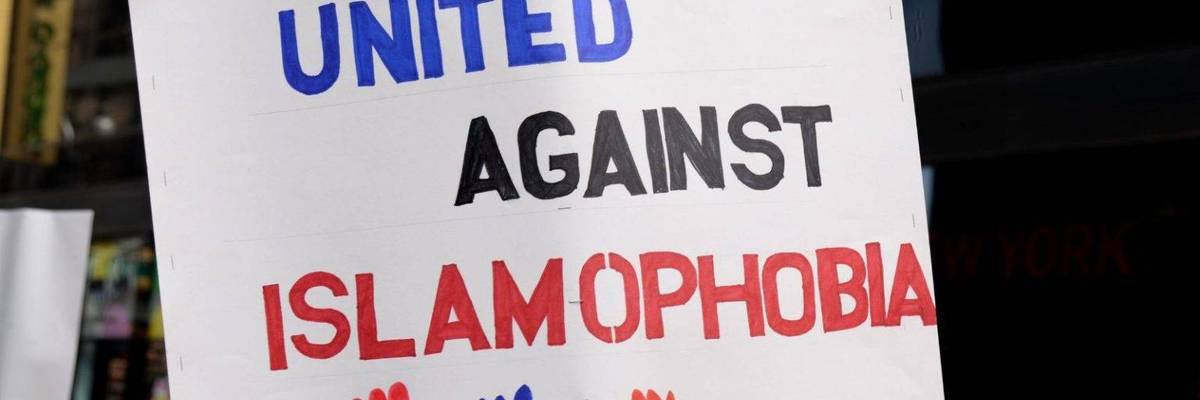
Protesters hold a sign reading, "United Against Islamophobia."
Muslim Children Should Not Carry the Burden of the 9/11 Attacks
Every child should learn about the devastating consequences of hatred, extremism, and violence, but no child should be made to feel responsible for those events simply because they share a faith with the perpetrators.
Muslim children were not born carrying the weight of 9/11. Society placed it on their shoulders. It is time for us to take it off.
As a child, I was called a "camel queen" by my teachers. Years later, while I was pregnant, a college professor looked at my stomach and joked in front of the whole class that I might have a "bomb" under there.
He was talking about my unborn child.
What has stayed with me all these years is not only the cruelty of the remark. It was where it happened. The comment came from a professor, in a classroom, an environment that should have been a place of learning, respect, and safety.
I hear from young people who become anxious when classroom discussions turn to terrorism or September 11. Not because they do not want to learn history, but because they worry the conversation will somehow become about them.
In that moment, I was not seen as a student, a mother-to-be, or a human being. I was seen through the lens of a vicious stereotype.
That moment taught me something I have never forgotten: Anti-Muslim prejudice is not always loud or obvious. Sometimes it appears as a joke. Sometimes it appears as an assumption. Sometimes it appears in the expectation that Muslims must constantly prove that they are not what others fear they might be.
My experience is not unique. In May, a 12-year-old Muslim student in Connecticut was reportedly subjected to repeated harassment and called anti-Muslim names. In a sign of the times, the Danbury Police Department searched the family’s home for weapons after allegations were made against the student.
In a 2025 survey of Muslims, the Institute for Social Policy and Understanding (ISPU), found, “Forty-seven percent of Muslim families with school-aged children report having a child who faced religious-based bullying in the past year, compared with 23% among the general public.”
Like many Muslim children, I learned early what it felt like to be viewed as different, foreign, or less worthy. Those experiences leave scars that are difficult to explain to people who have never lived them.
Today, I see those same burdens carried by Muslim students.
I hear from young people who become anxious when classroom discussions turn to terrorism or September 11. Not because they do not want to learn history, but because they worry the conversation will somehow become about them.
They wonder whether classmates will look at them and make jokes.
They wonder whether they will be expected to condemn atrocities they had nothing to do with.
No child should have to carry that burden.
This week, the organization I work for issued its Back to School Resource Guide for 2026-2027, which I authored. The guide gives teachers tips on how to discuss challenging topics with students, including providing comprehensive lesson plans that address the 9/11 attacks, specifically the victims and families impacted; the aftermath of the attacks, such as the war in Afghanistan; changes in national security; and the rise of hate crimes and discrimination against American Muslim communities.
The purpose of educational resources that address bias and inclusion is not to rewrite history or erase the tragedy of September 11. Muslims, like millions of other Americans, mourned the victims of al Qaeda’s vicious attacks. We condemned the perpetrators then, and we continue to condemn them today.
The purpose is much simpler: to help ensure that students can learn about difficult moments in history without becoming targets themselves.
Every child should be able to learn about 9/11. Every child should learn about the devastating consequences of hatred, extremism, and violence. But no child should be made to feel responsible for those events simply because they share a faith with the people who hijacked it.
I am no longer the little girl being mocked on the playground by teachers. I am no longer the college student sitting in a classroom while a professor jokes about my unborn child. But children today face many of the same assumptions.
Our children deserve better than that. They deserve classrooms where they are seen as students, not suspects. They deserve the freedom to learn about history without being associated with its worst actors. And they deserve a future in which their identity is not treated as a source of suspicion.
Most of all, they deserve to be children, free from the burden of defending themselves against crimes they did not commit.
We are at a crossroads
This country and this world are at a monumental crossroads. In a few short weeks, US voters will have an opportunity to beat back the forces of fascism and confront the billionaires who are rigging the economy, our media system, and our democracy, making it increasingly impossible for ordinary people to get by. We’re not just talking about the election. We’re talking about what must be done once these fascist elements are vanquished from power. We need a bolder set of solutions than what either major party has so far been willing to offer and a working-class movement ready to fight like hell for it. Trump didn't emerge from nowhere. The conditions that fueled MAGA authoritarianism were created by decades of radical neoliberal economic policies and a corrupt political system dominated by corporate interests. They slashed taxes on the super-rich, promising that the benefits would trickle down. They said giveaways to the corporate titans would make life more affordable for the rest of us. It was all bullshit. And when a bitter, betrayed populace searches for someone to blame, right-wing demagogues have little trouble finding scapegoats. People know when they're being lied to, but you won't hear any of this from the corporate media. Only independent journalism—powered and funded by people who believe in building a better world—can deliver truly trustworthy daily news. Our Fall Campaign is underway, and we need your help. To power our newsroom through the rest of the year, we need to raise $125,000 by midnight on October 31. So if you share our vision, please contribute whatever you can to sustain our work. |
Muslim children were not born carrying the weight of 9/11. Society placed it on their shoulders. It is time for us to take it off.
As a child, I was called a "camel queen" by my teachers. Years later, while I was pregnant, a college professor looked at my stomach and joked in front of the whole class that I might have a "bomb" under there.
He was talking about my unborn child.
What has stayed with me all these years is not only the cruelty of the remark. It was where it happened. The comment came from a professor, in a classroom, an environment that should have been a place of learning, respect, and safety.
I hear from young people who become anxious when classroom discussions turn to terrorism or September 11. Not because they do not want to learn history, but because they worry the conversation will somehow become about them.
In that moment, I was not seen as a student, a mother-to-be, or a human being. I was seen through the lens of a vicious stereotype.
That moment taught me something I have never forgotten: Anti-Muslim prejudice is not always loud or obvious. Sometimes it appears as a joke. Sometimes it appears as an assumption. Sometimes it appears in the expectation that Muslims must constantly prove that they are not what others fear they might be.
My experience is not unique. In May, a 12-year-old Muslim student in Connecticut was reportedly subjected to repeated harassment and called anti-Muslim names. In a sign of the times, the Danbury Police Department searched the family’s home for weapons after allegations were made against the student.
In a 2025 survey of Muslims, the Institute for Social Policy and Understanding (ISPU), found, “Forty-seven percent of Muslim families with school-aged children report having a child who faced religious-based bullying in the past year, compared with 23% among the general public.”
Like many Muslim children, I learned early what it felt like to be viewed as different, foreign, or less worthy. Those experiences leave scars that are difficult to explain to people who have never lived them.
Today, I see those same burdens carried by Muslim students.
I hear from young people who become anxious when classroom discussions turn to terrorism or September 11. Not because they do not want to learn history, but because they worry the conversation will somehow become about them.
They wonder whether classmates will look at them and make jokes.
They wonder whether they will be expected to condemn atrocities they had nothing to do with.
No child should have to carry that burden.
This week, the organization I work for issued its Back to School Resource Guide for 2026-2027, which I authored. The guide gives teachers tips on how to discuss challenging topics with students, including providing comprehensive lesson plans that address the 9/11 attacks, specifically the victims and families impacted; the aftermath of the attacks, such as the war in Afghanistan; changes in national security; and the rise of hate crimes and discrimination against American Muslim communities.
The purpose of educational resources that address bias and inclusion is not to rewrite history or erase the tragedy of September 11. Muslims, like millions of other Americans, mourned the victims of al Qaeda’s vicious attacks. We condemned the perpetrators then, and we continue to condemn them today.
The purpose is much simpler: to help ensure that students can learn about difficult moments in history without becoming targets themselves.
Every child should be able to learn about 9/11. Every child should learn about the devastating consequences of hatred, extremism, and violence. But no child should be made to feel responsible for those events simply because they share a faith with the people who hijacked it.
I am no longer the little girl being mocked on the playground by teachers. I am no longer the college student sitting in a classroom while a professor jokes about my unborn child. But children today face many of the same assumptions.
Our children deserve better than that. They deserve classrooms where they are seen as students, not suspects. They deserve the freedom to learn about history without being associated with its worst actors. And they deserve a future in which their identity is not treated as a source of suspicion.
Most of all, they deserve to be children, free from the burden of defending themselves against crimes they did not commit.
- Now, Like in 2001, 'Let Us Not Become the Evil We Deplore' ›
- 'Stolen Valor': Trump's Fabricated 9/11 Story Draws Immediate Scorn ›
- 16 Years After 9/11, Muslims Still Central Targets in War With No End ›
- The Stories Americans Tell about 9/11 Leave Out Discrimination Against Muslims ›
- Growing Up: Why Schools Need to Teach 9/11 ›
Muslim children were not born carrying the weight of 9/11. Society placed it on their shoulders. It is time for us to take it off.
As a child, I was called a "camel queen" by my teachers. Years later, while I was pregnant, a college professor looked at my stomach and joked in front of the whole class that I might have a "bomb" under there.
He was talking about my unborn child.
What has stayed with me all these years is not only the cruelty of the remark. It was where it happened. The comment came from a professor, in a classroom, an environment that should have been a place of learning, respect, and safety.
I hear from young people who become anxious when classroom discussions turn to terrorism or September 11. Not because they do not want to learn history, but because they worry the conversation will somehow become about them.
In that moment, I was not seen as a student, a mother-to-be, or a human being. I was seen through the lens of a vicious stereotype.
That moment taught me something I have never forgotten: Anti-Muslim prejudice is not always loud or obvious. Sometimes it appears as a joke. Sometimes it appears as an assumption. Sometimes it appears in the expectation that Muslims must constantly prove that they are not what others fear they might be.
My experience is not unique. In May, a 12-year-old Muslim student in Connecticut was reportedly subjected to repeated harassment and called anti-Muslim names. In a sign of the times, the Danbury Police Department searched the family’s home for weapons after allegations were made against the student.
In a 2025 survey of Muslims, the Institute for Social Policy and Understanding (ISPU), found, “Forty-seven percent of Muslim families with school-aged children report having a child who faced religious-based bullying in the past year, compared with 23% among the general public.”
Like many Muslim children, I learned early what it felt like to be viewed as different, foreign, or less worthy. Those experiences leave scars that are difficult to explain to people who have never lived them.
Today, I see those same burdens carried by Muslim students.
I hear from young people who become anxious when classroom discussions turn to terrorism or September 11. Not because they do not want to learn history, but because they worry the conversation will somehow become about them.
They wonder whether classmates will look at them and make jokes.
They wonder whether they will be expected to condemn atrocities they had nothing to do with.
No child should have to carry that burden.
This week, the organization I work for issued its Back to School Resource Guide for 2026-2027, which I authored. The guide gives teachers tips on how to discuss challenging topics with students, including providing comprehensive lesson plans that address the 9/11 attacks, specifically the victims and families impacted; the aftermath of the attacks, such as the war in Afghanistan; changes in national security; and the rise of hate crimes and discrimination against American Muslim communities.
The purpose of educational resources that address bias and inclusion is not to rewrite history or erase the tragedy of September 11. Muslims, like millions of other Americans, mourned the victims of al Qaeda’s vicious attacks. We condemned the perpetrators then, and we continue to condemn them today.
The purpose is much simpler: to help ensure that students can learn about difficult moments in history without becoming targets themselves.
Every child should be able to learn about 9/11. Every child should learn about the devastating consequences of hatred, extremism, and violence. But no child should be made to feel responsible for those events simply because they share a faith with the people who hijacked it.
I am no longer the little girl being mocked on the playground by teachers. I am no longer the college student sitting in a classroom while a professor jokes about my unborn child. But children today face many of the same assumptions.
Our children deserve better than that. They deserve classrooms where they are seen as students, not suspects. They deserve the freedom to learn about history without being associated with its worst actors. And they deserve a future in which their identity is not treated as a source of suspicion.
Most of all, they deserve to be children, free from the burden of defending themselves against crimes they did not commit.
- Now, Like in 2001, 'Let Us Not Become the Evil We Deplore' ›
- 'Stolen Valor': Trump's Fabricated 9/11 Story Draws Immediate Scorn ›
- 16 Years After 9/11, Muslims Still Central Targets in War With No End ›
- The Stories Americans Tell about 9/11 Leave Out Discrimination Against Muslims ›
- Growing Up: Why Schools Need to Teach 9/11 ›