SUBSCRIBE TO OUR FREE NEWSLETTER
Daily news & progressive opinion—funded by the people, not the corporations—delivered straight to your inbox.
5
#000000
#FFFFFF
To donate by check, phone, or other method, see our More Ways to Give page.
Daily news & progressive opinion—funded by the people, not the corporations—delivered straight to your inbox.
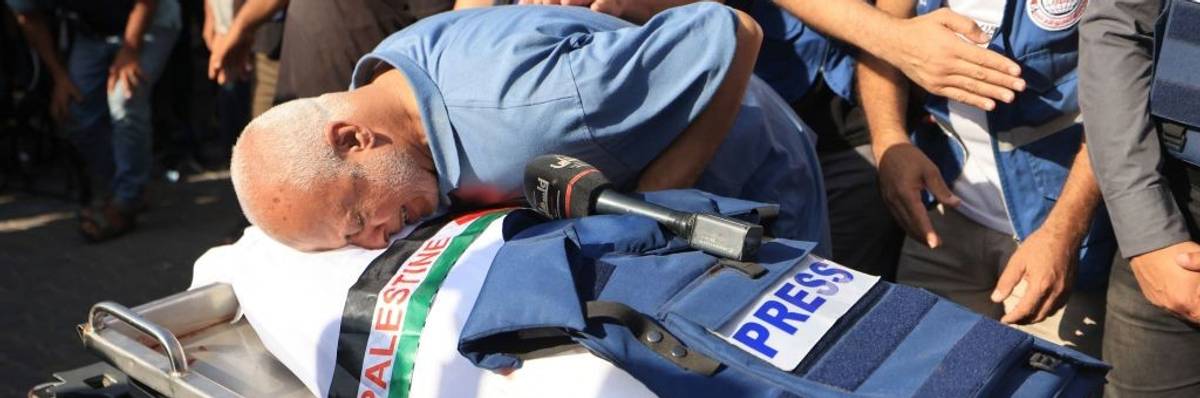
A relatives bids farewell during the funeral of Palestine TV journalist Mohamed Abu Hatab and eleven family members the day after they were killed when their home was hit in the Israeli bombardment of Khan Yunis, in the southern Gaza Strip on November 3, 2023.
There is no award or accolade that can do justice to the incredible craft and courage of Palestinian reporters working on the frontlines of this conflict.
By granting its 2024 World Press Freedom Prize to Palestinian journalists covering the Israeli war on Gaza, UNESCO has acknowledged a historic truth.
Even if the decision to name Gaza's journalists as laureates of its prestigious award was partly motivated by the courage of these journalists, the truth is that no one in the world deserved such recognition as those covering the genocidal war in Gaza.
"As humanity, we have a huge debt to their courage and commitment to freedom of expression," Mauricio Weibel, Chair of the International Jury of media professionals, which made the recommendation for the award, truthfully described the courage of Gaza's journalists.
Most people all over the world want the war to end. But how did they acquire the needed information that made them realize the extent of horror in Gaza? Certainly not through Israel's cheerleaders in mainstream media, but through Palestinian journalists on the ground who are using every means and every channel available to them to tell the story.
Courage is an admirable quality, especially when many journalists in Gaza knew that Israel was seeking to kill them, often along with their families, to ensure the horror of the war remains hidden from view, at worst, or contested as if a matter of opinion, at best.
Between October 7, 2023, and May 6, 2024, 142 Palestinian journalists in Gaza were killed in Israeli bombardment, assassinated or executed. It is higher than the total number of journalists killed in World War II and the Vietnam wars combined.
This number does not include many bloggers, intellectuals and writers who did not have professional media credentials, and also excludes the many family members who were often killed along with the targeted journalists.
But there is more to Gaza's journalists than bravery.
Whenever Israel launches a war on Gaza, it almost always denies access to international media professionals from entering the Strip. This go-to strategy is meant to ensure the story of the crimes that the Israeli army is about to commit goes unreported.
The strategy paid dividends in the so-called Cast Lead Operation in 2008-9. The true degree of the atrocities carried out in Gaza during that war, which resulted in the killing of over 1,400 Palestinians, was largely known when the war was over. By then, Israel had concluded its major military operation, and corporate mainstream western media had done a splendid job in ensuring the dominance of the Israeli political discourse on the war.
Israel's behavior since that war remained unchanged: barring international journalists, placing a gag order on Israeli journalists and killing Palestinian journalists who dared cover the story.
The August 2014 war on Gaza was one of the bloodiest for journalists. It lasted for 18 days and cost the lives of 17 journalists. Palestinian journalists, however, remained committed to their story. When one fell, ten seemed to take his place.
Occupied Palestine has always been one of the most dangerous places to be a journalist. The Palestinian Journalists' Union reported that between 2000 - the start of the Second Palestinian Uprising and May 11, 2022 - the day of the Israeli murder of the iconic Palestinian journalist Shireen Abu Akleh, 55 journalists were killed at the hands of the Israeli army.
The number might not seem too high if compared to the latest onslaught in Gaza, but, per international standards, it was a terrifying figure, based on an equally disturbing logic: killing the storyteller as the quickest way of killing the story itself.
For decades, Israel, an occupying power, has managed to depict itself as a victim in a state of self-defense. Without any critical voices in mainstream media, many around the world believed Israel's deceiving discourse on terrorism, security and self-defense.
The only obstacle that stood between the truth and Israel's engineered version of the truth are honest journalists – thus, the ongoing war on the media.
What Israel did not anticipate, however, is that by blocking international media access to Gaza, it would inadvertently empower Palestinian journalists to take charge of their own narrative.
"Interpretations depend very much on who the interpreter is, who he or she is addressing, what his or her purpose is, at what historical moment the interpretation takes place," late Palestinian intellectual Edward Said wrote in 'Covering Islam.'
Like any other form of intellectual interpretation, journalism becomes subjected to the same rule of positionality in academia, as in the relationship between the identity of the researcher and the social or political context of the subject matter.
Palestinian journalists in Gaza are themselves the story and the storytellers. Their success or failure to convey the story with all its factual and emotional details could make the difference between the continuation or the end of the Israeli genocide.
Though the war is yet to end, the Gaza journalists have already proven to be deserving of all the honors and accolades, not only because of their courage, but because of what we actually know about the war, despite the numerous and seemingly insurmountable obstacles created by Israel and its allies.
Most people all over the world want the war to end. But how did they acquire the needed information that made them realize the extent of horror in Gaza? Certainly not through Israel's cheerleaders in mainstream media, but through Palestinian journalists on the ground who are using every means and every channel available to them to tell the story.
These journalists include self-taught youngsters, like 9-year-old Lama Jamous, who wore a press vest and conveyed the details of life in displacement camps in southern Gaza, reporting from Nasser Hospital and many other places with poise and elegance.
As for the accuracy of information provided by these journalists, they were certainly professional enough to be verified by numerous human rights groups, medical and legal associations and millions of people around the world who used them to build a case against the Israeli war. Indeed, all we know about the war—the death toll, the degree of destruction, the daily human suffering, the mass graves, the famine, and much more—is possible because of these Gaza-based reporters.
The success, and the sacrifices of Gaza journalists should serve as a model for journalists and journalism around the world, as an example of how news about war crimes, sieges and human suffering in all its forms should be conveyed.
Dear Common Dreams reader, It’s been nearly 30 years since I co-founded Common Dreams with my late wife, Lina Newhouser. We had the radical notion that journalism should serve the public good, not corporate profits. It was clear to us from the outset what it would take to build such a project. No paid advertisements. No corporate sponsors. No millionaire publisher telling us what to think or do. Many people said we wouldn't last a year, but we proved those doubters wrong. Together with a tremendous team of journalists and dedicated staff, we built an independent media outlet free from the constraints of profits and corporate control. Our mission has always been simple: To inform. To inspire. To ignite change for the common good. Building Common Dreams was not easy. Our survival was never guaranteed. When you take on the most powerful forces—Wall Street greed, fossil fuel industry destruction, Big Tech lobbyists, and uber-rich oligarchs who have spent billions upon billions rigging the economy and democracy in their favor—the only bulwark you have is supporters who believe in your work. But here’s the urgent message from me today. It's never been this bad out there. And it's never been this hard to keep us going. At the very moment Common Dreams is most needed, the threats we face are intensifying. We need your support now more than ever. We don't accept corporate advertising and never will. We don't have a paywall because we don't think people should be blocked from critical news based on their ability to pay. Everything we do is funded by the donations of readers like you. When everyone does the little they can afford, we are strong. But if that support retreats or dries up, so do we. Will you donate now to make sure Common Dreams not only survives but thrives? —Craig Brown, Co-founder |
By granting its 2024 World Press Freedom Prize to Palestinian journalists covering the Israeli war on Gaza, UNESCO has acknowledged a historic truth.
Even if the decision to name Gaza's journalists as laureates of its prestigious award was partly motivated by the courage of these journalists, the truth is that no one in the world deserved such recognition as those covering the genocidal war in Gaza.
"As humanity, we have a huge debt to their courage and commitment to freedom of expression," Mauricio Weibel, Chair of the International Jury of media professionals, which made the recommendation for the award, truthfully described the courage of Gaza's journalists.
Most people all over the world want the war to end. But how did they acquire the needed information that made them realize the extent of horror in Gaza? Certainly not through Israel's cheerleaders in mainstream media, but through Palestinian journalists on the ground who are using every means and every channel available to them to tell the story.
Courage is an admirable quality, especially when many journalists in Gaza knew that Israel was seeking to kill them, often along with their families, to ensure the horror of the war remains hidden from view, at worst, or contested as if a matter of opinion, at best.
Between October 7, 2023, and May 6, 2024, 142 Palestinian journalists in Gaza were killed in Israeli bombardment, assassinated or executed. It is higher than the total number of journalists killed in World War II and the Vietnam wars combined.
This number does not include many bloggers, intellectuals and writers who did not have professional media credentials, and also excludes the many family members who were often killed along with the targeted journalists.
But there is more to Gaza's journalists than bravery.
Whenever Israel launches a war on Gaza, it almost always denies access to international media professionals from entering the Strip. This go-to strategy is meant to ensure the story of the crimes that the Israeli army is about to commit goes unreported.
The strategy paid dividends in the so-called Cast Lead Operation in 2008-9. The true degree of the atrocities carried out in Gaza during that war, which resulted in the killing of over 1,400 Palestinians, was largely known when the war was over. By then, Israel had concluded its major military operation, and corporate mainstream western media had done a splendid job in ensuring the dominance of the Israeli political discourse on the war.
Israel's behavior since that war remained unchanged: barring international journalists, placing a gag order on Israeli journalists and killing Palestinian journalists who dared cover the story.
The August 2014 war on Gaza was one of the bloodiest for journalists. It lasted for 18 days and cost the lives of 17 journalists. Palestinian journalists, however, remained committed to their story. When one fell, ten seemed to take his place.
Occupied Palestine has always been one of the most dangerous places to be a journalist. The Palestinian Journalists' Union reported that between 2000 - the start of the Second Palestinian Uprising and May 11, 2022 - the day of the Israeli murder of the iconic Palestinian journalist Shireen Abu Akleh, 55 journalists were killed at the hands of the Israeli army.
The number might not seem too high if compared to the latest onslaught in Gaza, but, per international standards, it was a terrifying figure, based on an equally disturbing logic: killing the storyteller as the quickest way of killing the story itself.
For decades, Israel, an occupying power, has managed to depict itself as a victim in a state of self-defense. Without any critical voices in mainstream media, many around the world believed Israel's deceiving discourse on terrorism, security and self-defense.
The only obstacle that stood between the truth and Israel's engineered version of the truth are honest journalists – thus, the ongoing war on the media.
What Israel did not anticipate, however, is that by blocking international media access to Gaza, it would inadvertently empower Palestinian journalists to take charge of their own narrative.
"Interpretations depend very much on who the interpreter is, who he or she is addressing, what his or her purpose is, at what historical moment the interpretation takes place," late Palestinian intellectual Edward Said wrote in 'Covering Islam.'
Like any other form of intellectual interpretation, journalism becomes subjected to the same rule of positionality in academia, as in the relationship between the identity of the researcher and the social or political context of the subject matter.
Palestinian journalists in Gaza are themselves the story and the storytellers. Their success or failure to convey the story with all its factual and emotional details could make the difference between the continuation or the end of the Israeli genocide.
Though the war is yet to end, the Gaza journalists have already proven to be deserving of all the honors and accolades, not only because of their courage, but because of what we actually know about the war, despite the numerous and seemingly insurmountable obstacles created by Israel and its allies.
Most people all over the world want the war to end. But how did they acquire the needed information that made them realize the extent of horror in Gaza? Certainly not through Israel's cheerleaders in mainstream media, but through Palestinian journalists on the ground who are using every means and every channel available to them to tell the story.
These journalists include self-taught youngsters, like 9-year-old Lama Jamous, who wore a press vest and conveyed the details of life in displacement camps in southern Gaza, reporting from Nasser Hospital and many other places with poise and elegance.
As for the accuracy of information provided by these journalists, they were certainly professional enough to be verified by numerous human rights groups, medical and legal associations and millions of people around the world who used them to build a case against the Israeli war. Indeed, all we know about the war—the death toll, the degree of destruction, the daily human suffering, the mass graves, the famine, and much more—is possible because of these Gaza-based reporters.
The success, and the sacrifices of Gaza journalists should serve as a model for journalists and journalism around the world, as an example of how news about war crimes, sieges and human suffering in all its forms should be conveyed.
By granting its 2024 World Press Freedom Prize to Palestinian journalists covering the Israeli war on Gaza, UNESCO has acknowledged a historic truth.
Even if the decision to name Gaza's journalists as laureates of its prestigious award was partly motivated by the courage of these journalists, the truth is that no one in the world deserved such recognition as those covering the genocidal war in Gaza.
"As humanity, we have a huge debt to their courage and commitment to freedom of expression," Mauricio Weibel, Chair of the International Jury of media professionals, which made the recommendation for the award, truthfully described the courage of Gaza's journalists.
Most people all over the world want the war to end. But how did they acquire the needed information that made them realize the extent of horror in Gaza? Certainly not through Israel's cheerleaders in mainstream media, but through Palestinian journalists on the ground who are using every means and every channel available to them to tell the story.
Courage is an admirable quality, especially when many journalists in Gaza knew that Israel was seeking to kill them, often along with their families, to ensure the horror of the war remains hidden from view, at worst, or contested as if a matter of opinion, at best.
Between October 7, 2023, and May 6, 2024, 142 Palestinian journalists in Gaza were killed in Israeli bombardment, assassinated or executed. It is higher than the total number of journalists killed in World War II and the Vietnam wars combined.
This number does not include many bloggers, intellectuals and writers who did not have professional media credentials, and also excludes the many family members who were often killed along with the targeted journalists.
But there is more to Gaza's journalists than bravery.
Whenever Israel launches a war on Gaza, it almost always denies access to international media professionals from entering the Strip. This go-to strategy is meant to ensure the story of the crimes that the Israeli army is about to commit goes unreported.
The strategy paid dividends in the so-called Cast Lead Operation in 2008-9. The true degree of the atrocities carried out in Gaza during that war, which resulted in the killing of over 1,400 Palestinians, was largely known when the war was over. By then, Israel had concluded its major military operation, and corporate mainstream western media had done a splendid job in ensuring the dominance of the Israeli political discourse on the war.
Israel's behavior since that war remained unchanged: barring international journalists, placing a gag order on Israeli journalists and killing Palestinian journalists who dared cover the story.
The August 2014 war on Gaza was one of the bloodiest for journalists. It lasted for 18 days and cost the lives of 17 journalists. Palestinian journalists, however, remained committed to their story. When one fell, ten seemed to take his place.
Occupied Palestine has always been one of the most dangerous places to be a journalist. The Palestinian Journalists' Union reported that between 2000 - the start of the Second Palestinian Uprising and May 11, 2022 - the day of the Israeli murder of the iconic Palestinian journalist Shireen Abu Akleh, 55 journalists were killed at the hands of the Israeli army.
The number might not seem too high if compared to the latest onslaught in Gaza, but, per international standards, it was a terrifying figure, based on an equally disturbing logic: killing the storyteller as the quickest way of killing the story itself.
For decades, Israel, an occupying power, has managed to depict itself as a victim in a state of self-defense. Without any critical voices in mainstream media, many around the world believed Israel's deceiving discourse on terrorism, security and self-defense.
The only obstacle that stood between the truth and Israel's engineered version of the truth are honest journalists – thus, the ongoing war on the media.
What Israel did not anticipate, however, is that by blocking international media access to Gaza, it would inadvertently empower Palestinian journalists to take charge of their own narrative.
"Interpretations depend very much on who the interpreter is, who he or she is addressing, what his or her purpose is, at what historical moment the interpretation takes place," late Palestinian intellectual Edward Said wrote in 'Covering Islam.'
Like any other form of intellectual interpretation, journalism becomes subjected to the same rule of positionality in academia, as in the relationship between the identity of the researcher and the social or political context of the subject matter.
Palestinian journalists in Gaza are themselves the story and the storytellers. Their success or failure to convey the story with all its factual and emotional details could make the difference between the continuation or the end of the Israeli genocide.
Though the war is yet to end, the Gaza journalists have already proven to be deserving of all the honors and accolades, not only because of their courage, but because of what we actually know about the war, despite the numerous and seemingly insurmountable obstacles created by Israel and its allies.
Most people all over the world want the war to end. But how did they acquire the needed information that made them realize the extent of horror in Gaza? Certainly not through Israel's cheerleaders in mainstream media, but through Palestinian journalists on the ground who are using every means and every channel available to them to tell the story.
These journalists include self-taught youngsters, like 9-year-old Lama Jamous, who wore a press vest and conveyed the details of life in displacement camps in southern Gaza, reporting from Nasser Hospital and many other places with poise and elegance.
As for the accuracy of information provided by these journalists, they were certainly professional enough to be verified by numerous human rights groups, medical and legal associations and millions of people around the world who used them to build a case against the Israeli war. Indeed, all we know about the war—the death toll, the degree of destruction, the daily human suffering, the mass graves, the famine, and much more—is possible because of these Gaza-based reporters.
The success, and the sacrifices of Gaza journalists should serve as a model for journalists and journalism around the world, as an example of how news about war crimes, sieges and human suffering in all its forms should be conveyed.