5
#000000
#FFFFFF
To donate by check, phone, or other method, see our More Ways to Give page.
Daily news & progressive opinion—funded by the people, not the corporations—delivered straight to your inbox.
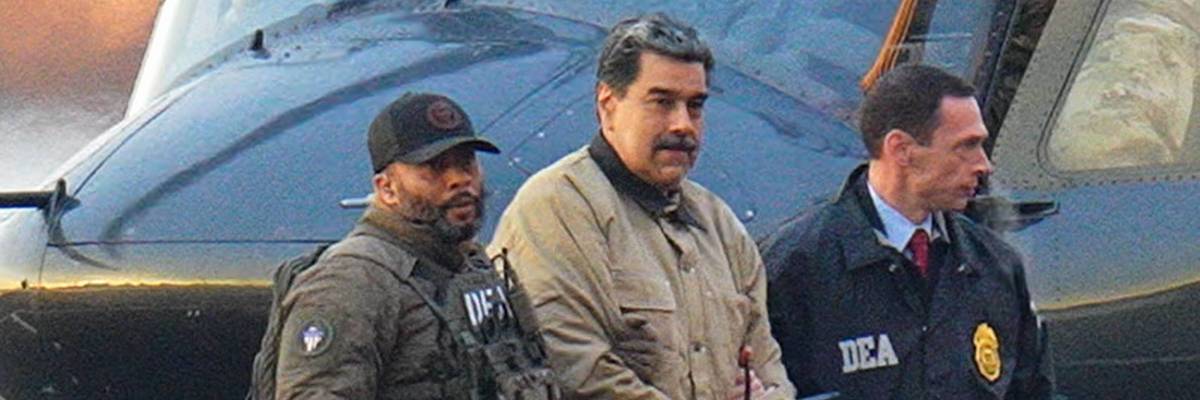
Nicolas Maduro is seen in handcuffs after landing at a Manhattan helipad, escorted by heavily armed Federal agents as they make their way into an armored car en route to a Federal courthouse in Manhattan on January 5, 2026 in New York City.
Nicolás Maduro, regardless of how one views his politics, was the sitting head of state and therefore entitled to full diplomatic immunity under international law. The United States, under the Foreign Sovereign Immunities Act, has no jurisdiction to prosecute foreign heads of state captured through force.
The world watched in disbelief as US military forces stormed Venezuelan territory in the early hours of 2026 and abducted sitting President Nicolás Maduro. This act was not merely a foreign policy misstep. It was a flagrant violation of international law. And let’s be clear about one thing: this was not the United States acting as a lawful democracy. This was the Trump administration acting unlawfully while mis-using America’s name.
The distinction is of extreme importance.
Venezuela is a sovereign member of the United Nations. To seize its head of state by force—without consent, without UN authorization, without even congressional approval—was an illegal act under virtually every international and constitutional standard. Article 2(4) of the UN Charter prohibits the use of force against the territorial integrity or political independence of any state. No Security Council resolution authorized this action. No imminent threat justified it.
The world responded accordingly. Nations across Latin America, Europe, Asia, and Africa condemned the operation. Spain, Mexico, Brazil, China, Russia, and even the United Nations Secretary-General labeled the act what it was: a violation of international law, a dangerous precedent, a kidnapping.
The Trump administration did not speak for the United States. It acted against it.
And yet, Donald Trump—flanked by civilian “advisors” and media personalities-turned-warmongers—defended it as a “law enforcement action.”
It was nothing of the sort.
This was not about counter-narcotics. This was not about defending American lives. This was about regime change—unilateral, unsanctioned, and unconstitutional. House Minority Leader Hakeem Jeffries, among others, correctly described the operation as unauthorized and un-American, pointing out that it bypassed Congress, violated the War Powers Resolution, and risked plunging a nation of 30 million into chaos.
Trump’s motives? Political theater, perhaps. Big Oil interests, likely. But justice? Security? Democracy? Not even close.
Those operating under the Trump administration’s orders—including US Navy units enforcing the unlawful blockade and the special forces executing the raid—must not be cloaked in the authority of the United States of America. These are not actions carried out on behalf of the American people, under lawful authorization or in defense of national interests. They are acting solely in service to Trump’s personal agenda. If their mission must bear a flag, let it be emblazoned not with the Stars and Stripes—but with the “Trump” brand. The Department of Justice, too, must recognize this distinction. It knows the law, and it knows better. The prosecution of Nicolás Maduro—based on an act that violated head-of-state immunity and flouted international norms—must be dismissed.
Let’s look at the law.
Nicolás Maduro, regardless of how one views his politics, was the sitting head of state and therefore entitled to full diplomatic immunity under international law. The United States, under the Foreign Sovereign Immunities Act, has no jurisdiction to prosecute foreign heads of state captured through force. The Trump administration knew this—or should have. But they went ahead anyway.
The Department of Justice should dismiss the indictment against Maduro on precisely these grounds. Legal scholars point out that this isn’t just about a single operation—it’s about the integrity of US law and the global rules-based order. If we allow this precedent to stand, then we normalize lawless invasions and the collapse of international norms that have, for decades, prevented global war.
Let’s also be honest: this isn’t new. The US has a long and ugly history of regime change efforts—Chile, Iran, Iraq, Libya, Honduras, and now Venezuela. But past mistakes cannot justify future crimes. As Professor Jeffrey Sachs told the United Nations Security Council, the difference between a lawful world and an anarchic one lies in our willingness to enforce the rules—especially when our own leaders break them.
That’s why we must say it again, loudly and without hesitation: this was the Trump administration’s crime—not America’s.
To conflate the two is to abandon the Constitution, the rule of law, and every principle that defines the legitimate exercise of American power. Congress was never consulted. The American people never consented. The action was hidden behind vague pretexts and carried out with overwhelming military force. This is not how a constitutional republic behaves. This is how an imperial presidency acts when left unchecked.
The Trump administration did not speak for the United States. It acted against it.
Now, it is up to the American people, lawmakers, and the judiciary to reclaim that distinction—and to ensure accountability for what may be one of the most reckless acts of foreign policy in modern US history.
We ask the Office of the Inspector General of the Department of Justice the following:
(1) Direct the DOJ to dismiss the criminal indictment against President Nicolás Maduro on the basis of head of state immunity and the FSIA; and
(2) Issue a recommendation to the Executive Branch that any future actions involving the use of force or the apprehension of foreign officials be fully consistent with international law and obtain prior congressional approval as mandated by the War Powers Resolution.
Because if we fail to act, then the next crime won’t just be Trump’s—it will be ours.
Dear Common Dreams reader, The U.S. is on a fast track to authoritarianism like nothing I've ever seen. Meanwhile, corporate news outlets are utterly capitulating to Trump, twisting their coverage to avoid drawing his ire while lining up to stuff cash in his pockets. That's why I believe that Common Dreams is doing the best and most consequential reporting that we've ever done. Our small but mighty team is a progressive reporting powerhouse, covering the news every day that the corporate media never will. Our mission has always been simple: To inform. To inspire. And to ignite change for the common good. Now here's the key piece that I want all our readers to understand: None of this would be possible without your financial support. That's not just some fundraising cliche. It's the absolute and literal truth. We don't accept corporate advertising and never will. We don't have a paywall because we don't think people should be blocked from critical news based on their ability to pay. Everything we do is funded by the donations of readers like you. Will you donate now to help power the nonprofit, independent reporting of Common Dreams? Thank you for being a vital member of our community. Together, we can keep independent journalism alive when it’s needed most. - Craig Brown, Co-founder |
The world watched in disbelief as US military forces stormed Venezuelan territory in the early hours of 2026 and abducted sitting President Nicolás Maduro. This act was not merely a foreign policy misstep. It was a flagrant violation of international law. And let’s be clear about one thing: this was not the United States acting as a lawful democracy. This was the Trump administration acting unlawfully while mis-using America’s name.
The distinction is of extreme importance.
Venezuela is a sovereign member of the United Nations. To seize its head of state by force—without consent, without UN authorization, without even congressional approval—was an illegal act under virtually every international and constitutional standard. Article 2(4) of the UN Charter prohibits the use of force against the territorial integrity or political independence of any state. No Security Council resolution authorized this action. No imminent threat justified it.
The world responded accordingly. Nations across Latin America, Europe, Asia, and Africa condemned the operation. Spain, Mexico, Brazil, China, Russia, and even the United Nations Secretary-General labeled the act what it was: a violation of international law, a dangerous precedent, a kidnapping.
The Trump administration did not speak for the United States. It acted against it.
And yet, Donald Trump—flanked by civilian “advisors” and media personalities-turned-warmongers—defended it as a “law enforcement action.”
It was nothing of the sort.
This was not about counter-narcotics. This was not about defending American lives. This was about regime change—unilateral, unsanctioned, and unconstitutional. House Minority Leader Hakeem Jeffries, among others, correctly described the operation as unauthorized and un-American, pointing out that it bypassed Congress, violated the War Powers Resolution, and risked plunging a nation of 30 million into chaos.
Trump’s motives? Political theater, perhaps. Big Oil interests, likely. But justice? Security? Democracy? Not even close.
Those operating under the Trump administration’s orders—including US Navy units enforcing the unlawful blockade and the special forces executing the raid—must not be cloaked in the authority of the United States of America. These are not actions carried out on behalf of the American people, under lawful authorization or in defense of national interests. They are acting solely in service to Trump’s personal agenda. If their mission must bear a flag, let it be emblazoned not with the Stars and Stripes—but with the “Trump” brand. The Department of Justice, too, must recognize this distinction. It knows the law, and it knows better. The prosecution of Nicolás Maduro—based on an act that violated head-of-state immunity and flouted international norms—must be dismissed.
Let’s look at the law.
Nicolás Maduro, regardless of how one views his politics, was the sitting head of state and therefore entitled to full diplomatic immunity under international law. The United States, under the Foreign Sovereign Immunities Act, has no jurisdiction to prosecute foreign heads of state captured through force. The Trump administration knew this—or should have. But they went ahead anyway.
The Department of Justice should dismiss the indictment against Maduro on precisely these grounds. Legal scholars point out that this isn’t just about a single operation—it’s about the integrity of US law and the global rules-based order. If we allow this precedent to stand, then we normalize lawless invasions and the collapse of international norms that have, for decades, prevented global war.
Let’s also be honest: this isn’t new. The US has a long and ugly history of regime change efforts—Chile, Iran, Iraq, Libya, Honduras, and now Venezuela. But past mistakes cannot justify future crimes. As Professor Jeffrey Sachs told the United Nations Security Council, the difference between a lawful world and an anarchic one lies in our willingness to enforce the rules—especially when our own leaders break them.
That’s why we must say it again, loudly and without hesitation: this was the Trump administration’s crime—not America’s.
To conflate the two is to abandon the Constitution, the rule of law, and every principle that defines the legitimate exercise of American power. Congress was never consulted. The American people never consented. The action was hidden behind vague pretexts and carried out with overwhelming military force. This is not how a constitutional republic behaves. This is how an imperial presidency acts when left unchecked.
The Trump administration did not speak for the United States. It acted against it.
Now, it is up to the American people, lawmakers, and the judiciary to reclaim that distinction—and to ensure accountability for what may be one of the most reckless acts of foreign policy in modern US history.
We ask the Office of the Inspector General of the Department of Justice the following:
(1) Direct the DOJ to dismiss the criminal indictment against President Nicolás Maduro on the basis of head of state immunity and the FSIA; and
(2) Issue a recommendation to the Executive Branch that any future actions involving the use of force or the apprehension of foreign officials be fully consistent with international law and obtain prior congressional approval as mandated by the War Powers Resolution.
Because if we fail to act, then the next crime won’t just be Trump’s—it will be ours.
The world watched in disbelief as US military forces stormed Venezuelan territory in the early hours of 2026 and abducted sitting President Nicolás Maduro. This act was not merely a foreign policy misstep. It was a flagrant violation of international law. And let’s be clear about one thing: this was not the United States acting as a lawful democracy. This was the Trump administration acting unlawfully while mis-using America’s name.
The distinction is of extreme importance.
Venezuela is a sovereign member of the United Nations. To seize its head of state by force—without consent, without UN authorization, without even congressional approval—was an illegal act under virtually every international and constitutional standard. Article 2(4) of the UN Charter prohibits the use of force against the territorial integrity or political independence of any state. No Security Council resolution authorized this action. No imminent threat justified it.
The world responded accordingly. Nations across Latin America, Europe, Asia, and Africa condemned the operation. Spain, Mexico, Brazil, China, Russia, and even the United Nations Secretary-General labeled the act what it was: a violation of international law, a dangerous precedent, a kidnapping.
The Trump administration did not speak for the United States. It acted against it.
And yet, Donald Trump—flanked by civilian “advisors” and media personalities-turned-warmongers—defended it as a “law enforcement action.”
It was nothing of the sort.
This was not about counter-narcotics. This was not about defending American lives. This was about regime change—unilateral, unsanctioned, and unconstitutional. House Minority Leader Hakeem Jeffries, among others, correctly described the operation as unauthorized and un-American, pointing out that it bypassed Congress, violated the War Powers Resolution, and risked plunging a nation of 30 million into chaos.
Trump’s motives? Political theater, perhaps. Big Oil interests, likely. But justice? Security? Democracy? Not even close.
Those operating under the Trump administration’s orders—including US Navy units enforcing the unlawful blockade and the special forces executing the raid—must not be cloaked in the authority of the United States of America. These are not actions carried out on behalf of the American people, under lawful authorization or in defense of national interests. They are acting solely in service to Trump’s personal agenda. If their mission must bear a flag, let it be emblazoned not with the Stars and Stripes—but with the “Trump” brand. The Department of Justice, too, must recognize this distinction. It knows the law, and it knows better. The prosecution of Nicolás Maduro—based on an act that violated head-of-state immunity and flouted international norms—must be dismissed.
Let’s look at the law.
Nicolás Maduro, regardless of how one views his politics, was the sitting head of state and therefore entitled to full diplomatic immunity under international law. The United States, under the Foreign Sovereign Immunities Act, has no jurisdiction to prosecute foreign heads of state captured through force. The Trump administration knew this—or should have. But they went ahead anyway.
The Department of Justice should dismiss the indictment against Maduro on precisely these grounds. Legal scholars point out that this isn’t just about a single operation—it’s about the integrity of US law and the global rules-based order. If we allow this precedent to stand, then we normalize lawless invasions and the collapse of international norms that have, for decades, prevented global war.
Let’s also be honest: this isn’t new. The US has a long and ugly history of regime change efforts—Chile, Iran, Iraq, Libya, Honduras, and now Venezuela. But past mistakes cannot justify future crimes. As Professor Jeffrey Sachs told the United Nations Security Council, the difference between a lawful world and an anarchic one lies in our willingness to enforce the rules—especially when our own leaders break them.
That’s why we must say it again, loudly and without hesitation: this was the Trump administration’s crime—not America’s.
To conflate the two is to abandon the Constitution, the rule of law, and every principle that defines the legitimate exercise of American power. Congress was never consulted. The American people never consented. The action was hidden behind vague pretexts and carried out with overwhelming military force. This is not how a constitutional republic behaves. This is how an imperial presidency acts when left unchecked.
The Trump administration did not speak for the United States. It acted against it.
Now, it is up to the American people, lawmakers, and the judiciary to reclaim that distinction—and to ensure accountability for what may be one of the most reckless acts of foreign policy in modern US history.
We ask the Office of the Inspector General of the Department of Justice the following:
(1) Direct the DOJ to dismiss the criminal indictment against President Nicolás Maduro on the basis of head of state immunity and the FSIA; and
(2) Issue a recommendation to the Executive Branch that any future actions involving the use of force or the apprehension of foreign officials be fully consistent with international law and obtain prior congressional approval as mandated by the War Powers Resolution.
Because if we fail to act, then the next crime won’t just be Trump’s—it will be ours.