SUBSCRIBE TO OUR FREE NEWSLETTER
Daily news & progressive opinion—funded by the people, not the corporations—delivered straight to your inbox.
5
#000000
#FFFFFF
To donate by check, phone, or other method, see our More Ways to Give page.
Daily news & progressive opinion—funded by the people, not the corporations—delivered straight to your inbox.
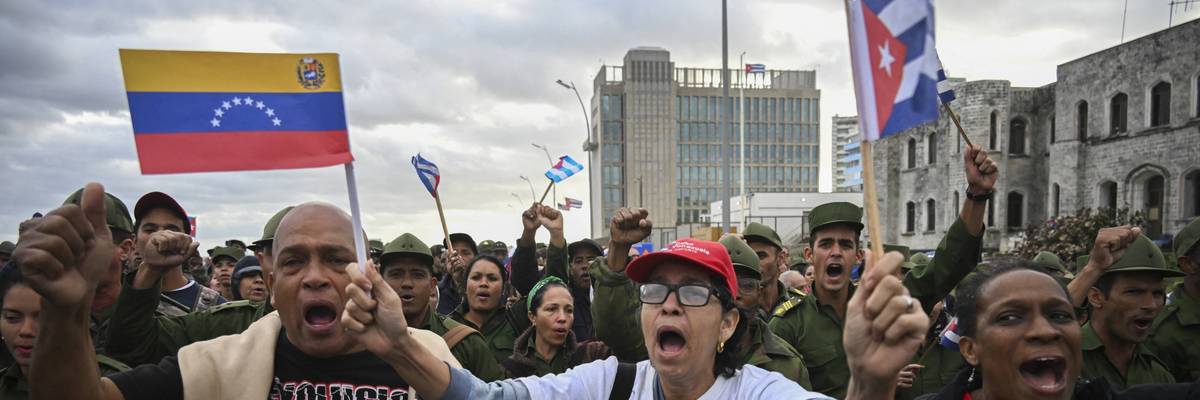
Protesters gather to call out the US attack on Venezuela, which killed 32 Cubans, in front of the US Embassy in Havana on January 16, 2026.
"No, imperialists, we have absolutely no fear of you... and we don't like to be threatened," said Cuba's president.
A day after receiving the remains of the 32 Cubans killed during the Trump administration's invasion of Venezuela and abduction of its leader, Cuba's president, Miguel Díaz-Canel, addressed thousands gathered outside the US Embassy in Havana on Friday.
"The current US administration has opened the door to an era of barbarism, plunder, and neo-fascism," Díaz-Canel declared to a massive crowd protesting the recent killings and demanding the US release Venezuelan President Nicolás Maduro.
Participants in the "anti-imperialist" action, including members of the armed forces, waved Cuban and Venezuelan flags, and held signs honoring the 32 people who were killed while carrying out missions representing Cuba's Revolutionary Armed Forces and the Ministry of the Interior.
"No one here surrenders," the Cuban leader said Friday, according to the Associated Press. "The current emperor of the White House and his infamous secretary of state haven't stopped threatening me."
While the Biden administration aimed to remove Cuba from the State Sponsors of Terrorism list, President Donald Trump reversed that decision after returning to office last January and restored a list of "restricted entities" created during his first term. US Secretary of State Marco Rubio, the son of Cuban immigrants, also expanded a visa restriction policy that targets Cuba's medical missions around the world.
Since US forces slaughtered dozens of Cubans while seizing Maduro, Trump and Rubio have warned that Cuba, Mexico, and Colombia could also be targeted by the US military. Trump has also urged the Cuban government to make a deal with him and pledged to prevent oil and other resources from reaching the island nation, which has been subjected to US sanctions for decades.
"No, imperialists, we have absolutely no fear of you... and we don't like to be threatened," Díaz-Canel said Friday, waving his finger at the embassy, according to Reuters. "You will not intimidate us."
"Cuba does not have to make any political concessions, and that will never be on the table for negotiations aimed at reaching an understanding between Cuba and the United States," he asserted. "It is important that they understand this. We will always be open to dialogue and improving relations between our two countries, but only on equal terms and based on mutual respect."
The demonstration in Havana came a day after Venezuelan workers led a march through Caracas, chanting, "Free Maduro!"
"He is our president and we want him back, we are in the streets, and we will not rest," said labor leader Anais Herrera. "The president prepared us for this, and that is why we are in combat, in the streets with the Venezuelan working class."
Maduro and his wife, Cilia Flores, were brought to New York City after their abduction. They were arraigned last week, and both pleaded not guilty to federal narco-terrorism charges. At the time, Maduro said in Spanish that "I am the president of Venezuela, and I consider myself a prisoner of war."
At the arraignment, Maduro's lawyer, Barry Pollack, said that he "is the head of a sovereign state and is entitled to the privileges and immunities that go with that office... In addition, there are issues about the legality of his military abduction."
Federal prosecutors and Trump have given no indications that they are willing to free Maduro or Flores. The US administration is also continuing its efforts to take control of Venezuela's oil resources.
Dear Common Dreams reader, It’s been nearly 30 years since I co-founded Common Dreams with my late wife, Lina Newhouser. We had the radical notion that journalism should serve the public good, not corporate profits. It was clear to us from the outset what it would take to build such a project. No paid advertisements. No corporate sponsors. No millionaire publisher telling us what to think or do. Many people said we wouldn't last a year, but we proved those doubters wrong. Together with a tremendous team of journalists and dedicated staff, we built an independent media outlet free from the constraints of profits and corporate control. Our mission has always been simple: To inform. To inspire. To ignite change for the common good. Building Common Dreams was not easy. Our survival was never guaranteed. When you take on the most powerful forces—Wall Street greed, fossil fuel industry destruction, Big Tech lobbyists, and uber-rich oligarchs who have spent billions upon billions rigging the economy and democracy in their favor—the only bulwark you have is supporters who believe in your work. But here’s the urgent message from me today. It's never been this bad out there. And it's never been this hard to keep us going. At the very moment Common Dreams is most needed, the threats we face are intensifying. We need your support now more than ever. We don't accept corporate advertising and never will. We don't have a paywall because we don't think people should be blocked from critical news based on their ability to pay. Everything we do is funded by the donations of readers like you. When everyone does the little they can afford, we are strong. But if that support retreats or dries up, so do we. Will you donate now to make sure Common Dreams not only survives but thrives? —Craig Brown, Co-founder |
A day after receiving the remains of the 32 Cubans killed during the Trump administration's invasion of Venezuela and abduction of its leader, Cuba's president, Miguel Díaz-Canel, addressed thousands gathered outside the US Embassy in Havana on Friday.
"The current US administration has opened the door to an era of barbarism, plunder, and neo-fascism," Díaz-Canel declared to a massive crowd protesting the recent killings and demanding the US release Venezuelan President Nicolás Maduro.
Participants in the "anti-imperialist" action, including members of the armed forces, waved Cuban and Venezuelan flags, and held signs honoring the 32 people who were killed while carrying out missions representing Cuba's Revolutionary Armed Forces and the Ministry of the Interior.
"No one here surrenders," the Cuban leader said Friday, according to the Associated Press. "The current emperor of the White House and his infamous secretary of state haven't stopped threatening me."
While the Biden administration aimed to remove Cuba from the State Sponsors of Terrorism list, President Donald Trump reversed that decision after returning to office last January and restored a list of "restricted entities" created during his first term. US Secretary of State Marco Rubio, the son of Cuban immigrants, also expanded a visa restriction policy that targets Cuba's medical missions around the world.
Since US forces slaughtered dozens of Cubans while seizing Maduro, Trump and Rubio have warned that Cuba, Mexico, and Colombia could also be targeted by the US military. Trump has also urged the Cuban government to make a deal with him and pledged to prevent oil and other resources from reaching the island nation, which has been subjected to US sanctions for decades.
"No, imperialists, we have absolutely no fear of you... and we don't like to be threatened," Díaz-Canel said Friday, waving his finger at the embassy, according to Reuters. "You will not intimidate us."
"Cuba does not have to make any political concessions, and that will never be on the table for negotiations aimed at reaching an understanding between Cuba and the United States," he asserted. "It is important that they understand this. We will always be open to dialogue and improving relations between our two countries, but only on equal terms and based on mutual respect."
The demonstration in Havana came a day after Venezuelan workers led a march through Caracas, chanting, "Free Maduro!"
"He is our president and we want him back, we are in the streets, and we will not rest," said labor leader Anais Herrera. "The president prepared us for this, and that is why we are in combat, in the streets with the Venezuelan working class."
Maduro and his wife, Cilia Flores, were brought to New York City after their abduction. They were arraigned last week, and both pleaded not guilty to federal narco-terrorism charges. At the time, Maduro said in Spanish that "I am the president of Venezuela, and I consider myself a prisoner of war."
At the arraignment, Maduro's lawyer, Barry Pollack, said that he "is the head of a sovereign state and is entitled to the privileges and immunities that go with that office... In addition, there are issues about the legality of his military abduction."
Federal prosecutors and Trump have given no indications that they are willing to free Maduro or Flores. The US administration is also continuing its efforts to take control of Venezuela's oil resources.
A day after receiving the remains of the 32 Cubans killed during the Trump administration's invasion of Venezuela and abduction of its leader, Cuba's president, Miguel Díaz-Canel, addressed thousands gathered outside the US Embassy in Havana on Friday.
"The current US administration has opened the door to an era of barbarism, plunder, and neo-fascism," Díaz-Canel declared to a massive crowd protesting the recent killings and demanding the US release Venezuelan President Nicolás Maduro.
Participants in the "anti-imperialist" action, including members of the armed forces, waved Cuban and Venezuelan flags, and held signs honoring the 32 people who were killed while carrying out missions representing Cuba's Revolutionary Armed Forces and the Ministry of the Interior.
"No one here surrenders," the Cuban leader said Friday, according to the Associated Press. "The current emperor of the White House and his infamous secretary of state haven't stopped threatening me."
While the Biden administration aimed to remove Cuba from the State Sponsors of Terrorism list, President Donald Trump reversed that decision after returning to office last January and restored a list of "restricted entities" created during his first term. US Secretary of State Marco Rubio, the son of Cuban immigrants, also expanded a visa restriction policy that targets Cuba's medical missions around the world.
Since US forces slaughtered dozens of Cubans while seizing Maduro, Trump and Rubio have warned that Cuba, Mexico, and Colombia could also be targeted by the US military. Trump has also urged the Cuban government to make a deal with him and pledged to prevent oil and other resources from reaching the island nation, which has been subjected to US sanctions for decades.
"No, imperialists, we have absolutely no fear of you... and we don't like to be threatened," Díaz-Canel said Friday, waving his finger at the embassy, according to Reuters. "You will not intimidate us."
"Cuba does not have to make any political concessions, and that will never be on the table for negotiations aimed at reaching an understanding between Cuba and the United States," he asserted. "It is important that they understand this. We will always be open to dialogue and improving relations between our two countries, but only on equal terms and based on mutual respect."
The demonstration in Havana came a day after Venezuelan workers led a march through Caracas, chanting, "Free Maduro!"
"He is our president and we want him back, we are in the streets, and we will not rest," said labor leader Anais Herrera. "The president prepared us for this, and that is why we are in combat, in the streets with the Venezuelan working class."
Maduro and his wife, Cilia Flores, were brought to New York City after their abduction. They were arraigned last week, and both pleaded not guilty to federal narco-terrorism charges. At the time, Maduro said in Spanish that "I am the president of Venezuela, and I consider myself a prisoner of war."
At the arraignment, Maduro's lawyer, Barry Pollack, said that he "is the head of a sovereign state and is entitled to the privileges and immunities that go with that office... In addition, there are issues about the legality of his military abduction."
Federal prosecutors and Trump have given no indications that they are willing to free Maduro or Flores. The US administration is also continuing its efforts to take control of Venezuela's oil resources.