SUBSCRIBE TO OUR FREE NEWSLETTER
Daily news & progressive opinion—funded by the people, not the corporations—delivered straight to your inbox.
5
#000000
#FFFFFF
To donate by check, phone, or other method, see our More Ways to Give page.
Daily news & progressive opinion—funded by the people, not the corporations—delivered straight to your inbox.
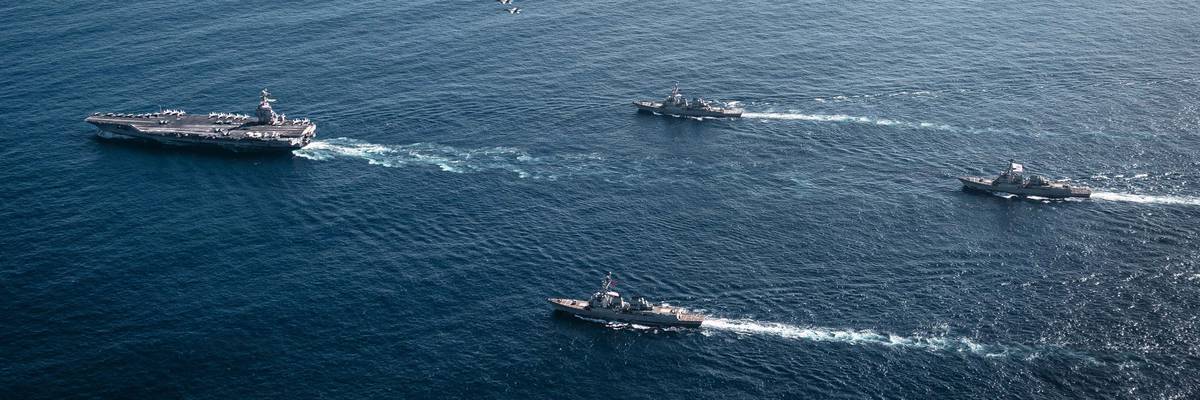
In this handout provided by the US Navy, the US Navy's Gerald R. Ford Carrier Strike Group, including the flagship USS Gerald R. Ford (CVN 78), left, USS Winston S. Churchill (DDG 81), front, USS Mahan (DDG 72), back, USS Bainbridge (DDG 96), and embarked Carrier Air Wing Eight F/A-18E/F Super Hornets assigned to Strike Fighter Squadrons 31, 37, 87, and 213, operates as a joint, multi-domain force with a US Air Force B-52 Stratofortress, November 13, 2025.
There is no strategic, legal, or moral justification for surrounding Venezuela with the most lethal naval assets on Earth.
As the USS Gerald R. Ford—the largest aircraft carrier afloat—casts its shadow along the Venezuelan coast, the United States must confront an uncomfortable question: What national interest is being protected by threatening a country that poses no military, territorial, or existential danger to the American republic?
The answer, made clear by an array of respected American scholars, former officials, and ex-military insiders, has nothing to do with security. Instead, it arises from a familiar mixture of ideology, geopolitical control, and the old reflex of imperial overreach. This is not defense. This is theater—one part provocation, one part political opportunism, and no part necessity.
Among the clearest voices cutting through the rhetoric is professor John Mearsheimer, perhaps the most prominent American realist in international relations. He does not mince words: Venezuela is not a threat to the United States. Its military lacks both the capacity and the intention to project power beyond its borders. Suggesting otherwise is “laughable,” he notes, because the true irritant is ideological. Venezuela’s Bolivarian model—imperfect and embattled as it is—represents a deviation from Washington’s preferred political order, a deviation the US has repeatedly sought to crush in Latin America for decades. For Mearsheimer, even if one entertained the fantasy of using force to change the regime, the idea collapses immediately under logistical absurdity and moral bankruptcy. Invading a nation of 28 million people, and then attempting to occupy and “stabilize” it, would be catastrophic in cost, chaotic in outcome, and impossible to justify.
The national security pretext collapses further under the testimony of Sheriff David Hathaway, a former Drug Enforcement Administration supervisory agent with firsthand experience in Latin America. He dismisses the drug-trafficking narrative not just as false, but as deliberately false. Cocaine originates in Colombia and Peru, not Venezuela, and the US fentanyl crisis has nothing to do with Caracas. There is no vast Maduro-led drug conspiracy, Hathaway explains, only a political fiction designed to mimic past excuses for intervention. He is blunt in stating that Washington has repeatedly used narcotics accusations as camouflage for intrusion, sabotage, and coercion. This is not about drugs. It is about dominance.
To continue down the present path is to invite disaster: another needless conflict, another wave of human suffering, another blot on American history.
Even those once inside the system acknowledge this. Jordan Goodro, a former Green Beret involved in the ill-fated 2019 coup attempt against President Nicolas Maduro, offers a rare insider glimpse into the dysfunction and deception behind such operations. The effort to remove Venezuela’s government was pushed aggressively by the Trump administration and then sabotaged internally by divisions within the American intelligence establishment. Yet despite that spectacular failure, the narrative is being recycled again—complete with the same exaggerations and the same hollow slogans about protecting freedom. Goodro’s own admission is unambiguous: Venezuela poses no military threat to the United States. Repeating failed strategies does not make them more credible; it merely exposes the compulsions driving them.
If the military and narcotics arguments fail, the economic one becomes impossible to ignore. Professor Jeffrey Sachs, one of the world’s most respected economists, calls out the interventionist posture for what it is: a resource-driven gambit. The aim is not humanitarian aid, nor national security, nor democracy—it is control over one of the world’s largest oil reserves. Sachs warns that the moral veneer placed over this pursuit is dangerously thin. To blockade, bomb, or invade a sovereign country under such distortions is not simply misguided; it is, in his words, “the epitome of gangsterism.” The cost would be human suffering on a mass scale—suffering already amplified by years of sanctions—and the benefits would accrue not to the Venezuelan people, but to those seeking to reshape the hemisphere for profit.
While these foreign provocations unfold, an equally disturbing drama plays out at home. A number of Democratic lawmakers—many with backgrounds in the military or intelligence services—issued a sober warning to US service members: Illegal orders must not be obeyed. They reminded the armed forces that loyalty lies first with the Constitution. Instead of engaging that foundational principle, President Donald Trump responded by accusing them of sedition and musing that such dissent might warrant the death penalty. No president who respects the rule of law speaks this way. Such rhetoric is not an expression of strength; it is a hint of despotism.
The irony is that the Americans telling the truth about Venezuela are not radicals or fringe theorists. They are sober-minded public servants and scholars—people like Sachs, Mearsheimer, Hathaway, and Goodro—whose assessments reflect America at its best: skeptical of power, loyal to constitutional principles, and unwilling to manufacture enemies where none exist. Their voices stand in stark contrast to those who believe that power confers moral exemption. Trump’s saber-rattling does not embody American values—it betrays them.
There is no strategic, legal, or moral justification for surrounding Venezuela with the most lethal naval assets on Earth. The Gerald R. Ford is not defending American shores; it is intimidating a smaller nation whose only “crime” is political independence. The United States must withdraw its fleet. It must halt its reckless rhetoric. And President Trump—whether sitting in the Oval Office or aspiring to return to it—must apologize to the lawmakers defending constitutional duty and make unambiguously clear that illegal orders will not be tolerated.
To continue down the present path is to invite disaster: another needless conflict, another wave of human suffering, another blot on American history. The case against intervention is not complicated. It is not partisan. It is not abstract. It is moral—and it is overwhelming.
Dear Common Dreams reader, It’s been nearly 30 years since I co-founded Common Dreams with my late wife, Lina Newhouser. We had the radical notion that journalism should serve the public good, not corporate profits. It was clear to us from the outset what it would take to build such a project. No paid advertisements. No corporate sponsors. No millionaire publisher telling us what to think or do. Many people said we wouldn't last a year, but we proved those doubters wrong. Together with a tremendous team of journalists and dedicated staff, we built an independent media outlet free from the constraints of profits and corporate control. Our mission has always been simple: To inform. To inspire. To ignite change for the common good. Building Common Dreams was not easy. Our survival was never guaranteed. When you take on the most powerful forces—Wall Street greed, fossil fuel industry destruction, Big Tech lobbyists, and uber-rich oligarchs who have spent billions upon billions rigging the economy and democracy in their favor—the only bulwark you have is supporters who believe in your work. But here’s the urgent message from me today. It's never been this bad out there. And it's never been this hard to keep us going. At the very moment Common Dreams is most needed, the threats we face are intensifying. We need your support now more than ever. We don't accept corporate advertising and never will. We don't have a paywall because we don't think people should be blocked from critical news based on their ability to pay. Everything we do is funded by the donations of readers like you. When everyone does the little they can afford, we are strong. But if that support retreats or dries up, so do we. Will you donate now to make sure Common Dreams not only survives but thrives? —Craig Brown, Co-founder |
As the USS Gerald R. Ford—the largest aircraft carrier afloat—casts its shadow along the Venezuelan coast, the United States must confront an uncomfortable question: What national interest is being protected by threatening a country that poses no military, territorial, or existential danger to the American republic?
The answer, made clear by an array of respected American scholars, former officials, and ex-military insiders, has nothing to do with security. Instead, it arises from a familiar mixture of ideology, geopolitical control, and the old reflex of imperial overreach. This is not defense. This is theater—one part provocation, one part political opportunism, and no part necessity.
Among the clearest voices cutting through the rhetoric is professor John Mearsheimer, perhaps the most prominent American realist in international relations. He does not mince words: Venezuela is not a threat to the United States. Its military lacks both the capacity and the intention to project power beyond its borders. Suggesting otherwise is “laughable,” he notes, because the true irritant is ideological. Venezuela’s Bolivarian model—imperfect and embattled as it is—represents a deviation from Washington’s preferred political order, a deviation the US has repeatedly sought to crush in Latin America for decades. For Mearsheimer, even if one entertained the fantasy of using force to change the regime, the idea collapses immediately under logistical absurdity and moral bankruptcy. Invading a nation of 28 million people, and then attempting to occupy and “stabilize” it, would be catastrophic in cost, chaotic in outcome, and impossible to justify.
The national security pretext collapses further under the testimony of Sheriff David Hathaway, a former Drug Enforcement Administration supervisory agent with firsthand experience in Latin America. He dismisses the drug-trafficking narrative not just as false, but as deliberately false. Cocaine originates in Colombia and Peru, not Venezuela, and the US fentanyl crisis has nothing to do with Caracas. There is no vast Maduro-led drug conspiracy, Hathaway explains, only a political fiction designed to mimic past excuses for intervention. He is blunt in stating that Washington has repeatedly used narcotics accusations as camouflage for intrusion, sabotage, and coercion. This is not about drugs. It is about dominance.
To continue down the present path is to invite disaster: another needless conflict, another wave of human suffering, another blot on American history.
Even those once inside the system acknowledge this. Jordan Goodro, a former Green Beret involved in the ill-fated 2019 coup attempt against President Nicolas Maduro, offers a rare insider glimpse into the dysfunction and deception behind such operations. The effort to remove Venezuela’s government was pushed aggressively by the Trump administration and then sabotaged internally by divisions within the American intelligence establishment. Yet despite that spectacular failure, the narrative is being recycled again—complete with the same exaggerations and the same hollow slogans about protecting freedom. Goodro’s own admission is unambiguous: Venezuela poses no military threat to the United States. Repeating failed strategies does not make them more credible; it merely exposes the compulsions driving them.
If the military and narcotics arguments fail, the economic one becomes impossible to ignore. Professor Jeffrey Sachs, one of the world’s most respected economists, calls out the interventionist posture for what it is: a resource-driven gambit. The aim is not humanitarian aid, nor national security, nor democracy—it is control over one of the world’s largest oil reserves. Sachs warns that the moral veneer placed over this pursuit is dangerously thin. To blockade, bomb, or invade a sovereign country under such distortions is not simply misguided; it is, in his words, “the epitome of gangsterism.” The cost would be human suffering on a mass scale—suffering already amplified by years of sanctions—and the benefits would accrue not to the Venezuelan people, but to those seeking to reshape the hemisphere for profit.
While these foreign provocations unfold, an equally disturbing drama plays out at home. A number of Democratic lawmakers—many with backgrounds in the military or intelligence services—issued a sober warning to US service members: Illegal orders must not be obeyed. They reminded the armed forces that loyalty lies first with the Constitution. Instead of engaging that foundational principle, President Donald Trump responded by accusing them of sedition and musing that such dissent might warrant the death penalty. No president who respects the rule of law speaks this way. Such rhetoric is not an expression of strength; it is a hint of despotism.
The irony is that the Americans telling the truth about Venezuela are not radicals or fringe theorists. They are sober-minded public servants and scholars—people like Sachs, Mearsheimer, Hathaway, and Goodro—whose assessments reflect America at its best: skeptical of power, loyal to constitutional principles, and unwilling to manufacture enemies where none exist. Their voices stand in stark contrast to those who believe that power confers moral exemption. Trump’s saber-rattling does not embody American values—it betrays them.
There is no strategic, legal, or moral justification for surrounding Venezuela with the most lethal naval assets on Earth. The Gerald R. Ford is not defending American shores; it is intimidating a smaller nation whose only “crime” is political independence. The United States must withdraw its fleet. It must halt its reckless rhetoric. And President Trump—whether sitting in the Oval Office or aspiring to return to it—must apologize to the lawmakers defending constitutional duty and make unambiguously clear that illegal orders will not be tolerated.
To continue down the present path is to invite disaster: another needless conflict, another wave of human suffering, another blot on American history. The case against intervention is not complicated. It is not partisan. It is not abstract. It is moral—and it is overwhelming.
As the USS Gerald R. Ford—the largest aircraft carrier afloat—casts its shadow along the Venezuelan coast, the United States must confront an uncomfortable question: What national interest is being protected by threatening a country that poses no military, territorial, or existential danger to the American republic?
The answer, made clear by an array of respected American scholars, former officials, and ex-military insiders, has nothing to do with security. Instead, it arises from a familiar mixture of ideology, geopolitical control, and the old reflex of imperial overreach. This is not defense. This is theater—one part provocation, one part political opportunism, and no part necessity.
Among the clearest voices cutting through the rhetoric is professor John Mearsheimer, perhaps the most prominent American realist in international relations. He does not mince words: Venezuela is not a threat to the United States. Its military lacks both the capacity and the intention to project power beyond its borders. Suggesting otherwise is “laughable,” he notes, because the true irritant is ideological. Venezuela’s Bolivarian model—imperfect and embattled as it is—represents a deviation from Washington’s preferred political order, a deviation the US has repeatedly sought to crush in Latin America for decades. For Mearsheimer, even if one entertained the fantasy of using force to change the regime, the idea collapses immediately under logistical absurdity and moral bankruptcy. Invading a nation of 28 million people, and then attempting to occupy and “stabilize” it, would be catastrophic in cost, chaotic in outcome, and impossible to justify.
The national security pretext collapses further under the testimony of Sheriff David Hathaway, a former Drug Enforcement Administration supervisory agent with firsthand experience in Latin America. He dismisses the drug-trafficking narrative not just as false, but as deliberately false. Cocaine originates in Colombia and Peru, not Venezuela, and the US fentanyl crisis has nothing to do with Caracas. There is no vast Maduro-led drug conspiracy, Hathaway explains, only a political fiction designed to mimic past excuses for intervention. He is blunt in stating that Washington has repeatedly used narcotics accusations as camouflage for intrusion, sabotage, and coercion. This is not about drugs. It is about dominance.
To continue down the present path is to invite disaster: another needless conflict, another wave of human suffering, another blot on American history.
Even those once inside the system acknowledge this. Jordan Goodro, a former Green Beret involved in the ill-fated 2019 coup attempt against President Nicolas Maduro, offers a rare insider glimpse into the dysfunction and deception behind such operations. The effort to remove Venezuela’s government was pushed aggressively by the Trump administration and then sabotaged internally by divisions within the American intelligence establishment. Yet despite that spectacular failure, the narrative is being recycled again—complete with the same exaggerations and the same hollow slogans about protecting freedom. Goodro’s own admission is unambiguous: Venezuela poses no military threat to the United States. Repeating failed strategies does not make them more credible; it merely exposes the compulsions driving them.
If the military and narcotics arguments fail, the economic one becomes impossible to ignore. Professor Jeffrey Sachs, one of the world’s most respected economists, calls out the interventionist posture for what it is: a resource-driven gambit. The aim is not humanitarian aid, nor national security, nor democracy—it is control over one of the world’s largest oil reserves. Sachs warns that the moral veneer placed over this pursuit is dangerously thin. To blockade, bomb, or invade a sovereign country under such distortions is not simply misguided; it is, in his words, “the epitome of gangsterism.” The cost would be human suffering on a mass scale—suffering already amplified by years of sanctions—and the benefits would accrue not to the Venezuelan people, but to those seeking to reshape the hemisphere for profit.
While these foreign provocations unfold, an equally disturbing drama plays out at home. A number of Democratic lawmakers—many with backgrounds in the military or intelligence services—issued a sober warning to US service members: Illegal orders must not be obeyed. They reminded the armed forces that loyalty lies first with the Constitution. Instead of engaging that foundational principle, President Donald Trump responded by accusing them of sedition and musing that such dissent might warrant the death penalty. No president who respects the rule of law speaks this way. Such rhetoric is not an expression of strength; it is a hint of despotism.
The irony is that the Americans telling the truth about Venezuela are not radicals or fringe theorists. They are sober-minded public servants and scholars—people like Sachs, Mearsheimer, Hathaway, and Goodro—whose assessments reflect America at its best: skeptical of power, loyal to constitutional principles, and unwilling to manufacture enemies where none exist. Their voices stand in stark contrast to those who believe that power confers moral exemption. Trump’s saber-rattling does not embody American values—it betrays them.
There is no strategic, legal, or moral justification for surrounding Venezuela with the most lethal naval assets on Earth. The Gerald R. Ford is not defending American shores; it is intimidating a smaller nation whose only “crime” is political independence. The United States must withdraw its fleet. It must halt its reckless rhetoric. And President Trump—whether sitting in the Oval Office or aspiring to return to it—must apologize to the lawmakers defending constitutional duty and make unambiguously clear that illegal orders will not be tolerated.
To continue down the present path is to invite disaster: another needless conflict, another wave of human suffering, another blot on American history. The case against intervention is not complicated. It is not partisan. It is not abstract. It is moral—and it is overwhelming.