5
#000000
#FFFFFF
To donate by check, phone, or other method, see our More Ways to Give page.
Daily news & progressive opinion—funded by the people, not the corporations—delivered straight to your inbox.
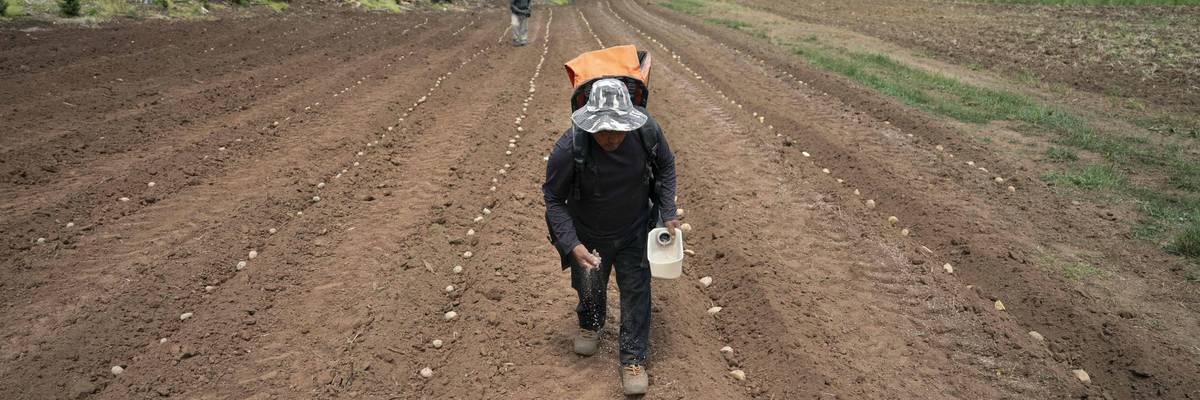
Workers spread fertilizer after planting potatoes at Bluff View Farms on April 24, 2026 in West Jefferson, North Carolina.
Petrochemical fertilizers built modern agriculture. The Iran War may be what finally breaks it—and opens the door to something better.
As the US-Israel war in Iran drags on, here at home, the billions spent on the war and the spiking gas prices drive the political conversation. The impacts on world food supplies could be far more consequential, though, raising questions about our dependence on globally traded chemical fertilizers—and about the alternatives.
The global food system relies on massive applications of petrochemicals, and up to 30% of fertilizer trade comes through the Strait of Hormuz. With the exception of pre-industrial and organic or regenerative practices, the world’s agriculture relies on these chemicals, making them vulnerable to price shocks and supply constraints.
Nitrogen fertilizer prices have climbed by 30% since the initial attack on Iran on February 28; urea prices have increased by 47%. Seventy percent of farmers responding to an American Farm Bureau survey say they are unable to afford all the fertilizer they need. Meanwhile, farm diesel prices have increased 46% since the end of February.
The effects of these price shocks take time to ripple through the planting and harvesting season, but they will likely show up as higher prices, along with empty store shelves, and—especially in impoverished regions—hungry children. Farmers are already making tough choices about what, and if, to plant given the colliding impacts of tariffs, extreme weather related to climate change, and the ongoing blockade of the Strait of Hormuz.
The Iran war’s fertilizer choke hold is just one reason regenerative agriculture deserves our active support.
“Every fossil fuel crisis reminds us how vulnerable conventional agriculture is,” says Gabrielle Taus, managing director of the nonprofit group Commonland. "Farmers tied to synthetic fertilisers are exposed to price shocks they cannot control.”
These price spikes come just at a time when farmers are also being squeezed by President Donald Trump’s tariffs and by a chaotic climate. Much of the West and Southeast US is under drought emergency conditions. The Midwest has been hit by storms and extreme temperature fluctuations. The journal Nature Climate Change estimates that human-caused climate change has already reduced agricultural productivity by 20%.
These converging shocks are adding to interest in regenerative agriculture. While the definition of this form of agriculture varies—and the term can sometimes be used for greenwashing—regenerative agriculture relies on the resources at hand (or under foot) to nourish the soil, instead of purchasing fertilizer from global petrochemical corporations. By combining age-old techniques of cover crops and crop rotation, compost, and animal husbandry, the soil is nourished, not depleted, and it is better able to retain moisture. Unlike corporate farming, this form of agriculture offers a buffer from global conflicts and trade wars and the impacts of climate change. And the farmers who adopt this approach develop an understanding of how to best manage farms that can thrive in a particular place. And their practices could contribute to revitalizing not only fresh water sources and ecosystems but also the vitality of hollowed-out rural communities.
Many experts question whether regenerative agriculture can actually take the place of industrial agriculture. A decades-long study by the Rodale Institute, which advocates for organic methods, suggests that with skill and persistence, these techniques work. Their side-by-side plots in Kutztown, Pennsylvania compared regenerative practices, including cover cropping, crop rotation, and composting, with conventional agriculture. The result was yields up to 30% higher for sustainable methods during extreme weather, profits that were 3-6 times higher overall, the use of 45% less energy—and 40% lower carbon emissions.
The work of the farmers also shifts, from using massive machinery and one-size-fits-all industrial farming methods, to the sort of deep knowledge that comes from knowing the microclimate, soil conditions, and water supplies of a particular place.
Regenerative farms become a productive and integrated part of not only the natural ecosystem but the social system.
Among young farmers, regenerative practices are already taking hold. According to the National Young Farmers Coalition's 2022 survey of more than 10,000 farmers age 40 and younger, 86% already describe their practices as regenerative. With the average age of today’s farmers at 58 years old, a new generation of farmers will have a major say in how tomorrow’s crops are raised.
Matt Turino, who manages the Sustainable Farm at the University of Illinois campus in Champaign Urbana, works with students who are learning the skills of sustainable and regenerative farming. “They talk a lot about growing food in their communities, resilient food production, changing the food systems so they’re not relying on international markets and big international disruptions like the Strait of Hormuz situation,” he said. They want a more ecologically minded food system, he added, that is healthy for their families and for the environment.
These practices could offer the next generation a livelihood that artificial intelligence cannot replace and that distant wars and blockades cannot upend.
Soil health is key to any farming. Regenerative practices enhance the microorganisms, organic content, and nutrients that comprise a healthy soil ecosystem. These practices not only result in higher yields, crops that are better able to resist disease and pests, and better water retention—they also enable soil to pull carbon out of the air and form it into a healthy part of the soil ecosystem.
Agriculture is responsible for about a third of all human-caused greenhouse gas emissions. Addition of nitrogen fertilizer to croplands is a powerful source of climate pollution, but regenerative approaches can actually store carbon deep in the soil, reducing the amount of carbon in the atmosphere. And these approaches avoid the fish-killing algae blooms and cancer clusters suspected to be caused by nitrogen fertilizer runoff.
At a time when fresh water is becoming scarce as a result of overuse and drought, regenerative approaches increase the capacity of soils to hold water and to prevent the erosion and flooding that results from compacted soils. For every 1% increase in soil organic matter, soil is able to hold 20,000 gallons more per acre, according to the US Department of Agriculture.
Many regenerative farmers raise animals along with crops. Rotational grazing and the use of manure helps build soil health. This is a marked contrast to today’s giant animal factory farms, where workers are poorly paid and at risk of injury, and animals are penned up inhumane conditions, while overflows of manure threaten fresh water supplies.
Regenerative farms become a productive and integrated part of not only the natural ecosystem but the social system.
Regenerative farming offers the intriguing possibility of ecosystem recovery and the recovery of rural communities.
For decades, the growth of industrial farming has pushed out small and medium-sized farms. Especially hard hit are farms owned by African American and Latino families. As a few giant landowners manage farms that once provided livelihoods to many smaller farm families, rural communities across the United States have been hollowed out. As farms are sold off, the local farm supply stores, mechanics, veterinarians, insurance brokers, schools, and restaurants that once served farm families closed up.
The competitive advantage of a regenerative farmer is their deep knowledge—not the adoption of one-size-fits-all chemical regimes and expensive technology. They learn the sorts of skills and wisdom our farming ancestors had. Regenerative practices require an understanding of particular microclimates, water availability, and soil conditions. The farmer must learn to choose seed varieties and to implement practices that optimize for human and ecological health as well as for economics.
If anything positive emerges from the war in Iran, it could be the expanded awareness that we do have choices about the future of agriculture.
“The particular knowledge of particular places is beyond the competence of any centralized power or authority,” writes Kentucky farmer and poet Wendell Berry in his book, What Are People For? (Counterpoint Press 1990) “Farmers must tend farms that they know and love… using tools and methods that they know and love, in the company of neighbors that they know and love.”
“We uplift the honor and dignity of labor,” say the creators of Soulfire Farm, an Afro-Indigenous community farm and training center located in upstate New York. “We center the sharing of practical, tangible, land-based skills that contribute to community self-provisioning and self-determination. With wise effort, our work is our love made visible.”
The Iran war’s fertilizer choke hold is just one reason regenerative agriculture deserves our active support. Regenerative farming can prevent the pollution of increasingly scarce fresh water resources, rebuild depleted soil, and slow climate change. These practices are more resilient and able to adapt to weather shocks, and they provide a source of stable employment at a time when jobs of all sorts are being displaced by AI. And with permanent farm employment come the opportunities for families to once again inhabit and rebuild hollowed-out rural communities.
It is hard work, and unlikely to make anyone rich. But regenerative farmers and ranchers say “their notion of ‘success’ goes beyond yield and farm size,” according to Lara Bryant, at the Natural Resources Defense Council, an environmental group. “It includes things like joy and happiness, the number of families they feed, watching how the land regenerates and flourishes, the money saved from not purchasing chemical inputs, the debt avoided by repurposing old equipment, and the relationships built with community members.”
If anything positive emerges from the war in Iran, it could be the expanded awareness that we do have choices about the future of agriculture.
Dear Common Dreams reader, It’s been nearly 30 years since I co-founded Common Dreams with my late wife, Lina Newhouser. We had the radical notion that journalism should serve the public good, not corporate profits. It was clear to us from the outset what it would take to build such a project. No paid advertisements. No corporate sponsors. No millionaire publisher telling us what to think or do. Many people said we wouldn't last a year, but we proved those doubters wrong. Together with a tremendous team of journalists and dedicated staff, we built an independent media outlet free from the constraints of profits and corporate control. Our mission has always been simple: To inform. To inspire. To ignite change for the common good. Building Common Dreams was not easy. Our survival was never guaranteed. When you take on the most powerful forces—Wall Street greed, fossil fuel industry destruction, Big Tech lobbyists, and uber-rich oligarchs who have spent billions upon billions rigging the economy and democracy in their favor—the only bulwark you have is supporters who believe in your work. But here’s the urgent message from me today. It's never been this bad out there. And it's never been this hard to keep us going. At the very moment Common Dreams is most needed, the threats we face are intensifying. We need your support now more than ever. We don't accept corporate advertising and never will. We don't have a paywall because we don't think people should be blocked from critical news based on their ability to pay. Everything we do is funded by the donations of readers like you. When everyone does the little they can afford, we are strong. But if that support retreats or dries up, so do we. Will you donate now to make sure Common Dreams not only survives but thrives? —Craig Brown, Co-founder |
As the US-Israel war in Iran drags on, here at home, the billions spent on the war and the spiking gas prices drive the political conversation. The impacts on world food supplies could be far more consequential, though, raising questions about our dependence on globally traded chemical fertilizers—and about the alternatives.
The global food system relies on massive applications of petrochemicals, and up to 30% of fertilizer trade comes through the Strait of Hormuz. With the exception of pre-industrial and organic or regenerative practices, the world’s agriculture relies on these chemicals, making them vulnerable to price shocks and supply constraints.
Nitrogen fertilizer prices have climbed by 30% since the initial attack on Iran on February 28; urea prices have increased by 47%. Seventy percent of farmers responding to an American Farm Bureau survey say they are unable to afford all the fertilizer they need. Meanwhile, farm diesel prices have increased 46% since the end of February.
The effects of these price shocks take time to ripple through the planting and harvesting season, but they will likely show up as higher prices, along with empty store shelves, and—especially in impoverished regions—hungry children. Farmers are already making tough choices about what, and if, to plant given the colliding impacts of tariffs, extreme weather related to climate change, and the ongoing blockade of the Strait of Hormuz.
The Iran war’s fertilizer choke hold is just one reason regenerative agriculture deserves our active support.
“Every fossil fuel crisis reminds us how vulnerable conventional agriculture is,” says Gabrielle Taus, managing director of the nonprofit group Commonland. "Farmers tied to synthetic fertilisers are exposed to price shocks they cannot control.”
These price spikes come just at a time when farmers are also being squeezed by President Donald Trump’s tariffs and by a chaotic climate. Much of the West and Southeast US is under drought emergency conditions. The Midwest has been hit by storms and extreme temperature fluctuations. The journal Nature Climate Change estimates that human-caused climate change has already reduced agricultural productivity by 20%.
These converging shocks are adding to interest in regenerative agriculture. While the definition of this form of agriculture varies—and the term can sometimes be used for greenwashing—regenerative agriculture relies on the resources at hand (or under foot) to nourish the soil, instead of purchasing fertilizer from global petrochemical corporations. By combining age-old techniques of cover crops and crop rotation, compost, and animal husbandry, the soil is nourished, not depleted, and it is better able to retain moisture. Unlike corporate farming, this form of agriculture offers a buffer from global conflicts and trade wars and the impacts of climate change. And the farmers who adopt this approach develop an understanding of how to best manage farms that can thrive in a particular place. And their practices could contribute to revitalizing not only fresh water sources and ecosystems but also the vitality of hollowed-out rural communities.
Many experts question whether regenerative agriculture can actually take the place of industrial agriculture. A decades-long study by the Rodale Institute, which advocates for organic methods, suggests that with skill and persistence, these techniques work. Their side-by-side plots in Kutztown, Pennsylvania compared regenerative practices, including cover cropping, crop rotation, and composting, with conventional agriculture. The result was yields up to 30% higher for sustainable methods during extreme weather, profits that were 3-6 times higher overall, the use of 45% less energy—and 40% lower carbon emissions.
The work of the farmers also shifts, from using massive machinery and one-size-fits-all industrial farming methods, to the sort of deep knowledge that comes from knowing the microclimate, soil conditions, and water supplies of a particular place.
Regenerative farms become a productive and integrated part of not only the natural ecosystem but the social system.
Among young farmers, regenerative practices are already taking hold. According to the National Young Farmers Coalition's 2022 survey of more than 10,000 farmers age 40 and younger, 86% already describe their practices as regenerative. With the average age of today’s farmers at 58 years old, a new generation of farmers will have a major say in how tomorrow’s crops are raised.
Matt Turino, who manages the Sustainable Farm at the University of Illinois campus in Champaign Urbana, works with students who are learning the skills of sustainable and regenerative farming. “They talk a lot about growing food in their communities, resilient food production, changing the food systems so they’re not relying on international markets and big international disruptions like the Strait of Hormuz situation,” he said. They want a more ecologically minded food system, he added, that is healthy for their families and for the environment.
These practices could offer the next generation a livelihood that artificial intelligence cannot replace and that distant wars and blockades cannot upend.
Soil health is key to any farming. Regenerative practices enhance the microorganisms, organic content, and nutrients that comprise a healthy soil ecosystem. These practices not only result in higher yields, crops that are better able to resist disease and pests, and better water retention—they also enable soil to pull carbon out of the air and form it into a healthy part of the soil ecosystem.
Agriculture is responsible for about a third of all human-caused greenhouse gas emissions. Addition of nitrogen fertilizer to croplands is a powerful source of climate pollution, but regenerative approaches can actually store carbon deep in the soil, reducing the amount of carbon in the atmosphere. And these approaches avoid the fish-killing algae blooms and cancer clusters suspected to be caused by nitrogen fertilizer runoff.
At a time when fresh water is becoming scarce as a result of overuse and drought, regenerative approaches increase the capacity of soils to hold water and to prevent the erosion and flooding that results from compacted soils. For every 1% increase in soil organic matter, soil is able to hold 20,000 gallons more per acre, according to the US Department of Agriculture.
Many regenerative farmers raise animals along with crops. Rotational grazing and the use of manure helps build soil health. This is a marked contrast to today’s giant animal factory farms, where workers are poorly paid and at risk of injury, and animals are penned up inhumane conditions, while overflows of manure threaten fresh water supplies.
Regenerative farms become a productive and integrated part of not only the natural ecosystem but the social system.
Regenerative farming offers the intriguing possibility of ecosystem recovery and the recovery of rural communities.
For decades, the growth of industrial farming has pushed out small and medium-sized farms. Especially hard hit are farms owned by African American and Latino families. As a few giant landowners manage farms that once provided livelihoods to many smaller farm families, rural communities across the United States have been hollowed out. As farms are sold off, the local farm supply stores, mechanics, veterinarians, insurance brokers, schools, and restaurants that once served farm families closed up.
The competitive advantage of a regenerative farmer is their deep knowledge—not the adoption of one-size-fits-all chemical regimes and expensive technology. They learn the sorts of skills and wisdom our farming ancestors had. Regenerative practices require an understanding of particular microclimates, water availability, and soil conditions. The farmer must learn to choose seed varieties and to implement practices that optimize for human and ecological health as well as for economics.
If anything positive emerges from the war in Iran, it could be the expanded awareness that we do have choices about the future of agriculture.
“The particular knowledge of particular places is beyond the competence of any centralized power or authority,” writes Kentucky farmer and poet Wendell Berry in his book, What Are People For? (Counterpoint Press 1990) “Farmers must tend farms that they know and love… using tools and methods that they know and love, in the company of neighbors that they know and love.”
“We uplift the honor and dignity of labor,” say the creators of Soulfire Farm, an Afro-Indigenous community farm and training center located in upstate New York. “We center the sharing of practical, tangible, land-based skills that contribute to community self-provisioning and self-determination. With wise effort, our work is our love made visible.”
The Iran war’s fertilizer choke hold is just one reason regenerative agriculture deserves our active support. Regenerative farming can prevent the pollution of increasingly scarce fresh water resources, rebuild depleted soil, and slow climate change. These practices are more resilient and able to adapt to weather shocks, and they provide a source of stable employment at a time when jobs of all sorts are being displaced by AI. And with permanent farm employment come the opportunities for families to once again inhabit and rebuild hollowed-out rural communities.
It is hard work, and unlikely to make anyone rich. But regenerative farmers and ranchers say “their notion of ‘success’ goes beyond yield and farm size,” according to Lara Bryant, at the Natural Resources Defense Council, an environmental group. “It includes things like joy and happiness, the number of families they feed, watching how the land regenerates and flourishes, the money saved from not purchasing chemical inputs, the debt avoided by repurposing old equipment, and the relationships built with community members.”
If anything positive emerges from the war in Iran, it could be the expanded awareness that we do have choices about the future of agriculture.
As the US-Israel war in Iran drags on, here at home, the billions spent on the war and the spiking gas prices drive the political conversation. The impacts on world food supplies could be far more consequential, though, raising questions about our dependence on globally traded chemical fertilizers—and about the alternatives.
The global food system relies on massive applications of petrochemicals, and up to 30% of fertilizer trade comes through the Strait of Hormuz. With the exception of pre-industrial and organic or regenerative practices, the world’s agriculture relies on these chemicals, making them vulnerable to price shocks and supply constraints.
Nitrogen fertilizer prices have climbed by 30% since the initial attack on Iran on February 28; urea prices have increased by 47%. Seventy percent of farmers responding to an American Farm Bureau survey say they are unable to afford all the fertilizer they need. Meanwhile, farm diesel prices have increased 46% since the end of February.
The effects of these price shocks take time to ripple through the planting and harvesting season, but they will likely show up as higher prices, along with empty store shelves, and—especially in impoverished regions—hungry children. Farmers are already making tough choices about what, and if, to plant given the colliding impacts of tariffs, extreme weather related to climate change, and the ongoing blockade of the Strait of Hormuz.
The Iran war’s fertilizer choke hold is just one reason regenerative agriculture deserves our active support.
“Every fossil fuel crisis reminds us how vulnerable conventional agriculture is,” says Gabrielle Taus, managing director of the nonprofit group Commonland. "Farmers tied to synthetic fertilisers are exposed to price shocks they cannot control.”
These price spikes come just at a time when farmers are also being squeezed by President Donald Trump’s tariffs and by a chaotic climate. Much of the West and Southeast US is under drought emergency conditions. The Midwest has been hit by storms and extreme temperature fluctuations. The journal Nature Climate Change estimates that human-caused climate change has already reduced agricultural productivity by 20%.
These converging shocks are adding to interest in regenerative agriculture. While the definition of this form of agriculture varies—and the term can sometimes be used for greenwashing—regenerative agriculture relies on the resources at hand (or under foot) to nourish the soil, instead of purchasing fertilizer from global petrochemical corporations. By combining age-old techniques of cover crops and crop rotation, compost, and animal husbandry, the soil is nourished, not depleted, and it is better able to retain moisture. Unlike corporate farming, this form of agriculture offers a buffer from global conflicts and trade wars and the impacts of climate change. And the farmers who adopt this approach develop an understanding of how to best manage farms that can thrive in a particular place. And their practices could contribute to revitalizing not only fresh water sources and ecosystems but also the vitality of hollowed-out rural communities.
Many experts question whether regenerative agriculture can actually take the place of industrial agriculture. A decades-long study by the Rodale Institute, which advocates for organic methods, suggests that with skill and persistence, these techniques work. Their side-by-side plots in Kutztown, Pennsylvania compared regenerative practices, including cover cropping, crop rotation, and composting, with conventional agriculture. The result was yields up to 30% higher for sustainable methods during extreme weather, profits that were 3-6 times higher overall, the use of 45% less energy—and 40% lower carbon emissions.
The work of the farmers also shifts, from using massive machinery and one-size-fits-all industrial farming methods, to the sort of deep knowledge that comes from knowing the microclimate, soil conditions, and water supplies of a particular place.
Regenerative farms become a productive and integrated part of not only the natural ecosystem but the social system.
Among young farmers, regenerative practices are already taking hold. According to the National Young Farmers Coalition's 2022 survey of more than 10,000 farmers age 40 and younger, 86% already describe their practices as regenerative. With the average age of today’s farmers at 58 years old, a new generation of farmers will have a major say in how tomorrow’s crops are raised.
Matt Turino, who manages the Sustainable Farm at the University of Illinois campus in Champaign Urbana, works with students who are learning the skills of sustainable and regenerative farming. “They talk a lot about growing food in their communities, resilient food production, changing the food systems so they’re not relying on international markets and big international disruptions like the Strait of Hormuz situation,” he said. They want a more ecologically minded food system, he added, that is healthy for their families and for the environment.
These practices could offer the next generation a livelihood that artificial intelligence cannot replace and that distant wars and blockades cannot upend.
Soil health is key to any farming. Regenerative practices enhance the microorganisms, organic content, and nutrients that comprise a healthy soil ecosystem. These practices not only result in higher yields, crops that are better able to resist disease and pests, and better water retention—they also enable soil to pull carbon out of the air and form it into a healthy part of the soil ecosystem.
Agriculture is responsible for about a third of all human-caused greenhouse gas emissions. Addition of nitrogen fertilizer to croplands is a powerful source of climate pollution, but regenerative approaches can actually store carbon deep in the soil, reducing the amount of carbon in the atmosphere. And these approaches avoid the fish-killing algae blooms and cancer clusters suspected to be caused by nitrogen fertilizer runoff.
At a time when fresh water is becoming scarce as a result of overuse and drought, regenerative approaches increase the capacity of soils to hold water and to prevent the erosion and flooding that results from compacted soils. For every 1% increase in soil organic matter, soil is able to hold 20,000 gallons more per acre, according to the US Department of Agriculture.
Many regenerative farmers raise animals along with crops. Rotational grazing and the use of manure helps build soil health. This is a marked contrast to today’s giant animal factory farms, where workers are poorly paid and at risk of injury, and animals are penned up inhumane conditions, while overflows of manure threaten fresh water supplies.
Regenerative farms become a productive and integrated part of not only the natural ecosystem but the social system.
Regenerative farming offers the intriguing possibility of ecosystem recovery and the recovery of rural communities.
For decades, the growth of industrial farming has pushed out small and medium-sized farms. Especially hard hit are farms owned by African American and Latino families. As a few giant landowners manage farms that once provided livelihoods to many smaller farm families, rural communities across the United States have been hollowed out. As farms are sold off, the local farm supply stores, mechanics, veterinarians, insurance brokers, schools, and restaurants that once served farm families closed up.
The competitive advantage of a regenerative farmer is their deep knowledge—not the adoption of one-size-fits-all chemical regimes and expensive technology. They learn the sorts of skills and wisdom our farming ancestors had. Regenerative practices require an understanding of particular microclimates, water availability, and soil conditions. The farmer must learn to choose seed varieties and to implement practices that optimize for human and ecological health as well as for economics.
If anything positive emerges from the war in Iran, it could be the expanded awareness that we do have choices about the future of agriculture.
“The particular knowledge of particular places is beyond the competence of any centralized power or authority,” writes Kentucky farmer and poet Wendell Berry in his book, What Are People For? (Counterpoint Press 1990) “Farmers must tend farms that they know and love… using tools and methods that they know and love, in the company of neighbors that they know and love.”
“We uplift the honor and dignity of labor,” say the creators of Soulfire Farm, an Afro-Indigenous community farm and training center located in upstate New York. “We center the sharing of practical, tangible, land-based skills that contribute to community self-provisioning and self-determination. With wise effort, our work is our love made visible.”
The Iran war’s fertilizer choke hold is just one reason regenerative agriculture deserves our active support. Regenerative farming can prevent the pollution of increasingly scarce fresh water resources, rebuild depleted soil, and slow climate change. These practices are more resilient and able to adapt to weather shocks, and they provide a source of stable employment at a time when jobs of all sorts are being displaced by AI. And with permanent farm employment come the opportunities for families to once again inhabit and rebuild hollowed-out rural communities.
It is hard work, and unlikely to make anyone rich. But regenerative farmers and ranchers say “their notion of ‘success’ goes beyond yield and farm size,” according to Lara Bryant, at the Natural Resources Defense Council, an environmental group. “It includes things like joy and happiness, the number of families they feed, watching how the land regenerates and flourishes, the money saved from not purchasing chemical inputs, the debt avoided by repurposing old equipment, and the relationships built with community members.”
If anything positive emerges from the war in Iran, it could be the expanded awareness that we do have choices about the future of agriculture.