SUBSCRIBE TO OUR FREE NEWSLETTER
Daily news & progressive opinion—funded by the people, not the corporations—delivered straight to your inbox.
5
#000000
#FFFFFF
To donate by check, phone, or other method, see our More Ways to Give page.
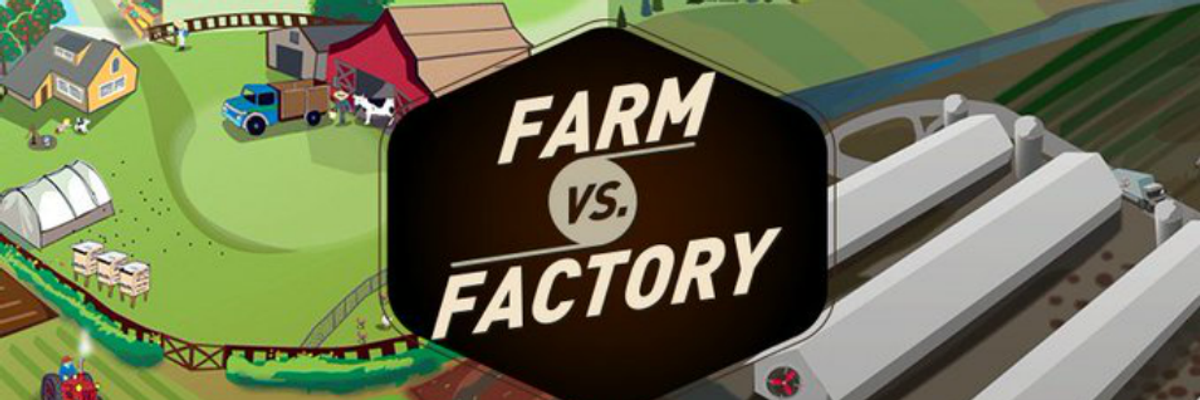
The national nonprofit Food & Water Watch on Friday launched its "Farm vs. Factory" website, an interactive tool that aims to shed light on the differences between sustainable and industrial agriculture.
"Clever marketing and sneaky messaging have made it difficult to differentiate between small scale farming and industrial animal production," the group said in a statement. "This website maps out the characteristics, proliferation, and history of industrial agriculture while showcasing what sustainable farms do differently."
Last year, Food & Water Watch began a nationwide campaign to outlaw factory farms and released a report (pdf) detailing how "these operations produce enormous volumes of waste, pollute the air and water, exploit workers, harm animal welfare, fuel antibiotic resistance and climate change, and harm the rural communities they are purported to benefit."
The new farm vs. factory website features side-by-side comparisons of each approach to agriculture, with sections focused on animals, crops, and humans. Each comparison features photos or videos.
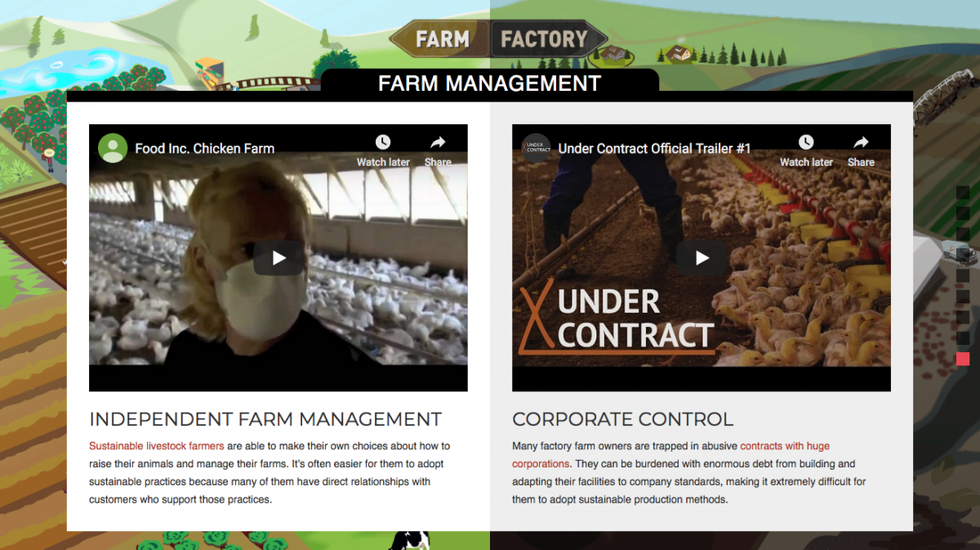
The animals section describes living conditions--pasture-raised compared with extreme confinement--as well as environmental and community impacts, antibiotic use, animal well-being, and farm management.
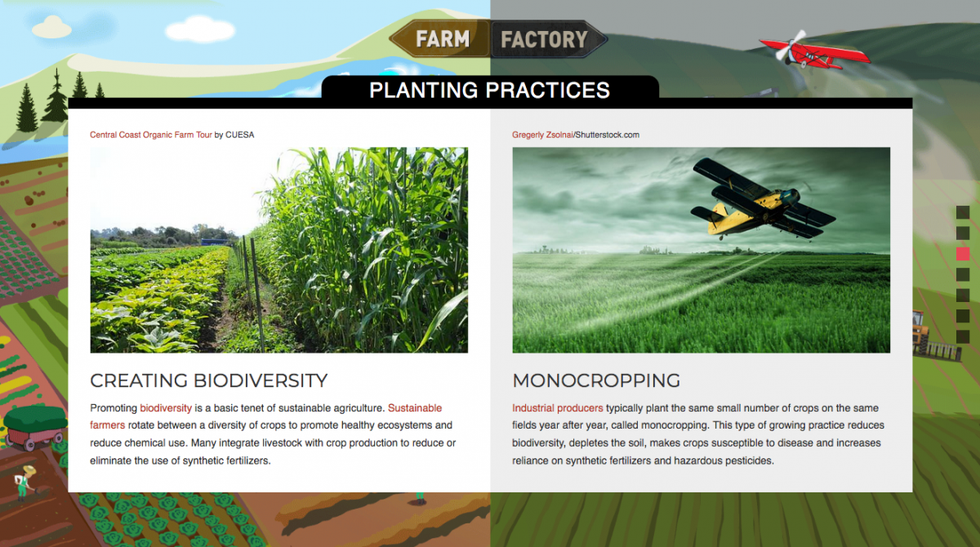
The crops section highlights differences in planting practices, pest control, fertilizer use, genetically modified (GMO) crops technology, and soil health.
"Sustainable farmers protect soil by rotating crops and avoiding pesticides and other soil pollutants," the website explains. However, with industrial operations, "the same crops are often grown on wide expanses of land year after year, leading to loss of soil nutrients."
The "food & you" section addresses the question: "How would a more sustainable food system look different from our current industrial model?"
To help readers figure that out, the section explores human nutrition (healthful food versus poor food quality), food distribution, farmer workers, and political influence--at which point Food & Water Watch encourages users to "take action today to help support sustainable farmers!"
The website also features a resources page where those interested can learn more about the impacts of industrial agriculture as well as how to get involved in grassroots political efforts to tackle food and water issues and outlaw factory farming.
The resources page links to a TED Talk about "fighting factory farms through legal means" by Michele Merkel, the group's co-director of food and water justice.
Watch:
The national nonprofit Food & Water Watch on Friday launched its "Farm vs. Factory" website, an interactive tool that aims to shed light on the differences between sustainable and industrial agriculture.
"Clever marketing and sneaky messaging have made it difficult to differentiate between small scale farming and industrial animal production," the group said in a statement. "This website maps out the characteristics, proliferation, and history of industrial agriculture while showcasing what sustainable farms do differently."
Last year, Food & Water Watch began a nationwide campaign to outlaw factory farms and released a report (pdf) detailing how "these operations produce enormous volumes of waste, pollute the air and water, exploit workers, harm animal welfare, fuel antibiotic resistance and climate change, and harm the rural communities they are purported to benefit."
The new farm vs. factory website features side-by-side comparisons of each approach to agriculture, with sections focused on animals, crops, and humans. Each comparison features photos or videos.
The animals section describes living conditions--pasture-raised compared with extreme confinement--as well as environmental and community impacts, antibiotic use, animal well-being, and farm management.
The crops section highlights differences in planting practices, pest control, fertilizer use, genetically modified (GMO) crops technology, and soil health.
"Sustainable farmers protect soil by rotating crops and avoiding pesticides and other soil pollutants," the website explains. However, with industrial operations, "the same crops are often grown on wide expanses of land year after year, leading to loss of soil nutrients."
The "food & you" section addresses the question: "How would a more sustainable food system look different from our current industrial model?"
To help readers figure that out, the section explores human nutrition (healthful food versus poor food quality), food distribution, farmer workers, and political influence--at which point Food & Water Watch encourages users to "take action today to help support sustainable farmers!"
The website also features a resources page where those interested can learn more about the impacts of industrial agriculture as well as how to get involved in grassroots political efforts to tackle food and water issues and outlaw factory farming.
The resources page links to a TED Talk about "fighting factory farms through legal means" by Michele Merkel, the group's co-director of food and water justice.
Watch:
The national nonprofit Food & Water Watch on Friday launched its "Farm vs. Factory" website, an interactive tool that aims to shed light on the differences between sustainable and industrial agriculture.
"Clever marketing and sneaky messaging have made it difficult to differentiate between small scale farming and industrial animal production," the group said in a statement. "This website maps out the characteristics, proliferation, and history of industrial agriculture while showcasing what sustainable farms do differently."
Last year, Food & Water Watch began a nationwide campaign to outlaw factory farms and released a report (pdf) detailing how "these operations produce enormous volumes of waste, pollute the air and water, exploit workers, harm animal welfare, fuel antibiotic resistance and climate change, and harm the rural communities they are purported to benefit."
The new farm vs. factory website features side-by-side comparisons of each approach to agriculture, with sections focused on animals, crops, and humans. Each comparison features photos or videos.
The animals section describes living conditions--pasture-raised compared with extreme confinement--as well as environmental and community impacts, antibiotic use, animal well-being, and farm management.
The crops section highlights differences in planting practices, pest control, fertilizer use, genetically modified (GMO) crops technology, and soil health.
"Sustainable farmers protect soil by rotating crops and avoiding pesticides and other soil pollutants," the website explains. However, with industrial operations, "the same crops are often grown on wide expanses of land year after year, leading to loss of soil nutrients."
The "food & you" section addresses the question: "How would a more sustainable food system look different from our current industrial model?"
To help readers figure that out, the section explores human nutrition (healthful food versus poor food quality), food distribution, farmer workers, and political influence--at which point Food & Water Watch encourages users to "take action today to help support sustainable farmers!"
The website also features a resources page where those interested can learn more about the impacts of industrial agriculture as well as how to get involved in grassroots political efforts to tackle food and water issues and outlaw factory farming.
The resources page links to a TED Talk about "fighting factory farms through legal means" by Michele Merkel, the group's co-director of food and water justice.
Watch: