SUBSCRIBE TO OUR FREE NEWSLETTER
Daily news & progressive opinion—funded by the people, not the corporations—delivered straight to your inbox.
5
#000000
#FFFFFF
To donate by check, phone, or other method, see our More Ways to Give page.
Daily news & progressive opinion—funded by the people, not the corporations—delivered straight to your inbox.

A silhouette photo shows a person holding a smartphone.
We are stuck in info-bureaucracies—just like real-life bureaucracies, only much more effective at giving us the runaround, wasting time, and conditioning us to accept the absurd as normal.
Drowning in my usual sea of online media saturation, I recently spotted an article in The Boston Globe that validated a long but increasingly less lonely quest against the perils of technocracy. It focused on a security safeguard we all know and love: two factor authentication and how it’s driving most of us bonkers:
How hard can it be to grab your phone, retrieve a six-digit code, and type it in—seemingly the simplest task in the world—to avoid, oh, having your bank account emptied, your identity stolen, or yourself rendered a kind of stateless person, adrift without access to your own life? Don’t get Thomas Lee, a Brigham and Women’s Hospital physician, started. “Two-factor authentication is sapping my will to live,” he said. Or litigator Kara Thorvaldsen. “It’s the bane of my existence,” she said. “Every time my husband tries to log into NESN, it somehow requires me to get a code and unlock something with Face ID, etc., etc., ad nauseam.” Or Kim Smith, a playwright, an actor, and an empty nester. “Sometimes the only reason I hear from my [youngest] daughter is when she needs the code that’s been sent to my phone,” she said. As porch pirate thefts mount, residents feel besieged. As two-factor—or, even worse, multifactor—authentication becomes inescapable, it’s safe to say that somewhere in America, a spouse is shouting from another room, “Did you get my code?” An employee can’t get into his work platform because he left his phone at the gym, or thinks he did. And an adult child is trying to help her cognitively faltering parents pay a bill, but can’t, for lack of that darn code.
Not a pretty picture but one that we all know all too well. For some reason, it got me thinking about T.S Eliot’s poem “The Love Song of Alfred J. Prufrock," a masterwork. In one of the more memorable lines, a disillusioned elderly man complains to himself muttering: “I have measured out my life with coffee spoons.” He was basically lamenting that he has let himself be lulled into a diminutive humdrum existence—characterized by small and inconsequential actions making his own narrow life feel smaller and smaller.
This line keeps surfacing in my ruminations about our culture’s slow steady march into some kind of technocratic dystopia—a digital panopticon where we all peck our way through life… where every action, gesture, word, deed, or genetic footprint is recorded and—a more alarming trend of late—presumably watched. In a curious inversion, this humdrum and plodding digital existence has turned out to be the precise opposite of the “machines of loving grace” meme introduced decades ago by another poet, Richard Brautigan—one often quoted by the techno-utopians who are now in charge of… well… almost everything it seems. Then I came across a similar lament from Alex Ross writing in The New Yorker:
You wake up and brace yourself for the barrage of toxic gibberish that constitutes the modern public sphere. Your email is overrun with spam, scams, and smut. There are voice mails from no one about nothing… Publications from the Times on down employ clickbait headlines that treat you like a starving rat in a Pavlovian experiment. AI systems simulate the experience of talking to an arrogant 10-year-old boy who knows far less than he thinks he does. When pressed, the chatbots admit that they cannot “naturally understand human morality, dignity, culture, or meaning.” It all adds up to a continuous discursive tinnitus—a buzz of random, fake, stupid, sinister chatter that nobody wants and nobody can stop.
Living our collective cultural experience by “measuring our life in coffee spoons” seems to resonate perfectly. We seem to be in some kind of number punching purgatory like the four sad corporate drones struggling to reclaim their humanity in the popular TV series Severance. We click away and are hypnotized by our screens. We overdose on mandatory cuteness courtesy of goofy cartoonish emojis and robot figures that some programmer seems to think is going to brighten our day.
As a thought experiment, I started musing about how much of my own time is frittered away on digital trivia. Elaborate verification processes just to use basic services. Endlessly punching numbers and codes into phones and computers and often reaching a dead end. The constant use of codes just to access our own stuff as if in some kind of military intelligence operation. Forcing us to constantly look over our shoulder about being hacked. (Is my life savings still there today?) Frequent visits to customer service hell which are only going to get worse as more and more AI chatbots get added to the mix by clueless companies. (Why is it that many popular companies can’t seem to figure out that customer service is the heart of their business?) Waiting on infinite hold because we might refuse to talk to some cartoon-like chatbot that’s clueless about dealing with anything with the slightest bit of complexity. (Wasn’t AI supposed to be “smart”? Or do companies just like to use “dumb AI” when it suits their purpose?)
I call the framework for these experiential trips to digital purgatory info-bureaucracies. They’re like real-life bureaucracies—only much more effective at giving us the runaround, wasting time, and conditioning us to accept the absurd as normal like the poor souls in Terry Gilliam’s strange but prescient movie Brazil. So here we are frittering away our already scarce and valuable time on these mindless digital chores when we could be doing things that enrich and sustain our lives.
Now that we’re rapidly moving to an “AI first” world, we won’t even be able to navigate these info-bureaucracies ourselves. Unfortunately, this will probably get worse before it gets better. Tech-enamored companies are increasingly using AI agents for customer service and the results are horrendous. Being able to speak to a human agent means mastering different workarounds for every 800 number you might have to call. And we can easily spend hours of our day on hold listening to someone else’s mind-numbing idea of snazzy music.
I believe that—right now—we’re at a unique crossroads in history where we have a window of opportunity to shape the future and our quality of life. But this may involve some hard choices.
Years ago, studies were done to determine how much time Americans spent waiting for red lights. According to some researchers, people in the US spend about 300 hours a year driving, a significant portion of which is spent waiting for traffic lights. One research organization calculated that this “comes up to a whopping four months of your life if you drive seven days a week for 50 years.”
Of course, arguably, this is simply one of the inconveniences we tolerate as expected time wasted in the complicated business of contemporary living. But I couldn’t help but think how much of our valuable quality time we now waste on the continual care and feeding of our Lilliputian-like digital lives. And how much already scarce quality time is also being spent on meaningless tasks plodding through digital labyrinths designed to increase corporate profit; unburden huge corporations from the anguish of having to hire more customer-service staff; and save them time while, of course, wasting ours.
More often than not, the AI agents we encounter turn out to be quite stupid by any human metric. I can assure you from years of working in high tech that companies unquestionably have the technical ability to provide much more user-friendly systems. But this isolation from human agents is intentional and serves their own interests. Many customers just give up trying to fix order problems and take a financial hit out of frustration. And these are vital systems of daily life. We’re talking about essential services such as banking, credit card transactions, paying taxes, and other functions. And once you’re in the tech soup, you’re forced to stay there if the matter is important enough.
Henry David Thoreau admonished us to “simplify, simplify.” But how can we accomplish this as the digital maze envelops us? I believe that—right now—we’re at a unique crossroads in history where we have a window of opportunity to shape the future and our quality of life. But this may involve some hard choices. I believe that Americans are intuiting this, and the AI data center pushback is a healthy and hopeful expression of this.
Another great American poet, Wendell Berry, captured it well. In “Life is a Miracle: An Essay Against Modern Superstition,” Berry said: “It is easy for me to imagine that the next great division of the world will be between people who wish to live as creatures and people who wish to live as machines.” It seems clear that this is the unavoidable existential choice we now face. We have to decide what kind of world we want to live in and then summon all the agency we can muster to bring it about.
Dear Common Dreams reader, It’s been nearly 30 years since I co-founded Common Dreams with my late wife, Lina Newhouser. We had the radical notion that journalism should serve the public good, not corporate profits. It was clear to us from the outset what it would take to build such a project. No paid advertisements. No corporate sponsors. No millionaire publisher telling us what to think or do. Many people said we wouldn't last a year, but we proved those doubters wrong. Together with a tremendous team of journalists and dedicated staff, we built an independent media outlet free from the constraints of profits and corporate control. Our mission has always been simple: To inform. To inspire. To ignite change for the common good. Building Common Dreams was not easy. Our survival was never guaranteed. When you take on the most powerful forces—Wall Street greed, fossil fuel industry destruction, Big Tech lobbyists, and uber-rich oligarchs who have spent billions upon billions rigging the economy and democracy in their favor—the only bulwark you have is supporters who believe in your work. But here’s the urgent message from me today. It's never been this bad out there. And it's never been this hard to keep us going. At the very moment Common Dreams is most needed, the threats we face are intensifying. We need your support now more than ever. We don't accept corporate advertising and never will. We don't have a paywall because we don't think people should be blocked from critical news based on their ability to pay. Everything we do is funded by the donations of readers like you. When everyone does the little they can afford, we are strong. But if that support retreats or dries up, so do we. Will you donate now to make sure Common Dreams not only survives but thrives? —Craig Brown, Co-founder |
Drowning in my usual sea of online media saturation, I recently spotted an article in The Boston Globe that validated a long but increasingly less lonely quest against the perils of technocracy. It focused on a security safeguard we all know and love: two factor authentication and how it’s driving most of us bonkers:
How hard can it be to grab your phone, retrieve a six-digit code, and type it in—seemingly the simplest task in the world—to avoid, oh, having your bank account emptied, your identity stolen, or yourself rendered a kind of stateless person, adrift without access to your own life? Don’t get Thomas Lee, a Brigham and Women’s Hospital physician, started. “Two-factor authentication is sapping my will to live,” he said. Or litigator Kara Thorvaldsen. “It’s the bane of my existence,” she said. “Every time my husband tries to log into NESN, it somehow requires me to get a code and unlock something with Face ID, etc., etc., ad nauseam.” Or Kim Smith, a playwright, an actor, and an empty nester. “Sometimes the only reason I hear from my [youngest] daughter is when she needs the code that’s been sent to my phone,” she said. As porch pirate thefts mount, residents feel besieged. As two-factor—or, even worse, multifactor—authentication becomes inescapable, it’s safe to say that somewhere in America, a spouse is shouting from another room, “Did you get my code?” An employee can’t get into his work platform because he left his phone at the gym, or thinks he did. And an adult child is trying to help her cognitively faltering parents pay a bill, but can’t, for lack of that darn code.
Not a pretty picture but one that we all know all too well. For some reason, it got me thinking about T.S Eliot’s poem “The Love Song of Alfred J. Prufrock," a masterwork. In one of the more memorable lines, a disillusioned elderly man complains to himself muttering: “I have measured out my life with coffee spoons.” He was basically lamenting that he has let himself be lulled into a diminutive humdrum existence—characterized by small and inconsequential actions making his own narrow life feel smaller and smaller.
This line keeps surfacing in my ruminations about our culture’s slow steady march into some kind of technocratic dystopia—a digital panopticon where we all peck our way through life… where every action, gesture, word, deed, or genetic footprint is recorded and—a more alarming trend of late—presumably watched. In a curious inversion, this humdrum and plodding digital existence has turned out to be the precise opposite of the “machines of loving grace” meme introduced decades ago by another poet, Richard Brautigan—one often quoted by the techno-utopians who are now in charge of… well… almost everything it seems. Then I came across a similar lament from Alex Ross writing in The New Yorker:
You wake up and brace yourself for the barrage of toxic gibberish that constitutes the modern public sphere. Your email is overrun with spam, scams, and smut. There are voice mails from no one about nothing… Publications from the Times on down employ clickbait headlines that treat you like a starving rat in a Pavlovian experiment. AI systems simulate the experience of talking to an arrogant 10-year-old boy who knows far less than he thinks he does. When pressed, the chatbots admit that they cannot “naturally understand human morality, dignity, culture, or meaning.” It all adds up to a continuous discursive tinnitus—a buzz of random, fake, stupid, sinister chatter that nobody wants and nobody can stop.
Living our collective cultural experience by “measuring our life in coffee spoons” seems to resonate perfectly. We seem to be in some kind of number punching purgatory like the four sad corporate drones struggling to reclaim their humanity in the popular TV series Severance. We click away and are hypnotized by our screens. We overdose on mandatory cuteness courtesy of goofy cartoonish emojis and robot figures that some programmer seems to think is going to brighten our day.
As a thought experiment, I started musing about how much of my own time is frittered away on digital trivia. Elaborate verification processes just to use basic services. Endlessly punching numbers and codes into phones and computers and often reaching a dead end. The constant use of codes just to access our own stuff as if in some kind of military intelligence operation. Forcing us to constantly look over our shoulder about being hacked. (Is my life savings still there today?) Frequent visits to customer service hell which are only going to get worse as more and more AI chatbots get added to the mix by clueless companies. (Why is it that many popular companies can’t seem to figure out that customer service is the heart of their business?) Waiting on infinite hold because we might refuse to talk to some cartoon-like chatbot that’s clueless about dealing with anything with the slightest bit of complexity. (Wasn’t AI supposed to be “smart”? Or do companies just like to use “dumb AI” when it suits their purpose?)
I call the framework for these experiential trips to digital purgatory info-bureaucracies. They’re like real-life bureaucracies—only much more effective at giving us the runaround, wasting time, and conditioning us to accept the absurd as normal like the poor souls in Terry Gilliam’s strange but prescient movie Brazil. So here we are frittering away our already scarce and valuable time on these mindless digital chores when we could be doing things that enrich and sustain our lives.
Now that we’re rapidly moving to an “AI first” world, we won’t even be able to navigate these info-bureaucracies ourselves. Unfortunately, this will probably get worse before it gets better. Tech-enamored companies are increasingly using AI agents for customer service and the results are horrendous. Being able to speak to a human agent means mastering different workarounds for every 800 number you might have to call. And we can easily spend hours of our day on hold listening to someone else’s mind-numbing idea of snazzy music.
I believe that—right now—we’re at a unique crossroads in history where we have a window of opportunity to shape the future and our quality of life. But this may involve some hard choices.
Years ago, studies were done to determine how much time Americans spent waiting for red lights. According to some researchers, people in the US spend about 300 hours a year driving, a significant portion of which is spent waiting for traffic lights. One research organization calculated that this “comes up to a whopping four months of your life if you drive seven days a week for 50 years.”
Of course, arguably, this is simply one of the inconveniences we tolerate as expected time wasted in the complicated business of contemporary living. But I couldn’t help but think how much of our valuable quality time we now waste on the continual care and feeding of our Lilliputian-like digital lives. And how much already scarce quality time is also being spent on meaningless tasks plodding through digital labyrinths designed to increase corporate profit; unburden huge corporations from the anguish of having to hire more customer-service staff; and save them time while, of course, wasting ours.
More often than not, the AI agents we encounter turn out to be quite stupid by any human metric. I can assure you from years of working in high tech that companies unquestionably have the technical ability to provide much more user-friendly systems. But this isolation from human agents is intentional and serves their own interests. Many customers just give up trying to fix order problems and take a financial hit out of frustration. And these are vital systems of daily life. We’re talking about essential services such as banking, credit card transactions, paying taxes, and other functions. And once you’re in the tech soup, you’re forced to stay there if the matter is important enough.
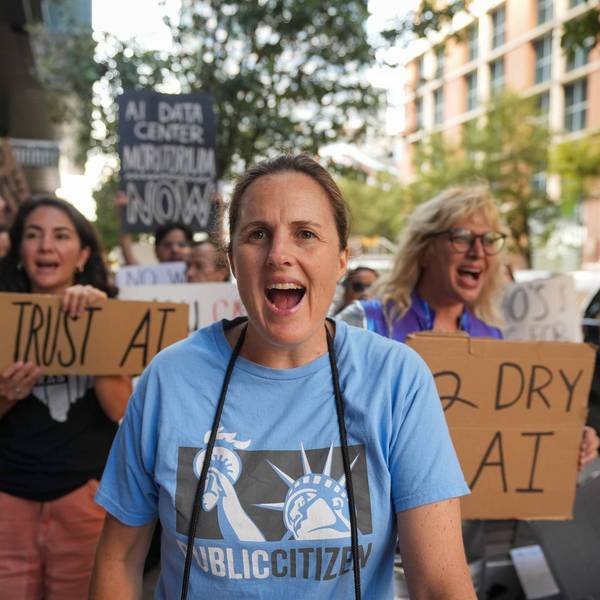
Henry David Thoreau admonished us to “simplify, simplify.” But how can we accomplish this as the digital maze envelops us? I believe that—right now—we’re at a unique crossroads in history where we have a window of opportunity to shape the future and our quality of life. But this may involve some hard choices. I believe that Americans are intuiting this, and the AI data center pushback is a healthy and hopeful expression of this.
Another great American poet, Wendell Berry, captured it well. In “Life is a Miracle: An Essay Against Modern Superstition,” Berry said: “It is easy for me to imagine that the next great division of the world will be between people who wish to live as creatures and people who wish to live as machines.” It seems clear that this is the unavoidable existential choice we now face. We have to decide what kind of world we want to live in and then summon all the agency we can muster to bring it about.
Drowning in my usual sea of online media saturation, I recently spotted an article in The Boston Globe that validated a long but increasingly less lonely quest against the perils of technocracy. It focused on a security safeguard we all know and love: two factor authentication and how it’s driving most of us bonkers:
How hard can it be to grab your phone, retrieve a six-digit code, and type it in—seemingly the simplest task in the world—to avoid, oh, having your bank account emptied, your identity stolen, or yourself rendered a kind of stateless person, adrift without access to your own life? Don’t get Thomas Lee, a Brigham and Women’s Hospital physician, started. “Two-factor authentication is sapping my will to live,” he said. Or litigator Kara Thorvaldsen. “It’s the bane of my existence,” she said. “Every time my husband tries to log into NESN, it somehow requires me to get a code and unlock something with Face ID, etc., etc., ad nauseam.” Or Kim Smith, a playwright, an actor, and an empty nester. “Sometimes the only reason I hear from my [youngest] daughter is when she needs the code that’s been sent to my phone,” she said. As porch pirate thefts mount, residents feel besieged. As two-factor—or, even worse, multifactor—authentication becomes inescapable, it’s safe to say that somewhere in America, a spouse is shouting from another room, “Did you get my code?” An employee can’t get into his work platform because he left his phone at the gym, or thinks he did. And an adult child is trying to help her cognitively faltering parents pay a bill, but can’t, for lack of that darn code.
Not a pretty picture but one that we all know all too well. For some reason, it got me thinking about T.S Eliot’s poem “The Love Song of Alfred J. Prufrock," a masterwork. In one of the more memorable lines, a disillusioned elderly man complains to himself muttering: “I have measured out my life with coffee spoons.” He was basically lamenting that he has let himself be lulled into a diminutive humdrum existence—characterized by small and inconsequential actions making his own narrow life feel smaller and smaller.
This line keeps surfacing in my ruminations about our culture’s slow steady march into some kind of technocratic dystopia—a digital panopticon where we all peck our way through life… where every action, gesture, word, deed, or genetic footprint is recorded and—a more alarming trend of late—presumably watched. In a curious inversion, this humdrum and plodding digital existence has turned out to be the precise opposite of the “machines of loving grace” meme introduced decades ago by another poet, Richard Brautigan—one often quoted by the techno-utopians who are now in charge of… well… almost everything it seems. Then I came across a similar lament from Alex Ross writing in The New Yorker:
You wake up and brace yourself for the barrage of toxic gibberish that constitutes the modern public sphere. Your email is overrun with spam, scams, and smut. There are voice mails from no one about nothing… Publications from the Times on down employ clickbait headlines that treat you like a starving rat in a Pavlovian experiment. AI systems simulate the experience of talking to an arrogant 10-year-old boy who knows far less than he thinks he does. When pressed, the chatbots admit that they cannot “naturally understand human morality, dignity, culture, or meaning.” It all adds up to a continuous discursive tinnitus—a buzz of random, fake, stupid, sinister chatter that nobody wants and nobody can stop.
Living our collective cultural experience by “measuring our life in coffee spoons” seems to resonate perfectly. We seem to be in some kind of number punching purgatory like the four sad corporate drones struggling to reclaim their humanity in the popular TV series Severance. We click away and are hypnotized by our screens. We overdose on mandatory cuteness courtesy of goofy cartoonish emojis and robot figures that some programmer seems to think is going to brighten our day.
As a thought experiment, I started musing about how much of my own time is frittered away on digital trivia. Elaborate verification processes just to use basic services. Endlessly punching numbers and codes into phones and computers and often reaching a dead end. The constant use of codes just to access our own stuff as if in some kind of military intelligence operation. Forcing us to constantly look over our shoulder about being hacked. (Is my life savings still there today?) Frequent visits to customer service hell which are only going to get worse as more and more AI chatbots get added to the mix by clueless companies. (Why is it that many popular companies can’t seem to figure out that customer service is the heart of their business?) Waiting on infinite hold because we might refuse to talk to some cartoon-like chatbot that’s clueless about dealing with anything with the slightest bit of complexity. (Wasn’t AI supposed to be “smart”? Or do companies just like to use “dumb AI” when it suits their purpose?)
I call the framework for these experiential trips to digital purgatory info-bureaucracies. They’re like real-life bureaucracies—only much more effective at giving us the runaround, wasting time, and conditioning us to accept the absurd as normal like the poor souls in Terry Gilliam’s strange but prescient movie Brazil. So here we are frittering away our already scarce and valuable time on these mindless digital chores when we could be doing things that enrich and sustain our lives.
Now that we’re rapidly moving to an “AI first” world, we won’t even be able to navigate these info-bureaucracies ourselves. Unfortunately, this will probably get worse before it gets better. Tech-enamored companies are increasingly using AI agents for customer service and the results are horrendous. Being able to speak to a human agent means mastering different workarounds for every 800 number you might have to call. And we can easily spend hours of our day on hold listening to someone else’s mind-numbing idea of snazzy music.
I believe that—right now—we’re at a unique crossroads in history where we have a window of opportunity to shape the future and our quality of life. But this may involve some hard choices.
Years ago, studies were done to determine how much time Americans spent waiting for red lights. According to some researchers, people in the US spend about 300 hours a year driving, a significant portion of which is spent waiting for traffic lights. One research organization calculated that this “comes up to a whopping four months of your life if you drive seven days a week for 50 years.”
Of course, arguably, this is simply one of the inconveniences we tolerate as expected time wasted in the complicated business of contemporary living. But I couldn’t help but think how much of our valuable quality time we now waste on the continual care and feeding of our Lilliputian-like digital lives. And how much already scarce quality time is also being spent on meaningless tasks plodding through digital labyrinths designed to increase corporate profit; unburden huge corporations from the anguish of having to hire more customer-service staff; and save them time while, of course, wasting ours.
More often than not, the AI agents we encounter turn out to be quite stupid by any human metric. I can assure you from years of working in high tech that companies unquestionably have the technical ability to provide much more user-friendly systems. But this isolation from human agents is intentional and serves their own interests. Many customers just give up trying to fix order problems and take a financial hit out of frustration. And these are vital systems of daily life. We’re talking about essential services such as banking, credit card transactions, paying taxes, and other functions. And once you’re in the tech soup, you’re forced to stay there if the matter is important enough.
Henry David Thoreau admonished us to “simplify, simplify.” But how can we accomplish this as the digital maze envelops us? I believe that—right now—we’re at a unique crossroads in history where we have a window of opportunity to shape the future and our quality of life. But this may involve some hard choices. I believe that Americans are intuiting this, and the AI data center pushback is a healthy and hopeful expression of this.
Another great American poet, Wendell Berry, captured it well. In “Life is a Miracle: An Essay Against Modern Superstition,” Berry said: “It is easy for me to imagine that the next great division of the world will be between people who wish to live as creatures and people who wish to live as machines.” It seems clear that this is the unavoidable existential choice we now face. We have to decide what kind of world we want to live in and then summon all the agency we can muster to bring it about.