5
#000000
#FFFFFF
To donate by check, phone, or other method, see our More Ways to Give page.
Daily news & progressive opinion—funded by the people, not the corporations—delivered straight to your inbox.
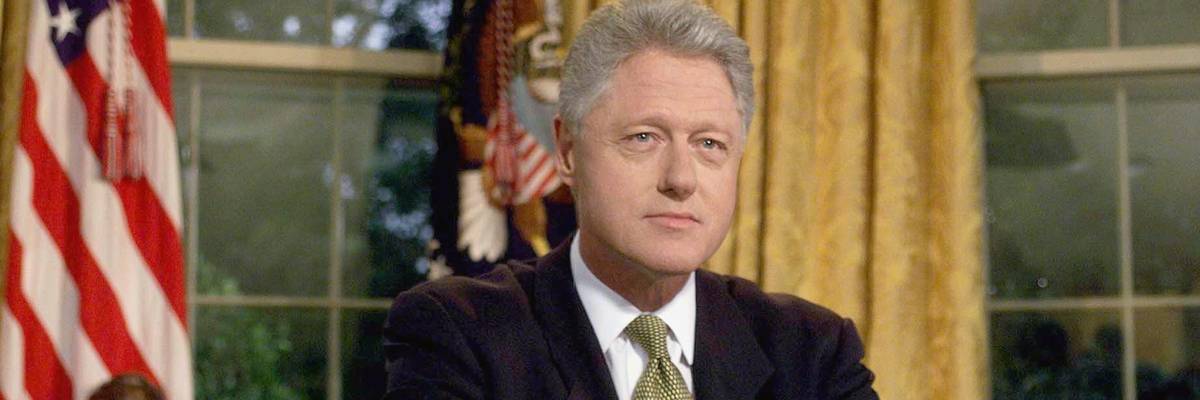
US President Bill Clinton poses for photographs after addressing the nation from the Oval Office in the White House 10 June, 1999, following the end of hostilities in Yugoslavia.
Party leadership needs to study and learn from what the Wall Street wing has cost in terms of lost elections and the increasing tilt of the playing field.
In his stumbling explanation of the muddled autopsy report on the 2024 election debacle, Democratic National Committee chair Ken Martin uttered two pieces of wisdom that regrettably, neither he nor the party has heeded: “The Democratic brand is in trouble and needs repair,” and “I agree with folks who have said we have to learn from the past to win the future.” Had they followed that advice, they would have seen how history tells a neglected and important story.
It begins when Bill Clinton was handed the keys to the White House by a group of largely Southern officials who formed the New Democrats with the mission of putting a Southern, pro-business candidate in the White House. With its pointed references to Reagan speeches and policies, Clinton’s Second Inaugural signaled a devil’s bargain that ended a century of Democratic Party policies.
In 1896, William Jennings Bryan had articulated the level playing field principles that served as the Democrats’ North Star for much of the last century: “There are those who believe that, if you will only legislate to make the well-to-do prosperous, their prosperity will leak through on those below. The Democratic idea, however, has been that if you legislate to make the masses prosperous, their prosperity will find its way up through every class which rests upon them.” In the term following his inaugural rejection of those principles, Clinton repealed one of the crown jewels of the New Deal, the Glass-Steagall Act regulating banks, and handed social media the gift of the Communications Decency Act of 1996, exempting them from the rules governing print and broadcasting.
In the years since Bill Clinton left the White House for a comfortable retirement, the New Democrats asserted control of the party, courting big donors with the pro-Wall Street policies resembling those of his second term. Their strategy uncannily mirrored that of Donald Trump’s Republicans by offering positions on social issues that appeased elements of the base while supporting economic policies benefiting corporate America. In their fight for the soul of the party, the New Democrats pulled no punches, blocking Sen. Bernie Sanders (I-Vt.) in 2016 and primarying 2026 opponents with the zeal of Donald Trump.
One lesson history teaches us is that if inequalities are allowed to fester, things can get very ugly.
Their biggest failure may be that in abandoning the level playing field principle, the New Democrats offered no substitute, save triangulation. Today most of us would stumble over trying to define the Democratic Party in one sentence, but one can easily do that for the Republicans—less taxes, less government. With the midterms six months away, this lack of a unified message already has the faithful worried.
The historical data missing from the autopsy and Martin’s explanations tells the story of what the ascension of the Wall Street Democrats has cost their party and the country. Since 2000, the Democrats have controlled the House only 4 out of 15 terms and the Senate only 6 out of 15. For only four years have Democrats held a majority of state governerships. Democratic presidential victories were anomalies. Barack Obama benefited from a record turnout of BIPOC voters. Joe Biden won because of the mishandling of Covid-19. Even allowing for gerrymandering and voter suppression, it appears clear that the Democratic Party has been in decline for some time.
Given the pro-Wall Street leanings of both parties, we should not be surprised that we have essentially been governed by a minority. Since 2000, the winning presidential candidate has only averaged 30.18% of the voting-eligible population. Today, only 27% of voters identify with either party, while 45% identify as independents. That is the lowest total ever for Democrats.
The numbers in various data and reports tell how the tilt of the playing field continues to widen. Although real total wealth has tripled since 1989, the share of the top 10% has increased from 63% to 72%, but the bottom 50% saw their share decline from 4% to 2%. Meanwhile, labor’s share of production has declined ominously. According to the St. Louis Federal Reserve, it fell from 64% in 2001 to 56% in 2023. During most of the 1950s and 60s it hovered around 60%.
Business concentration recalls the trusts that sparked such widespread discontent during the late 19th century. The best figures come from a study by the Democratic staff of the House Committee on Small Business that was mothballed after its release in December 2023—and goes unmentioned in the autopsy. Bristling with footnotes, the eye-opening Report on Competition in the Small Business Economy cites a Boston Federal Reserve study that shows the economy is 50% more concentrated today than in 2005. It goes on to state, “The dramatic increase in income and wealth inequality seen over the past four decades in the US can also be largely attributed to higher levels of concentration across industries.” Sounding like an outraged 1890 Farmers’ Alliance tract, the study paints a grim picture of today’s farmers: “From the seeds they plant, to the fertilizer in the soil to the machinery that allows them to make it all happen at scale, the price they pay at every step is at the whim of a handful of companies.”
Faced with similar conditions during the Gilded Age, discontented workers and farmers organized to press for the Sherman, Interstate Commerce, and Safety Appliance Acts; laid the groundwork for the 16th, 17th, and 19th amendments; initiated bureaus of labor statistics and factory inspections; and enhanced access to higher education. Because they feared both parties were the tools of tycoons, the discontented also formed new parties, of which the Greenbackers and Populists are the most notable. Most of all, in a flurry of civic engagement, they founded groups like the Grange, Knights of Labor, Women’s Christian Temperance Movement, and Farmers’ Alliance.
Whether today’s discontent will have a similar impact remains an open question. A good part of the answer will depend on whether people like Ken Martin continue to support the Wall Street wing of the party or realize what that support has cost in terms of lost elections and the increasing tilt of the playing field. What is clear is that the drastically tilted playing field has become extremely volatile. One lesson history teaches us is that if inequalities are allowed to fester, things can get very ugly. During the discontent of the Gilded Age, lynchings averaged 150 per year between 1881 and 1900, or one every 2.4 days. Another 1,400 people perished in riots, in the most violent three decades in our history. All of us can see and fear the growling, anvil-shaped clouds that threaten to darken our lives, as they did over a century ago.
Dear Common Dreams reader, It’s been nearly 30 years since I co-founded Common Dreams with my late wife, Lina Newhouser. We had the radical notion that journalism should serve the public good, not corporate profits. It was clear to us from the outset what it would take to build such a project. No paid advertisements. No corporate sponsors. No millionaire publisher telling us what to think or do. Many people said we wouldn't last a year, but we proved those doubters wrong. Together with a tremendous team of journalists and dedicated staff, we built an independent media outlet free from the constraints of profits and corporate control. Our mission has always been simple: To inform. To inspire. To ignite change for the common good. Building Common Dreams was not easy. Our survival was never guaranteed. When you take on the most powerful forces—Wall Street greed, fossil fuel industry destruction, Big Tech lobbyists, and uber-rich oligarchs who have spent billions upon billions rigging the economy and democracy in their favor—the only bulwark you have is supporters who believe in your work. But here’s the urgent message from me today. It's never been this bad out there. And it's never been this hard to keep us going. At the very moment Common Dreams is most needed, the threats we face are intensifying. We need your support now more than ever. We don't accept corporate advertising and never will. We don't have a paywall because we don't think people should be blocked from critical news based on their ability to pay. Everything we do is funded by the donations of readers like you. When everyone does the little they can afford, we are strong. But if that support retreats or dries up, so do we. Will you donate now to make sure Common Dreams not only survives but thrives? —Craig Brown, Co-founder |
In his stumbling explanation of the muddled autopsy report on the 2024 election debacle, Democratic National Committee chair Ken Martin uttered two pieces of wisdom that regrettably, neither he nor the party has heeded: “The Democratic brand is in trouble and needs repair,” and “I agree with folks who have said we have to learn from the past to win the future.” Had they followed that advice, they would have seen how history tells a neglected and important story.
It begins when Bill Clinton was handed the keys to the White House by a group of largely Southern officials who formed the New Democrats with the mission of putting a Southern, pro-business candidate in the White House. With its pointed references to Reagan speeches and policies, Clinton’s Second Inaugural signaled a devil’s bargain that ended a century of Democratic Party policies.
In 1896, William Jennings Bryan had articulated the level playing field principles that served as the Democrats’ North Star for much of the last century: “There are those who believe that, if you will only legislate to make the well-to-do prosperous, their prosperity will leak through on those below. The Democratic idea, however, has been that if you legislate to make the masses prosperous, their prosperity will find its way up through every class which rests upon them.” In the term following his inaugural rejection of those principles, Clinton repealed one of the crown jewels of the New Deal, the Glass-Steagall Act regulating banks, and handed social media the gift of the Communications Decency Act of 1996, exempting them from the rules governing print and broadcasting.
In the years since Bill Clinton left the White House for a comfortable retirement, the New Democrats asserted control of the party, courting big donors with the pro-Wall Street policies resembling those of his second term. Their strategy uncannily mirrored that of Donald Trump’s Republicans by offering positions on social issues that appeased elements of the base while supporting economic policies benefiting corporate America. In their fight for the soul of the party, the New Democrats pulled no punches, blocking Sen. Bernie Sanders (I-Vt.) in 2016 and primarying 2026 opponents with the zeal of Donald Trump.
One lesson history teaches us is that if inequalities are allowed to fester, things can get very ugly.
Their biggest failure may be that in abandoning the level playing field principle, the New Democrats offered no substitute, save triangulation. Today most of us would stumble over trying to define the Democratic Party in one sentence, but one can easily do that for the Republicans—less taxes, less government. With the midterms six months away, this lack of a unified message already has the faithful worried.
The historical data missing from the autopsy and Martin’s explanations tells the story of what the ascension of the Wall Street Democrats has cost their party and the country. Since 2000, the Democrats have controlled the House only 4 out of 15 terms and the Senate only 6 out of 15. For only four years have Democrats held a majority of state governerships. Democratic presidential victories were anomalies. Barack Obama benefited from a record turnout of BIPOC voters. Joe Biden won because of the mishandling of Covid-19. Even allowing for gerrymandering and voter suppression, it appears clear that the Democratic Party has been in decline for some time.
Given the pro-Wall Street leanings of both parties, we should not be surprised that we have essentially been governed by a minority. Since 2000, the winning presidential candidate has only averaged 30.18% of the voting-eligible population. Today, only 27% of voters identify with either party, while 45% identify as independents. That is the lowest total ever for Democrats.
The numbers in various data and reports tell how the tilt of the playing field continues to widen. Although real total wealth has tripled since 1989, the share of the top 10% has increased from 63% to 72%, but the bottom 50% saw their share decline from 4% to 2%. Meanwhile, labor’s share of production has declined ominously. According to the St. Louis Federal Reserve, it fell from 64% in 2001 to 56% in 2023. During most of the 1950s and 60s it hovered around 60%.
Business concentration recalls the trusts that sparked such widespread discontent during the late 19th century. The best figures come from a study by the Democratic staff of the House Committee on Small Business that was mothballed after its release in December 2023—and goes unmentioned in the autopsy. Bristling with footnotes, the eye-opening Report on Competition in the Small Business Economy cites a Boston Federal Reserve study that shows the economy is 50% more concentrated today than in 2005. It goes on to state, “The dramatic increase in income and wealth inequality seen over the past four decades in the US can also be largely attributed to higher levels of concentration across industries.” Sounding like an outraged 1890 Farmers’ Alliance tract, the study paints a grim picture of today’s farmers: “From the seeds they plant, to the fertilizer in the soil to the machinery that allows them to make it all happen at scale, the price they pay at every step is at the whim of a handful of companies.”
Faced with similar conditions during the Gilded Age, discontented workers and farmers organized to press for the Sherman, Interstate Commerce, and Safety Appliance Acts; laid the groundwork for the 16th, 17th, and 19th amendments; initiated bureaus of labor statistics and factory inspections; and enhanced access to higher education. Because they feared both parties were the tools of tycoons, the discontented also formed new parties, of which the Greenbackers and Populists are the most notable. Most of all, in a flurry of civic engagement, they founded groups like the Grange, Knights of Labor, Women’s Christian Temperance Movement, and Farmers’ Alliance.
Whether today’s discontent will have a similar impact remains an open question. A good part of the answer will depend on whether people like Ken Martin continue to support the Wall Street wing of the party or realize what that support has cost in terms of lost elections and the increasing tilt of the playing field. What is clear is that the drastically tilted playing field has become extremely volatile. One lesson history teaches us is that if inequalities are allowed to fester, things can get very ugly. During the discontent of the Gilded Age, lynchings averaged 150 per year between 1881 and 1900, or one every 2.4 days. Another 1,400 people perished in riots, in the most violent three decades in our history. All of us can see and fear the growling, anvil-shaped clouds that threaten to darken our lives, as they did over a century ago.
In his stumbling explanation of the muddled autopsy report on the 2024 election debacle, Democratic National Committee chair Ken Martin uttered two pieces of wisdom that regrettably, neither he nor the party has heeded: “The Democratic brand is in trouble and needs repair,” and “I agree with folks who have said we have to learn from the past to win the future.” Had they followed that advice, they would have seen how history tells a neglected and important story.
It begins when Bill Clinton was handed the keys to the White House by a group of largely Southern officials who formed the New Democrats with the mission of putting a Southern, pro-business candidate in the White House. With its pointed references to Reagan speeches and policies, Clinton’s Second Inaugural signaled a devil’s bargain that ended a century of Democratic Party policies.
In 1896, William Jennings Bryan had articulated the level playing field principles that served as the Democrats’ North Star for much of the last century: “There are those who believe that, if you will only legislate to make the well-to-do prosperous, their prosperity will leak through on those below. The Democratic idea, however, has been that if you legislate to make the masses prosperous, their prosperity will find its way up through every class which rests upon them.” In the term following his inaugural rejection of those principles, Clinton repealed one of the crown jewels of the New Deal, the Glass-Steagall Act regulating banks, and handed social media the gift of the Communications Decency Act of 1996, exempting them from the rules governing print and broadcasting.
In the years since Bill Clinton left the White House for a comfortable retirement, the New Democrats asserted control of the party, courting big donors with the pro-Wall Street policies resembling those of his second term. Their strategy uncannily mirrored that of Donald Trump’s Republicans by offering positions on social issues that appeased elements of the base while supporting economic policies benefiting corporate America. In their fight for the soul of the party, the New Democrats pulled no punches, blocking Sen. Bernie Sanders (I-Vt.) in 2016 and primarying 2026 opponents with the zeal of Donald Trump.
One lesson history teaches us is that if inequalities are allowed to fester, things can get very ugly.
Their biggest failure may be that in abandoning the level playing field principle, the New Democrats offered no substitute, save triangulation. Today most of us would stumble over trying to define the Democratic Party in one sentence, but one can easily do that for the Republicans—less taxes, less government. With the midterms six months away, this lack of a unified message already has the faithful worried.
The historical data missing from the autopsy and Martin’s explanations tells the story of what the ascension of the Wall Street Democrats has cost their party and the country. Since 2000, the Democrats have controlled the House only 4 out of 15 terms and the Senate only 6 out of 15. For only four years have Democrats held a majority of state governerships. Democratic presidential victories were anomalies. Barack Obama benefited from a record turnout of BIPOC voters. Joe Biden won because of the mishandling of Covid-19. Even allowing for gerrymandering and voter suppression, it appears clear that the Democratic Party has been in decline for some time.
Given the pro-Wall Street leanings of both parties, we should not be surprised that we have essentially been governed by a minority. Since 2000, the winning presidential candidate has only averaged 30.18% of the voting-eligible population. Today, only 27% of voters identify with either party, while 45% identify as independents. That is the lowest total ever for Democrats.
The numbers in various data and reports tell how the tilt of the playing field continues to widen. Although real total wealth has tripled since 1989, the share of the top 10% has increased from 63% to 72%, but the bottom 50% saw their share decline from 4% to 2%. Meanwhile, labor’s share of production has declined ominously. According to the St. Louis Federal Reserve, it fell from 64% in 2001 to 56% in 2023. During most of the 1950s and 60s it hovered around 60%.
Business concentration recalls the trusts that sparked such widespread discontent during the late 19th century. The best figures come from a study by the Democratic staff of the House Committee on Small Business that was mothballed after its release in December 2023—and goes unmentioned in the autopsy. Bristling with footnotes, the eye-opening Report on Competition in the Small Business Economy cites a Boston Federal Reserve study that shows the economy is 50% more concentrated today than in 2005. It goes on to state, “The dramatic increase in income and wealth inequality seen over the past four decades in the US can also be largely attributed to higher levels of concentration across industries.” Sounding like an outraged 1890 Farmers’ Alliance tract, the study paints a grim picture of today’s farmers: “From the seeds they plant, to the fertilizer in the soil to the machinery that allows them to make it all happen at scale, the price they pay at every step is at the whim of a handful of companies.”
Faced with similar conditions during the Gilded Age, discontented workers and farmers organized to press for the Sherman, Interstate Commerce, and Safety Appliance Acts; laid the groundwork for the 16th, 17th, and 19th amendments; initiated bureaus of labor statistics and factory inspections; and enhanced access to higher education. Because they feared both parties were the tools of tycoons, the discontented also formed new parties, of which the Greenbackers and Populists are the most notable. Most of all, in a flurry of civic engagement, they founded groups like the Grange, Knights of Labor, Women’s Christian Temperance Movement, and Farmers’ Alliance.
Whether today’s discontent will have a similar impact remains an open question. A good part of the answer will depend on whether people like Ken Martin continue to support the Wall Street wing of the party or realize what that support has cost in terms of lost elections and the increasing tilt of the playing field. What is clear is that the drastically tilted playing field has become extremely volatile. One lesson history teaches us is that if inequalities are allowed to fester, things can get very ugly. During the discontent of the Gilded Age, lynchings averaged 150 per year between 1881 and 1900, or one every 2.4 days. Another 1,400 people perished in riots, in the most violent three decades in our history. All of us can see and fear the growling, anvil-shaped clouds that threaten to darken our lives, as they did over a century ago.