SUBSCRIBE TO OUR FREE NEWSLETTER
Daily news & progressive opinion—funded by the people, not the corporations—delivered straight to your inbox.
5
#000000
#FFFFFF
To donate by check, phone, or other method, see our More Ways to Give page.
Daily news & progressive opinion—funded by the people, not the corporations—delivered straight to your inbox.
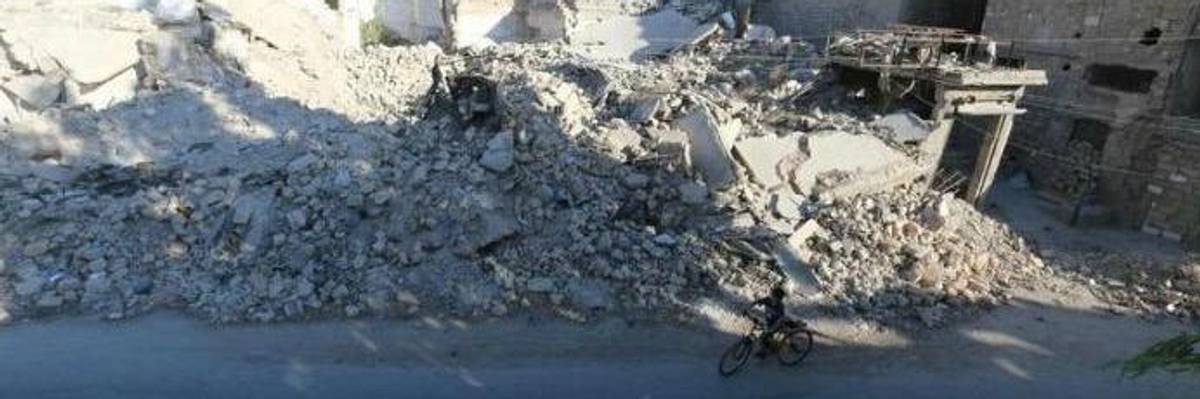
A boy rides a bicycle near rubble of damaged buildings in the rebel-held al-Maadi district of Aleppo, Syria.
These shadowy alliances are reshaping how wars are fought, who profits from them, and why traditional peacekeeping doesn’t work anymore.
Picture a weapon that can level a city block, manufactured in Belgium, assembled in Dubai, financed through Swiss banks, and delivered to militants by a “logistics company” registered in Singapore. This isn’t the plot of a thriller—it’s how modern warfare works.
When a sophisticated drone strike hit Saudi oil facilities in 2019, investigators traced the weapons technology not to a nation-state, but to a complex network of corporate suppliers and militant groups.
When corporations can effectively arm and support militant groups with impunity, concepts like state sovereignty and international law begin to break down.
Welcome to the new face of global conflict, where the most dangerous relationships aren’t between countries, but between corporations and armed groups. These shadowy alliances are reshaping how wars are fought, who profits from them, and why traditional peacekeeping doesn’t work anymore.
The old image of arms dealers as shady men with briefcases full of cash is hopelessly outdated. Today’s weapons trade runs through legitimate-looking corporations, tech companies, and financial institutions that have mastered the art of working in war’s gray zones.
Take the ongoing conflict in Yemen. While media attention focuses on state actors, private military contractors and defense corporations have formed intricate relationships with local militant groups. These companies don’t just supply weapons. They provide training, maintenance, and even operational support, all while maintaining a veneer of legitimate business operations.
“What we’re seeing is the corporatization of conflict,” explains Sarah Martinez, a specialist in non-state armed groups at the International Institute for Strategic Studies. “These aren’t simple arms deals anymore—they’re long-term business relationships that create sustained cycles of violence.”
The financial web supporting these alliances is deliberately opaque and designed to evade accountability. Private military companies, often registered in offshore jurisdictions like Dubai or Singapore, form partnerships with shell corporations based in the Caribbean. These shell entities, in turn, subcontract their operations to ambiguous “logistics companies” operating out of Eastern Europe. This elaborate system of front companies and subcontractors allows weapons and military equipment to flow freely into conflict zones without raising red flags. Responsibility is diffused across a web of corporate structures, making it nearly impossible to trace the ultimate source of arms shipments or hold anyone accountable for fueling conflicts.
In Africa’s resource-rich regions, the situation is becoming even more alarming. Here, private security firms, often funded by Western investors, forge alliances with local militant groups under the pretext of protecting valuable oil and mineral installations. What starts as a “security” operation to safeguard resources often escalates into these firms operating as de facto private armies, controlling entire regions and undermining the authority of national governments. These alliances not only destabilize local politics but also complicate international peacekeeping efforts, creating power vacuums where non-state actors can thrive. In such an environment, financial backing for these operations becomes a critical tool, turning what appears to be routine corporate transactions into a driving force behind some of the world’s most enduring conflicts.
Modern conflict isn’t just about guns and bombs. Today’s militant groups need sophisticated technology, which they’re getting from seemingly legitimate sources. Communications equipment, surveillance technology, and cyber tools flow through corporate channels that straddle the line between legal and illegal. These tools allow groups to operate covertly, communicate securely, and execute sophisticated cyber-attacks, which can be as damaging as conventional warfare. For instance, militant groups are using encrypted communication tools to evade state surveillance, while also acquiring drones and other high-tech surveillance equipment through corporate gray markets.
This access to advanced technology extends beyond just weaponry. It’s also about operational capacity. “The real game-changer isn’t the weapons themselves, but the support systems,” notes James Wilson, a former United Nations weapons inspector. When militant groups can access corporate-level logistics, training, and technical support, they become far more dangerous than traditional armed forces. These corporate partnerships allow militant organizations to mimic the structure of formal military forces, combining guerrilla tactics with modern technology to disrupt state control, launch cyberattacks, and even hold territories with a level of sophistication unseen in previous decades
The pattern repeats across regions. In Syria, corporate entities linked to Russian military industries provide not just weapons but entire support ecosystems to various armed groups. These companies deliver everything from logistical support and advanced weaponry to financial aid, creating a symbiotic relationship with local militias. This dynamic allows both the corporations and the armed groups to thrive in a perpetual state of conflict.
There is a growing call for the development of new international legal frameworks that hold corporations accountable for their roles in conflicts, particularly when they profit from or directly contribute to violence.
Similarly, in the Horn of Africa, Chinese companies, while officially involved in building infrastructure projects, are simultaneously supplying militant groups with equipment and technical expertise under the radar. These companies are benefiting financially from both sides—securing government contracts for infrastructure while also arming insurgents. According to the U.N. Security Council, these arrangements contribute to what conflict researchers call “sustained instability zones”—regions where violence is deliberately prolonged because it becomes profitable for both corporate actors and armed groups.
As a result, traditional peacekeeping missions, which were designed to manage conflict between state actors, are increasingly ineffective. These missions are often incapable of addressing the complex web of corporate and non-state alliances that fuel these conflicts. As the International Peace Institute highlights, peacekeepers find themselves irrelevant in these new conflict ecosystems, where the drivers of violence are no longer solely state actors but profit-driven corporations and armed factions operating outside the bounds of state control.
U.N. peacekeeping was designed for a world where states were the primary actors in conflicts. But what happens when the real power lies with corporate-militant alliances that operate across borders? Traditional diplomatic tools and peace agreements often miss the real drivers of conflict.
“Peacekeepers can monitor cease-fires between armies, but they can’t address corporate supply chains that fuel conflicts,” explains former U.N. peacekeeper Colonel Maria Rodriguez. “We’re using 20th-century tools to fight 21st-century wars.”
These alliances don’t just threaten local stability. They’re undermining the entire international system. When corporations can effectively arm and support militant groups with impunity, concepts like state sovereignty and international law begin to break down.
The numbers are staggering. According to the Stockholm International Peace Research Institute, corporate-militant alliances now influence conflicts affecting over 250 million people globally. These arrangements have created shadow economies worth an estimated $300 billion annually.
Traditional sanctions and arms embargo often fail because they target state actors rather than the increasingly influential corporate-militant networks that drive modern conflicts. Some experts argue for a completely new approach to international conflict management. First, they suggest recognizing that these corporate-militant alliances, rather than state actions, are the primary forces behind many of today’s wars. Without this shift in focus, sanctions will continue to miss their mark.
Second, there is a growing call for the development of new international legal frameworks that hold corporations accountable for their roles in conflicts, particularly when they profit from or directly contribute to violence. This would address the legal gaps that allow companies to evade responsibility when operating in conflict zones.
Finally, experts propose peacekeeping operations that disrupt these corporate-militant alliances instead of merely focus on separating armed forces. By cutting off the financial and logistical support that such networks provide to militant groups, peacekeeping efforts could become more effective in curbing conflict.
The real question is whether the international community can adapt fast enough to address this new reality, and whether global institutions are equipped to deal with conflicts that no longer fit neatly within the old rules of engagement.
The future of global conflict isn’t just about nation-states anymore. It’s about complex alliances between corporations and armed groups that profit from sustained instability. As one U.N. official put it (speaking on condition of anonymity): “We’re still playing checkers while they’re playing a much more dangerous game.” This sentiment underscores the growing complexity of global conflict, where traditional methods of diplomacy and peacekeeping are falling behind the rapidly evolving alliances between non-state actors.
The question isn’t whether these alliances will reshape global conflict. They already have, as seen in regions from the Middle East to Latin America. The involvement of multinational corporations in resource-driven conflicts, alongside insurgent and militant groups, adds layers of complexity that traditional state-based frameworks struggle to address. These alliances transcend borders, ideologies, and legal frameworks, creating new kinds of power dynamics that the international system was not designed to manage.
The real question is whether the international community can adapt fast enough to address this new reality, and whether global institutions are equipped to deal with conflicts that no longer fit neatly within the old rules of engagement. This crisis requires not only new thinking about conflict resolution, peace enforcement, and international law, but also a reevaluation of how power is distributed in a globalized world where non-state actors hold increasing sway. Until then, corporate-militant alliances will continue to challenge not just regional stability but the very foundation of the international order, undermining the principles of sovereignty, territorial integrity, and governance that have long underpinned global relations.
Dear Common Dreams reader, It’s been nearly 30 years since I co-founded Common Dreams with my late wife, Lina Newhouser. We had the radical notion that journalism should serve the public good, not corporate profits. It was clear to us from the outset what it would take to build such a project. No paid advertisements. No corporate sponsors. No millionaire publisher telling us what to think or do. Many people said we wouldn't last a year, but we proved those doubters wrong. Together with a tremendous team of journalists and dedicated staff, we built an independent media outlet free from the constraints of profits and corporate control. Our mission has always been simple: To inform. To inspire. To ignite change for the common good. Building Common Dreams was not easy. Our survival was never guaranteed. When you take on the most powerful forces—Wall Street greed, fossil fuel industry destruction, Big Tech lobbyists, and uber-rich oligarchs who have spent billions upon billions rigging the economy and democracy in their favor—the only bulwark you have is supporters who believe in your work. But here’s the urgent message from me today. It's never been this bad out there. And it's never been this hard to keep us going. At the very moment Common Dreams is most needed, the threats we face are intensifying. We need your support now more than ever. We don't accept corporate advertising and never will. We don't have a paywall because we don't think people should be blocked from critical news based on their ability to pay. Everything we do is funded by the donations of readers like you. When everyone does the little they can afford, we are strong. But if that support retreats or dries up, so do we. Will you donate now to make sure Common Dreams not only survives but thrives? —Craig Brown, Co-founder |
Picture a weapon that can level a city block, manufactured in Belgium, assembled in Dubai, financed through Swiss banks, and delivered to militants by a “logistics company” registered in Singapore. This isn’t the plot of a thriller—it’s how modern warfare works.
When a sophisticated drone strike hit Saudi oil facilities in 2019, investigators traced the weapons technology not to a nation-state, but to a complex network of corporate suppliers and militant groups.
When corporations can effectively arm and support militant groups with impunity, concepts like state sovereignty and international law begin to break down.
Welcome to the new face of global conflict, where the most dangerous relationships aren’t between countries, but between corporations and armed groups. These shadowy alliances are reshaping how wars are fought, who profits from them, and why traditional peacekeeping doesn’t work anymore.
The old image of arms dealers as shady men with briefcases full of cash is hopelessly outdated. Today’s weapons trade runs through legitimate-looking corporations, tech companies, and financial institutions that have mastered the art of working in war’s gray zones.
Take the ongoing conflict in Yemen. While media attention focuses on state actors, private military contractors and defense corporations have formed intricate relationships with local militant groups. These companies don’t just supply weapons. They provide training, maintenance, and even operational support, all while maintaining a veneer of legitimate business operations.
“What we’re seeing is the corporatization of conflict,” explains Sarah Martinez, a specialist in non-state armed groups at the International Institute for Strategic Studies. “These aren’t simple arms deals anymore—they’re long-term business relationships that create sustained cycles of violence.”
The financial web supporting these alliances is deliberately opaque and designed to evade accountability. Private military companies, often registered in offshore jurisdictions like Dubai or Singapore, form partnerships with shell corporations based in the Caribbean. These shell entities, in turn, subcontract their operations to ambiguous “logistics companies” operating out of Eastern Europe. This elaborate system of front companies and subcontractors allows weapons and military equipment to flow freely into conflict zones without raising red flags. Responsibility is diffused across a web of corporate structures, making it nearly impossible to trace the ultimate source of arms shipments or hold anyone accountable for fueling conflicts.
In Africa’s resource-rich regions, the situation is becoming even more alarming. Here, private security firms, often funded by Western investors, forge alliances with local militant groups under the pretext of protecting valuable oil and mineral installations. What starts as a “security” operation to safeguard resources often escalates into these firms operating as de facto private armies, controlling entire regions and undermining the authority of national governments. These alliances not only destabilize local politics but also complicate international peacekeeping efforts, creating power vacuums where non-state actors can thrive. In such an environment, financial backing for these operations becomes a critical tool, turning what appears to be routine corporate transactions into a driving force behind some of the world’s most enduring conflicts.
Modern conflict isn’t just about guns and bombs. Today’s militant groups need sophisticated technology, which they’re getting from seemingly legitimate sources. Communications equipment, surveillance technology, and cyber tools flow through corporate channels that straddle the line between legal and illegal. These tools allow groups to operate covertly, communicate securely, and execute sophisticated cyber-attacks, which can be as damaging as conventional warfare. For instance, militant groups are using encrypted communication tools to evade state surveillance, while also acquiring drones and other high-tech surveillance equipment through corporate gray markets.
This access to advanced technology extends beyond just weaponry. It’s also about operational capacity. “The real game-changer isn’t the weapons themselves, but the support systems,” notes James Wilson, a former United Nations weapons inspector. When militant groups can access corporate-level logistics, training, and technical support, they become far more dangerous than traditional armed forces. These corporate partnerships allow militant organizations to mimic the structure of formal military forces, combining guerrilla tactics with modern technology to disrupt state control, launch cyberattacks, and even hold territories with a level of sophistication unseen in previous decades
The pattern repeats across regions. In Syria, corporate entities linked to Russian military industries provide not just weapons but entire support ecosystems to various armed groups. These companies deliver everything from logistical support and advanced weaponry to financial aid, creating a symbiotic relationship with local militias. This dynamic allows both the corporations and the armed groups to thrive in a perpetual state of conflict.
There is a growing call for the development of new international legal frameworks that hold corporations accountable for their roles in conflicts, particularly when they profit from or directly contribute to violence.
Similarly, in the Horn of Africa, Chinese companies, while officially involved in building infrastructure projects, are simultaneously supplying militant groups with equipment and technical expertise under the radar. These companies are benefiting financially from both sides—securing government contracts for infrastructure while also arming insurgents. According to the U.N. Security Council, these arrangements contribute to what conflict researchers call “sustained instability zones”—regions where violence is deliberately prolonged because it becomes profitable for both corporate actors and armed groups.
As a result, traditional peacekeeping missions, which were designed to manage conflict between state actors, are increasingly ineffective. These missions are often incapable of addressing the complex web of corporate and non-state alliances that fuel these conflicts. As the International Peace Institute highlights, peacekeepers find themselves irrelevant in these new conflict ecosystems, where the drivers of violence are no longer solely state actors but profit-driven corporations and armed factions operating outside the bounds of state control.
U.N. peacekeeping was designed for a world where states were the primary actors in conflicts. But what happens when the real power lies with corporate-militant alliances that operate across borders? Traditional diplomatic tools and peace agreements often miss the real drivers of conflict.
“Peacekeepers can monitor cease-fires between armies, but they can’t address corporate supply chains that fuel conflicts,” explains former U.N. peacekeeper Colonel Maria Rodriguez. “We’re using 20th-century tools to fight 21st-century wars.”
These alliances don’t just threaten local stability. They’re undermining the entire international system. When corporations can effectively arm and support militant groups with impunity, concepts like state sovereignty and international law begin to break down.
The numbers are staggering. According to the Stockholm International Peace Research Institute, corporate-militant alliances now influence conflicts affecting over 250 million people globally. These arrangements have created shadow economies worth an estimated $300 billion annually.
Traditional sanctions and arms embargo often fail because they target state actors rather than the increasingly influential corporate-militant networks that drive modern conflicts. Some experts argue for a completely new approach to international conflict management. First, they suggest recognizing that these corporate-militant alliances, rather than state actions, are the primary forces behind many of today’s wars. Without this shift in focus, sanctions will continue to miss their mark.
Second, there is a growing call for the development of new international legal frameworks that hold corporations accountable for their roles in conflicts, particularly when they profit from or directly contribute to violence. This would address the legal gaps that allow companies to evade responsibility when operating in conflict zones.
Finally, experts propose peacekeeping operations that disrupt these corporate-militant alliances instead of merely focus on separating armed forces. By cutting off the financial and logistical support that such networks provide to militant groups, peacekeeping efforts could become more effective in curbing conflict.
The real question is whether the international community can adapt fast enough to address this new reality, and whether global institutions are equipped to deal with conflicts that no longer fit neatly within the old rules of engagement.
The future of global conflict isn’t just about nation-states anymore. It’s about complex alliances between corporations and armed groups that profit from sustained instability. As one U.N. official put it (speaking on condition of anonymity): “We’re still playing checkers while they’re playing a much more dangerous game.” This sentiment underscores the growing complexity of global conflict, where traditional methods of diplomacy and peacekeeping are falling behind the rapidly evolving alliances between non-state actors.
The question isn’t whether these alliances will reshape global conflict. They already have, as seen in regions from the Middle East to Latin America. The involvement of multinational corporations in resource-driven conflicts, alongside insurgent and militant groups, adds layers of complexity that traditional state-based frameworks struggle to address. These alliances transcend borders, ideologies, and legal frameworks, creating new kinds of power dynamics that the international system was not designed to manage.
The real question is whether the international community can adapt fast enough to address this new reality, and whether global institutions are equipped to deal with conflicts that no longer fit neatly within the old rules of engagement. This crisis requires not only new thinking about conflict resolution, peace enforcement, and international law, but also a reevaluation of how power is distributed in a globalized world where non-state actors hold increasing sway. Until then, corporate-militant alliances will continue to challenge not just regional stability but the very foundation of the international order, undermining the principles of sovereignty, territorial integrity, and governance that have long underpinned global relations.
Picture a weapon that can level a city block, manufactured in Belgium, assembled in Dubai, financed through Swiss banks, and delivered to militants by a “logistics company” registered in Singapore. This isn’t the plot of a thriller—it’s how modern warfare works.
When a sophisticated drone strike hit Saudi oil facilities in 2019, investigators traced the weapons technology not to a nation-state, but to a complex network of corporate suppliers and militant groups.
When corporations can effectively arm and support militant groups with impunity, concepts like state sovereignty and international law begin to break down.
Welcome to the new face of global conflict, where the most dangerous relationships aren’t between countries, but between corporations and armed groups. These shadowy alliances are reshaping how wars are fought, who profits from them, and why traditional peacekeeping doesn’t work anymore.
The old image of arms dealers as shady men with briefcases full of cash is hopelessly outdated. Today’s weapons trade runs through legitimate-looking corporations, tech companies, and financial institutions that have mastered the art of working in war’s gray zones.
Take the ongoing conflict in Yemen. While media attention focuses on state actors, private military contractors and defense corporations have formed intricate relationships with local militant groups. These companies don’t just supply weapons. They provide training, maintenance, and even operational support, all while maintaining a veneer of legitimate business operations.
“What we’re seeing is the corporatization of conflict,” explains Sarah Martinez, a specialist in non-state armed groups at the International Institute for Strategic Studies. “These aren’t simple arms deals anymore—they’re long-term business relationships that create sustained cycles of violence.”
The financial web supporting these alliances is deliberately opaque and designed to evade accountability. Private military companies, often registered in offshore jurisdictions like Dubai or Singapore, form partnerships with shell corporations based in the Caribbean. These shell entities, in turn, subcontract their operations to ambiguous “logistics companies” operating out of Eastern Europe. This elaborate system of front companies and subcontractors allows weapons and military equipment to flow freely into conflict zones without raising red flags. Responsibility is diffused across a web of corporate structures, making it nearly impossible to trace the ultimate source of arms shipments or hold anyone accountable for fueling conflicts.
In Africa’s resource-rich regions, the situation is becoming even more alarming. Here, private security firms, often funded by Western investors, forge alliances with local militant groups under the pretext of protecting valuable oil and mineral installations. What starts as a “security” operation to safeguard resources often escalates into these firms operating as de facto private armies, controlling entire regions and undermining the authority of national governments. These alliances not only destabilize local politics but also complicate international peacekeeping efforts, creating power vacuums where non-state actors can thrive. In such an environment, financial backing for these operations becomes a critical tool, turning what appears to be routine corporate transactions into a driving force behind some of the world’s most enduring conflicts.
Modern conflict isn’t just about guns and bombs. Today’s militant groups need sophisticated technology, which they’re getting from seemingly legitimate sources. Communications equipment, surveillance technology, and cyber tools flow through corporate channels that straddle the line between legal and illegal. These tools allow groups to operate covertly, communicate securely, and execute sophisticated cyber-attacks, which can be as damaging as conventional warfare. For instance, militant groups are using encrypted communication tools to evade state surveillance, while also acquiring drones and other high-tech surveillance equipment through corporate gray markets.
This access to advanced technology extends beyond just weaponry. It’s also about operational capacity. “The real game-changer isn’t the weapons themselves, but the support systems,” notes James Wilson, a former United Nations weapons inspector. When militant groups can access corporate-level logistics, training, and technical support, they become far more dangerous than traditional armed forces. These corporate partnerships allow militant organizations to mimic the structure of formal military forces, combining guerrilla tactics with modern technology to disrupt state control, launch cyberattacks, and even hold territories with a level of sophistication unseen in previous decades
The pattern repeats across regions. In Syria, corporate entities linked to Russian military industries provide not just weapons but entire support ecosystems to various armed groups. These companies deliver everything from logistical support and advanced weaponry to financial aid, creating a symbiotic relationship with local militias. This dynamic allows both the corporations and the armed groups to thrive in a perpetual state of conflict.
There is a growing call for the development of new international legal frameworks that hold corporations accountable for their roles in conflicts, particularly when they profit from or directly contribute to violence.
Similarly, in the Horn of Africa, Chinese companies, while officially involved in building infrastructure projects, are simultaneously supplying militant groups with equipment and technical expertise under the radar. These companies are benefiting financially from both sides—securing government contracts for infrastructure while also arming insurgents. According to the U.N. Security Council, these arrangements contribute to what conflict researchers call “sustained instability zones”—regions where violence is deliberately prolonged because it becomes profitable for both corporate actors and armed groups.
As a result, traditional peacekeeping missions, which were designed to manage conflict between state actors, are increasingly ineffective. These missions are often incapable of addressing the complex web of corporate and non-state alliances that fuel these conflicts. As the International Peace Institute highlights, peacekeepers find themselves irrelevant in these new conflict ecosystems, where the drivers of violence are no longer solely state actors but profit-driven corporations and armed factions operating outside the bounds of state control.
U.N. peacekeeping was designed for a world where states were the primary actors in conflicts. But what happens when the real power lies with corporate-militant alliances that operate across borders? Traditional diplomatic tools and peace agreements often miss the real drivers of conflict.
“Peacekeepers can monitor cease-fires between armies, but they can’t address corporate supply chains that fuel conflicts,” explains former U.N. peacekeeper Colonel Maria Rodriguez. “We’re using 20th-century tools to fight 21st-century wars.”
These alliances don’t just threaten local stability. They’re undermining the entire international system. When corporations can effectively arm and support militant groups with impunity, concepts like state sovereignty and international law begin to break down.
The numbers are staggering. According to the Stockholm International Peace Research Institute, corporate-militant alliances now influence conflicts affecting over 250 million people globally. These arrangements have created shadow economies worth an estimated $300 billion annually.
Traditional sanctions and arms embargo often fail because they target state actors rather than the increasingly influential corporate-militant networks that drive modern conflicts. Some experts argue for a completely new approach to international conflict management. First, they suggest recognizing that these corporate-militant alliances, rather than state actions, are the primary forces behind many of today’s wars. Without this shift in focus, sanctions will continue to miss their mark.
Second, there is a growing call for the development of new international legal frameworks that hold corporations accountable for their roles in conflicts, particularly when they profit from or directly contribute to violence. This would address the legal gaps that allow companies to evade responsibility when operating in conflict zones.
Finally, experts propose peacekeeping operations that disrupt these corporate-militant alliances instead of merely focus on separating armed forces. By cutting off the financial and logistical support that such networks provide to militant groups, peacekeeping efforts could become more effective in curbing conflict.
The real question is whether the international community can adapt fast enough to address this new reality, and whether global institutions are equipped to deal with conflicts that no longer fit neatly within the old rules of engagement.
The future of global conflict isn’t just about nation-states anymore. It’s about complex alliances between corporations and armed groups that profit from sustained instability. As one U.N. official put it (speaking on condition of anonymity): “We’re still playing checkers while they’re playing a much more dangerous game.” This sentiment underscores the growing complexity of global conflict, where traditional methods of diplomacy and peacekeeping are falling behind the rapidly evolving alliances between non-state actors.
The question isn’t whether these alliances will reshape global conflict. They already have, as seen in regions from the Middle East to Latin America. The involvement of multinational corporations in resource-driven conflicts, alongside insurgent and militant groups, adds layers of complexity that traditional state-based frameworks struggle to address. These alliances transcend borders, ideologies, and legal frameworks, creating new kinds of power dynamics that the international system was not designed to manage.
The real question is whether the international community can adapt fast enough to address this new reality, and whether global institutions are equipped to deal with conflicts that no longer fit neatly within the old rules of engagement. This crisis requires not only new thinking about conflict resolution, peace enforcement, and international law, but also a reevaluation of how power is distributed in a globalized world where non-state actors hold increasing sway. Until then, corporate-militant alliances will continue to challenge not just regional stability but the very foundation of the international order, undermining the principles of sovereignty, territorial integrity, and governance that have long underpinned global relations.