SUBSCRIBE TO OUR FREE NEWSLETTER
Daily news & progressive opinion—funded by the people, not the corporations—delivered straight to your inbox.
5
#000000
#FFFFFF
To donate by check, phone, or other method, see our More Ways to Give page.
Daily news & progressive opinion—funded by the people, not the corporations—delivered straight to your inbox.
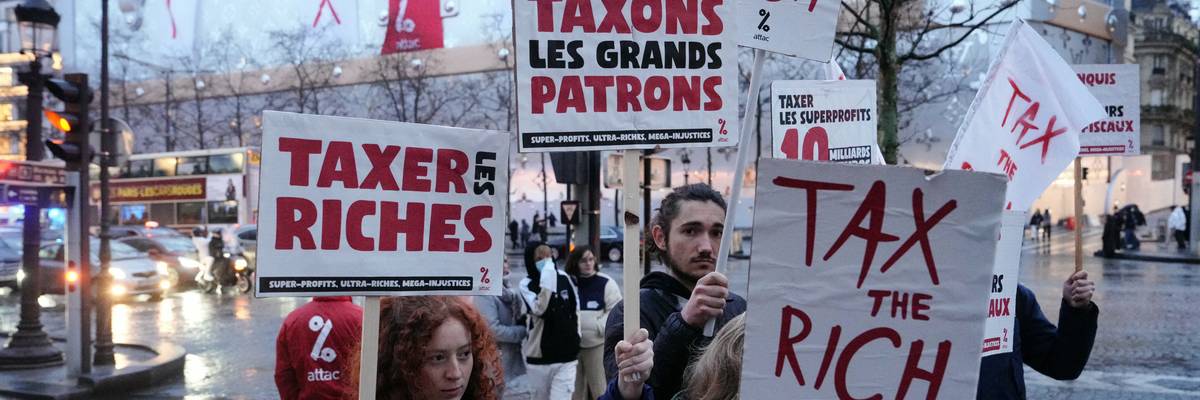
Protesters hold placards reading "Tax the rich" as banners are displayed on the rooftop of the new Louis Vuitton hotel under construction concealed in a Louis Vuitton trunk during an action by Attac France NGO on the Champs Elysees in Paris on February 24, 2024.
World leaders should make clear that international economic cooperation is not just about helping businesses move money across borders; it must also help countries raise the resources needed to serve their people.
For working families, corporate taxes might seem like a distant concern—something for accountants, lobbyists, and politicians in Washington to debate. But corporate taxes are vital to whether our communities can afford healthcare, infrastructure, good schools, and other public services people need to raise healthy families.
A generation ago, nearly a third of federal revenue came from corporate taxes. Today they cover only about 6%. When corporations pay less, the gap doesn’t disappear: It means that ordinary taxpayers have to make up for it—or we get weaker schools, roads, and healthcare, plus even bigger deficits.
Most Americans, across party lines, think big corporations should pay more. So why doesn’t it happen? Because corporations spend heavily on lobbying and campaign contributions, and their favorite talking point is “competitiveness”: Dare to tax us more, and we’ll take our business elsewhere. This threat has helped justify decades of corporate tax cuts.
To help workers adapt, governments need the resources to invest in education and training, and a stronger safety net. Fair corporate taxation is a sensible way to pay for that transition.
But does raising corporate taxes really drive businesses overseas and cost jobs? That’s not what the evidence shows.
Evidence shows that businesses decide where to invest based on many factors, including access to customers, skilled workers, good infrastructure, and the rule of law. And these are precisely the things that taxes pay for. The real reason the US is home to more of the world’s top companies than any other country isn’t low taxes. It’s our large market, productive workforce, and strong institutions.
Economic growth is underpinned by these public goods, but its rewards are distributed very unevenly. The rise of artificial intelligence is a case in point. AI has flourished thanks to public research funding, universities, an educated workforce, and taxpayer subsidies.
Record profits are already concentrated in a handful of tech giants, while workers are getting a smaller slice of the country’s income than ever before. The rise of AI threatens to widen this divide further. Workers may face job losses or lower wages, while a relatively small number of companies and their investors capture the bulk of the gains.
To help workers adapt, governments need the resources to invest in education and training, and a stronger safety net. Fair corporate taxation is a sensible way to pay for that transition.
But AI profits, like those from other digital products and services, can be easy to move on paper: Profits from a service built in California and used by customers in Ohio can be booked in an offshore tax haven.
It’s not just AI. The same pattern runs through pharmaceuticals, energy, and manufacturing, with multinational corporations using complex legal arrangements to book profits in tax havens. The root cause of the problem is that individual countries face pressure to offer tax breaks out of fear that businesses will move elsewhere.
The upshot is a race to the bottom in which corporations escape taxation and public budgets come under pressure. This is why the G20, which brings together the world’s major advanced and emerging economies, must strengthen international cooperation on a meaningful minimum corporate tax—and close loopholes that allow multinational companies to avoid taxes through offshore accounting arrangements.
The G20 should reject the flawed assumption that countries must keep cutting corporate taxes to stay competitive. Instead, world leaders make clear that international economic cooperation is not just about helping businesses move money across borders. It must also help countries raise the resources needed to serve their people.
Working families have a direct stake in the corporate tax debate. A successful economy is not one that is “competitive” but one that works for all. Corporate taxes are how we collectively secure the conditions that make a prosperous economy work for working families.
This country and this world are at a monumental crossroads. US voters have an opportunity to beat back the forces of fascism and confront the billionaires who are rigging the economy, our media system, and our democracy, making it increasingly impossible for ordinary people to get by. We’re not just talking about the election. We’re talking about what must be done once these fascist elements are vanquished from power. We need a bolder set of solutions than what either major party has so far been willing to offer and a working-class movement ready to fight like hell for it. Trump didn't emerge from nowhere. The conditions that fueled MAGA authoritarianism were created by decades of radical neoliberal economic policies and a corrupt political system dominated by corporate interests. They slashed taxes on the super-rich, promising that the benefits would trickle down. They said giveaways to the corporate titans would make life more affordable for the rest of us. It was all bullshit. And when a bitter, betrayed populace searches for someone to blame, right-wing demagogues have little trouble finding scapegoats. People know when they're being lied to, but you won't hear any of this from the corporate media. Only independent journalism—powered and funded by people who believe in building a better world—can deliver truly trustworthy daily news. If you share our vision, please contribute whatever you can to sustain our work. |
For working families, corporate taxes might seem like a distant concern—something for accountants, lobbyists, and politicians in Washington to debate. But corporate taxes are vital to whether our communities can afford healthcare, infrastructure, good schools, and other public services people need to raise healthy families.
A generation ago, nearly a third of federal revenue came from corporate taxes. Today they cover only about 6%. When corporations pay less, the gap doesn’t disappear: It means that ordinary taxpayers have to make up for it—or we get weaker schools, roads, and healthcare, plus even bigger deficits.
Most Americans, across party lines, think big corporations should pay more. So why doesn’t it happen? Because corporations spend heavily on lobbying and campaign contributions, and their favorite talking point is “competitiveness”: Dare to tax us more, and we’ll take our business elsewhere. This threat has helped justify decades of corporate tax cuts.
To help workers adapt, governments need the resources to invest in education and training, and a stronger safety net. Fair corporate taxation is a sensible way to pay for that transition.
But does raising corporate taxes really drive businesses overseas and cost jobs? That’s not what the evidence shows.
Evidence shows that businesses decide where to invest based on many factors, including access to customers, skilled workers, good infrastructure, and the rule of law. And these are precisely the things that taxes pay for. The real reason the US is home to more of the world’s top companies than any other country isn’t low taxes. It’s our large market, productive workforce, and strong institutions.
Economic growth is underpinned by these public goods, but its rewards are distributed very unevenly. The rise of artificial intelligence is a case in point. AI has flourished thanks to public research funding, universities, an educated workforce, and taxpayer subsidies.
Record profits are already concentrated in a handful of tech giants, while workers are getting a smaller slice of the country’s income than ever before. The rise of AI threatens to widen this divide further. Workers may face job losses or lower wages, while a relatively small number of companies and their investors capture the bulk of the gains.
To help workers adapt, governments need the resources to invest in education and training, and a stronger safety net. Fair corporate taxation is a sensible way to pay for that transition.
But AI profits, like those from other digital products and services, can be easy to move on paper: Profits from a service built in California and used by customers in Ohio can be booked in an offshore tax haven.
It’s not just AI. The same pattern runs through pharmaceuticals, energy, and manufacturing, with multinational corporations using complex legal arrangements to book profits in tax havens. The root cause of the problem is that individual countries face pressure to offer tax breaks out of fear that businesses will move elsewhere.
The upshot is a race to the bottom in which corporations escape taxation and public budgets come under pressure. This is why the G20, which brings together the world’s major advanced and emerging economies, must strengthen international cooperation on a meaningful minimum corporate tax—and close loopholes that allow multinational companies to avoid taxes through offshore accounting arrangements.
The G20 should reject the flawed assumption that countries must keep cutting corporate taxes to stay competitive. Instead, world leaders make clear that international economic cooperation is not just about helping businesses move money across borders. It must also help countries raise the resources needed to serve their people.
Working families have a direct stake in the corporate tax debate. A successful economy is not one that is “competitive” but one that works for all. Corporate taxes are how we collectively secure the conditions that make a prosperous economy work for working families.