SUBSCRIBE TO OUR FREE NEWSLETTER
Daily news & progressive opinion—funded by the people, not the corporations—delivered straight to your inbox.
5
#000000
#FFFFFF
To donate by check, phone, or other method, see our More Ways to Give page.

The Trump administration’s sweeping tariffs have harmed the economy by increasing input costs and uncertainty for businesses and raising prices for consumers, placing a particularly heavy burden on people with low and moderate incomes. Now President Donald Trump is floating the idea of replacing income taxes with tariffs—a proposal that could not plausibly make up for lost revenue and would follow the administration’s pattern of showering wealthy households with windfalls at the expense of households with incomes in the bottom half of the income distribution. This plan would raise taxes on people with incomes in the bottom 20% by $4,000 (26% of income) and the middle 20% by $5,300 (8.7% of income), while wealthy households would receive a $337,000 windfall (21% of income), on average.
Instead, policymakers should abandon the administration’s economically harmful and regressive tariffs and pursue more efficient and equitable revenue-raising policies. In particular, raising the corporate tax rate, which mostly taxes profits not inputs, would raise significant revenues and have little impact on overall investment, while the costs would be borne predominantly by wealthy shareholders of large corporations.
Beginning in February 2025, the administration announced and implemented sweeping taxes on imported goods, known as tariffs, justifying them in part on the need to raise revenues. The Supreme Court struck down some of these tariffs, but the administration responded by imposing a new set of replacement tariffs under a different authority. These tariffs are still highly significant: as of March 10, the effective tariff rate was 12% compared with 2.6% in early 2025. Underneath this average rate is a complex and highly variable tariff regime that differs considerably by country and type of product and has been subject to frequent changes over the past year.
Tariffs can play a useful role in trade policy as a way to remedy specific trade issues—such as the need to ensure domestic production of goods related to national security—but are highly flawed as a general revenue source because of the economic distortions they create and the burden they place on families with low and moderate incomes. To a much greater extent than other types of taxes, tariffs distort, or alter, households’ and businesses’ decisions about purchasing, investment, and savings in ways that can make them worse off. For example, high tariffs on imported steel encourage US companies to ramp up steel production instead of investing capital and labor into other sectors that might, absent the tariff, generate higher returns.
If tariffs are expanded to replace all or a substantial share of the federal income tax, most households, and especially those with the lowest incomes, would face a massive tax increase, while wealthy households would be substantially better off.
Tariffs can harm the domestic economy in other ways. By raising the price of imported business inputs (that is, goods that are used to make other goods, such as steel used in automobiles and buildings, including apartment buildings), goods manufactured in the US are often more expensive because of tariffs. Even producers of purely domestic goods may increase prices because of reduced competition from tariffed foreign goods. Moreover, the tariffs’ chaotic and haphazard implementation over the past year has created an uncertain environment that is harmful to businesses trying to decide when, whether, or where to invest.
Other countries may also impose their own tariffs on US products (or otherwise retaliate), which can reduce US exports and harm domestic markets, as happened when China paused purchases of US soybeans last year.
Tariffs are regressive because they place a heavier burden on households with low and moderate incomes than on high-income households compared to other taxes. If made permanent, the current tariffs would reduce after-tax incomes of households with incomes in the bottom 10% of the income distribution by about 1.4%, compared with 0.4% for households with incomes in the top 10%, according to Yale Budget Lab. For households struggling to afford to meet their basic needs, this tariff-driven income reduction could have serious consequences: Yale estimates that the administration’s tariffs last year would lead to hundreds of thousands more people living in poverty, with millions more seeing their incomes fall further below the poverty line. Higher tariffs would increase poverty more severely.
Economists generally agree that tariffs are a regressive tax, while federal income taxes are progressive. For example, tariffs are imposed on goods at a flat rate meaning that everyone purchasing those goods pays the same rate regardless of income, instead of a progressive rate structure that ensures high-income households pay higher rates than households with lower incomes.
For this reason, if tariffs are expanded to replace all or a substantial share of the federal income tax, most households, and especially those with the lowest incomes, would face a massive tax increase, while wealthy households would be substantially better off.
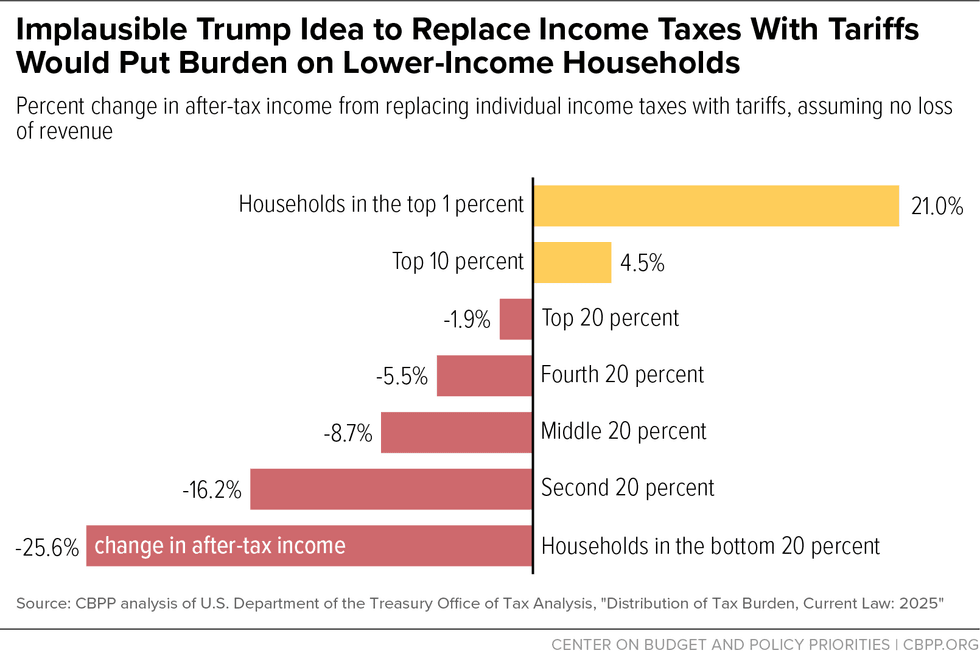
Importantly, this calculation ignores the fact that it would be impossible for tariffs to generate enough revenue to replace the income tax: The personal income tax alone generates $2.4 trillion in annual revenue while estimates suggest tariffs could realistically raise a maximum of only about $500 billion.
Increasing revenues by raising the corporate income tax rate would be a far better approach than the president’s harmful tariff scheme. Raising the corporate tax rate—which Republicans slashed in 2017—would raise substantial revenue in a progressive and efficient manner.
While tariffs are a tax on imported goods, including business inputs, the corporate income tax is a tax on corporations’ profits, or their net income after deducting expenses. Notably, a substantial (and growing) share of the corporate tax base consists of so-called “excess profits”—that is, profits above what a firm needs to justify an investment. Taxing those profits is efficient because it would not deter the firm from making break-even investments because they would remain profitable. A study by tax scholar Edward Fox estimated that as much as 96% of the corporate tax fell on excess profits from 1995 to 2013.
More of the corporate tax is falling on excess returns because the amount of those excess profits is rising, in part, due to declining competition and increasing concentration among corporations, which give businesses “market power” that allows them to raise their prices well above their costs. Another reason is that changes in tax policy have effectively exempted more of firms’ normal return on investments from taxation, meaning the corporate tax has applied more to excess profits. For example, the 2017 tax law allowed firms to immediately deduct the full cost of equipment purchases rather than deduct those costs gradually as the value of the investment declines—a change last year’s Republican megabill both made permanent and expanded.
Given the nation’s need for more revenues, policymakers should embrace sound, progressive policies like raising the corporate tax rate.
Some may argue that higher corporate taxes would simply be passed on to consumers through higher prices, but the corporate tax—as a tax on profits—allows businesses to deduct and exempt from taxation key input costs, especially labor. This means that it generally does not have a direct impact on firms’ pricing decisions. The traditional economic concern about raising corporate taxes is not that they raise prices, but that they can reduce investment and thus affect productivity and workers’ wages. Yet, because they often (and increasingly) fall on excess profits, they are less likely to reduce investment and are a relatively efficient source of revenue.
Raising the corporate tax rate would also make the tax system more progressive. Both conventional scoring authorities and outside experts (e.g., the Joint Committee on Taxation, Congressional Budget Office, Department of the Treasury, and the nonpartisan Tax Policy Center) agree that the corporate tax is predominately paid by shareholders and the owners of capital income. The ownership of corporate shares—as with other kinds of wealth—is highly concentrated among households with high net worth; households with net worth in the bottom 50% hold just 1% of equities. Because white households are overrepresented among the wealthy while households of color are overrepresented at the lower end of the wealth distribution due to racial barriers to economic opportunity, raising the corporate tax rate can also help reduce racial wealth inequality.
Evidence from the 2017 tax law supports the view that corporate tax cuts primarily benefit high-income households—and, inversely, that corporate tax increases would fall on those same households. The law cut the corporate tax rate dramatically from 35% to 21%, with people at the top of the income distribution receiving the vast majority of the resulting gain. One study found that people with incomes in the top 10% of the income distribution received 80% of the 2017 law’s corporate tax cuts benefit.
Moreover, raising the corporate tax rate has the potential to raise significant revenues; raising it to 28%—halfway between the current rate and the pre-2017 tax rate—would raise around $1 trillion over 10 years—enough to replace about two-thirds of the current tariffs.
Given the nation’s need for more revenues, policymakers should embrace sound, progressive policies like raising the corporate tax rate, while abandoning harmful tariffs and resoundingly rejecting the president’s disastrous proposal to replace income taxes with massive tariffs.
The Trump administration’s sweeping tariffs have harmed the economy by increasing input costs and uncertainty for businesses and raising prices for consumers, placing a particularly heavy burden on people with low and moderate incomes. Now President Donald Trump is floating the idea of replacing income taxes with tariffs—a proposal that could not plausibly make up for lost revenue and would follow the administration’s pattern of showering wealthy households with windfalls at the expense of households with incomes in the bottom half of the income distribution. This plan would raise taxes on people with incomes in the bottom 20% by $4,000 (26% of income) and the middle 20% by $5,300 (8.7% of income), while wealthy households would receive a $337,000 windfall (21% of income), on average.
Instead, policymakers should abandon the administration’s economically harmful and regressive tariffs and pursue more efficient and equitable revenue-raising policies. In particular, raising the corporate tax rate, which mostly taxes profits not inputs, would raise significant revenues and have little impact on overall investment, while the costs would be borne predominantly by wealthy shareholders of large corporations.
Beginning in February 2025, the administration announced and implemented sweeping taxes on imported goods, known as tariffs, justifying them in part on the need to raise revenues. The Supreme Court struck down some of these tariffs, but the administration responded by imposing a new set of replacement tariffs under a different authority. These tariffs are still highly significant: as of March 10, the effective tariff rate was 12% compared with 2.6% in early 2025. Underneath this average rate is a complex and highly variable tariff regime that differs considerably by country and type of product and has been subject to frequent changes over the past year.
Tariffs can play a useful role in trade policy as a way to remedy specific trade issues—such as the need to ensure domestic production of goods related to national security—but are highly flawed as a general revenue source because of the economic distortions they create and the burden they place on families with low and moderate incomes. To a much greater extent than other types of taxes, tariffs distort, or alter, households’ and businesses’ decisions about purchasing, investment, and savings in ways that can make them worse off. For example, high tariffs on imported steel encourage US companies to ramp up steel production instead of investing capital and labor into other sectors that might, absent the tariff, generate higher returns.
If tariffs are expanded to replace all or a substantial share of the federal income tax, most households, and especially those with the lowest incomes, would face a massive tax increase, while wealthy households would be substantially better off.
Tariffs can harm the domestic economy in other ways. By raising the price of imported business inputs (that is, goods that are used to make other goods, such as steel used in automobiles and buildings, including apartment buildings), goods manufactured in the US are often more expensive because of tariffs. Even producers of purely domestic goods may increase prices because of reduced competition from tariffed foreign goods. Moreover, the tariffs’ chaotic and haphazard implementation over the past year has created an uncertain environment that is harmful to businesses trying to decide when, whether, or where to invest.
Other countries may also impose their own tariffs on US products (or otherwise retaliate), which can reduce US exports and harm domestic markets, as happened when China paused purchases of US soybeans last year.
Tariffs are regressive because they place a heavier burden on households with low and moderate incomes than on high-income households compared to other taxes. If made permanent, the current tariffs would reduce after-tax incomes of households with incomes in the bottom 10% of the income distribution by about 1.4%, compared with 0.4% for households with incomes in the top 10%, according to Yale Budget Lab. For households struggling to afford to meet their basic needs, this tariff-driven income reduction could have serious consequences: Yale estimates that the administration’s tariffs last year would lead to hundreds of thousands more people living in poverty, with millions more seeing their incomes fall further below the poverty line. Higher tariffs would increase poverty more severely.
Economists generally agree that tariffs are a regressive tax, while federal income taxes are progressive. For example, tariffs are imposed on goods at a flat rate meaning that everyone purchasing those goods pays the same rate regardless of income, instead of a progressive rate structure that ensures high-income households pay higher rates than households with lower incomes.
For this reason, if tariffs are expanded to replace all or a substantial share of the federal income tax, most households, and especially those with the lowest incomes, would face a massive tax increase, while wealthy households would be substantially better off.
Importantly, this calculation ignores the fact that it would be impossible for tariffs to generate enough revenue to replace the income tax: The personal income tax alone generates $2.4 trillion in annual revenue while estimates suggest tariffs could realistically raise a maximum of only about $500 billion.
Increasing revenues by raising the corporate income tax rate would be a far better approach than the president’s harmful tariff scheme. Raising the corporate tax rate—which Republicans slashed in 2017—would raise substantial revenue in a progressive and efficient manner.
While tariffs are a tax on imported goods, including business inputs, the corporate income tax is a tax on corporations’ profits, or their net income after deducting expenses. Notably, a substantial (and growing) share of the corporate tax base consists of so-called “excess profits”—that is, profits above what a firm needs to justify an investment. Taxing those profits is efficient because it would not deter the firm from making break-even investments because they would remain profitable. A study by tax scholar Edward Fox estimated that as much as 96% of the corporate tax fell on excess profits from 1995 to 2013.
More of the corporate tax is falling on excess returns because the amount of those excess profits is rising, in part, due to declining competition and increasing concentration among corporations, which give businesses “market power” that allows them to raise their prices well above their costs. Another reason is that changes in tax policy have effectively exempted more of firms’ normal return on investments from taxation, meaning the corporate tax has applied more to excess profits. For example, the 2017 tax law allowed firms to immediately deduct the full cost of equipment purchases rather than deduct those costs gradually as the value of the investment declines—a change last year’s Republican megabill both made permanent and expanded.
Given the nation’s need for more revenues, policymakers should embrace sound, progressive policies like raising the corporate tax rate.
Some may argue that higher corporate taxes would simply be passed on to consumers through higher prices, but the corporate tax—as a tax on profits—allows businesses to deduct and exempt from taxation key input costs, especially labor. This means that it generally does not have a direct impact on firms’ pricing decisions. The traditional economic concern about raising corporate taxes is not that they raise prices, but that they can reduce investment and thus affect productivity and workers’ wages. Yet, because they often (and increasingly) fall on excess profits, they are less likely to reduce investment and are a relatively efficient source of revenue.
Raising the corporate tax rate would also make the tax system more progressive. Both conventional scoring authorities and outside experts (e.g., the Joint Committee on Taxation, Congressional Budget Office, Department of the Treasury, and the nonpartisan Tax Policy Center) agree that the corporate tax is predominately paid by shareholders and the owners of capital income. The ownership of corporate shares—as with other kinds of wealth—is highly concentrated among households with high net worth; households with net worth in the bottom 50% hold just 1% of equities. Because white households are overrepresented among the wealthy while households of color are overrepresented at the lower end of the wealth distribution due to racial barriers to economic opportunity, raising the corporate tax rate can also help reduce racial wealth inequality.
Evidence from the 2017 tax law supports the view that corporate tax cuts primarily benefit high-income households—and, inversely, that corporate tax increases would fall on those same households. The law cut the corporate tax rate dramatically from 35% to 21%, with people at the top of the income distribution receiving the vast majority of the resulting gain. One study found that people with incomes in the top 10% of the income distribution received 80% of the 2017 law’s corporate tax cuts benefit.
Moreover, raising the corporate tax rate has the potential to raise significant revenues; raising it to 28%—halfway between the current rate and the pre-2017 tax rate—would raise around $1 trillion over 10 years—enough to replace about two-thirds of the current tariffs.
Given the nation’s need for more revenues, policymakers should embrace sound, progressive policies like raising the corporate tax rate, while abandoning harmful tariffs and resoundingly rejecting the president’s disastrous proposal to replace income taxes with massive tariffs.
The Trump administration’s sweeping tariffs have harmed the economy by increasing input costs and uncertainty for businesses and raising prices for consumers, placing a particularly heavy burden on people with low and moderate incomes. Now President Donald Trump is floating the idea of replacing income taxes with tariffs—a proposal that could not plausibly make up for lost revenue and would follow the administration’s pattern of showering wealthy households with windfalls at the expense of households with incomes in the bottom half of the income distribution. This plan would raise taxes on people with incomes in the bottom 20% by $4,000 (26% of income) and the middle 20% by $5,300 (8.7% of income), while wealthy households would receive a $337,000 windfall (21% of income), on average.
Instead, policymakers should abandon the administration’s economically harmful and regressive tariffs and pursue more efficient and equitable revenue-raising policies. In particular, raising the corporate tax rate, which mostly taxes profits not inputs, would raise significant revenues and have little impact on overall investment, while the costs would be borne predominantly by wealthy shareholders of large corporations.
Beginning in February 2025, the administration announced and implemented sweeping taxes on imported goods, known as tariffs, justifying them in part on the need to raise revenues. The Supreme Court struck down some of these tariffs, but the administration responded by imposing a new set of replacement tariffs under a different authority. These tariffs are still highly significant: as of March 10, the effective tariff rate was 12% compared with 2.6% in early 2025. Underneath this average rate is a complex and highly variable tariff regime that differs considerably by country and type of product and has been subject to frequent changes over the past year.
Tariffs can play a useful role in trade policy as a way to remedy specific trade issues—such as the need to ensure domestic production of goods related to national security—but are highly flawed as a general revenue source because of the economic distortions they create and the burden they place on families with low and moderate incomes. To a much greater extent than other types of taxes, tariffs distort, or alter, households’ and businesses’ decisions about purchasing, investment, and savings in ways that can make them worse off. For example, high tariffs on imported steel encourage US companies to ramp up steel production instead of investing capital and labor into other sectors that might, absent the tariff, generate higher returns.
If tariffs are expanded to replace all or a substantial share of the federal income tax, most households, and especially those with the lowest incomes, would face a massive tax increase, while wealthy households would be substantially better off.
Tariffs can harm the domestic economy in other ways. By raising the price of imported business inputs (that is, goods that are used to make other goods, such as steel used in automobiles and buildings, including apartment buildings), goods manufactured in the US are often more expensive because of tariffs. Even producers of purely domestic goods may increase prices because of reduced competition from tariffed foreign goods. Moreover, the tariffs’ chaotic and haphazard implementation over the past year has created an uncertain environment that is harmful to businesses trying to decide when, whether, or where to invest.
Other countries may also impose their own tariffs on US products (or otherwise retaliate), which can reduce US exports and harm domestic markets, as happened when China paused purchases of US soybeans last year.
Tariffs are regressive because they place a heavier burden on households with low and moderate incomes than on high-income households compared to other taxes. If made permanent, the current tariffs would reduce after-tax incomes of households with incomes in the bottom 10% of the income distribution by about 1.4%, compared with 0.4% for households with incomes in the top 10%, according to Yale Budget Lab. For households struggling to afford to meet their basic needs, this tariff-driven income reduction could have serious consequences: Yale estimates that the administration’s tariffs last year would lead to hundreds of thousands more people living in poverty, with millions more seeing their incomes fall further below the poverty line. Higher tariffs would increase poverty more severely.
Economists generally agree that tariffs are a regressive tax, while federal income taxes are progressive. For example, tariffs are imposed on goods at a flat rate meaning that everyone purchasing those goods pays the same rate regardless of income, instead of a progressive rate structure that ensures high-income households pay higher rates than households with lower incomes.
For this reason, if tariffs are expanded to replace all or a substantial share of the federal income tax, most households, and especially those with the lowest incomes, would face a massive tax increase, while wealthy households would be substantially better off.
Importantly, this calculation ignores the fact that it would be impossible for tariffs to generate enough revenue to replace the income tax: The personal income tax alone generates $2.4 trillion in annual revenue while estimates suggest tariffs could realistically raise a maximum of only about $500 billion.
Increasing revenues by raising the corporate income tax rate would be a far better approach than the president’s harmful tariff scheme. Raising the corporate tax rate—which Republicans slashed in 2017—would raise substantial revenue in a progressive and efficient manner.
While tariffs are a tax on imported goods, including business inputs, the corporate income tax is a tax on corporations’ profits, or their net income after deducting expenses. Notably, a substantial (and growing) share of the corporate tax base consists of so-called “excess profits”—that is, profits above what a firm needs to justify an investment. Taxing those profits is efficient because it would not deter the firm from making break-even investments because they would remain profitable. A study by tax scholar Edward Fox estimated that as much as 96% of the corporate tax fell on excess profits from 1995 to 2013.
More of the corporate tax is falling on excess returns because the amount of those excess profits is rising, in part, due to declining competition and increasing concentration among corporations, which give businesses “market power” that allows them to raise their prices well above their costs. Another reason is that changes in tax policy have effectively exempted more of firms’ normal return on investments from taxation, meaning the corporate tax has applied more to excess profits. For example, the 2017 tax law allowed firms to immediately deduct the full cost of equipment purchases rather than deduct those costs gradually as the value of the investment declines—a change last year’s Republican megabill both made permanent and expanded.
Given the nation’s need for more revenues, policymakers should embrace sound, progressive policies like raising the corporate tax rate.
Some may argue that higher corporate taxes would simply be passed on to consumers through higher prices, but the corporate tax—as a tax on profits—allows businesses to deduct and exempt from taxation key input costs, especially labor. This means that it generally does not have a direct impact on firms’ pricing decisions. The traditional economic concern about raising corporate taxes is not that they raise prices, but that they can reduce investment and thus affect productivity and workers’ wages. Yet, because they often (and increasingly) fall on excess profits, they are less likely to reduce investment and are a relatively efficient source of revenue.
Raising the corporate tax rate would also make the tax system more progressive. Both conventional scoring authorities and outside experts (e.g., the Joint Committee on Taxation, Congressional Budget Office, Department of the Treasury, and the nonpartisan Tax Policy Center) agree that the corporate tax is predominately paid by shareholders and the owners of capital income. The ownership of corporate shares—as with other kinds of wealth—is highly concentrated among households with high net worth; households with net worth in the bottom 50% hold just 1% of equities. Because white households are overrepresented among the wealthy while households of color are overrepresented at the lower end of the wealth distribution due to racial barriers to economic opportunity, raising the corporate tax rate can also help reduce racial wealth inequality.
Evidence from the 2017 tax law supports the view that corporate tax cuts primarily benefit high-income households—and, inversely, that corporate tax increases would fall on those same households. The law cut the corporate tax rate dramatically from 35% to 21%, with people at the top of the income distribution receiving the vast majority of the resulting gain. One study found that people with incomes in the top 10% of the income distribution received 80% of the 2017 law’s corporate tax cuts benefit.
Moreover, raising the corporate tax rate has the potential to raise significant revenues; raising it to 28%—halfway between the current rate and the pre-2017 tax rate—would raise around $1 trillion over 10 years—enough to replace about two-thirds of the current tariffs.
Given the nation’s need for more revenues, policymakers should embrace sound, progressive policies like raising the corporate tax rate, while abandoning harmful tariffs and resoundingly rejecting the president’s disastrous proposal to replace income taxes with massive tariffs.