SUBSCRIBE TO OUR FREE NEWSLETTER
Daily news & progressive opinion—funded by the people, not the corporations—delivered straight to your inbox.
5
#000000
#FFFFFF
To donate by check, phone, or other method, see our More Ways to Give page.
Daily news & progressive opinion—funded by the people, not the corporations—delivered straight to your inbox.
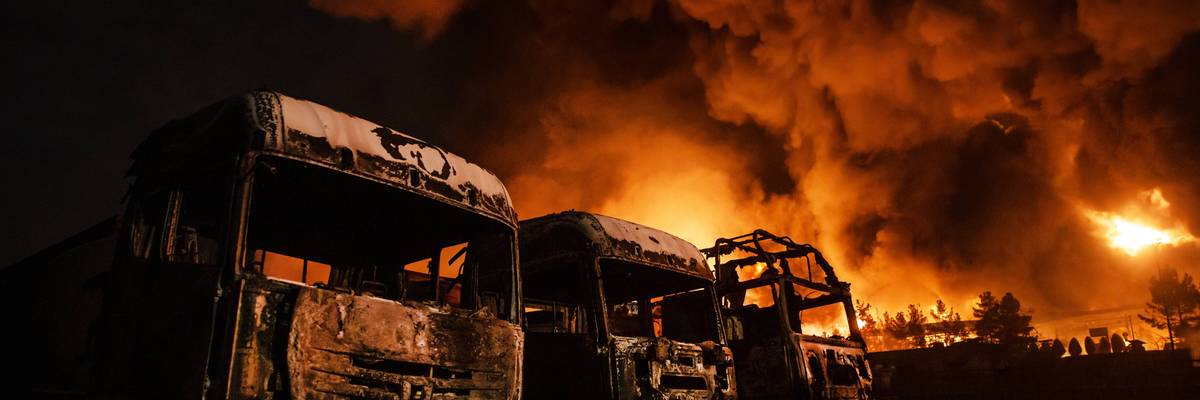
Fire breaks out at the Shahran oil depot after US and Israeli attacks, leaving numerous fuel tankers and vehicles in the area unusable in Tehran, Iran on March 8, 2026.
Reinvesting just 15% of global military spending, roughly $387 billion, would be more than enough to cover the annual costs of climate adaptation in developing countries. The money exists. The will does not.
Last week, the British government quietly informed the United Nation's Green Climate Fund that it would halve the contribution it pledged just two years ago, not because the climate crisis has eased, but because it is spending more on weapons. The move was framed as a "hugely difficult decision," not ideological, and necessary to deliver what United Kingdom Foreign Minister Yvette Cooper called "the biggest increase in defence spending since the Cold War." The planet, apparently, can wait.
It cannot.
The UK's retreat from climate finance is not some isolated budget decision. It is part of a choice being made across the Global North: to rearm, to retreat from development commitments, and to leave the countries least responsible for the climate crisis to deal with its worst consequences on their own.
Global military expenditure reached $2.887 trillion in 2025, pushing the global military burden to 2.5% of GDP, its highest level since 2009. Europe's alone surged 14% to $864 billion, the highest level ever recorded for the continent. Meanwhile, the UN's own analysis found that reinvesting just 15% of global military spending, roughly $387 billion, would be more than enough to cover the annual costs of climate adaptation in developing countries. The money exists. The will does not.
More conflict and more military spending will only deepen the crisis and make millions more people vulnerable to it.
The UK's Green Climate Fund cut does not happen in a vacuum; the US has refused to deliver any further money to the GCF under President Donald Trump and has also given up its seat on the fund's board. According to the Organisation for Economic Co-operation and Development, international development assistance fell by 23.1% in 2025, the steepest annual decline on record, with the United States slashing its aid budget by 57%, Germany by 17%, and France and the UK by 11% each.
The countries that industrialized on the back of fossil fuels, with the highest historical emissions and the highest per capita carbon footprints, are the ones least bothered by any of this.
And yet for the Global South, the signal being sent today is unmistakable: The nations least responsible for the climate catastrophe bearing down on them will have to bear its consequences largely alone, watching the world burn while the architects of that burning pivot to missiles and military budgets. The prospect of just and equitable climate finance from the developed world is beginning to look not merely uncertain, but futile.
The same wars that are killing climate finance are generating record profits elsewhere. Oil and gas companies' profits are soaring as the Iran conflict continues. Chevron, Shell, BP, ConocoPhillips, Exxon, and TotalEnergies are projected to make $2,967 a second in profits in 2026, nearly $37 million more per day than in 2025, with total projected profits across the six companies reaching approximately $94 billion for the year. None of that windfall is going toward the energy transition. BP has slashed planned investment in renewable energy and increased oil and gas spending, Shell has watered down its 2030 climate targets, ExxonMobil has cut its planned low-carbon investment by a third, and TotalEnergies has declined to adopt a transition plan aligned with 1.5°C of warming.
If a handful of fossil fuel corporations are posting billions in profits in a single year, profits made possible by geopolitical instability, then holding them liable through regulation and taxation is not radical but logical. Windfall profit taxes on fossil fuel companies, long discussed and rarely enacted, could generate precisely the kind of revenue that developed governments claim they no longer have for climate finance.
A February 2026 report by Climate Action Network Europe shows the framework already exists, recommending a differentiated corporate tax on fossil fuel profits with revenues recycled directly into the energy transition and international climate finance. Oxfam makes the same case, calling for a Rich Polluter Profit Tax and an equity-based road map that reflects the historical responsibility and financial capacity of different states. The United States and Europe built their wealth on fossil fuels. Many countries in the Global South remain dependent on them not by choice, but by circumstance. Demanding they exit on the same timeline is neither fair nor realistic.
The tools and the arguments exist. What is missing is political will, and the Global South cannot afford to keep waiting for it. The path forward lies in demanding structural reform of the international tax regime that allows fossil fuel super profits and billionaire fortunes to escape accountability; of the debt architecture that forces climate-vulnerable nations to choose between servicing loans and financing adaptation; and of the COP process itself, which has too long allowed wealthy nations to treat climate finance pledges as suggestions rather than obligations.
So, while the world heats up and vulnerable countries face worsening heatwaves, floods, and disasters, while thousands lose lives and livelihoods, one thing is becoming painfully certain: More conflict and more military spending will only deepen the crisis and make millions more people vulnerable to it. The Global South did not start these wars. It should not be made to pay for them, not with its people, its economies, or its climate.
Dear Common Dreams reader, It’s been nearly 30 years since I co-founded Common Dreams with my late wife, Lina Newhouser. We had the radical notion that journalism should serve the public good, not corporate profits. It was clear to us from the outset what it would take to build such a project. No paid advertisements. No corporate sponsors. No millionaire publisher telling us what to think or do. Many people said we wouldn't last a year, but we proved those doubters wrong. Together with a tremendous team of journalists and dedicated staff, we built an independent media outlet free from the constraints of profits and corporate control. Our mission has always been simple: To inform. To inspire. To ignite change for the common good. Building Common Dreams was not easy. Our survival was never guaranteed. When you take on the most powerful forces—Wall Street greed, fossil fuel industry destruction, Big Tech lobbyists, and uber-rich oligarchs who have spent billions upon billions rigging the economy and democracy in their favor—the only bulwark you have is supporters who believe in your work. But here’s the urgent message from me today. It's never been this bad out there. And it's never been this hard to keep us going. At the very moment Common Dreams is most needed, the threats we face are intensifying. We need your support now more than ever. We don't accept corporate advertising and never will. We don't have a paywall because we don't think people should be blocked from critical news based on their ability to pay. Everything we do is funded by the donations of readers like you. When everyone does the little they can afford, we are strong. But if that support retreats or dries up, so do we. Will you donate now to make sure Common Dreams not only survives but thrives? —Craig Brown, Co-founder |
Last week, the British government quietly informed the United Nation's Green Climate Fund that it would halve the contribution it pledged just two years ago, not because the climate crisis has eased, but because it is spending more on weapons. The move was framed as a "hugely difficult decision," not ideological, and necessary to deliver what United Kingdom Foreign Minister Yvette Cooper called "the biggest increase in defence spending since the Cold War." The planet, apparently, can wait.
It cannot.
The UK's retreat from climate finance is not some isolated budget decision. It is part of a choice being made across the Global North: to rearm, to retreat from development commitments, and to leave the countries least responsible for the climate crisis to deal with its worst consequences on their own.
Global military expenditure reached $2.887 trillion in 2025, pushing the global military burden to 2.5% of GDP, its highest level since 2009. Europe's alone surged 14% to $864 billion, the highest level ever recorded for the continent. Meanwhile, the UN's own analysis found that reinvesting just 15% of global military spending, roughly $387 billion, would be more than enough to cover the annual costs of climate adaptation in developing countries. The money exists. The will does not.
More conflict and more military spending will only deepen the crisis and make millions more people vulnerable to it.
The UK's Green Climate Fund cut does not happen in a vacuum; the US has refused to deliver any further money to the GCF under President Donald Trump and has also given up its seat on the fund's board. According to the Organisation for Economic Co-operation and Development, international development assistance fell by 23.1% in 2025, the steepest annual decline on record, with the United States slashing its aid budget by 57%, Germany by 17%, and France and the UK by 11% each.
The countries that industrialized on the back of fossil fuels, with the highest historical emissions and the highest per capita carbon footprints, are the ones least bothered by any of this.
And yet for the Global South, the signal being sent today is unmistakable: The nations least responsible for the climate catastrophe bearing down on them will have to bear its consequences largely alone, watching the world burn while the architects of that burning pivot to missiles and military budgets. The prospect of just and equitable climate finance from the developed world is beginning to look not merely uncertain, but futile.
The same wars that are killing climate finance are generating record profits elsewhere. Oil and gas companies' profits are soaring as the Iran conflict continues. Chevron, Shell, BP, ConocoPhillips, Exxon, and TotalEnergies are projected to make $2,967 a second in profits in 2026, nearly $37 million more per day than in 2025, with total projected profits across the six companies reaching approximately $94 billion for the year. None of that windfall is going toward the energy transition. BP has slashed planned investment in renewable energy and increased oil and gas spending, Shell has watered down its 2030 climate targets, ExxonMobil has cut its planned low-carbon investment by a third, and TotalEnergies has declined to adopt a transition plan aligned with 1.5°C of warming.
If a handful of fossil fuel corporations are posting billions in profits in a single year, profits made possible by geopolitical instability, then holding them liable through regulation and taxation is not radical but logical. Windfall profit taxes on fossil fuel companies, long discussed and rarely enacted, could generate precisely the kind of revenue that developed governments claim they no longer have for climate finance.
A February 2026 report by Climate Action Network Europe shows the framework already exists, recommending a differentiated corporate tax on fossil fuel profits with revenues recycled directly into the energy transition and international climate finance. Oxfam makes the same case, calling for a Rich Polluter Profit Tax and an equity-based road map that reflects the historical responsibility and financial capacity of different states. The United States and Europe built their wealth on fossil fuels. Many countries in the Global South remain dependent on them not by choice, but by circumstance. Demanding they exit on the same timeline is neither fair nor realistic.
The tools and the arguments exist. What is missing is political will, and the Global South cannot afford to keep waiting for it. The path forward lies in demanding structural reform of the international tax regime that allows fossil fuel super profits and billionaire fortunes to escape accountability; of the debt architecture that forces climate-vulnerable nations to choose between servicing loans and financing adaptation; and of the COP process itself, which has too long allowed wealthy nations to treat climate finance pledges as suggestions rather than obligations.
So, while the world heats up and vulnerable countries face worsening heatwaves, floods, and disasters, while thousands lose lives and livelihoods, one thing is becoming painfully certain: More conflict and more military spending will only deepen the crisis and make millions more people vulnerable to it. The Global South did not start these wars. It should not be made to pay for them, not with its people, its economies, or its climate.
Last week, the British government quietly informed the United Nation's Green Climate Fund that it would halve the contribution it pledged just two years ago, not because the climate crisis has eased, but because it is spending more on weapons. The move was framed as a "hugely difficult decision," not ideological, and necessary to deliver what United Kingdom Foreign Minister Yvette Cooper called "the biggest increase in defence spending since the Cold War." The planet, apparently, can wait.
It cannot.
The UK's retreat from climate finance is not some isolated budget decision. It is part of a choice being made across the Global North: to rearm, to retreat from development commitments, and to leave the countries least responsible for the climate crisis to deal with its worst consequences on their own.
Global military expenditure reached $2.887 trillion in 2025, pushing the global military burden to 2.5% of GDP, its highest level since 2009. Europe's alone surged 14% to $864 billion, the highest level ever recorded for the continent. Meanwhile, the UN's own analysis found that reinvesting just 15% of global military spending, roughly $387 billion, would be more than enough to cover the annual costs of climate adaptation in developing countries. The money exists. The will does not.
More conflict and more military spending will only deepen the crisis and make millions more people vulnerable to it.
The UK's Green Climate Fund cut does not happen in a vacuum; the US has refused to deliver any further money to the GCF under President Donald Trump and has also given up its seat on the fund's board. According to the Organisation for Economic Co-operation and Development, international development assistance fell by 23.1% in 2025, the steepest annual decline on record, with the United States slashing its aid budget by 57%, Germany by 17%, and France and the UK by 11% each.
The countries that industrialized on the back of fossil fuels, with the highest historical emissions and the highest per capita carbon footprints, are the ones least bothered by any of this.
And yet for the Global South, the signal being sent today is unmistakable: The nations least responsible for the climate catastrophe bearing down on them will have to bear its consequences largely alone, watching the world burn while the architects of that burning pivot to missiles and military budgets. The prospect of just and equitable climate finance from the developed world is beginning to look not merely uncertain, but futile.
The same wars that are killing climate finance are generating record profits elsewhere. Oil and gas companies' profits are soaring as the Iran conflict continues. Chevron, Shell, BP, ConocoPhillips, Exxon, and TotalEnergies are projected to make $2,967 a second in profits in 2026, nearly $37 million more per day than in 2025, with total projected profits across the six companies reaching approximately $94 billion for the year. None of that windfall is going toward the energy transition. BP has slashed planned investment in renewable energy and increased oil and gas spending, Shell has watered down its 2030 climate targets, ExxonMobil has cut its planned low-carbon investment by a third, and TotalEnergies has declined to adopt a transition plan aligned with 1.5°C of warming.
If a handful of fossil fuel corporations are posting billions in profits in a single year, profits made possible by geopolitical instability, then holding them liable through regulation and taxation is not radical but logical. Windfall profit taxes on fossil fuel companies, long discussed and rarely enacted, could generate precisely the kind of revenue that developed governments claim they no longer have for climate finance.
A February 2026 report by Climate Action Network Europe shows the framework already exists, recommending a differentiated corporate tax on fossil fuel profits with revenues recycled directly into the energy transition and international climate finance. Oxfam makes the same case, calling for a Rich Polluter Profit Tax and an equity-based road map that reflects the historical responsibility and financial capacity of different states. The United States and Europe built their wealth on fossil fuels. Many countries in the Global South remain dependent on them not by choice, but by circumstance. Demanding they exit on the same timeline is neither fair nor realistic.
The tools and the arguments exist. What is missing is political will, and the Global South cannot afford to keep waiting for it. The path forward lies in demanding structural reform of the international tax regime that allows fossil fuel super profits and billionaire fortunes to escape accountability; of the debt architecture that forces climate-vulnerable nations to choose between servicing loans and financing adaptation; and of the COP process itself, which has too long allowed wealthy nations to treat climate finance pledges as suggestions rather than obligations.
So, while the world heats up and vulnerable countries face worsening heatwaves, floods, and disasters, while thousands lose lives and livelihoods, one thing is becoming painfully certain: More conflict and more military spending will only deepen the crisis and make millions more people vulnerable to it. The Global South did not start these wars. It should not be made to pay for them, not with its people, its economies, or its climate.