5
#000000
#FFFFFF
To donate by check, phone, or other method, see our More Ways to Give page.
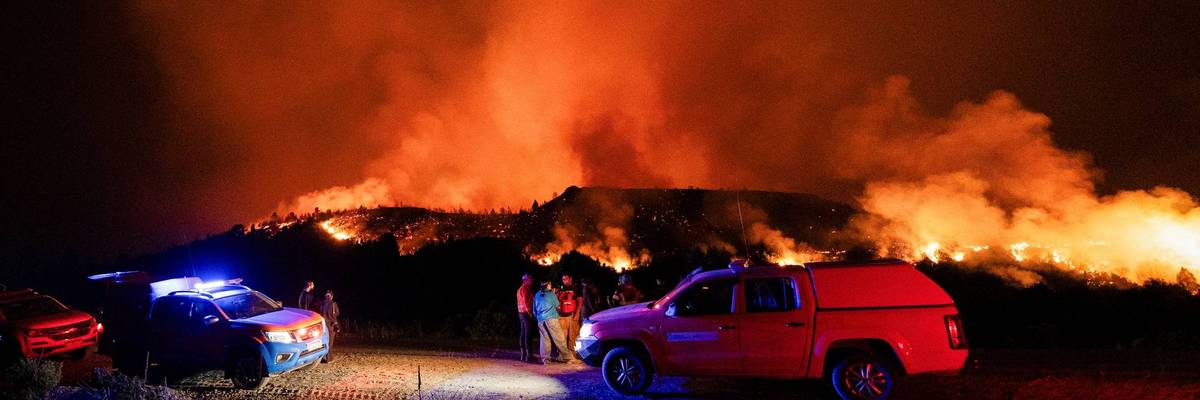
Every once in a while I have to snap out of the hypnotic grip of the bizarre news cycle and remind myself—and you—that there’s something even more important underway than the obvious mental and moral decline of the president: the relentless rise in the temperature of the planet. So here’s my latest occasional update from the physical world, and I fear the news is not good.
Let’s begin with the immediate past, and stay close to home, because the US has been the center of some of the most extreme meteorological action on planet Earth recently. Consider our winter: Though it was chilly in the Northeast, if you averaged the temperature across the lower 48 it was the second-hottest winter on record. That's because nine states had their hottest winter ever and five their second hottest. As Andrea Thompson pointed out in Scientific American: “Nowhere in the US had a record cold winter this year. Nowhere even came close.”
That winter, by the way, was December, January, and February—what we call “meteorological winter” because it coincides with the coldest quarter of the year. It was outrageously hot and very dry, with severely shrunken snowpacks across the mountains of the West, which made Westerners nervous about the chances for wildfire as the summer wore on.
And then came March.
The havoc unleashed by a super El Niño will coincide with the havoc unleashed by President Donald Trump in the Gulf to produce a perfect storm of support for rapid action on getting off fossil fuels.
March was the single craziest month in US weather history. Here’s how Seth Borenstein put it in the lede of his account for The Associated Press:
March’s persistent unseasonable heat was so intense that the continental United States registered its most abnormally hot month in 132 years of records, according to federal weather data.
The federal government is still collecting weather data (though far less than it used to), and so we know the following remarkable fact according to the National Oceanic and Atmospheric Administration (NOAA):
The average maximum temperature for March was especially high at 11.4°F (6.3°C) above the 20th century average and was almost a degree warmer than the average daytime high for April.
As Bob Henson points out in the Yale-based blog Eye of the Storm:
In 35 of the 48 contiguous states, the statewide average reading was among the top-10 warmest for any March. Not a single contiguous state was cooler than average.
Henson also points out that a lack of rainfall meant it’s so far been the driest year in American history:
The nationally averaged precipitation total for 2026 to date is an ominous one: a mere 4.79 inches. That’s the lowest value on record for any January-to-March interval, including such notoriously dry periods as the Dust Bowl of the 1930s. The previous record low was 5.27 inches, set in Jan.-Mar. 1910.
As Henson’s colleague Jeff Masters succinctly told the AP:
Climate change is kicking our butts
And I fear it’s barely begun the beating. Because over the last two weeks, even as the world has fixed its gaze on the Middle East, meteorologists have been staring in some awe and terror at what appears to be a rapidly building El Niño. I’ve been telling you this is on the way for some months, but it’s coming into ever-clearer focus. NOAA again, in its April forecast, put the odds of a El Niño beginning this summer at better than 60%. More to the point, the wide array of computer models around the planet are beginning to predict a so-called “super El Niño,” when temperatures in the critical region of the Pacific shoot up far far far higher than in the past. Henson and Masters again:
For October, roughly half of the ECMWF ensemble is calling for sea surface temperatures in the main El Niño region (Niño3.4) to exceed 2.5°C above the seasonal average. Such values would correspond to what’s loosely referred to as a “super El Niño.” Though there’s no official definition for a “super” event, the term is often attached to El Niño when its peak anomalies reach at least +2.0°C. Since 1950, the only El Niño events that have hit this threshold for at least one three-month interval were in 1972-73, 1982-83, 1997-98, 2015-16, and 2023-24. Only one of those events, in 2015-16, pushed all the way past +2.5°C.
Here’s a useful graph of the various estimates from the computer modelling, courtesy of Zeke Hausfather:
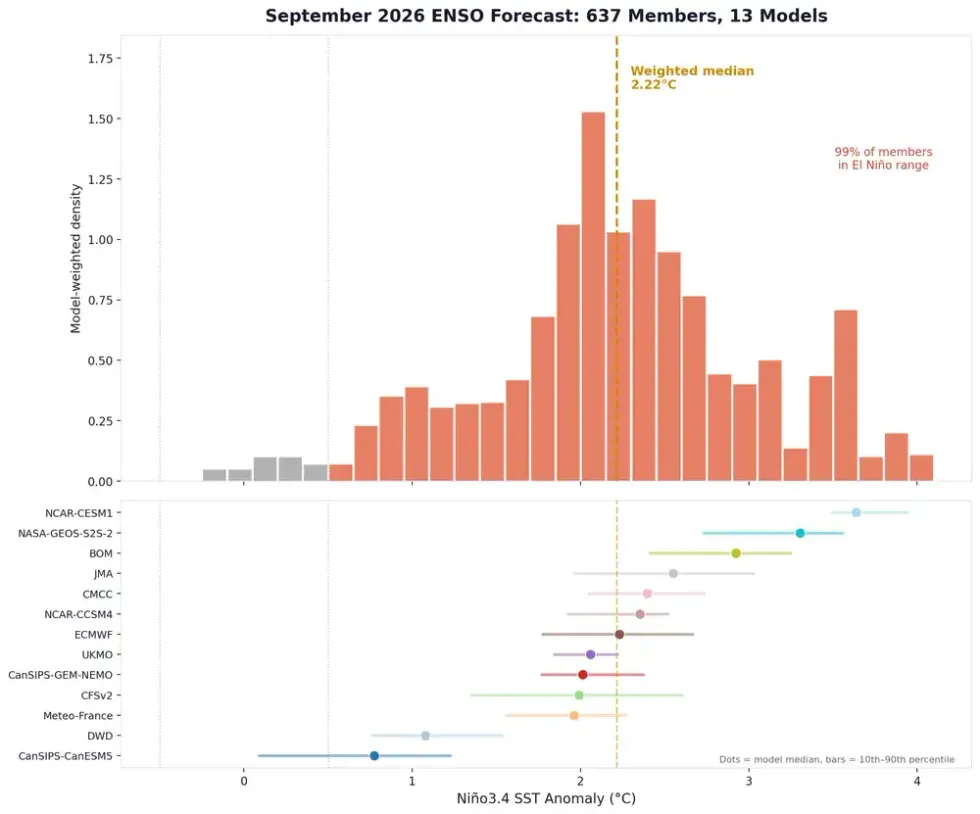
Basically it reads: a world we haven’t seen before. Because remember, El Niño comes on top of the steadily rising temperature of the Earth. If these forecasts bear out, then possibly 2026 and certainly 2027 will be the hottest years ever recorded on this Earth. As the atmospheric scientist Paul Roundy put it, there’s a “real potential for the strongest El Niño event in 140 years.” We don’t know, of course, exactly how this will manifest, but as Gabrielle Cannon wrote Monday in The Guardian
A super El Niño that occurred in 2015 brought severe drought in Ethiopia, water supply shortages in Puerto Rico, and smashed records after unleashing a vicious hurricane season in the central North Pacific, according to an analysis by US federal scientists.
The cycle tends to create drought and heat across Australia, around southern and central Africa, in India and in parts of South America, including in the Amazon rainforest. Heavy precipitation, meanwhile, could hit the southern tier of the US, parts of the Middle East, and south-central Asia.
I think it’s safe to say that we can expect more weather chaos than we’ve ever seen before (the good folks at Covering Climate Now put together a useful briefing for reporters last week). Here’s my prediction, since my job is to figure out how the physical and political worlds intersect:
The havoc unleashed by a super El Niño will coincide with the havoc unleashed by President Donald Trump in the Gulf to produce a perfect storm of support for rapid action on getting off fossil fuels. Our brief vacation from thinking about climate change as a crucial fact of life on this planet will be over; the conjoined fears of the next months will combine to put us in a very new place politically.
My main fear is that this useful moment is coming very late in the game.
And by that I mean that the last few weeks have also produced a new round of research on the damage that human warming of the Earth is doing to its most basic systems. For simplicity’s sake let’s concentrate on one big system, the Atlantic Meridional Overturning Current or AMOC, that system of currents (like the Gulf Stream) in the Atlantic that are the planet’s biggest heat distribution system.
The collapse of the AMOC has been a recurring nightmare in the climate literature—I first wrote about it in The End of Nature in the 1980s. But the prevailing theory was that it would take a good long while, probably more than a century. In recent years that consensus has been weakening, and the fears of a much more rapid failure of these currents—which keep Europe far warmer than it would otherwise be—have grown rapidly. We’re about a decade out from an ominous paper in Nature that warned that an anomaly in the north Atlantic—a “cold blob” in an otherwise rapidly warming global ocean—could signal that melting ice pouring off Greenland was fatally weakening the currents, by changing the salinity and hence the density of seawater. Research since them has not been comforting, with at least one prominent paper warning the collapse could come as early as the 2030s. Last year Iceland declared an AMOC collapse as a “national security risk,” since the disappearance of the current could turn the temperate country into what one of its foremost experts called “one giant glacier.” It would certainly be a civilizational event for all of Europe.
Anyway, a new paper last week in Science seemed to indicate, with data gathered from four mooring buoys along the western edge of these currents, that there is:
a meridionally consistent decline in deep western overturning transport across these latitudes over the past two decades. This decline, observed at the western boundary, may serve as an effective indicator of AMOC weakening
Here’s how Alec Luhn explained the significance in New Scientist:
The study’s analysis of the latest RAPID-MOCHA data shows that the flow of the AMOC is declining by about 90,000 cubic metres of water per second each year, a faster rate than what has previously been observed. That means between 2004 and 2023, the AMOC weakened by about 10%.
But the uncertainty range of this change in flow is almost as large as the change itself. For this reason, Xin’s study also analyses pressure changes at three mooring arrays that have been installed since 2004 in the western Atlantic off the West Indies, the US East Coast and Nova Scotia, Canada. There, it finds an even greater weakening of the AMOC, with much less uncertainty.
“It is the strongest direct observational evidence so far” that the AMOC is weakening, as models have long shown, says Stefan Rahmstorf at the University of Potsdam, Germany, who wasn’t involved in the research.
Meanwhile, another new and equally ominous paper in Nature late last month showed that a collapsing Atlantic current system would release prodigious amounts of carbon into the atmosphere, thus dramatically increasing overall global warming even as Europe froze. As William Hunter helpfully explained in (of all places) the Daily Mail:
The scientists’ computer simulations revealed that halting this key current will release vast stores of carbon currently trapped deep beneath the ocean.
This would increase the concentration of CO2 in the atmosphere by 47 to 83 parts per million, triggering up to 0.27°C (0.5°F) of additional warming worldwide.
"Our study shows how an AMOC collapse could flip the Southern Ocean from a carbon sink into a carbon source, releasing vast amounts of CO2 and fuelling further global warming," said Johan Rockström, director of the Potsdam Institute for Climate Impact Research, "The ocean has been our greatest ally, absorbing a quarter of human-made CO2 emissions."
The scariest piece of the puzzle in the new study may be the profound, and completely opposite, consequences for the two poles. As the authors put it:
regional temperature anomalies are pronounced: Arctic temperatures cool by ~ 7°C (60°N-90 °N), while Antarctic temperatures warm by ~ 6°C (60°S-90°S).
A world in which the Arctic quickly cooled 12°F just as the Antarctic warmed by 10°F would be a very very different world indeed, one capable of violent change on a scale I don’t really want to imagine. In any event, as Potsdam Institute director Johan Rockstrom explained:
The more CO2 in our atmosphere at the stage of shutdown, the higher the likelihood of additional warming. Put simply, rising emissions today increase the risk of a stronger climate response down the line.
And that’s the one part of the equation we can do something about. We have one tool to keep carbon dioxide out of the atmosphere: the substitution of clean energy for fossil fuel. Our weapons in this fight are solar panels, wind turbines, and batteries. We need to crash them into place before these systems crash down upon us. That’s the job.
Every once in a while I have to snap out of the hypnotic grip of the bizarre news cycle and remind myself—and you—that there’s something even more important underway than the obvious mental and moral decline of the president: the relentless rise in the temperature of the planet. So here’s my latest occasional update from the physical world, and I fear the news is not good.
Let’s begin with the immediate past, and stay close to home, because the US has been the center of some of the most extreme meteorological action on planet Earth recently. Consider our winter: Though it was chilly in the Northeast, if you averaged the temperature across the lower 48 it was the second-hottest winter on record. That's because nine states had their hottest winter ever and five their second hottest. As Andrea Thompson pointed out in Scientific American: “Nowhere in the US had a record cold winter this year. Nowhere even came close.”
That winter, by the way, was December, January, and February—what we call “meteorological winter” because it coincides with the coldest quarter of the year. It was outrageously hot and very dry, with severely shrunken snowpacks across the mountains of the West, which made Westerners nervous about the chances for wildfire as the summer wore on.
And then came March.
The havoc unleashed by a super El Niño will coincide with the havoc unleashed by President Donald Trump in the Gulf to produce a perfect storm of support for rapid action on getting off fossil fuels.
March was the single craziest month in US weather history. Here’s how Seth Borenstein put it in the lede of his account for The Associated Press:
March’s persistent unseasonable heat was so intense that the continental United States registered its most abnormally hot month in 132 years of records, according to federal weather data.
The federal government is still collecting weather data (though far less than it used to), and so we know the following remarkable fact according to the National Oceanic and Atmospheric Administration (NOAA):
The average maximum temperature for March was especially high at 11.4°F (6.3°C) above the 20th century average and was almost a degree warmer than the average daytime high for April.
As Bob Henson points out in the Yale-based blog Eye of the Storm:
In 35 of the 48 contiguous states, the statewide average reading was among the top-10 warmest for any March. Not a single contiguous state was cooler than average.
Henson also points out that a lack of rainfall meant it’s so far been the driest year in American history:
The nationally averaged precipitation total for 2026 to date is an ominous one: a mere 4.79 inches. That’s the lowest value on record for any January-to-March interval, including such notoriously dry periods as the Dust Bowl of the 1930s. The previous record low was 5.27 inches, set in Jan.-Mar. 1910.
As Henson’s colleague Jeff Masters succinctly told the AP:
Climate change is kicking our butts
And I fear it’s barely begun the beating. Because over the last two weeks, even as the world has fixed its gaze on the Middle East, meteorologists have been staring in some awe and terror at what appears to be a rapidly building El Niño. I’ve been telling you this is on the way for some months, but it’s coming into ever-clearer focus. NOAA again, in its April forecast, put the odds of a El Niño beginning this summer at better than 60%. More to the point, the wide array of computer models around the planet are beginning to predict a so-called “super El Niño,” when temperatures in the critical region of the Pacific shoot up far far far higher than in the past. Henson and Masters again:
For October, roughly half of the ECMWF ensemble is calling for sea surface temperatures in the main El Niño region (Niño3.4) to exceed 2.5°C above the seasonal average. Such values would correspond to what’s loosely referred to as a “super El Niño.” Though there’s no official definition for a “super” event, the term is often attached to El Niño when its peak anomalies reach at least +2.0°C. Since 1950, the only El Niño events that have hit this threshold for at least one three-month interval were in 1972-73, 1982-83, 1997-98, 2015-16, and 2023-24. Only one of those events, in 2015-16, pushed all the way past +2.5°C.
Here’s a useful graph of the various estimates from the computer modelling, courtesy of Zeke Hausfather:
Basically it reads: a world we haven’t seen before. Because remember, El Niño comes on top of the steadily rising temperature of the Earth. If these forecasts bear out, then possibly 2026 and certainly 2027 will be the hottest years ever recorded on this Earth. As the atmospheric scientist Paul Roundy put it, there’s a “real potential for the strongest El Niño event in 140 years.” We don’t know, of course, exactly how this will manifest, but as Gabrielle Cannon wrote Monday in The Guardian
A super El Niño that occurred in 2015 brought severe drought in Ethiopia, water supply shortages in Puerto Rico, and smashed records after unleashing a vicious hurricane season in the central North Pacific, according to an analysis by US federal scientists.
The cycle tends to create drought and heat across Australia, around southern and central Africa, in India and in parts of South America, including in the Amazon rainforest. Heavy precipitation, meanwhile, could hit the southern tier of the US, parts of the Middle East, and south-central Asia.
I think it’s safe to say that we can expect more weather chaos than we’ve ever seen before (the good folks at Covering Climate Now put together a useful briefing for reporters last week). Here’s my prediction, since my job is to figure out how the physical and political worlds intersect:
The havoc unleashed by a super El Niño will coincide with the havoc unleashed by President Donald Trump in the Gulf to produce a perfect storm of support for rapid action on getting off fossil fuels. Our brief vacation from thinking about climate change as a crucial fact of life on this planet will be over; the conjoined fears of the next months will combine to put us in a very new place politically.
My main fear is that this useful moment is coming very late in the game.
And by that I mean that the last few weeks have also produced a new round of research on the damage that human warming of the Earth is doing to its most basic systems. For simplicity’s sake let’s concentrate on one big system, the Atlantic Meridional Overturning Current or AMOC, that system of currents (like the Gulf Stream) in the Atlantic that are the planet’s biggest heat distribution system.
The collapse of the AMOC has been a recurring nightmare in the climate literature—I first wrote about it in The End of Nature in the 1980s. But the prevailing theory was that it would take a good long while, probably more than a century. In recent years that consensus has been weakening, and the fears of a much more rapid failure of these currents—which keep Europe far warmer than it would otherwise be—have grown rapidly. We’re about a decade out from an ominous paper in Nature that warned that an anomaly in the north Atlantic—a “cold blob” in an otherwise rapidly warming global ocean—could signal that melting ice pouring off Greenland was fatally weakening the currents, by changing the salinity and hence the density of seawater. Research since them has not been comforting, with at least one prominent paper warning the collapse could come as early as the 2030s. Last year Iceland declared an AMOC collapse as a “national security risk,” since the disappearance of the current could turn the temperate country into what one of its foremost experts called “one giant glacier.” It would certainly be a civilizational event for all of Europe.
Anyway, a new paper last week in Science seemed to indicate, with data gathered from four mooring buoys along the western edge of these currents, that there is:
a meridionally consistent decline in deep western overturning transport across these latitudes over the past two decades. This decline, observed at the western boundary, may serve as an effective indicator of AMOC weakening
Here’s how Alec Luhn explained the significance in New Scientist:
The study’s analysis of the latest RAPID-MOCHA data shows that the flow of the AMOC is declining by about 90,000 cubic metres of water per second each year, a faster rate than what has previously been observed. That means between 2004 and 2023, the AMOC weakened by about 10%.
But the uncertainty range of this change in flow is almost as large as the change itself. For this reason, Xin’s study also analyses pressure changes at three mooring arrays that have been installed since 2004 in the western Atlantic off the West Indies, the US East Coast and Nova Scotia, Canada. There, it finds an even greater weakening of the AMOC, with much less uncertainty.
“It is the strongest direct observational evidence so far” that the AMOC is weakening, as models have long shown, says Stefan Rahmstorf at the University of Potsdam, Germany, who wasn’t involved in the research.
Meanwhile, another new and equally ominous paper in Nature late last month showed that a collapsing Atlantic current system would release prodigious amounts of carbon into the atmosphere, thus dramatically increasing overall global warming even as Europe froze. As William Hunter helpfully explained in (of all places) the Daily Mail:
The scientists’ computer simulations revealed that halting this key current will release vast stores of carbon currently trapped deep beneath the ocean.
This would increase the concentration of CO2 in the atmosphere by 47 to 83 parts per million, triggering up to 0.27°C (0.5°F) of additional warming worldwide.
"Our study shows how an AMOC collapse could flip the Southern Ocean from a carbon sink into a carbon source, releasing vast amounts of CO2 and fuelling further global warming," said Johan Rockström, director of the Potsdam Institute for Climate Impact Research, "The ocean has been our greatest ally, absorbing a quarter of human-made CO2 emissions."
The scariest piece of the puzzle in the new study may be the profound, and completely opposite, consequences for the two poles. As the authors put it:
regional temperature anomalies are pronounced: Arctic temperatures cool by ~ 7°C (60°N-90 °N), while Antarctic temperatures warm by ~ 6°C (60°S-90°S).
A world in which the Arctic quickly cooled 12°F just as the Antarctic warmed by 10°F would be a very very different world indeed, one capable of violent change on a scale I don’t really want to imagine. In any event, as Potsdam Institute director Johan Rockstrom explained:
The more CO2 in our atmosphere at the stage of shutdown, the higher the likelihood of additional warming. Put simply, rising emissions today increase the risk of a stronger climate response down the line.
And that’s the one part of the equation we can do something about. We have one tool to keep carbon dioxide out of the atmosphere: the substitution of clean energy for fossil fuel. Our weapons in this fight are solar panels, wind turbines, and batteries. We need to crash them into place before these systems crash down upon us. That’s the job.
Every once in a while I have to snap out of the hypnotic grip of the bizarre news cycle and remind myself—and you—that there’s something even more important underway than the obvious mental and moral decline of the president: the relentless rise in the temperature of the planet. So here’s my latest occasional update from the physical world, and I fear the news is not good.
Let’s begin with the immediate past, and stay close to home, because the US has been the center of some of the most extreme meteorological action on planet Earth recently. Consider our winter: Though it was chilly in the Northeast, if you averaged the temperature across the lower 48 it was the second-hottest winter on record. That's because nine states had their hottest winter ever and five their second hottest. As Andrea Thompson pointed out in Scientific American: “Nowhere in the US had a record cold winter this year. Nowhere even came close.”
That winter, by the way, was December, January, and February—what we call “meteorological winter” because it coincides with the coldest quarter of the year. It was outrageously hot and very dry, with severely shrunken snowpacks across the mountains of the West, which made Westerners nervous about the chances for wildfire as the summer wore on.
And then came March.
The havoc unleashed by a super El Niño will coincide with the havoc unleashed by President Donald Trump in the Gulf to produce a perfect storm of support for rapid action on getting off fossil fuels.
March was the single craziest month in US weather history. Here’s how Seth Borenstein put it in the lede of his account for The Associated Press:
March’s persistent unseasonable heat was so intense that the continental United States registered its most abnormally hot month in 132 years of records, according to federal weather data.
The federal government is still collecting weather data (though far less than it used to), and so we know the following remarkable fact according to the National Oceanic and Atmospheric Administration (NOAA):
The average maximum temperature for March was especially high at 11.4°F (6.3°C) above the 20th century average and was almost a degree warmer than the average daytime high for April.
As Bob Henson points out in the Yale-based blog Eye of the Storm:
In 35 of the 48 contiguous states, the statewide average reading was among the top-10 warmest for any March. Not a single contiguous state was cooler than average.
Henson also points out that a lack of rainfall meant it’s so far been the driest year in American history:
The nationally averaged precipitation total for 2026 to date is an ominous one: a mere 4.79 inches. That’s the lowest value on record for any January-to-March interval, including such notoriously dry periods as the Dust Bowl of the 1930s. The previous record low was 5.27 inches, set in Jan.-Mar. 1910.
As Henson’s colleague Jeff Masters succinctly told the AP:
Climate change is kicking our butts
And I fear it’s barely begun the beating. Because over the last two weeks, even as the world has fixed its gaze on the Middle East, meteorologists have been staring in some awe and terror at what appears to be a rapidly building El Niño. I’ve been telling you this is on the way for some months, but it’s coming into ever-clearer focus. NOAA again, in its April forecast, put the odds of a El Niño beginning this summer at better than 60%. More to the point, the wide array of computer models around the planet are beginning to predict a so-called “super El Niño,” when temperatures in the critical region of the Pacific shoot up far far far higher than in the past. Henson and Masters again:
For October, roughly half of the ECMWF ensemble is calling for sea surface temperatures in the main El Niño region (Niño3.4) to exceed 2.5°C above the seasonal average. Such values would correspond to what’s loosely referred to as a “super El Niño.” Though there’s no official definition for a “super” event, the term is often attached to El Niño when its peak anomalies reach at least +2.0°C. Since 1950, the only El Niño events that have hit this threshold for at least one three-month interval were in 1972-73, 1982-83, 1997-98, 2015-16, and 2023-24. Only one of those events, in 2015-16, pushed all the way past +2.5°C.
Here’s a useful graph of the various estimates from the computer modelling, courtesy of Zeke Hausfather:
Basically it reads: a world we haven’t seen before. Because remember, El Niño comes on top of the steadily rising temperature of the Earth. If these forecasts bear out, then possibly 2026 and certainly 2027 will be the hottest years ever recorded on this Earth. As the atmospheric scientist Paul Roundy put it, there’s a “real potential for the strongest El Niño event in 140 years.” We don’t know, of course, exactly how this will manifest, but as Gabrielle Cannon wrote Monday in The Guardian
A super El Niño that occurred in 2015 brought severe drought in Ethiopia, water supply shortages in Puerto Rico, and smashed records after unleashing a vicious hurricane season in the central North Pacific, according to an analysis by US federal scientists.
The cycle tends to create drought and heat across Australia, around southern and central Africa, in India and in parts of South America, including in the Amazon rainforest. Heavy precipitation, meanwhile, could hit the southern tier of the US, parts of the Middle East, and south-central Asia.
I think it’s safe to say that we can expect more weather chaos than we’ve ever seen before (the good folks at Covering Climate Now put together a useful briefing for reporters last week). Here’s my prediction, since my job is to figure out how the physical and political worlds intersect:
The havoc unleashed by a super El Niño will coincide with the havoc unleashed by President Donald Trump in the Gulf to produce a perfect storm of support for rapid action on getting off fossil fuels. Our brief vacation from thinking about climate change as a crucial fact of life on this planet will be over; the conjoined fears of the next months will combine to put us in a very new place politically.
My main fear is that this useful moment is coming very late in the game.
And by that I mean that the last few weeks have also produced a new round of research on the damage that human warming of the Earth is doing to its most basic systems. For simplicity’s sake let’s concentrate on one big system, the Atlantic Meridional Overturning Current or AMOC, that system of currents (like the Gulf Stream) in the Atlantic that are the planet’s biggest heat distribution system.
The collapse of the AMOC has been a recurring nightmare in the climate literature—I first wrote about it in The End of Nature in the 1980s. But the prevailing theory was that it would take a good long while, probably more than a century. In recent years that consensus has been weakening, and the fears of a much more rapid failure of these currents—which keep Europe far warmer than it would otherwise be—have grown rapidly. We’re about a decade out from an ominous paper in Nature that warned that an anomaly in the north Atlantic—a “cold blob” in an otherwise rapidly warming global ocean—could signal that melting ice pouring off Greenland was fatally weakening the currents, by changing the salinity and hence the density of seawater. Research since them has not been comforting, with at least one prominent paper warning the collapse could come as early as the 2030s. Last year Iceland declared an AMOC collapse as a “national security risk,” since the disappearance of the current could turn the temperate country into what one of its foremost experts called “one giant glacier.” It would certainly be a civilizational event for all of Europe.
Anyway, a new paper last week in Science seemed to indicate, with data gathered from four mooring buoys along the western edge of these currents, that there is:
a meridionally consistent decline in deep western overturning transport across these latitudes over the past two decades. This decline, observed at the western boundary, may serve as an effective indicator of AMOC weakening
Here’s how Alec Luhn explained the significance in New Scientist:
The study’s analysis of the latest RAPID-MOCHA data shows that the flow of the AMOC is declining by about 90,000 cubic metres of water per second each year, a faster rate than what has previously been observed. That means between 2004 and 2023, the AMOC weakened by about 10%.
But the uncertainty range of this change in flow is almost as large as the change itself. For this reason, Xin’s study also analyses pressure changes at three mooring arrays that have been installed since 2004 in the western Atlantic off the West Indies, the US East Coast and Nova Scotia, Canada. There, it finds an even greater weakening of the AMOC, with much less uncertainty.
“It is the strongest direct observational evidence so far” that the AMOC is weakening, as models have long shown, says Stefan Rahmstorf at the University of Potsdam, Germany, who wasn’t involved in the research.
Meanwhile, another new and equally ominous paper in Nature late last month showed that a collapsing Atlantic current system would release prodigious amounts of carbon into the atmosphere, thus dramatically increasing overall global warming even as Europe froze. As William Hunter helpfully explained in (of all places) the Daily Mail:
The scientists’ computer simulations revealed that halting this key current will release vast stores of carbon currently trapped deep beneath the ocean.
This would increase the concentration of CO2 in the atmosphere by 47 to 83 parts per million, triggering up to 0.27°C (0.5°F) of additional warming worldwide.
"Our study shows how an AMOC collapse could flip the Southern Ocean from a carbon sink into a carbon source, releasing vast amounts of CO2 and fuelling further global warming," said Johan Rockström, director of the Potsdam Institute for Climate Impact Research, "The ocean has been our greatest ally, absorbing a quarter of human-made CO2 emissions."
The scariest piece of the puzzle in the new study may be the profound, and completely opposite, consequences for the two poles. As the authors put it:
regional temperature anomalies are pronounced: Arctic temperatures cool by ~ 7°C (60°N-90 °N), while Antarctic temperatures warm by ~ 6°C (60°S-90°S).
A world in which the Arctic quickly cooled 12°F just as the Antarctic warmed by 10°F would be a very very different world indeed, one capable of violent change on a scale I don’t really want to imagine. In any event, as Potsdam Institute director Johan Rockstrom explained:
The more CO2 in our atmosphere at the stage of shutdown, the higher the likelihood of additional warming. Put simply, rising emissions today increase the risk of a stronger climate response down the line.
And that’s the one part of the equation we can do something about. We have one tool to keep carbon dioxide out of the atmosphere: the substitution of clean energy for fossil fuel. Our weapons in this fight are solar panels, wind turbines, and batteries. We need to crash them into place before these systems crash down upon us. That’s the job.