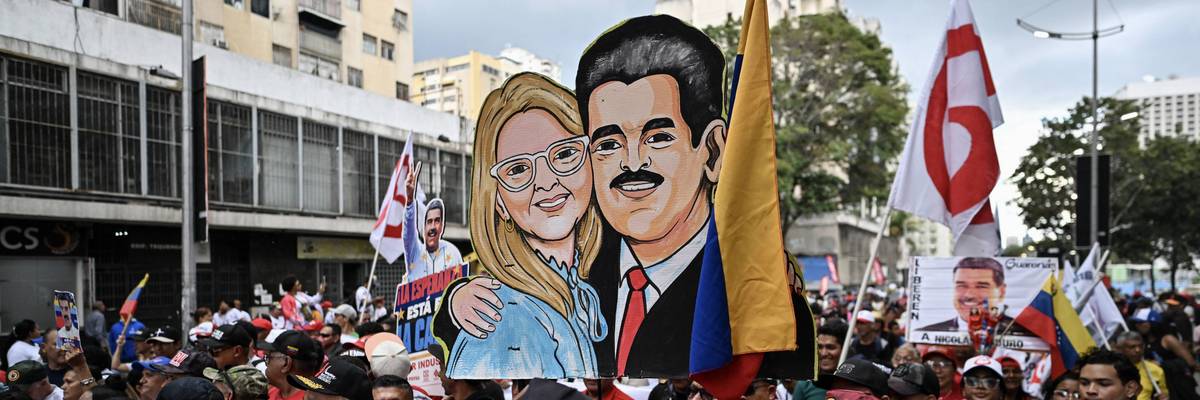
Supporters hold a hand-drawn portrait depicting ousted Venezuelan President Nicolas Maduro and his wife, Cilia Flores, during a demonstration calling for the release of him and his wife from a US prison in Caracas on January 23, 2026.
Cilia Flores: A First Lady in a New York Cell
Cilia Flores is one of the most prominent political prisoners in the world, yet most women’s rights organizations have not said a word in her defense.
On International Working Women’s Day in 2025, Cilia Flores, the wife of Venezuelan President Nicolás Maduro, read a poem she wrote highlighting the historic role played by Latin American women in the fight against imperialism:
We’re not flowers the wind can pluck,
we’re roots of rebel and loyal land,
we’re grandmothers, mothers, daughters, granddaughters;
we are woman.
Our blood pulses with the Manuelas,
Luisas, Josefas, Juanas, Cecilias,
Apacuanas, Bartolinas, Eulalias,
Martas, Anas Marías, Barbaritas
and so many others who legacy inspires,
commits, and strengthens us
to continue walking and traveling our path.
And in our hands and chests
a light is on that nobody will ever turn off:
love, peace and liberty.
—Cilia Flores, International Working Women’s Day 2025
One year later, she languishes in a cell in New York City, having been dragged out of her room and kidnapped by US forces on the January 3 attack on Venezuela. The first images after her abduction showed her face bruised. We later learned she had broken ribs, 23 stitches in her forehead, and deteriorating health inside US custody.
Flores is no ordinary first lady. She first rose to prominence in 1992 as a defense lawyer for a group of Venezuelan military officers who rose up against the government of Carlos Andrés Pérez, which had massacred thousands of people in the Caracazo of 1989–nationwide riots following the imposition of neoliberal austerity measures. Key among those officers was Hugo Chávez, the founder of the Bolivarian Revolution.
Out of solidarity with Cilia, with Venezuelan women in general, we must make it our cause to fight for her freedom.
In 1993, Cilia founded the Bolivarian Circle of Human Rights and aligned herself with Chávez’s revolutionary movement. In 2000, having helped Chávez win consecutive presidential elections, she was elected to the legislature. By 2006, she became the president of the National Assembly, the first woman in Venezuela’s history to occupy the post. Flores held important positions in the United Socialist Party of Venezuela and became the country’s solicitor general in 2012, a post she left to run Nicolás Maduro’s presidential campaign after President Chávez’s passing.
Cilia married Nicolás, her longtime partner, following the election. Feeling that the title of “first lady” could not capture her importance to the Bolivarian Revolution, her husband dubbed her the primera combatiente, or first combatant.
After working behind the scenes as a key adviser to President Maduro, she ran for election to the National Assembly and won in 2015, 2020, and 2025.
Today, she faces charges of conspiracy to import cocaine, along with possession of machine guns and destructive devices. The charges are absurd.
In the early 1990s, back when Venezuela was a key ally of the United States, over 50% of the world’s cocaine was trafficked through the country. By 2025, as Venezuela was considered an “unusual and extraordinary threat” to the United States, that number was down to 5%. President Donald Trump’s rhetoric of Venezuela flooding the US with cocaine, and his constant conflation of cocaine with fentanyl (which is neither trafficked through nor produced in Venezuela), has no basis in reality.
Now that the Trump administration controls Venezuela’s oil trade, the rhetoric on drugs has flipped. Following a visit to Venezuela, the head of US Southern Command touted a new counternarcotics cooperation agreement. Was the abduction of Nicolás and Cilia sufficient to end whatever alleged narcotics operation the Venezuelan government was accused of running? It’s more likely that such operations never existed in the first place. The allegations of drug trafficking served not only to discredit the Venezuelan government and its leaders but also paved the way for the January 3 attack.
Cilia Flores is one of the most prominent political prisoners in the world, yet most women’s rights organizations have not said a word in her defense. She is a sitting member of Venezuela’s National Assembly and played an instrumental role in the movement that greatly expanded democratic, economic, and social rights in the country.
Cilia stands with Palestine. In a November 2023 conference in Turkey, she said: “We are witnessing a genocide… We see the victims in Gaza. We see the death of children, women, the elderly, and civilians. We see civilian victims coming out of their destroyed homes, but unable to leave the city because they are in an open-air prison.”
Cilia brought feminism to the Bolivarian Revolution. On International Working Women’s Day in 2023, she helped launch a social mission aimed at protecting women from the worst of the economic war. At the time, she said: “Venezuelan women have shown they are the vanguard. Women make up more than half the population, but we are also mothers of the other half, so we form a whole. And in this war that Venezuela has endured, we achieved victory and are standing firm thanks to the participation of Venezuelan women, who did not just stay home taking care of children, building their families, but also took to the streets to defend the nation. Our women are patriots... and in the next scenario, whatever it may be, we will be victorious because women will be at the forefront of any battle."
Little did she know that the next scenario would be a prison cell in the United States. Out of solidarity with Cilia, with Venezuelan women in general, we must make it our cause to fight for her freedom.
Recalling her beautiful poem above, today our blood pulses with Cilia.
We are at a crossroads
This country and this world are at a monumental crossroads. In a few short weeks, US voters will have an opportunity to beat back the forces of fascism and confront the billionaires who are rigging the economy, our media system, and our democracy, making it increasingly impossible for ordinary people to get by. We’re not just talking about the election. We’re talking about what must be done once these fascist elements are vanquished from power. We need a bolder set of solutions than what either major party has so far been willing to offer and a working-class movement ready to fight like hell for it. Trump didn't emerge from nowhere. The conditions that fueled MAGA authoritarianism were created by decades of radical neoliberal economic policies and a corrupt political system dominated by corporate interests. They slashed taxes on the super-rich, promising that the benefits would trickle down. They said giveaways to the corporate titans would make life more affordable for the rest of us. It was all bullshit. And when a bitter, betrayed populace searches for someone to blame, right-wing demagogues have little trouble finding scapegoats. People know when they're being lied to, but you won't hear any of this from the corporate media. Only independent journalism—powered and funded by people who believe in building a better world—can deliver truly trustworthy daily news. Our Fall Campaign is underway, and we need your help. To power our newsroom through the rest of the year, we need to raise $125,000 by midnight on October 31. So if you share our vision, please contribute whatever you can to sustain our work. |
On International Working Women’s Day in 2025, Cilia Flores, the wife of Venezuelan President Nicolás Maduro, read a poem she wrote highlighting the historic role played by Latin American women in the fight against imperialism:
We’re not flowers the wind can pluck,
we’re roots of rebel and loyal land,
we’re grandmothers, mothers, daughters, granddaughters;
we are woman.
Our blood pulses with the Manuelas,
Luisas, Josefas, Juanas, Cecilias,
Apacuanas, Bartolinas, Eulalias,
Martas, Anas Marías, Barbaritas
and so many others who legacy inspires,
commits, and strengthens us
to continue walking and traveling our path.
And in our hands and chests
a light is on that nobody will ever turn off:
love, peace and liberty.
—Cilia Flores, International Working Women’s Day 2025
One year later, she languishes in a cell in New York City, having been dragged out of her room and kidnapped by US forces on the January 3 attack on Venezuela. The first images after her abduction showed her face bruised. We later learned she had broken ribs, 23 stitches in her forehead, and deteriorating health inside US custody.
Flores is no ordinary first lady. She first rose to prominence in 1992 as a defense lawyer for a group of Venezuelan military officers who rose up against the government of Carlos Andrés Pérez, which had massacred thousands of people in the Caracazo of 1989–nationwide riots following the imposition of neoliberal austerity measures. Key among those officers was Hugo Chávez, the founder of the Bolivarian Revolution.
Out of solidarity with Cilia, with Venezuelan women in general, we must make it our cause to fight for her freedom.
In 1993, Cilia founded the Bolivarian Circle of Human Rights and aligned herself with Chávez’s revolutionary movement. In 2000, having helped Chávez win consecutive presidential elections, she was elected to the legislature. By 2006, she became the president of the National Assembly, the first woman in Venezuela’s history to occupy the post. Flores held important positions in the United Socialist Party of Venezuela and became the country’s solicitor general in 2012, a post she left to run Nicolás Maduro’s presidential campaign after President Chávez’s passing.
Cilia married Nicolás, her longtime partner, following the election. Feeling that the title of “first lady” could not capture her importance to the Bolivarian Revolution, her husband dubbed her the primera combatiente, or first combatant.
After working behind the scenes as a key adviser to President Maduro, she ran for election to the National Assembly and won in 2015, 2020, and 2025.
Today, she faces charges of conspiracy to import cocaine, along with possession of machine guns and destructive devices. The charges are absurd.
In the early 1990s, back when Venezuela was a key ally of the United States, over 50% of the world’s cocaine was trafficked through the country. By 2025, as Venezuela was considered an “unusual and extraordinary threat” to the United States, that number was down to 5%. President Donald Trump’s rhetoric of Venezuela flooding the US with cocaine, and his constant conflation of cocaine with fentanyl (which is neither trafficked through nor produced in Venezuela), has no basis in reality.
Now that the Trump administration controls Venezuela’s oil trade, the rhetoric on drugs has flipped. Following a visit to Venezuela, the head of US Southern Command touted a new counternarcotics cooperation agreement. Was the abduction of Nicolás and Cilia sufficient to end whatever alleged narcotics operation the Venezuelan government was accused of running? It’s more likely that such operations never existed in the first place. The allegations of drug trafficking served not only to discredit the Venezuelan government and its leaders but also paved the way for the January 3 attack.
Cilia Flores is one of the most prominent political prisoners in the world, yet most women’s rights organizations have not said a word in her defense. She is a sitting member of Venezuela’s National Assembly and played an instrumental role in the movement that greatly expanded democratic, economic, and social rights in the country.
Cilia stands with Palestine. In a November 2023 conference in Turkey, she said: “We are witnessing a genocide… We see the victims in Gaza. We see the death of children, women, the elderly, and civilians. We see civilian victims coming out of their destroyed homes, but unable to leave the city because they are in an open-air prison.”
Cilia brought feminism to the Bolivarian Revolution. On International Working Women’s Day in 2023, she helped launch a social mission aimed at protecting women from the worst of the economic war. At the time, she said: “Venezuelan women have shown they are the vanguard. Women make up more than half the population, but we are also mothers of the other half, so we form a whole. And in this war that Venezuela has endured, we achieved victory and are standing firm thanks to the participation of Venezuelan women, who did not just stay home taking care of children, building their families, but also took to the streets to defend the nation. Our women are patriots... and in the next scenario, whatever it may be, we will be victorious because women will be at the forefront of any battle."
Little did she know that the next scenario would be a prison cell in the United States. Out of solidarity with Cilia, with Venezuelan women in general, we must make it our cause to fight for her freedom.
Recalling her beautiful poem above, today our blood pulses with Cilia.
- Trump's Attack on Venezuela Would Be Wrong Even If It Were Legal ›
- Illegal, Immoral, Dangerous: No One Voted for Trump's Attack on Venezuela ›
- ‘Free Maduro!’ Thousands of Venezuelans Rally to Demand Trump Release Kidnapped President ›
- 'A criminal act of imperial aggression': Statement from Progressive International's Cabinet on the US invasion of Venezuela ›
- 'I Consider Myself a Prisoner of War,' Says Maduro, Pleading Not Guilty in US Court ›
On International Working Women’s Day in 2025, Cilia Flores, the wife of Venezuelan President Nicolás Maduro, read a poem she wrote highlighting the historic role played by Latin American women in the fight against imperialism:
We’re not flowers the wind can pluck,
we’re roots of rebel and loyal land,
we’re grandmothers, mothers, daughters, granddaughters;
we are woman.
Our blood pulses with the Manuelas,
Luisas, Josefas, Juanas, Cecilias,
Apacuanas, Bartolinas, Eulalias,
Martas, Anas Marías, Barbaritas
and so many others who legacy inspires,
commits, and strengthens us
to continue walking and traveling our path.
And in our hands and chests
a light is on that nobody will ever turn off:
love, peace and liberty.
—Cilia Flores, International Working Women’s Day 2025
One year later, she languishes in a cell in New York City, having been dragged out of her room and kidnapped by US forces on the January 3 attack on Venezuela. The first images after her abduction showed her face bruised. We later learned she had broken ribs, 23 stitches in her forehead, and deteriorating health inside US custody.
Flores is no ordinary first lady. She first rose to prominence in 1992 as a defense lawyer for a group of Venezuelan military officers who rose up against the government of Carlos Andrés Pérez, which had massacred thousands of people in the Caracazo of 1989–nationwide riots following the imposition of neoliberal austerity measures. Key among those officers was Hugo Chávez, the founder of the Bolivarian Revolution.
Out of solidarity with Cilia, with Venezuelan women in general, we must make it our cause to fight for her freedom.
In 1993, Cilia founded the Bolivarian Circle of Human Rights and aligned herself with Chávez’s revolutionary movement. In 2000, having helped Chávez win consecutive presidential elections, she was elected to the legislature. By 2006, she became the president of the National Assembly, the first woman in Venezuela’s history to occupy the post. Flores held important positions in the United Socialist Party of Venezuela and became the country’s solicitor general in 2012, a post she left to run Nicolás Maduro’s presidential campaign after President Chávez’s passing.
Cilia married Nicolás, her longtime partner, following the election. Feeling that the title of “first lady” could not capture her importance to the Bolivarian Revolution, her husband dubbed her the primera combatiente, or first combatant.
After working behind the scenes as a key adviser to President Maduro, she ran for election to the National Assembly and won in 2015, 2020, and 2025.
Today, she faces charges of conspiracy to import cocaine, along with possession of machine guns and destructive devices. The charges are absurd.
In the early 1990s, back when Venezuela was a key ally of the United States, over 50% of the world’s cocaine was trafficked through the country. By 2025, as Venezuela was considered an “unusual and extraordinary threat” to the United States, that number was down to 5%. President Donald Trump’s rhetoric of Venezuela flooding the US with cocaine, and his constant conflation of cocaine with fentanyl (which is neither trafficked through nor produced in Venezuela), has no basis in reality.
Now that the Trump administration controls Venezuela’s oil trade, the rhetoric on drugs has flipped. Following a visit to Venezuela, the head of US Southern Command touted a new counternarcotics cooperation agreement. Was the abduction of Nicolás and Cilia sufficient to end whatever alleged narcotics operation the Venezuelan government was accused of running? It’s more likely that such operations never existed in the first place. The allegations of drug trafficking served not only to discredit the Venezuelan government and its leaders but also paved the way for the January 3 attack.
Cilia Flores is one of the most prominent political prisoners in the world, yet most women’s rights organizations have not said a word in her defense. She is a sitting member of Venezuela’s National Assembly and played an instrumental role in the movement that greatly expanded democratic, economic, and social rights in the country.
Cilia stands with Palestine. In a November 2023 conference in Turkey, she said: “We are witnessing a genocide… We see the victims in Gaza. We see the death of children, women, the elderly, and civilians. We see civilian victims coming out of their destroyed homes, but unable to leave the city because they are in an open-air prison.”
Cilia brought feminism to the Bolivarian Revolution. On International Working Women’s Day in 2023, she helped launch a social mission aimed at protecting women from the worst of the economic war. At the time, she said: “Venezuelan women have shown they are the vanguard. Women make up more than half the population, but we are also mothers of the other half, so we form a whole. And in this war that Venezuela has endured, we achieved victory and are standing firm thanks to the participation of Venezuelan women, who did not just stay home taking care of children, building their families, but also took to the streets to defend the nation. Our women are patriots... and in the next scenario, whatever it may be, we will be victorious because women will be at the forefront of any battle."
Little did she know that the next scenario would be a prison cell in the United States. Out of solidarity with Cilia, with Venezuelan women in general, we must make it our cause to fight for her freedom.
Recalling her beautiful poem above, today our blood pulses with Cilia.
- Trump's Attack on Venezuela Would Be Wrong Even If It Were Legal ›
- Illegal, Immoral, Dangerous: No One Voted for Trump's Attack on Venezuela ›
- ‘Free Maduro!’ Thousands of Venezuelans Rally to Demand Trump Release Kidnapped President ›
- 'A criminal act of imperial aggression': Statement from Progressive International's Cabinet on the US invasion of Venezuela ›
- 'I Consider Myself a Prisoner of War,' Says Maduro, Pleading Not Guilty in US Court ›