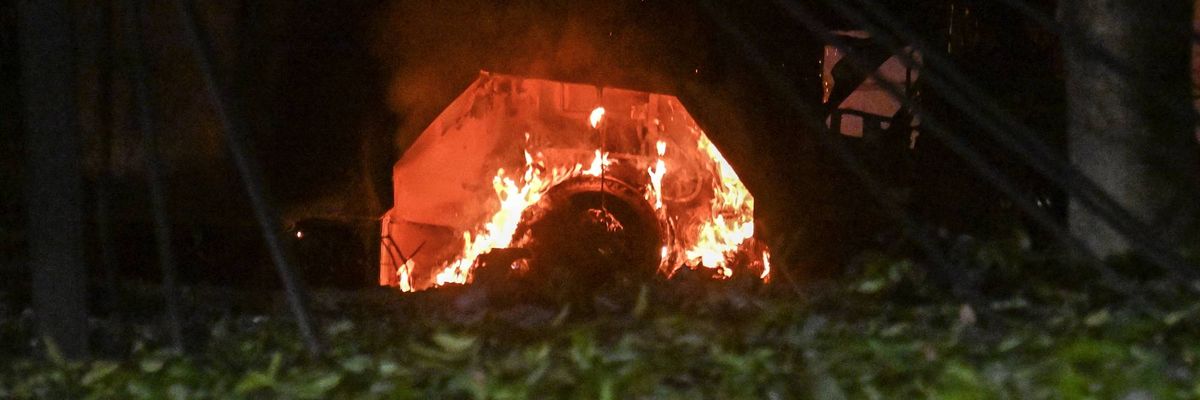
A vehicle burns at La Carlota air base in Caracas after a series of explosions on January 3, 2026.
Trump's Attack on Venezuela Would Be Wrong Even If It Were Legal
Making a a war “legal” doesn’t make it just or moral. Legal wars still kill and maim innocent people, still destroy communities, still create intense hatred that guarantees future wars.
Oh good. Now we have a war to focus on. Everyone’s tired of Epstein by now, and tired of the possibility that the bad guy may be, ho hum, our own national leader, aka, the commander in chief.
So the commander in chief has stepped in for the sake of the public good, bestowing on America a far more traditional enemy to hate and fear and let dominate the headlines: narco-terrorists.
I’m still trying to grasp the fact that President Donald Trump has actually invaded Venezuela. He’s no longer simply bombing boats in the ocean. The US military bombed Caracas on January 3 and broke into the home of the country’s president, Nicolás Maduro, and his wife Cilia Flores. They were kidnapped and extradited to the United States, where they are now on trial for drug trafficking—as though that was the moral purpose of the invasion.
Obviously it wasn’t. As The Intercept notes:
This is a clear-cut act of military aggression, a brazen violation of international law, and a textbook example of unreconstructed 19th-century colonialism.
Donald Trump now says that the US will "run" Venezuela and "take" the country’s vast oil reserves.
I’m in sync with the enormous outrage over this invasion, both here in the US and around the world. Where I back away slightly, however, is when a critic points out that Trump’s military action was “illegal,” because he invaded Venezuela without congressional approval. When I read this kind of criticism, I feel an inner alarm go off. Making a a war “legal” doesn’t make it just or moral. Legal wars still kill and maim innocent people, still destroy communities, still create intense hatred that guarantees future wars. In other words, war itself is always the core of the wrong.
In no way am I saying I oppose self-defense, or even retaliation. I’m saying, instead, that I believe we need to rethink what self-defense actually means.
What, oh what, is power? We live in a world that is armed against itself with preposterous enormity—nuclear armed against itself, for God’s sake. Violent response is embedded in the way we think, regarded as the nature of protection. Where’s my gun? And it’s likely to be the first response to a perceived threat, especially at the national level. And anyone who dares to question this is easily belittled as crying: “Gosh, can’t we all just get along?”
I took aim, so to speak, at this cynicism in a poem I wrote some years ago, called “Can’t We All Just... Oh Forget It,” which begins:
The cynics
play with their sticks
and knives, mocking
the merciful, the naïve,
the cheek turners.
Can’t we all just . . .
oh, forget it.
But maybe the answer
is yes,
if we undo the language,
the easy smirkwords
that belittle
our evolving...
Belittle our evolving! Disagreement—conflict—is often incredibly complex. Simply “eliminating” it, shooting it out of existence, may be a tempting course of action, but it solves nothing. Instead, we have to understand it. And every time we understand the reasons for a conflict—and figure out how to rectify and transcend those reasons—we evolve.
Consider these words about the Venezuela invasion by Jordan Liz:
Ultimately, whether it’s removing Maduro or invading Cuba, Mexico, or Colombia, none of these actions will solve the drug crisis because they fail to tackle the root cause: public suffering. While there are many reasons people turn to drugs, the lack of adequate healthcare, poverty, homelessness, social stigmas about drug use, and criminalization are the leading factors. People turn to drugs when their governments and communities turn their back on them. Drug cartels, like any other capitalist enterprise, exploit these people’s hopes and desires for their own gain.
...If Trump really cared about the drug crisis, he would be working tirelessly to solve the affordability crisis—not denying its existence or spending billions on battleships.
War is not the answer, even if it’s legal.
We are at a crossroads
This country and this world are at a monumental crossroads. In a few short weeks, US voters will have an opportunity to beat back the forces of fascism and confront the billionaires who are rigging the economy, our media system, and our democracy, making it increasingly impossible for ordinary people to get by. We’re not just talking about the election. We’re talking about what must be done once these fascist elements are vanquished from power. We need a bolder set of solutions than what either major party has so far been willing to offer and a working-class movement ready to fight like hell for it. Trump didn't emerge from nowhere. The conditions that fueled MAGA authoritarianism were created by decades of radical neoliberal economic policies and a corrupt political system dominated by corporate interests. They slashed taxes on the super-rich, promising that the benefits would trickle down. They said giveaways to the corporate titans would make life more affordable for the rest of us. It was all bullshit. And when a bitter, betrayed populace searches for someone to blame, right-wing demagogues have little trouble finding scapegoats. People know when they're being lied to, but you won't hear any of this from the corporate media. Only independent journalism—powered and funded by people who believe in building a better world—can deliver truly trustworthy daily news. Our Fall Campaign is underway, and we need your help. To power our newsroom through the rest of the year, we need to raise $125,000 by midnight on October 31. So if you share our vision, please contribute whatever you can to sustain our work. |
Oh good. Now we have a war to focus on. Everyone’s tired of Epstein by now, and tired of the possibility that the bad guy may be, ho hum, our own national leader, aka, the commander in chief.
So the commander in chief has stepped in for the sake of the public good, bestowing on America a far more traditional enemy to hate and fear and let dominate the headlines: narco-terrorists.
I’m still trying to grasp the fact that President Donald Trump has actually invaded Venezuela. He’s no longer simply bombing boats in the ocean. The US military bombed Caracas on January 3 and broke into the home of the country’s president, Nicolás Maduro, and his wife Cilia Flores. They were kidnapped and extradited to the United States, where they are now on trial for drug trafficking—as though that was the moral purpose of the invasion.
Obviously it wasn’t. As The Intercept notes:
This is a clear-cut act of military aggression, a brazen violation of international law, and a textbook example of unreconstructed 19th-century colonialism.
Donald Trump now says that the US will "run" Venezuela and "take" the country’s vast oil reserves.
I’m in sync with the enormous outrage over this invasion, both here in the US and around the world. Where I back away slightly, however, is when a critic points out that Trump’s military action was “illegal,” because he invaded Venezuela without congressional approval. When I read this kind of criticism, I feel an inner alarm go off. Making a a war “legal” doesn’t make it just or moral. Legal wars still kill and maim innocent people, still destroy communities, still create intense hatred that guarantees future wars. In other words, war itself is always the core of the wrong.
In no way am I saying I oppose self-defense, or even retaliation. I’m saying, instead, that I believe we need to rethink what self-defense actually means.
What, oh what, is power? We live in a world that is armed against itself with preposterous enormity—nuclear armed against itself, for God’s sake. Violent response is embedded in the way we think, regarded as the nature of protection. Where’s my gun? And it’s likely to be the first response to a perceived threat, especially at the national level. And anyone who dares to question this is easily belittled as crying: “Gosh, can’t we all just get along?”
I took aim, so to speak, at this cynicism in a poem I wrote some years ago, called “Can’t We All Just... Oh Forget It,” which begins:
The cynics
play with their sticks
and knives, mocking
the merciful, the naïve,
the cheek turners.
Can’t we all just . . .
oh, forget it.
But maybe the answer
is yes,
if we undo the language,
the easy smirkwords
that belittle
our evolving...
Belittle our evolving! Disagreement—conflict—is often incredibly complex. Simply “eliminating” it, shooting it out of existence, may be a tempting course of action, but it solves nothing. Instead, we have to understand it. And every time we understand the reasons for a conflict—and figure out how to rectify and transcend those reasons—we evolve.
Consider these words about the Venezuela invasion by Jordan Liz:
Ultimately, whether it’s removing Maduro or invading Cuba, Mexico, or Colombia, none of these actions will solve the drug crisis because they fail to tackle the root cause: public suffering. While there are many reasons people turn to drugs, the lack of adequate healthcare, poverty, homelessness, social stigmas about drug use, and criminalization are the leading factors. People turn to drugs when their governments and communities turn their back on them. Drug cartels, like any other capitalist enterprise, exploit these people’s hopes and desires for their own gain.
...If Trump really cared about the drug crisis, he would be working tirelessly to solve the affordability crisis—not denying its existence or spending billions on battleships.
War is not the answer, even if it’s legal.
- International Law Experts Agree: Trump-Ordered Attack on Venezuela 100% Illegal ›
- 'The Actions of a Rogue State': US Lawmakers Demand Emergency Vote to Stop Trump War on Venezuela ›
- Trump Administration Has ‘Made the Decision to Attack Military Installations Inside Venezuela’: Report ›
- After Venezuela Assault, Trump and Rubio Warn Cuba, Mexico, and Colombia Could Be Next ›
- 63% of US Voters Oppose Attack on Venezuela as Trump's March to War Accelerates ›
- 'This Is State Terrorism': Global Outrage as Trump Launches Illegal Assault on Venezuela ›
- Opinion | Cilia Flores: A First Lady in a New York Cell | Common Dreams ›
Oh good. Now we have a war to focus on. Everyone’s tired of Epstein by now, and tired of the possibility that the bad guy may be, ho hum, our own national leader, aka, the commander in chief.
So the commander in chief has stepped in for the sake of the public good, bestowing on America a far more traditional enemy to hate and fear and let dominate the headlines: narco-terrorists.
I’m still trying to grasp the fact that President Donald Trump has actually invaded Venezuela. He’s no longer simply bombing boats in the ocean. The US military bombed Caracas on January 3 and broke into the home of the country’s president, Nicolás Maduro, and his wife Cilia Flores. They were kidnapped and extradited to the United States, where they are now on trial for drug trafficking—as though that was the moral purpose of the invasion.
Obviously it wasn’t. As The Intercept notes:
This is a clear-cut act of military aggression, a brazen violation of international law, and a textbook example of unreconstructed 19th-century colonialism.
Donald Trump now says that the US will "run" Venezuela and "take" the country’s vast oil reserves.
I’m in sync with the enormous outrage over this invasion, both here in the US and around the world. Where I back away slightly, however, is when a critic points out that Trump’s military action was “illegal,” because he invaded Venezuela without congressional approval. When I read this kind of criticism, I feel an inner alarm go off. Making a a war “legal” doesn’t make it just or moral. Legal wars still kill and maim innocent people, still destroy communities, still create intense hatred that guarantees future wars. In other words, war itself is always the core of the wrong.
In no way am I saying I oppose self-defense, or even retaliation. I’m saying, instead, that I believe we need to rethink what self-defense actually means.
What, oh what, is power? We live in a world that is armed against itself with preposterous enormity—nuclear armed against itself, for God’s sake. Violent response is embedded in the way we think, regarded as the nature of protection. Where’s my gun? And it’s likely to be the first response to a perceived threat, especially at the national level. And anyone who dares to question this is easily belittled as crying: “Gosh, can’t we all just get along?”
I took aim, so to speak, at this cynicism in a poem I wrote some years ago, called “Can’t We All Just... Oh Forget It,” which begins:
The cynics
play with their sticks
and knives, mocking
the merciful, the naïve,
the cheek turners.
Can’t we all just . . .
oh, forget it.
But maybe the answer
is yes,
if we undo the language,
the easy smirkwords
that belittle
our evolving...
Belittle our evolving! Disagreement—conflict—is often incredibly complex. Simply “eliminating” it, shooting it out of existence, may be a tempting course of action, but it solves nothing. Instead, we have to understand it. And every time we understand the reasons for a conflict—and figure out how to rectify and transcend those reasons—we evolve.
Consider these words about the Venezuela invasion by Jordan Liz:
Ultimately, whether it’s removing Maduro or invading Cuba, Mexico, or Colombia, none of these actions will solve the drug crisis because they fail to tackle the root cause: public suffering. While there are many reasons people turn to drugs, the lack of adequate healthcare, poverty, homelessness, social stigmas about drug use, and criminalization are the leading factors. People turn to drugs when their governments and communities turn their back on them. Drug cartels, like any other capitalist enterprise, exploit these people’s hopes and desires for their own gain.
...If Trump really cared about the drug crisis, he would be working tirelessly to solve the affordability crisis—not denying its existence or spending billions on battleships.
War is not the answer, even if it’s legal.
- International Law Experts Agree: Trump-Ordered Attack on Venezuela 100% Illegal ›
- 'The Actions of a Rogue State': US Lawmakers Demand Emergency Vote to Stop Trump War on Venezuela ›
- Trump Administration Has ‘Made the Decision to Attack Military Installations Inside Venezuela’: Report ›
- After Venezuela Assault, Trump and Rubio Warn Cuba, Mexico, and Colombia Could Be Next ›
- 63% of US Voters Oppose Attack on Venezuela as Trump's March to War Accelerates ›
- 'This Is State Terrorism': Global Outrage as Trump Launches Illegal Assault on Venezuela ›
- Opinion | Cilia Flores: A First Lady in a New York Cell | Common Dreams ›