5
#000000
#FFFFFF
To donate by check, phone, or other method, see our More Ways to Give page.
Daily news & progressive opinion—funded by the people, not the corporations—delivered straight to your inbox.
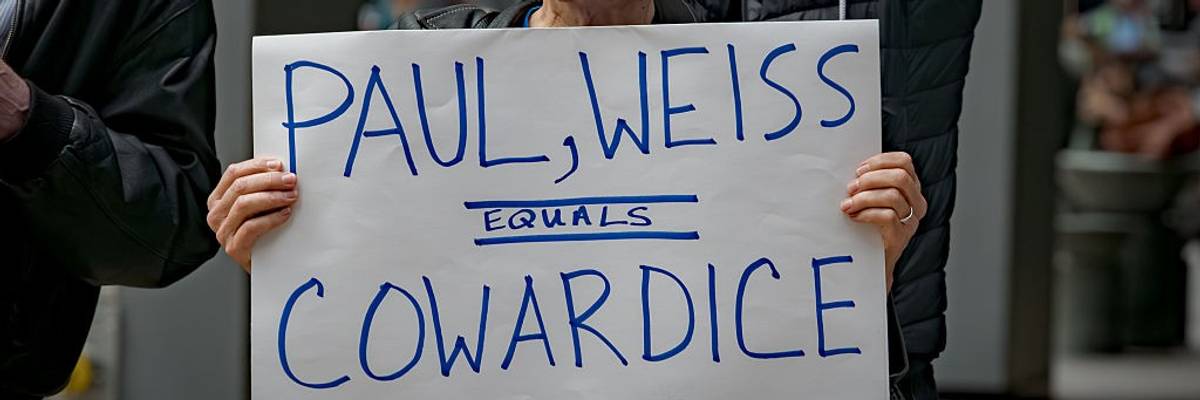
A participant is seen holding a sign outside Paul, Weiss law firm offices as members and allies of the activist group Rise and Resist gathered outside New York based law firms involved in the capitulation to appease Trump into rescinding an executive order that suspended the firm's lawyers from holding security clearances, terminated any of its federal government contracts and prevented its employees from entering federal government buildings on national security grounds.
Nine Big Law firms that paid a large sum of money and met demands for supposed peace with the Trump administration now find themselves the subject of DOJ subpoenas.
In an early victory for President Donald Trump’s protection racket, the leaders of nine prestigious Big Law firms collectively paid almost $1 billion and sacrificed their professional integrity to secure peace with his administration—or so they thought.
They were wrong.
In June 2025, the American Bar Association (ABA) sued the Trump administration for targeting those firms and five others. The ABA claims that Trump has sought to intimidate attorneys from representing clients and causes that he didn’t like.
After a federal judge denied Trump’s motion to dismiss the ABA’s complaint in April, the ABA subpoenaed the files of Trump adviser Boris Ephsteyn, a key liaison in negotiating settlements between the nine capitulating firms and the White House. The Department of Justice (DOJ) moved to quash the subpoena, arguing that the confidentiality of presidential communications is a constitutional safeguard.
Among the problems with the government’s position are that:
The dispute may well land in the US Supreme Court, which has become Trump’s preferred forum.
On July 2, the DOJ took a step that seemed odd: It served subpoenas on the nine capitulating firms, as well as four firms that fought Trump’s executive order and won. (It also subpoenaed a firm that took no public action.) Those subpoenas sought some of the same information that the ABA wanted from Ephsteyn:
All communications on or after January 20, 2025 that [each firm] sent to Boris Epshteyn, received from Boris Epshteyn, or participated in with Boris Epshteyn.
They also sought all communications relating to the negotiations, implementation, enforcement, and monitoring of the agreements.
Presumably the Justice Department already has access to the law firms’ communications with Ephsteyn. If so, why did it subpoena the firms for some of the same material, including documents that it didn’t want the White House to provide in response to the ABA’s subpoena?
Possible answers:
On July 17, the DOJ moved to disqualify Susman Godfrey from representing the ABA. It relies on the governing District of Columbia Rules of Professional Conduct, specifically, Rule 3.7, which states: “A lawyer shall not act as advocate at a trial in which the lawyer is likely to be a necessary witness….” [Emphasis supplied]
The Justice Department argues that the rule “contains a bright line rule prohibiting a lawyer from serving as both advocate and fact witness in the same matter….”
Not quite.
First, Rule 3.7 does not apply to all “fact witnesses.” It applies only to necessary witnesses. Susman Godfrey lawyers have become potential witnesses only because the DOJ subpoenaed documents from the firm as a whole.
Second, the rule applies only to individual lawyers within a law firm and, except in special circumstances inapplicable to the ABA case, not to all members of an entire firm. The DOJ has sought to depose as potential witnesses only the chairpersons of the 14 firms.
Third, the rule focuses on the interests of the client (here, the ABA), not its opponent (the White House). As the official commentary to Rule 3.7 explains: “If the only reason for not permitting a lawyer to combine the roles of advocate and witness is possible prejudice to the opposing party [the White House], there is no reason to disqualify other lawyers in the testifying lawyer’s firm from acting as advocates in that trial.”
Finally, the rule bars only an advocate who is likely to be a necessary witness at trial. The case may never reach the trial stage, and Susman Godfrey is free to represent the ABA until it does. Since 1992, DC Bar Ethics Opinion 228 has made that clear.
Meanwhile, the nine capitulating firms now face a quandary: What does Trump want from them? If they comply with the DOJ’s subpoenas, they will disclose some of the very information that the Justice Department is trying block by objecting to the ABA’s subpoena.
Regardless of the DOJ’s motivations, federal judges do not take kindly to an advocate’s misreading of the governing law or ignoring precedent that cuts against its position.
Here’s the real kicker: The subpoenas to Susman Godfrey and its fellow resisting law firms have already backfired. They are more evidence supporting the ABA’s claims of presidential intimidation and harassment.
As for the nine firms that settled—and the many other institutions that have that capitulated to Trump—the entire episode demonstrates that appeasing a bully will never produce finality.
Dear Common Dreams reader, It’s been nearly 30 years since I co-founded Common Dreams with my late wife, Lina Newhouser. We had the radical notion that journalism should serve the public good, not corporate profits. It was clear to us from the outset what it would take to build such a project. No paid advertisements. No corporate sponsors. No millionaire publisher telling us what to think or do. Many people said we wouldn't last a year, but we proved those doubters wrong. Together with a tremendous team of journalists and dedicated staff, we built an independent media outlet free from the constraints of profits and corporate control. Our mission has always been simple: To inform. To inspire. To ignite change for the common good. Building Common Dreams was not easy. Our survival was never guaranteed. When you take on the most powerful forces—Wall Street greed, fossil fuel industry destruction, Big Tech lobbyists, and uber-rich oligarchs who have spent billions upon billions rigging the economy and democracy in their favor—the only bulwark you have is supporters who believe in your work. But here’s the urgent message from me today. It's never been this bad out there. And it's never been this hard to keep us going. At the very moment Common Dreams is most needed, the threats we face are intensifying. We need your support now more than ever. We don't accept corporate advertising and never will. We don't have a paywall because we don't think people should be blocked from critical news based on their ability to pay. Everything we do is funded by the donations of readers like you. When everyone does the little they can afford, we are strong. But if that support retreats or dries up, so do we. Will you donate now to make sure Common Dreams not only survives but thrives? —Craig Brown, Co-founder |
In an early victory for President Donald Trump’s protection racket, the leaders of nine prestigious Big Law firms collectively paid almost $1 billion and sacrificed their professional integrity to secure peace with his administration—or so they thought.
They were wrong.
In June 2025, the American Bar Association (ABA) sued the Trump administration for targeting those firms and five others. The ABA claims that Trump has sought to intimidate attorneys from representing clients and causes that he didn’t like.
After a federal judge denied Trump’s motion to dismiss the ABA’s complaint in April, the ABA subpoenaed the files of Trump adviser Boris Ephsteyn, a key liaison in negotiating settlements between the nine capitulating firms and the White House. The Department of Justice (DOJ) moved to quash the subpoena, arguing that the confidentiality of presidential communications is a constitutional safeguard.
Among the problems with the government’s position are that:
The dispute may well land in the US Supreme Court, which has become Trump’s preferred forum.
On July 2, the DOJ took a step that seemed odd: It served subpoenas on the nine capitulating firms, as well as four firms that fought Trump’s executive order and won. (It also subpoenaed a firm that took no public action.) Those subpoenas sought some of the same information that the ABA wanted from Ephsteyn:
All communications on or after January 20, 2025 that [each firm] sent to Boris Epshteyn, received from Boris Epshteyn, or participated in with Boris Epshteyn.
They also sought all communications relating to the negotiations, implementation, enforcement, and monitoring of the agreements.
Presumably the Justice Department already has access to the law firms’ communications with Ephsteyn. If so, why did it subpoena the firms for some of the same material, including documents that it didn’t want the White House to provide in response to the ABA’s subpoena?
Possible answers:
On July 17, the DOJ moved to disqualify Susman Godfrey from representing the ABA. It relies on the governing District of Columbia Rules of Professional Conduct, specifically, Rule 3.7, which states: “A lawyer shall not act as advocate at a trial in which the lawyer is likely to be a necessary witness….” [Emphasis supplied]
The Justice Department argues that the rule “contains a bright line rule prohibiting a lawyer from serving as both advocate and fact witness in the same matter….”
Not quite.
First, Rule 3.7 does not apply to all “fact witnesses.” It applies only to necessary witnesses. Susman Godfrey lawyers have become potential witnesses only because the DOJ subpoenaed documents from the firm as a whole.
Second, the rule applies only to individual lawyers within a law firm and, except in special circumstances inapplicable to the ABA case, not to all members of an entire firm. The DOJ has sought to depose as potential witnesses only the chairpersons of the 14 firms.
Third, the rule focuses on the interests of the client (here, the ABA), not its opponent (the White House). As the official commentary to Rule 3.7 explains: “If the only reason for not permitting a lawyer to combine the roles of advocate and witness is possible prejudice to the opposing party [the White House], there is no reason to disqualify other lawyers in the testifying lawyer’s firm from acting as advocates in that trial.”
Finally, the rule bars only an advocate who is likely to be a necessary witness at trial. The case may never reach the trial stage, and Susman Godfrey is free to represent the ABA until it does. Since 1992, DC Bar Ethics Opinion 228 has made that clear.
Meanwhile, the nine capitulating firms now face a quandary: What does Trump want from them? If they comply with the DOJ’s subpoenas, they will disclose some of the very information that the Justice Department is trying block by objecting to the ABA’s subpoena.
Regardless of the DOJ’s motivations, federal judges do not take kindly to an advocate’s misreading of the governing law or ignoring precedent that cuts against its position.
Here’s the real kicker: The subpoenas to Susman Godfrey and its fellow resisting law firms have already backfired. They are more evidence supporting the ABA’s claims of presidential intimidation and harassment.
As for the nine firms that settled—and the many other institutions that have that capitulated to Trump—the entire episode demonstrates that appeasing a bully will never produce finality.
In an early victory for President Donald Trump’s protection racket, the leaders of nine prestigious Big Law firms collectively paid almost $1 billion and sacrificed their professional integrity to secure peace with his administration—or so they thought.
They were wrong.
In June 2025, the American Bar Association (ABA) sued the Trump administration for targeting those firms and five others. The ABA claims that Trump has sought to intimidate attorneys from representing clients and causes that he didn’t like.
After a federal judge denied Trump’s motion to dismiss the ABA’s complaint in April, the ABA subpoenaed the files of Trump adviser Boris Ephsteyn, a key liaison in negotiating settlements between the nine capitulating firms and the White House. The Department of Justice (DOJ) moved to quash the subpoena, arguing that the confidentiality of presidential communications is a constitutional safeguard.
Among the problems with the government’s position are that:
The dispute may well land in the US Supreme Court, which has become Trump’s preferred forum.
On July 2, the DOJ took a step that seemed odd: It served subpoenas on the nine capitulating firms, as well as four firms that fought Trump’s executive order and won. (It also subpoenaed a firm that took no public action.) Those subpoenas sought some of the same information that the ABA wanted from Ephsteyn:
All communications on or after January 20, 2025 that [each firm] sent to Boris Epshteyn, received from Boris Epshteyn, or participated in with Boris Epshteyn.
They also sought all communications relating to the negotiations, implementation, enforcement, and monitoring of the agreements.
Presumably the Justice Department already has access to the law firms’ communications with Ephsteyn. If so, why did it subpoena the firms for some of the same material, including documents that it didn’t want the White House to provide in response to the ABA’s subpoena?
Possible answers:
On July 17, the DOJ moved to disqualify Susman Godfrey from representing the ABA. It relies on the governing District of Columbia Rules of Professional Conduct, specifically, Rule 3.7, which states: “A lawyer shall not act as advocate at a trial in which the lawyer is likely to be a necessary witness….” [Emphasis supplied]
The Justice Department argues that the rule “contains a bright line rule prohibiting a lawyer from serving as both advocate and fact witness in the same matter….”
Not quite.
First, Rule 3.7 does not apply to all “fact witnesses.” It applies only to necessary witnesses. Susman Godfrey lawyers have become potential witnesses only because the DOJ subpoenaed documents from the firm as a whole.
Second, the rule applies only to individual lawyers within a law firm and, except in special circumstances inapplicable to the ABA case, not to all members of an entire firm. The DOJ has sought to depose as potential witnesses only the chairpersons of the 14 firms.
Third, the rule focuses on the interests of the client (here, the ABA), not its opponent (the White House). As the official commentary to Rule 3.7 explains: “If the only reason for not permitting a lawyer to combine the roles of advocate and witness is possible prejudice to the opposing party [the White House], there is no reason to disqualify other lawyers in the testifying lawyer’s firm from acting as advocates in that trial.”
Finally, the rule bars only an advocate who is likely to be a necessary witness at trial. The case may never reach the trial stage, and Susman Godfrey is free to represent the ABA until it does. Since 1992, DC Bar Ethics Opinion 228 has made that clear.
Meanwhile, the nine capitulating firms now face a quandary: What does Trump want from them? If they comply with the DOJ’s subpoenas, they will disclose some of the very information that the Justice Department is trying block by objecting to the ABA’s subpoena.
Regardless of the DOJ’s motivations, federal judges do not take kindly to an advocate’s misreading of the governing law or ignoring precedent that cuts against its position.
Here’s the real kicker: The subpoenas to Susman Godfrey and its fellow resisting law firms have already backfired. They are more evidence supporting the ABA’s claims of presidential intimidation and harassment.
As for the nine firms that settled—and the many other institutions that have that capitulated to Trump—the entire episode demonstrates that appeasing a bully will never produce finality.