
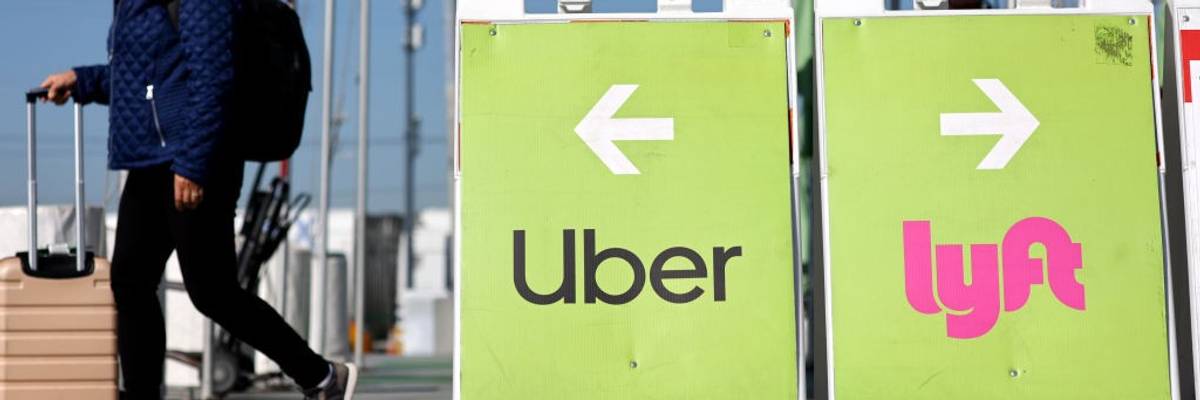
A traveler walks toward the Uber rideshare vehicle pickup area at Los Angeles International Airport (LAX) on February 8, 2023 in Los Angeles, California.
Workers Are Fighting Back Against Silicon Valley's Race to the Lowest Wage
There should be rules that prevent companies from using personal data to quietly lower pay for some people while others earn more for the same work, and working people should have the ability to organize.
Recent reporting has confirmed what many working people already feel every day: Companies are using personal data to decide the lowest wage someone will accept. What working people call exploitation, Silicon Valley calls innovation.
The seven largest gig platforms in the United States—Amazon Flex, DoorDash, Favor, Instacart, Lyft, Shipt, and Uber—are using data that tracks how long its users stay on an app, what jobs they accept, and how urgently they need income. This algorithm calculates what the employers can pay to get the job done at the lowest rate individuals will accept.
Not what their labor is worth. Not what is fair.
Gig work was sold as a way to make extra money on a flexible schedule. But that’s not what it looks like today. Nearly 1 in 4 people in the US now participate in some form of gig or freelance work. What was supposed to be a side hustle has become a main source of income for one-third of gig workers.
This isn’t just about gig work. It’s about whether we allow companies to rewrite the rules of the economy—or whether we demand a system that works for the people in it.
As layoffs rise and wages fall further behind the cost of living, more people are being pushed into this kind of work to keep up. Black people and other workers of color, who tend to be more dependent on this type of work than white people, have been especially hard hit. But these unfair practices can impact all workers.
“Under surveillance wage systems, different people may be paid different wages for largely the same work, and individual workers cannot predict their incomes over time,” the Washington Center for Equitable Growth reports. “Not only has pay for app-controlled jobs decreased over time,” but “people who work longer hours are paid less per hour.”
This is what happens when an economy limits options for some people, then funnels them into systems that take advantage of that lack of choice. Now they’re going even further—using data to predict what some experts call a “desperation wage,” or the lowest amount someone will accept based on their behavior.
And it’s not just happening in gig work. Similar systems are being used to set rent and adjust prices for goods and services in real time. The same idea applies: Use data to figure out the worst price or wage someone will tolerate, then charge just below that or pay just above it.
When you combine higher unemployment, lower wealth, and fewer protections, you get a system where some people have less room to say no—and are more likely to be taken advantage of. The message is simple: Take it or leave it. And for many, leaving it isn’t an option.
That’s why we’re starting to see pushback. Working people are demanding more transparency. Some are organizing. New models are emerging that promise fairer pay and more control. But these changes are happening because people are speaking up—not because companies chose to act.
So what needs to happen next is clear. If companies are going to use algorithms to shape pay and access to work, those systems should be transparent. People should know how their pay is calculated.
Workers should be able to see how much of each transaction goes to them compared with how much the company keeps. There should be rules that prevent companies from using personal data to quietly lower pay for some people while others earn more for the same work. And working people should have the ability to organize and push back.
Because this isn’t just about gig work. It’s about whether we allow companies to rewrite the rules of the economy—or whether we demand a system that works for the people in it. Technology should make work more stable, more fair, and more predictable. Right now, it’s doing the opposite. And that’s not inevitable.
It’s a choice.
An Urgent Message From Our Co-Founder
Dear Common Dreams reader, It’s been nearly 30 years since I co-founded Common Dreams with my late wife, Lina Newhouser. We had the radical notion that journalism should serve the public good, not corporate profits. It was clear to us from the outset what it would take to build such a project. No paid advertisements. No corporate sponsors. No millionaire publisher telling us what to think or do. Many people said we wouldn't last a year, but we proved those doubters wrong. Together with a tremendous team of journalists and dedicated staff, we built an independent media outlet free from the constraints of profits and corporate control. Our mission has always been simple: To inform. To inspire. To ignite change for the common good. Building Common Dreams was not easy. Our survival was never guaranteed. When you take on the most powerful forces—Wall Street greed, fossil fuel industry destruction, Big Tech lobbyists, and uber-rich oligarchs who have spent billions upon billions rigging the economy and democracy in their favor—the only bulwark you have is supporters who believe in your work. But here’s the urgent message from me today. It's never been this bad out there. And it's never been this hard to keep us going. At the very moment Common Dreams is most needed, the threats we face are intensifying. We need your support now more than ever. We don't accept corporate advertising and never will. We don't have a paywall because we don't think people should be blocked from critical news based on their ability to pay. Everything we do is funded by the donations of readers like you. When everyone does the little they can afford, we are strong. But if that support retreats or dries up, so do we. Will you donate now to make sure Common Dreams not only survives but thrives? —Craig Brown, Co-founder |
Recent reporting has confirmed what many working people already feel every day: Companies are using personal data to decide the lowest wage someone will accept. What working people call exploitation, Silicon Valley calls innovation.
The seven largest gig platforms in the United States—Amazon Flex, DoorDash, Favor, Instacart, Lyft, Shipt, and Uber—are using data that tracks how long its users stay on an app, what jobs they accept, and how urgently they need income. This algorithm calculates what the employers can pay to get the job done at the lowest rate individuals will accept.
Not what their labor is worth. Not what is fair.
Gig work was sold as a way to make extra money on a flexible schedule. But that’s not what it looks like today. Nearly 1 in 4 people in the US now participate in some form of gig or freelance work. What was supposed to be a side hustle has become a main source of income for one-third of gig workers.
This isn’t just about gig work. It’s about whether we allow companies to rewrite the rules of the economy—or whether we demand a system that works for the people in it.
As layoffs rise and wages fall further behind the cost of living, more people are being pushed into this kind of work to keep up. Black people and other workers of color, who tend to be more dependent on this type of work than white people, have been especially hard hit. But these unfair practices can impact all workers.
“Under surveillance wage systems, different people may be paid different wages for largely the same work, and individual workers cannot predict their incomes over time,” the Washington Center for Equitable Growth reports. “Not only has pay for app-controlled jobs decreased over time,” but “people who work longer hours are paid less per hour.”
This is what happens when an economy limits options for some people, then funnels them into systems that take advantage of that lack of choice. Now they’re going even further—using data to predict what some experts call a “desperation wage,” or the lowest amount someone will accept based on their behavior.
And it’s not just happening in gig work. Similar systems are being used to set rent and adjust prices for goods and services in real time. The same idea applies: Use data to figure out the worst price or wage someone will tolerate, then charge just below that or pay just above it.
When you combine higher unemployment, lower wealth, and fewer protections, you get a system where some people have less room to say no—and are more likely to be taken advantage of. The message is simple: Take it or leave it. And for many, leaving it isn’t an option.
That’s why we’re starting to see pushback. Working people are demanding more transparency. Some are organizing. New models are emerging that promise fairer pay and more control. But these changes are happening because people are speaking up—not because companies chose to act.
So what needs to happen next is clear. If companies are going to use algorithms to shape pay and access to work, those systems should be transparent. People should know how their pay is calculated.
Workers should be able to see how much of each transaction goes to them compared with how much the company keeps. There should be rules that prevent companies from using personal data to quietly lower pay for some people while others earn more for the same work. And working people should have the ability to organize and push back.
Because this isn’t just about gig work. It’s about whether we allow companies to rewrite the rules of the economy—or whether we demand a system that works for the people in it. Technology should make work more stable, more fair, and more predictable. Right now, it’s doing the opposite. And that’s not inevitable.
It’s a choice.
- Richest 0.001% Now Own Three Times More Wealth Than Poorest Half of Humanity Combined ›
- Bernie Sanders' "Raise the Wage Act" Would Make Life Better for 40 Million Americans: Analysis ›
- Bargaining to Save Our Jobs from Artificial Intelligence ›
- Meet the 7 Corporations Doing the Most to Undermine Democracy Worldwide ›
Recent reporting has confirmed what many working people already feel every day: Companies are using personal data to decide the lowest wage someone will accept. What working people call exploitation, Silicon Valley calls innovation.
The seven largest gig platforms in the United States—Amazon Flex, DoorDash, Favor, Instacart, Lyft, Shipt, and Uber—are using data that tracks how long its users stay on an app, what jobs they accept, and how urgently they need income. This algorithm calculates what the employers can pay to get the job done at the lowest rate individuals will accept.
Not what their labor is worth. Not what is fair.
Gig work was sold as a way to make extra money on a flexible schedule. But that’s not what it looks like today. Nearly 1 in 4 people in the US now participate in some form of gig or freelance work. What was supposed to be a side hustle has become a main source of income for one-third of gig workers.
This isn’t just about gig work. It’s about whether we allow companies to rewrite the rules of the economy—or whether we demand a system that works for the people in it.
As layoffs rise and wages fall further behind the cost of living, more people are being pushed into this kind of work to keep up. Black people and other workers of color, who tend to be more dependent on this type of work than white people, have been especially hard hit. But these unfair practices can impact all workers.
“Under surveillance wage systems, different people may be paid different wages for largely the same work, and individual workers cannot predict their incomes over time,” the Washington Center for Equitable Growth reports. “Not only has pay for app-controlled jobs decreased over time,” but “people who work longer hours are paid less per hour.”
This is what happens when an economy limits options for some people, then funnels them into systems that take advantage of that lack of choice. Now they’re going even further—using data to predict what some experts call a “desperation wage,” or the lowest amount someone will accept based on their behavior.
And it’s not just happening in gig work. Similar systems are being used to set rent and adjust prices for goods and services in real time. The same idea applies: Use data to figure out the worst price or wage someone will tolerate, then charge just below that or pay just above it.
When you combine higher unemployment, lower wealth, and fewer protections, you get a system where some people have less room to say no—and are more likely to be taken advantage of. The message is simple: Take it or leave it. And for many, leaving it isn’t an option.
That’s why we’re starting to see pushback. Working people are demanding more transparency. Some are organizing. New models are emerging that promise fairer pay and more control. But these changes are happening because people are speaking up—not because companies chose to act.
So what needs to happen next is clear. If companies are going to use algorithms to shape pay and access to work, those systems should be transparent. People should know how their pay is calculated.
Workers should be able to see how much of each transaction goes to them compared with how much the company keeps. There should be rules that prevent companies from using personal data to quietly lower pay for some people while others earn more for the same work. And working people should have the ability to organize and push back.
Because this isn’t just about gig work. It’s about whether we allow companies to rewrite the rules of the economy—or whether we demand a system that works for the people in it. Technology should make work more stable, more fair, and more predictable. Right now, it’s doing the opposite. And that’s not inevitable.
It’s a choice.
- Richest 0.001% Now Own Three Times More Wealth Than Poorest Half of Humanity Combined ›
- Bernie Sanders' "Raise the Wage Act" Would Make Life Better for 40 Million Americans: Analysis ›
- Bargaining to Save Our Jobs from Artificial Intelligence ›
- Meet the 7 Corporations Doing the Most to Undermine Democracy Worldwide ›