SUBSCRIBE TO OUR FREE NEWSLETTER
Daily news & progressive opinion—funded by the people, not the corporations—delivered straight to your inbox.
5
#000000
#FFFFFF
To donate by check, phone, or other method, see our More Ways to Give page.
Daily news & progressive opinion—funded by the people, not the corporations—delivered straight to your inbox.
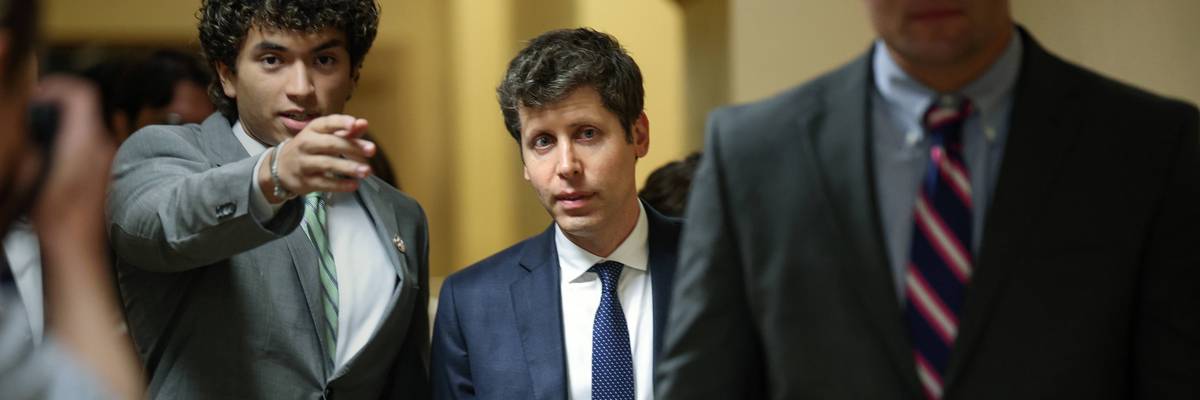
Sam Altman, CEO of OpenAI, leaves a meeting at the U.S. Capitol on July 29, 2026 in Washington, DC. Altman is meeting with lawmakers to discuss artificial intelligence policy ahead of the August 1 deadline for AI leaders to develop a framework to limit AI security threats.
Remember, these industry leaders are doing what they do for money—and lots of it. They are choosing to endanger the property and lives of others for personal profit. If they mess up, they should be forced to pay a very high price.
Amidst all the talk of the need for government regulation of AI, there has been too little discussion of the simplest route: criminal liability. The basic story is that the AI companies are being irresponsible in dealing with a product they know to be dangerous. The companies and the people who run them need to know that they face serious monetary risk from letting their little models run wild, and possibly criminal prosecution and jail time.
To be clear, sensible regulation of AI would be desirable. But let’s be serious. We have Pete Hegseth, Sean Duffy, and RFK Jr. all running major government departments. Do we really think having someone like this overseeing AI development would be an improvement?
We do already have laws to deal with harms caused by AI; we just need to be prepared to use them. Again, no one would expect President Trump’s personal lawyer and Attorney General Todd Blanche to take criminal or civil actions against AI in the public interest. If there was a major incident, he would most likely look to initiate a prosecution in pursuit of a payoff for dropping the case. But the law does not begin and end with Donald Trump’s Justice Department.
This isn’t a question of vindictiveness. We all know, the AI boys more than anyone, that AI is potentially very dangerous. If they opt to push full speed ahead, without necessary safeguards, they have to be prepared to face the consequences.
If we can forget about the extinction events that keep our pundits busy, and focus instead on the millions of far more likely disasters that AI could cause, there will almost certainly be plenty of room for state-level prosecutions, as well as civil suits.
To take some hypothetical cases, suppose an AI system manages to hack into a city’s traffic control system, and the resulting chaos leads to a number of car crashes, causing serious injuries and death, in addition to property damage. To take another case, suppose AI falsifies clinical trial data, leading a drug to be approved even though the trials show it to be ineffective or dangerous. Or suppose AI gets inside a bank’s computers and makes a total mess of its records in a way that they cannot be reconstructed. (I know banks almost certainly have backups, but our super-intelligent AI can surely get into the backup records as well.)
I know that each of these disasters is extremely unlikely, but all of them are millions or even billions of times more likely than the extinction events we hear about in the media. And given that there are probably millions of disasters like these that AI could possibly cause, there is a pretty good chance that we will see some serious disaster in the not-too-distant future.
As I noted in an earlier piece, a mistaken report from AI led the Navy to put helicopters in the air to board a Chinese cargo ship that they wrongly believed was carrying parts for Iran’s nuclear program. Fortunately, the information was checked, and the helicopters were called back before there was an actual confrontation, but this was luck. Sooner or later we will see a mistake that is not caught.
It would, of course, be best if an AI disaster never happens, but one practice that will substantially reduce the risk is that Sam Altman, Elon Musk, and the rest of the boys understand that their companies will be fully liable for any harm caused and they personally may face criminal liability. In other words, they may not just lose all their money; they may have to spend much of the rest of their lives in prison.
This isn’t a question of vindictiveness. We all know, the AI boys more than anyone, that AI is potentially very dangerous. If they opt to push full speed ahead, without necessary safeguards, they have to be prepared to face the consequences.
Drunk driving is really an appropriate analogy. Everyone should understand that if they get behind the wheel when they are intoxicated, they hugely increase the probability of an accident. That is why we throw people in jail for it. The same standard should apply to OpenAI, Anthropic, and the rest. If they push ahead with testing without appropriate safeguards, they should be prepared to pay the price, including potential criminal penalties.
Remember, they are doing this for money, lots of it. They are choosing to endanger the property and lives of others for personal profit. If they mess up, they should be forced to pay a very high price. Incentives matter.
Dear Common Dreams reader, It’s been nearly 30 years since I co-founded Common Dreams with my late wife, Lina Newhouser. We had the radical notion that journalism should serve the public good, not corporate profits. It was clear to us from the outset what it would take to build such a project. No paid advertisements. No corporate sponsors. No millionaire publisher telling us what to think or do. Many people said we wouldn't last a year, but we proved those doubters wrong. Together with a tremendous team of journalists and dedicated staff, we built an independent media outlet free from the constraints of profits and corporate control. Our mission has always been simple: To inform. To inspire. To ignite change for the common good. Building Common Dreams was not easy. Our survival was never guaranteed. When you take on the most powerful forces—Wall Street greed, fossil fuel industry destruction, Big Tech lobbyists, and uber-rich oligarchs who have spent billions upon billions rigging the economy and democracy in their favor—the only bulwark you have is supporters who believe in your work. But here’s the urgent message from me today. It's never been this bad out there. And it's never been this hard to keep us going. At the very moment Common Dreams is most needed, the threats we face are intensifying. We need your support now more than ever. We don't accept corporate advertising and never will. We don't have a paywall because we don't think people should be blocked from critical news based on their ability to pay. Everything we do is funded by the donations of readers like you. When everyone does the little they can afford, we are strong. But if that support retreats or dries up, so do we. Will you donate now to make sure Common Dreams not only survives but thrives? —Craig Brown, Co-founder |
Amidst all the talk of the need for government regulation of AI, there has been too little discussion of the simplest route: criminal liability. The basic story is that the AI companies are being irresponsible in dealing with a product they know to be dangerous. The companies and the people who run them need to know that they face serious monetary risk from letting their little models run wild, and possibly criminal prosecution and jail time.
To be clear, sensible regulation of AI would be desirable. But let’s be serious. We have Pete Hegseth, Sean Duffy, and RFK Jr. all running major government departments. Do we really think having someone like this overseeing AI development would be an improvement?
We do already have laws to deal with harms caused by AI; we just need to be prepared to use them. Again, no one would expect President Trump’s personal lawyer and Attorney General Todd Blanche to take criminal or civil actions against AI in the public interest. If there was a major incident, he would most likely look to initiate a prosecution in pursuit of a payoff for dropping the case. But the law does not begin and end with Donald Trump’s Justice Department.
This isn’t a question of vindictiveness. We all know, the AI boys more than anyone, that AI is potentially very dangerous. If they opt to push full speed ahead, without necessary safeguards, they have to be prepared to face the consequences.
If we can forget about the extinction events that keep our pundits busy, and focus instead on the millions of far more likely disasters that AI could cause, there will almost certainly be plenty of room for state-level prosecutions, as well as civil suits.
To take some hypothetical cases, suppose an AI system manages to hack into a city’s traffic control system, and the resulting chaos leads to a number of car crashes, causing serious injuries and death, in addition to property damage. To take another case, suppose AI falsifies clinical trial data, leading a drug to be approved even though the trials show it to be ineffective or dangerous. Or suppose AI gets inside a bank’s computers and makes a total mess of its records in a way that they cannot be reconstructed. (I know banks almost certainly have backups, but our super-intelligent AI can surely get into the backup records as well.)
I know that each of these disasters is extremely unlikely, but all of them are millions or even billions of times more likely than the extinction events we hear about in the media. And given that there are probably millions of disasters like these that AI could possibly cause, there is a pretty good chance that we will see some serious disaster in the not-too-distant future.
As I noted in an earlier piece, a mistaken report from AI led the Navy to put helicopters in the air to board a Chinese cargo ship that they wrongly believed was carrying parts for Iran’s nuclear program. Fortunately, the information was checked, and the helicopters were called back before there was an actual confrontation, but this was luck. Sooner or later we will see a mistake that is not caught.
It would, of course, be best if an AI disaster never happens, but one practice that will substantially reduce the risk is that Sam Altman, Elon Musk, and the rest of the boys understand that their companies will be fully liable for any harm caused and they personally may face criminal liability. In other words, they may not just lose all their money; they may have to spend much of the rest of their lives in prison.
This isn’t a question of vindictiveness. We all know, the AI boys more than anyone, that AI is potentially very dangerous. If they opt to push full speed ahead, without necessary safeguards, they have to be prepared to face the consequences.
Drunk driving is really an appropriate analogy. Everyone should understand that if they get behind the wheel when they are intoxicated, they hugely increase the probability of an accident. That is why we throw people in jail for it. The same standard should apply to OpenAI, Anthropic, and the rest. If they push ahead with testing without appropriate safeguards, they should be prepared to pay the price, including potential criminal penalties.
Remember, they are doing this for money, lots of it. They are choosing to endanger the property and lives of others for personal profit. If they mess up, they should be forced to pay a very high price. Incentives matter.
Amidst all the talk of the need for government regulation of AI, there has been too little discussion of the simplest route: criminal liability. The basic story is that the AI companies are being irresponsible in dealing with a product they know to be dangerous. The companies and the people who run them need to know that they face serious monetary risk from letting their little models run wild, and possibly criminal prosecution and jail time.
To be clear, sensible regulation of AI would be desirable. But let’s be serious. We have Pete Hegseth, Sean Duffy, and RFK Jr. all running major government departments. Do we really think having someone like this overseeing AI development would be an improvement?
We do already have laws to deal with harms caused by AI; we just need to be prepared to use them. Again, no one would expect President Trump’s personal lawyer and Attorney General Todd Blanche to take criminal or civil actions against AI in the public interest. If there was a major incident, he would most likely look to initiate a prosecution in pursuit of a payoff for dropping the case. But the law does not begin and end with Donald Trump’s Justice Department.
This isn’t a question of vindictiveness. We all know, the AI boys more than anyone, that AI is potentially very dangerous. If they opt to push full speed ahead, without necessary safeguards, they have to be prepared to face the consequences.
If we can forget about the extinction events that keep our pundits busy, and focus instead on the millions of far more likely disasters that AI could cause, there will almost certainly be plenty of room for state-level prosecutions, as well as civil suits.
To take some hypothetical cases, suppose an AI system manages to hack into a city’s traffic control system, and the resulting chaos leads to a number of car crashes, causing serious injuries and death, in addition to property damage. To take another case, suppose AI falsifies clinical trial data, leading a drug to be approved even though the trials show it to be ineffective or dangerous. Or suppose AI gets inside a bank’s computers and makes a total mess of its records in a way that they cannot be reconstructed. (I know banks almost certainly have backups, but our super-intelligent AI can surely get into the backup records as well.)
I know that each of these disasters is extremely unlikely, but all of them are millions or even billions of times more likely than the extinction events we hear about in the media. And given that there are probably millions of disasters like these that AI could possibly cause, there is a pretty good chance that we will see some serious disaster in the not-too-distant future.
As I noted in an earlier piece, a mistaken report from AI led the Navy to put helicopters in the air to board a Chinese cargo ship that they wrongly believed was carrying parts for Iran’s nuclear program. Fortunately, the information was checked, and the helicopters were called back before there was an actual confrontation, but this was luck. Sooner or later we will see a mistake that is not caught.
It would, of course, be best if an AI disaster never happens, but one practice that will substantially reduce the risk is that Sam Altman, Elon Musk, and the rest of the boys understand that their companies will be fully liable for any harm caused and they personally may face criminal liability. In other words, they may not just lose all their money; they may have to spend much of the rest of their lives in prison.
This isn’t a question of vindictiveness. We all know, the AI boys more than anyone, that AI is potentially very dangerous. If they opt to push full speed ahead, without necessary safeguards, they have to be prepared to face the consequences.
Drunk driving is really an appropriate analogy. Everyone should understand that if they get behind the wheel when they are intoxicated, they hugely increase the probability of an accident. That is why we throw people in jail for it. The same standard should apply to OpenAI, Anthropic, and the rest. If they push ahead with testing without appropriate safeguards, they should be prepared to pay the price, including potential criminal penalties.
Remember, they are doing this for money, lots of it. They are choosing to endanger the property and lives of others for personal profit. If they mess up, they should be forced to pay a very high price. Incentives matter.