SUBSCRIBE TO OUR FREE NEWSLETTER
Daily news & progressive opinion—funded by the people, not the corporations—delivered straight to your inbox.
5
#000000
#FFFFFF
To donate by check, phone, or other method, see our More Ways to Give page.
Daily news & progressive opinion—funded by the people, not the corporations—delivered straight to your inbox.
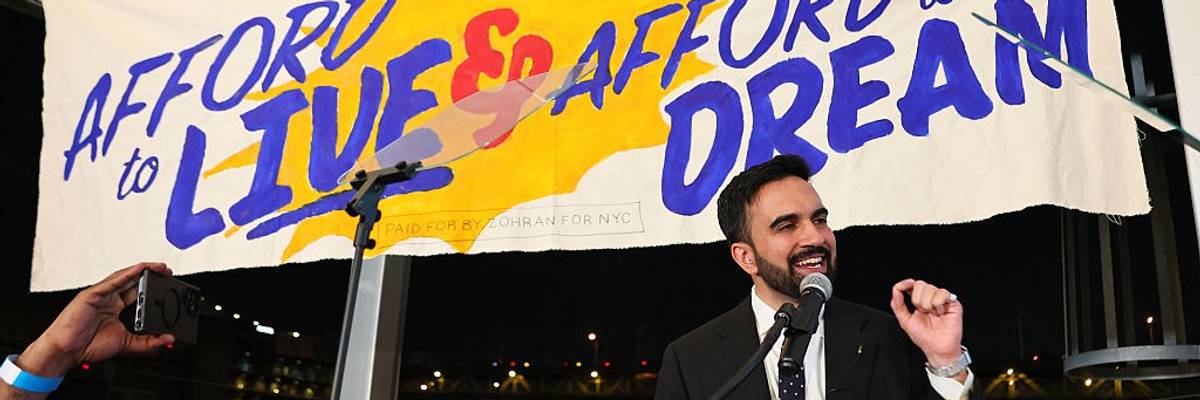
New York mayoral candidate, State Assemblyman Zohran Mamdani (D-36) speaks to supporters during an election night gathering at The Greats of Craft LIC on June 24, 2025 in the Long Island City neighborhood of the Queens borough in New York City.
The rise of cost-of-living focused candidates like Bernie Sanders, Zohran Mamdani, and Katie Wilson suggests that the electoral engagement of those who live on wages and salaries is rising.
Recent electoral dynamics suggest an affordability crisis is mobilizing a newly engaged electorate. Cost-of-living conditions are a measure of class relations: “According to a Statista Consumer Insights survey conducted in June and July 2025, 49% of US adults said that the high cost of living was one of the biggest challenges they currently face—making it by far the most common answer.”
The billionaire corporations and the wealthy, attached to the political system, are benefiting. “The total wealth of the top 10%—or those with a net worth of more than $2 million—reached a record $113 trillion in the second quarter, up from $108 trillion in the first quarter,” CNBC’s Robert Frank writes, citing Federal Reserve Bank data. “The increase follows three years of continued growth for those at the top, with the top 10% adding over $40 trillion to their wealth since 2020.”
A driver of the wealth boom at the top is the stock market. The prices of so-called Magnificent Seven stocks of Alphabet, Amazon, Apple, Nvidia, Meta, Microsoft and Tesla, are booming.
Meanwhile, a cost-of-living crisis festers on Main Street. Significantly, this working majority does not set prices or wages, the drivers of cost-of-living conditions.
NYC’s response to systemic unaffordable childcare, food, and rent is, therefore, a conscious decision of the working class on behalf of its own self-interest, electorally speaking.
It’s not an either or situation. “The roots of today’s affordability crisis actually lie not in recent price spikes,” according to Heidi Shierholz, president at the Economic Policy Institute and former chief economist at the US Department of Labor, “but in the long-term suppression of workers’ pay.”
On that same note of wage suppression, the working class labors largely union free in the US. Private-sector workers, the majority of the American labor force, do not collectively bargain their wages, salaries, and working conditions with employers.
Why? Anti-labor union policies are one of the main workplace conditions that have marked the postwar economy since the 1970s. Other anti-worker policies causing wage suppression are corporate-driven globalization and excessive unemployment.
So-called free trade pacts like the North American Free Trade Agreement happened under Democratic President Bill Clinton. Corporations relocated to Mexico, where workers earn a fraction of the pay that their American counterparts receive.
The federal minimum wage has been stuck at $7.25 an hour since 2009, when President Barack Obama was in the White House. He promised to sign the Employee Free Choice Act, an amendment to the National Labor Relations Act of 1935. With the EFCA, a simple majority of employees (50%) could check a card showing support to join a union at a workplace, replacing the National Labor Relations Board secret-ballot elections stacked in favor of employers.
First, however, the EFCA required enough votes to pass the Senate and House for President Obama to sign it into law, as he promised to. Democrats held a majority in the House and Senate in 2009-2011, Obama’s first term, but the bill never made it through the upper house.
Democrats had a majority in both chambers at the start of his presidency in the 111th Congress (2009-2011). The bill made it through the House but died in the Senate. “Several lobbying and consulting groups aligned with the Democratic Party were actively working with anti-union employers to defeat the EFCA,” according to the Arizona State University School Center for Work and Democracy.
The Democratic Party controlled the House and Senate when President Joe Biden took office in January 2021. Recall that Biden said, "Nothing fundamental will change," to his wealthy donors before winning the White House over Trump. Nothing fundamental changed in terms of reversing the fall of labor unions and rise of anti-union companies such as Walmart and Amazon.
Weakening unions has been a leading policy of neoliberalism, moving income and wealth from the bottom and middle to the top. Out with New Deal and Great Society policies for those who live on wages and salaries. In with policies for those who live on profits from investment capital.
Cut to today. The affordability crisis, the struggle to make ends meet, is a class struggle. That struggle is gaining traction electorally, beginning with the two presidential campaigns of Vermont independent Sen. Bernie Sanders.
A more recent case in point is the victory of Mayor-elect Zohran Mamdani, a democratic socialist, in NYC. How? He in part focused on rising prices of childcare, food, and rent compared with salaries and wages.
That is why the voters in NYC chose him as mayor recently. NYC’s response to systemic unaffordable childcare, food, and rent is, therefore, a conscious decision of the working class on behalf of its own self-interest, electorally speaking.
Therein lies a dilemma. I mean the fact that Democratic candidates, once elected, sell out their voters. By contrast, donors with deep pockets get what they demand, election after election.
This relationship profits donors. The politics of capitalist economics is a powerful force to contend with. There is no alternative to confronting this force, to paraphrase the late British Pime Minister Margaret Thatcher, proclaiming the power of liberal capitalism to rule via crushing opposition its opponents.
The popularity of Mr. Mamdani in NYC and Katie Wilson, mayor-elect in Seattle, who like him focuses laser like on policies to address the cost-of-living crisis for working families, suggests that the electoral engagement of those who live on wages and salaries is rising. That’s a step forward but by no means a victory over a resilient economic system with a track record of crushing and co-opting political reforms that improve people’s lives.
Dear Common Dreams reader, It’s been nearly 30 years since I co-founded Common Dreams with my late wife, Lina Newhouser. We had the radical notion that journalism should serve the public good, not corporate profits. It was clear to us from the outset what it would take to build such a project. No paid advertisements. No corporate sponsors. No millionaire publisher telling us what to think or do. Many people said we wouldn't last a year, but we proved those doubters wrong. Together with a tremendous team of journalists and dedicated staff, we built an independent media outlet free from the constraints of profits and corporate control. Our mission has always been simple: To inform. To inspire. To ignite change for the common good. Building Common Dreams was not easy. Our survival was never guaranteed. When you take on the most powerful forces—Wall Street greed, fossil fuel industry destruction, Big Tech lobbyists, and uber-rich oligarchs who have spent billions upon billions rigging the economy and democracy in their favor—the only bulwark you have is supporters who believe in your work. But here’s the urgent message from me today. It's never been this bad out there. And it's never been this hard to keep us going. At the very moment Common Dreams is most needed, the threats we face are intensifying. We need your support now more than ever. We don't accept corporate advertising and never will. We don't have a paywall because we don't think people should be blocked from critical news based on their ability to pay. Everything we do is funded by the donations of readers like you. When everyone does the little they can afford, we are strong. But if that support retreats or dries up, so do we. Will you donate now to make sure Common Dreams not only survives but thrives? —Craig Brown, Co-founder |
Recent electoral dynamics suggest an affordability crisis is mobilizing a newly engaged electorate. Cost-of-living conditions are a measure of class relations: “According to a Statista Consumer Insights survey conducted in June and July 2025, 49% of US adults said that the high cost of living was one of the biggest challenges they currently face—making it by far the most common answer.”
The billionaire corporations and the wealthy, attached to the political system, are benefiting. “The total wealth of the top 10%—or those with a net worth of more than $2 million—reached a record $113 trillion in the second quarter, up from $108 trillion in the first quarter,” CNBC’s Robert Frank writes, citing Federal Reserve Bank data. “The increase follows three years of continued growth for those at the top, with the top 10% adding over $40 trillion to their wealth since 2020.”
A driver of the wealth boom at the top is the stock market. The prices of so-called Magnificent Seven stocks of Alphabet, Amazon, Apple, Nvidia, Meta, Microsoft and Tesla, are booming.
Meanwhile, a cost-of-living crisis festers on Main Street. Significantly, this working majority does not set prices or wages, the drivers of cost-of-living conditions.
NYC’s response to systemic unaffordable childcare, food, and rent is, therefore, a conscious decision of the working class on behalf of its own self-interest, electorally speaking.
It’s not an either or situation. “The roots of today’s affordability crisis actually lie not in recent price spikes,” according to Heidi Shierholz, president at the Economic Policy Institute and former chief economist at the US Department of Labor, “but in the long-term suppression of workers’ pay.”
On that same note of wage suppression, the working class labors largely union free in the US. Private-sector workers, the majority of the American labor force, do not collectively bargain their wages, salaries, and working conditions with employers.
Why? Anti-labor union policies are one of the main workplace conditions that have marked the postwar economy since the 1970s. Other anti-worker policies causing wage suppression are corporate-driven globalization and excessive unemployment.
So-called free trade pacts like the North American Free Trade Agreement happened under Democratic President Bill Clinton. Corporations relocated to Mexico, where workers earn a fraction of the pay that their American counterparts receive.
The federal minimum wage has been stuck at $7.25 an hour since 2009, when President Barack Obama was in the White House. He promised to sign the Employee Free Choice Act, an amendment to the National Labor Relations Act of 1935. With the EFCA, a simple majority of employees (50%) could check a card showing support to join a union at a workplace, replacing the National Labor Relations Board secret-ballot elections stacked in favor of employers.
First, however, the EFCA required enough votes to pass the Senate and House for President Obama to sign it into law, as he promised to. Democrats held a majority in the House and Senate in 2009-2011, Obama’s first term, but the bill never made it through the upper house.
Democrats had a majority in both chambers at the start of his presidency in the 111th Congress (2009-2011). The bill made it through the House but died in the Senate. “Several lobbying and consulting groups aligned with the Democratic Party were actively working with anti-union employers to defeat the EFCA,” according to the Arizona State University School Center for Work and Democracy.
The Democratic Party controlled the House and Senate when President Joe Biden took office in January 2021. Recall that Biden said, "Nothing fundamental will change," to his wealthy donors before winning the White House over Trump. Nothing fundamental changed in terms of reversing the fall of labor unions and rise of anti-union companies such as Walmart and Amazon.
Weakening unions has been a leading policy of neoliberalism, moving income and wealth from the bottom and middle to the top. Out with New Deal and Great Society policies for those who live on wages and salaries. In with policies for those who live on profits from investment capital.
Cut to today. The affordability crisis, the struggle to make ends meet, is a class struggle. That struggle is gaining traction electorally, beginning with the two presidential campaigns of Vermont independent Sen. Bernie Sanders.
A more recent case in point is the victory of Mayor-elect Zohran Mamdani, a democratic socialist, in NYC. How? He in part focused on rising prices of childcare, food, and rent compared with salaries and wages.
That is why the voters in NYC chose him as mayor recently. NYC’s response to systemic unaffordable childcare, food, and rent is, therefore, a conscious decision of the working class on behalf of its own self-interest, electorally speaking.
Therein lies a dilemma. I mean the fact that Democratic candidates, once elected, sell out their voters. By contrast, donors with deep pockets get what they demand, election after election.
This relationship profits donors. The politics of capitalist economics is a powerful force to contend with. There is no alternative to confronting this force, to paraphrase the late British Pime Minister Margaret Thatcher, proclaiming the power of liberal capitalism to rule via crushing opposition its opponents.
The popularity of Mr. Mamdani in NYC and Katie Wilson, mayor-elect in Seattle, who like him focuses laser like on policies to address the cost-of-living crisis for working families, suggests that the electoral engagement of those who live on wages and salaries is rising. That’s a step forward but by no means a victory over a resilient economic system with a track record of crushing and co-opting political reforms that improve people’s lives.
Recent electoral dynamics suggest an affordability crisis is mobilizing a newly engaged electorate. Cost-of-living conditions are a measure of class relations: “According to a Statista Consumer Insights survey conducted in June and July 2025, 49% of US adults said that the high cost of living was one of the biggest challenges they currently face—making it by far the most common answer.”
The billionaire corporations and the wealthy, attached to the political system, are benefiting. “The total wealth of the top 10%—or those with a net worth of more than $2 million—reached a record $113 trillion in the second quarter, up from $108 trillion in the first quarter,” CNBC’s Robert Frank writes, citing Federal Reserve Bank data. “The increase follows three years of continued growth for those at the top, with the top 10% adding over $40 trillion to their wealth since 2020.”
A driver of the wealth boom at the top is the stock market. The prices of so-called Magnificent Seven stocks of Alphabet, Amazon, Apple, Nvidia, Meta, Microsoft and Tesla, are booming.
Meanwhile, a cost-of-living crisis festers on Main Street. Significantly, this working majority does not set prices or wages, the drivers of cost-of-living conditions.
NYC’s response to systemic unaffordable childcare, food, and rent is, therefore, a conscious decision of the working class on behalf of its own self-interest, electorally speaking.
It’s not an either or situation. “The roots of today’s affordability crisis actually lie not in recent price spikes,” according to Heidi Shierholz, president at the Economic Policy Institute and former chief economist at the US Department of Labor, “but in the long-term suppression of workers’ pay.”
On that same note of wage suppression, the working class labors largely union free in the US. Private-sector workers, the majority of the American labor force, do not collectively bargain their wages, salaries, and working conditions with employers.
Why? Anti-labor union policies are one of the main workplace conditions that have marked the postwar economy since the 1970s. Other anti-worker policies causing wage suppression are corporate-driven globalization and excessive unemployment.
So-called free trade pacts like the North American Free Trade Agreement happened under Democratic President Bill Clinton. Corporations relocated to Mexico, where workers earn a fraction of the pay that their American counterparts receive.
The federal minimum wage has been stuck at $7.25 an hour since 2009, when President Barack Obama was in the White House. He promised to sign the Employee Free Choice Act, an amendment to the National Labor Relations Act of 1935. With the EFCA, a simple majority of employees (50%) could check a card showing support to join a union at a workplace, replacing the National Labor Relations Board secret-ballot elections stacked in favor of employers.
First, however, the EFCA required enough votes to pass the Senate and House for President Obama to sign it into law, as he promised to. Democrats held a majority in the House and Senate in 2009-2011, Obama’s first term, but the bill never made it through the upper house.
Democrats had a majority in both chambers at the start of his presidency in the 111th Congress (2009-2011). The bill made it through the House but died in the Senate. “Several lobbying and consulting groups aligned with the Democratic Party were actively working with anti-union employers to defeat the EFCA,” according to the Arizona State University School Center for Work and Democracy.
The Democratic Party controlled the House and Senate when President Joe Biden took office in January 2021. Recall that Biden said, "Nothing fundamental will change," to his wealthy donors before winning the White House over Trump. Nothing fundamental changed in terms of reversing the fall of labor unions and rise of anti-union companies such as Walmart and Amazon.
Weakening unions has been a leading policy of neoliberalism, moving income and wealth from the bottom and middle to the top. Out with New Deal and Great Society policies for those who live on wages and salaries. In with policies for those who live on profits from investment capital.
Cut to today. The affordability crisis, the struggle to make ends meet, is a class struggle. That struggle is gaining traction electorally, beginning with the two presidential campaigns of Vermont independent Sen. Bernie Sanders.
A more recent case in point is the victory of Mayor-elect Zohran Mamdani, a democratic socialist, in NYC. How? He in part focused on rising prices of childcare, food, and rent compared with salaries and wages.
That is why the voters in NYC chose him as mayor recently. NYC’s response to systemic unaffordable childcare, food, and rent is, therefore, a conscious decision of the working class on behalf of its own self-interest, electorally speaking.
Therein lies a dilemma. I mean the fact that Democratic candidates, once elected, sell out their voters. By contrast, donors with deep pockets get what they demand, election after election.
This relationship profits donors. The politics of capitalist economics is a powerful force to contend with. There is no alternative to confronting this force, to paraphrase the late British Pime Minister Margaret Thatcher, proclaiming the power of liberal capitalism to rule via crushing opposition its opponents.
The popularity of Mr. Mamdani in NYC and Katie Wilson, mayor-elect in Seattle, who like him focuses laser like on policies to address the cost-of-living crisis for working families, suggests that the electoral engagement of those who live on wages and salaries is rising. That’s a step forward but by no means a victory over a resilient economic system with a track record of crushing and co-opting political reforms that improve people’s lives.