SUBSCRIBE TO OUR FREE NEWSLETTER
Daily news & progressive opinion—funded by the people, not the corporations—delivered straight to your inbox.
5
#000000
#FFFFFF
To donate by check, phone, or other method, see our More Ways to Give page.
Daily news & progressive opinion—funded by the people, not the corporations—delivered straight to your inbox.
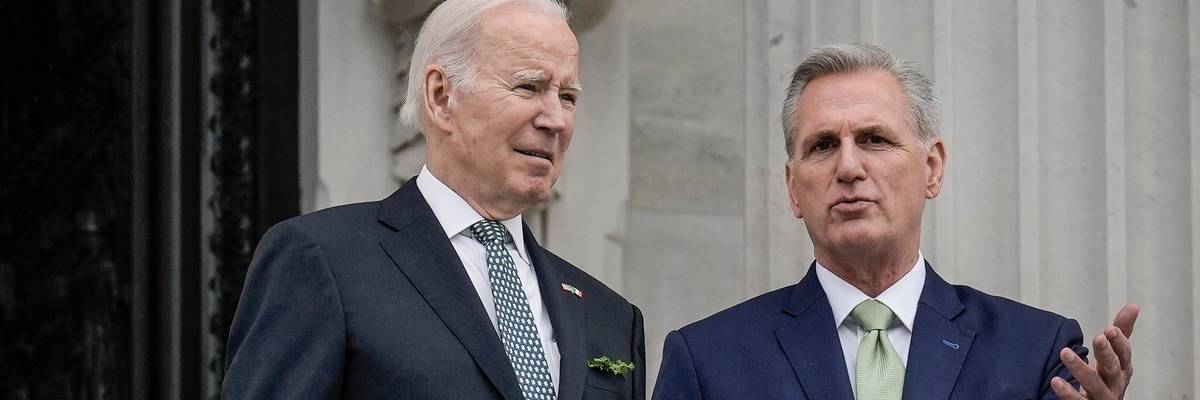
While Biden was able to hold off the worst harm, this deal still causes significant harm to ordinary people and sets a terrible precedent for more hostage-taking.
The Fiscal Responsibility Act of 2023, the debt ceiling deal President Biden signed into law recently, served its primary purpose: avoiding default on our nation’s debt, which would have plunged the economy into chaos.
President Biden also skillfully repelled the worst of the House Republicans’ demands, which included slashing social programs and government services by 60 percent. That would have utterly devastated everything from Head Start and Pell Grants to job training, housing and nutrition assistance, and even air traffic safety.
So talking points from the White House paint the bipartisan deal as a victory for ordinary people. But that isn’t the whole story.
The bill will still cut or freeze many programs that were already underfunded by the last debt ceiling drama in 2011 — even as it increases military spending by a whopping $28 billion, bringing the Pentagon to a shocking 56 percent share of the budget Congress sets each year.
The deal also prevents President Biden from pausing student loan payments and imposes harsh “work requirements” for some recipients of the Supplemental Nutrition Assistance Program (SNAP aka food stamps) and the Temporary Assistance to Needy Families (TANF) program.
Work requirements don’t encourage work — they just make it more difficult for even eligible families to get help.
In a final blow, the deal cuts corners on environmental review for energy projects — and specifically greenlights a pet project of Senator Joe Manchin (D-WV) for a highly destructive fossil fuel pipeline for his state. Authorization of this pipeline had failed every other legislative attempt.
Hacking back social programs and basic government services while spending more money on the Pentagon — by far the largest part of the discretionary budget — proves none of this was about reducing the debt. So does the fact that the GOP allowed no tax increases on the wealthiest Americans or corporations to raise revenue.
Instead, GOP House Speaker Kevin McCarthy’s Republican caucus insisted on taking the debt ceiling and the American people hostage to their demands to slash funding for programs that benefit people other than the wealthy and military contractors. This after they raised the debt ceiling three times under Trump, who added $7.8 trillion to the national debt.
In fact, Republicans are currently preparing a bill that will extend the 2017 Trump tax cuts for the wealthy, which would the Congressional Budget Office estimates would add $3.5 trillion more to the debt over the next decade.
While Biden was able to hold off the worst harm, this deal still causes significant harm to ordinary people and sets a terrible precedent for more hostage taking.
In the future, Congress should abolish the debt ceiling. It doesn’t limit debt — it just creates one hostage situation after another when the GOP refuses to pay the country’s bills.
If Congress won’t act, the president should intervene with his considerable executive power and invoke Section 4 of the 14th amendment, which says that the validity of the public debt of the United States “shall not be questioned.” He could even mint enough money to ensure there would be no default and no harm to families.
Democratic lawmakers and President Biden didn’t take any of these steps, instead opting to negotiate with their hostage takers. Next time, they shouldn’t make the same mistake.
Dear Common Dreams reader, It’s been nearly 30 years since I co-founded Common Dreams with my late wife, Lina Newhouser. We had the radical notion that journalism should serve the public good, not corporate profits. It was clear to us from the outset what it would take to build such a project. No paid advertisements. No corporate sponsors. No millionaire publisher telling us what to think or do. Many people said we wouldn't last a year, but we proved those doubters wrong. Together with a tremendous team of journalists and dedicated staff, we built an independent media outlet free from the constraints of profits and corporate control. Our mission has always been simple: To inform. To inspire. To ignite change for the common good. Building Common Dreams was not easy. Our survival was never guaranteed. When you take on the most powerful forces—Wall Street greed, fossil fuel industry destruction, Big Tech lobbyists, and uber-rich oligarchs who have spent billions upon billions rigging the economy and democracy in their favor—the only bulwark you have is supporters who believe in your work. But here’s the urgent message from me today. It's never been this bad out there. And it's never been this hard to keep us going. At the very moment Common Dreams is most needed, the threats we face are intensifying. We need your support now more than ever. We don't accept corporate advertising and never will. We don't have a paywall because we don't think people should be blocked from critical news based on their ability to pay. Everything we do is funded by the donations of readers like you. When everyone does the little they can afford, we are strong. But if that support retreats or dries up, so do we. Will you donate now to make sure Common Dreams not only survives but thrives? —Craig Brown, Co-founder |
The Fiscal Responsibility Act of 2023, the debt ceiling deal President Biden signed into law recently, served its primary purpose: avoiding default on our nation’s debt, which would have plunged the economy into chaos.
President Biden also skillfully repelled the worst of the House Republicans’ demands, which included slashing social programs and government services by 60 percent. That would have utterly devastated everything from Head Start and Pell Grants to job training, housing and nutrition assistance, and even air traffic safety.
So talking points from the White House paint the bipartisan deal as a victory for ordinary people. But that isn’t the whole story.
The bill will still cut or freeze many programs that were already underfunded by the last debt ceiling drama in 2011 — even as it increases military spending by a whopping $28 billion, bringing the Pentagon to a shocking 56 percent share of the budget Congress sets each year.
The deal also prevents President Biden from pausing student loan payments and imposes harsh “work requirements” for some recipients of the Supplemental Nutrition Assistance Program (SNAP aka food stamps) and the Temporary Assistance to Needy Families (TANF) program.
Work requirements don’t encourage work — they just make it more difficult for even eligible families to get help.
In a final blow, the deal cuts corners on environmental review for energy projects — and specifically greenlights a pet project of Senator Joe Manchin (D-WV) for a highly destructive fossil fuel pipeline for his state. Authorization of this pipeline had failed every other legislative attempt.
Hacking back social programs and basic government services while spending more money on the Pentagon — by far the largest part of the discretionary budget — proves none of this was about reducing the debt. So does the fact that the GOP allowed no tax increases on the wealthiest Americans or corporations to raise revenue.
Instead, GOP House Speaker Kevin McCarthy’s Republican caucus insisted on taking the debt ceiling and the American people hostage to their demands to slash funding for programs that benefit people other than the wealthy and military contractors. This after they raised the debt ceiling three times under Trump, who added $7.8 trillion to the national debt.
In fact, Republicans are currently preparing a bill that will extend the 2017 Trump tax cuts for the wealthy, which would the Congressional Budget Office estimates would add $3.5 trillion more to the debt over the next decade.
While Biden was able to hold off the worst harm, this deal still causes significant harm to ordinary people and sets a terrible precedent for more hostage taking.
In the future, Congress should abolish the debt ceiling. It doesn’t limit debt — it just creates one hostage situation after another when the GOP refuses to pay the country’s bills.
If Congress won’t act, the president should intervene with his considerable executive power and invoke Section 4 of the 14th amendment, which says that the validity of the public debt of the United States “shall not be questioned.” He could even mint enough money to ensure there would be no default and no harm to families.
Democratic lawmakers and President Biden didn’t take any of these steps, instead opting to negotiate with their hostage takers. Next time, they shouldn’t make the same mistake.
The Fiscal Responsibility Act of 2023, the debt ceiling deal President Biden signed into law recently, served its primary purpose: avoiding default on our nation’s debt, which would have plunged the economy into chaos.
President Biden also skillfully repelled the worst of the House Republicans’ demands, which included slashing social programs and government services by 60 percent. That would have utterly devastated everything from Head Start and Pell Grants to job training, housing and nutrition assistance, and even air traffic safety.
So talking points from the White House paint the bipartisan deal as a victory for ordinary people. But that isn’t the whole story.
The bill will still cut or freeze many programs that were already underfunded by the last debt ceiling drama in 2011 — even as it increases military spending by a whopping $28 billion, bringing the Pentagon to a shocking 56 percent share of the budget Congress sets each year.
The deal also prevents President Biden from pausing student loan payments and imposes harsh “work requirements” for some recipients of the Supplemental Nutrition Assistance Program (SNAP aka food stamps) and the Temporary Assistance to Needy Families (TANF) program.
Work requirements don’t encourage work — they just make it more difficult for even eligible families to get help.
In a final blow, the deal cuts corners on environmental review for energy projects — and specifically greenlights a pet project of Senator Joe Manchin (D-WV) for a highly destructive fossil fuel pipeline for his state. Authorization of this pipeline had failed every other legislative attempt.
Hacking back social programs and basic government services while spending more money on the Pentagon — by far the largest part of the discretionary budget — proves none of this was about reducing the debt. So does the fact that the GOP allowed no tax increases on the wealthiest Americans or corporations to raise revenue.
Instead, GOP House Speaker Kevin McCarthy’s Republican caucus insisted on taking the debt ceiling and the American people hostage to their demands to slash funding for programs that benefit people other than the wealthy and military contractors. This after they raised the debt ceiling three times under Trump, who added $7.8 trillion to the national debt.
In fact, Republicans are currently preparing a bill that will extend the 2017 Trump tax cuts for the wealthy, which would the Congressional Budget Office estimates would add $3.5 trillion more to the debt over the next decade.
While Biden was able to hold off the worst harm, this deal still causes significant harm to ordinary people and sets a terrible precedent for more hostage taking.
In the future, Congress should abolish the debt ceiling. It doesn’t limit debt — it just creates one hostage situation after another when the GOP refuses to pay the country’s bills.
If Congress won’t act, the president should intervene with his considerable executive power and invoke Section 4 of the 14th amendment, which says that the validity of the public debt of the United States “shall not be questioned.” He could even mint enough money to ensure there would be no default and no harm to families.
Democratic lawmakers and President Biden didn’t take any of these steps, instead opting to negotiate with their hostage takers. Next time, they shouldn’t make the same mistake.