SUBSCRIBE TO OUR FREE NEWSLETTER
Daily news & progressive opinion—funded by the people, not the corporations—delivered straight to your inbox.
5
#000000
#FFFFFF
To donate by check, phone, or other method, see our More Ways to Give page.


Daily news & progressive opinion—funded by the people, not the corporations—delivered straight to your inbox.

Mia Jacobs
Communications Director, CPC
Email: Mia.Jacobs@mail.house.gov
Phone: (202) 225-3106
Representative Pramila Jayapal, chair of the Congressional Progressive Caucus, issued the following statement on the Congressional Budget Office's (CBO) estimate of the cost of President Biden's executive order canceling student debt for more than 40 million borrowers:
WASHINGTON - Representative Pramila Jayapal, chair of the Congressional Progressive Caucus, issued the following statement on the Congressional Budget Office's (CBO) estimate of the cost of President Biden's executive order canceling student debt for more than 40 million borrowers:
"President Biden's historic decision to cancel student debt brought well-deserved relief to 43 million people across the country -- 97 percent of whom are low- and middle-income people -- who have been unable to buy homes, invest in their communities, or start a family because of the burden of their debt. As CBO's own report points out, 45 percent -- nearly half -- of Americans will see their loans fully canceled. The benefits of this decision cannot be overstated, especially for Black and Latino borrowers who have been disproportionately impacted by the student-debt crisis.
"Unlike Republicans, who sought tax breaks for corporations and billionaires, the fulfillment of this campaign promise illustrates President Biden's commitment to lift up working families. The President's student debt cancellation order is a major accomplishment with broadly shared benefits that is helping give people the freedom to reach their full potential, instead of sinking trillions of dollars into corporations and the rich."
CBO's cost projection for student debt cancellation is over a 40-year period instead of the 10-year projection CBO typically uses. When put in the context of the U.S. economy, student debt cancellation is projected to peak at a bit more than 0.09 percent of GDP in 2023-25. That is less than one-thirtieth of the military budget. Projected costs for student debt cancellation then fall to around 0.07 percent of GDP by 2032 and drop to 0.02 percent of GDP by 2042.
The Congressional Progressive Caucus (CPC) is made up of nearly 100 members standing up for progressive ideals in Washington and throughout the country. Since 1991, the CPC has advocated for progressive policies that prioritize working Americans over corporate interests, fight economic and social inequality, and advance civil liberties.
(202) 225-3106Democrats on the Joint Economic Committee said that "continued uncertainty" caused by the president's policies could reduce manufacturing investments by nearly half a trillion dollars by the end of this decade.
US President Donald Trump's tariff whiplash has already harmed domestic manufacturing and could continue to do so through at least the end of this decade to the tune of nearly half a trillion dollars, a report published Monday by congressional Democrats on a key economic committee warned.
The Joint Economic Committee (JEC)-Minority said that recent data belied Trump's claim that his global trade war would boost domestic manufacturing, pointing to the 37,000 manufacturing jobs lost since the president announced his so-called "Liberation Day" tariffs in April.
"Hiring in the manufacturing sector has dropped to its lowest level in nearly a decade," the Democrats on the committee wrote. "In addition, many experts have noted that in and of itself, the uncertainty created by the administration so far could significantly damage the broader economy long-term."
"Based on both US business investment projections and economic analyses of the UK in the aftermath of Brexit, the Joint Economic Committee-Minority calculates that a similarly prolonged period of uncertainty in the US could result in an average of 13% less manufacturing investment per year, amounting to approximately $490 billion in foregone investment by 2029," the report states.
"The uncertainty created by the administration so far could significantly damage the broader economy long-term."
"Although businesses have received additional clarity on reciprocal tariff rates in recent days, uncertainty over outstanding negotiations is likely to continue to delay long-term investments and pricing decisions," the publication adds. "Furthermore, even if the uncertainty about the US economy were to end tomorrow, evidence suggests that the uncertainty that businesses have already faced in recent months would still have long-term consequences for the manufacturing sector."
According to the JEC Democrats, the Trump administration has made nearly 100 different tariff policy decisions since April—"including threats, delays, and reversals"—creating uncertainty and insecurity in markets and economies around the world. It's not just manufacturing and markets—economic data released last week by the Bureau of Labor Statistics showed that businesses in some sectors are passing the costs of Trump's tariffs on to consumers.
As the new JEC minority report notes:
As independent research has shown, businesses are less likely to make long-term investments when they face high uncertainty about future policies and economic conditions. For manufacturers, decisions to expand production—which often entail major, irreversible investments in equipment and new facilities that typically take years to complete—require an especially high degree of confidence that these expenses will pay off. This barrier, along with other factors, makes manufacturing the sector most likely to see its growth affected by trade policy uncertainty, as noted recently by analysts at Goldman Sachs.
"Strengthening American manufacturing is critical to the future of our economy and our national security," Joint Economic Committee Ranking Member Maggie Hassan (D-N.H.) said in a statement Monday. "While President Trump promised that he would expand our manufacturing sector, this report shows that, instead, the chaos and uncertainty created by his tariffs has placed a burden on American manufacturers that could weigh our country down for years to come."
"Congressman Bresnahan didn't just vote to gut Pennsylvania hospitals. He looked out for his own bottom line before doing it," said one advocate.
Congressman Rob Bresnahan, a Republican who campaigned on banning stock trading by lawmakers only to make at least 626 stock trades since taking office in January, was under scrutiny Monday for a particular sale he made just before he voted for the largest Medicaid cut in US history.
Soon after a report showed that 10 rural hospitals in Bresnahan's state of Pennsylvania were at risk of being shut down, the congressman sold between $100,001 and $250,000 in bonds issued by the Allegheny County Hospital Development Authority for the University of Pittsburgh Medical Center.
The New York Times reported on the sale a month after it was revealed that Bresnahan sold up to $15,000 of stock he held in Centene Corporation, the largest Medicaid provider in the country. When President Donald Trump signed the so-called One Big Beautiful Bill Act into law last month, Centene's stock plummeted by 40%.
Bresnahan repeatedly said he would not vote to cut the safety net before he voted in favor of the bill.
The law is expected to cut $1 trillion from Medicaid over the next decade, with 10-15 million people projected to lose health coverage through the safety net program, according to one recent analysis. More than 700 hospitals, particularly those in rural areas, are likely to close due to a loss of Medicaid funding.
"His prolific stock trading is more than just a broken promise," said Cousin. "It's political malpractice and a scandal of his own making."
The economic justice group Unrig the Economy said that despite Bresnahan's introduction of a bill in May to bar members of Congress from buying and selling stocks—with the caveat that they could keep stocks they held before starting their terms in a blind trust—the congressman is "the one doing the selling... out of Pennsylvania hospitals."
"Congressman Bresnahan didn't just vote to gut Pennsylvania hospitals. He looked out for his own bottom line before doing it," said Unrig Our Economy campaign director Leor Tal. "Hospitals across Pennsylvania could close thanks to his vote, forcing families to drive long distances and experience longer wait times for critical care."
"Not everyone has a secret helicopter they can use whenever they want," added Tal, referring to recent reports that the multi-millionaire congressman owns a helicopter worth as much as $1.5 million, which he purchased through a limited liability company he set up.
Eli Cousin, a spokesperson for the Democratic Congressional Campaign Committee, told the Times that Bresnahan's stock trading "will define his time in Washington and be a major reason why he will lose his seat."
"His prolific stock trading is more than just a broken promise," said Cousin. "It's political malpractice and a scandal of his own making."
"If troops or federal agents violate our rights, they must be held accountable," the ACLU said.
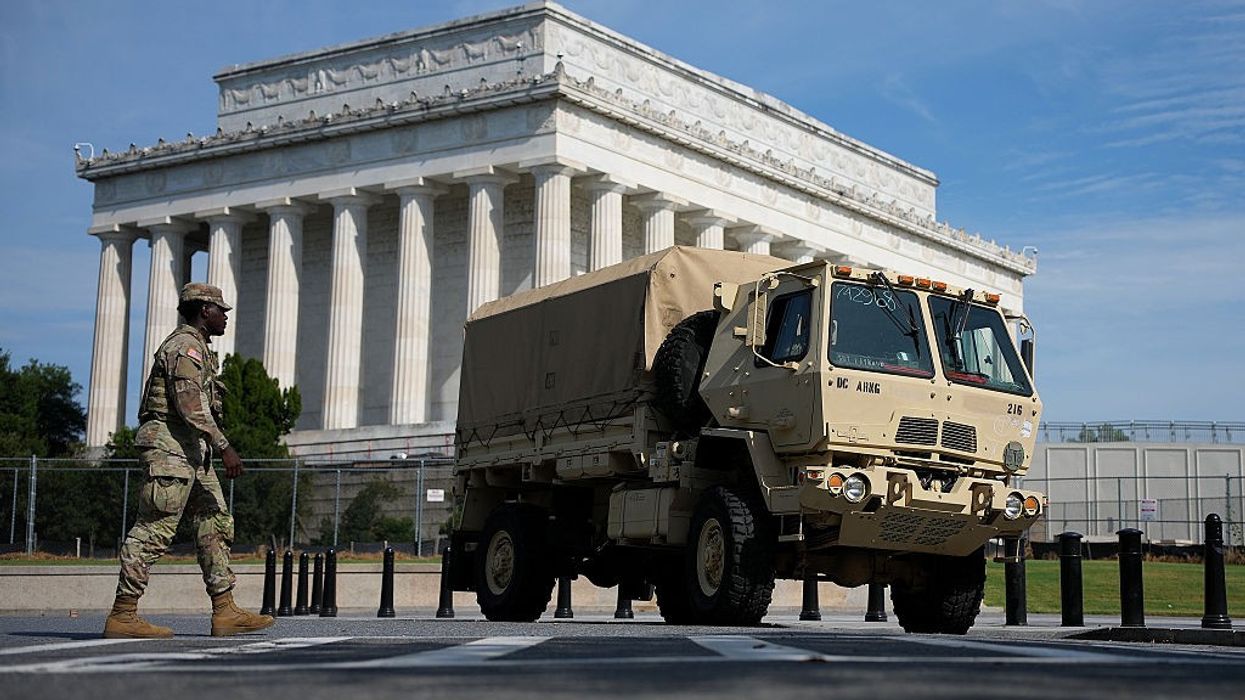
As President Donald Trump escalates the US military occupation of Washington, DC—including by importing hundreds of out-of-state National Guard troops and allowing others to start carrying guns on missions in the nation's capital—the ACLU on Monday reminded his administration that federal forces are constitutionally obligated to protect, not violate, residents' rights.
"With additional state National Guard troops deploying to DC as untrained federal law enforcement agents perform local police duties in city streets, the American Civil Liberties Union is issuing a stark reminder to all federal and military officials that—no matter what uniform they wear or what authority they claim—they are bound by the US Constitution and all federal and local laws," the group said in a statement.
Over the weekend, the Republican governors of Ohio, South Carolina, and West Virginia announced that they are deploying hundreds of National Guard troops to join the 800 DC guardsmen and women recently activated by Trump, who also asserted federal control over the city's Metropolitan Police Department (MPD).
Sending military troops and heavily-armed federal agents to patrol the streets and scare vulnerable communities does not make us safer.
— ACLU (@aclu.org) August 18, 2025 at 12:08 PM
Trump dubiously declared a public safety emergency in a city where violent crime is down 26% from a year ago, when it was at its second-lowest level since 1966, according to official statistics. Critics have noted that Trump's crackdown isn't just targeting criminals, but also unhoused and mentally ill people, who have had their homes destroyed and property taken.
Contradicting assurances from military officials, The Wall Street Journal reported Sunday that the newly deployed troops may be ordered to start carrying firearms. This, along with the president's vow to let police "do whatever the hell they want" to reduce crime in the city and other statements, have raised serious concerns of possible abuses.
"Through his manufactured emergency, President Trump is engaging in dangerous political theater to expand his power and sow fear in our communities," ACLU National Security Project director Hina Shamsi said Monday. "Sending heavily armed federal agents and National Guard troops from hundreds of miles away into our nation's capital is unnecessary, inflammatory, and puts people's rights at high risk of being violated."
Shamsi stressed that "federal agents and military troops are bound by the Constitution, including our rights to peaceful assembly, freedom of speech, due process, and safeguards against unlawful searches and seizures. If troops or federal agents violate our rights, they must be held accountable."
On Friday, the District of Columbia sued the Trump administration to block its order asserting federal authority over the MPD, arguing the move violated the Home Rule Act. U.S. Attorney General Bondi subsequently rescinded her order to replace DC Police Chief Pamela Smith with Drug Enforcement Administration Administrator Terry Cole.
Also on Friday, a group of House Democrats introduced a resolution to terminate Trump's emergency declaration.
The deployment of out-of-state National Guard troops onto our streets is a brazen abuse of power meant to create fear in the District.Join us in the fight for statehood to give D.C. residents the same guardrails against federal overreach as other states: dcstatehoodnow.org
[image or embed]
— ACLU of the District of Columbia (@aclu-dc.bsky.social) August 18, 2025 at 7:23 AM
ACLU of DC executive director Monica Hopkins argued Monday that there is a way to curb Trump's "brazen abuse of power" in the District.
"We need the nation to join us in the fight for statehood so that DC residents are treated like those in every other state and have the same guardrails against federal overreach," she said.