SUBSCRIBE TO OUR FREE NEWSLETTER
Daily news & progressive opinion—funded by the people, not the corporations—delivered straight to your inbox.
5
#000000
#FFFFFF
To donate by check, phone, or other method, see our More Ways to Give page.

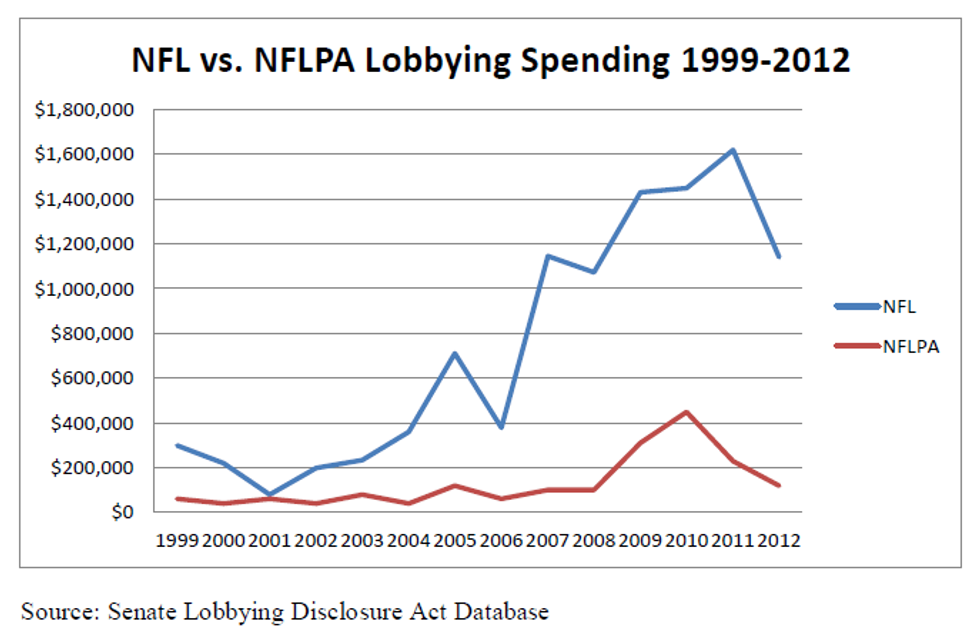
In anticipation of the Super Bowl, today Citizens for Responsibility and Ethics in Washington (CREW) released its latest report, Defensive Game, which examines patterns in lobbying spending by both the National Football League (NFL) and the National Football League Players' Association (NFLPA). CREW's research shows that over the past five years, the NFL has been on the defensive, beefing up its lobbying team and creating its first political action committee (PAC) in light of increased congressional interest in player safety, drug testing, and labor issues.
Read more about Defensive Game or download the full report
In 2012, the NFL spent $1.14 million on federal lobbying, a more than five-fold increase of what it spent a decade ago. The NFLPA, which spends far less on lobbying, saw its spending triple from $40,000 in 2002 to $120,000 in 2012.
"With increasing scrutiny and coverage of the lasting, debilitating effects football careers can have on players' health, the NFL has gone into damage control mode -- pumping up its lobbying spending and donations to influential members of Congress," said CREW Executive Director Melanie Sloan.
Gridiron-PAC, formed by the NFL in 2008, did not start making donations until the 2010 election cycle, when labor negotiations with the NFLPA grew tense and Congress began to express interest in the NFL's response to concussions and head trauma. During the 2012 election cycle, the PAC contributed $838,000 to federal candidates, PACs, and party committees -- an increase of 26 percent from the 2010 election cycle.
The top recipients of donations from the PAC have mostly been a bipartisan group of congressional leadership and key members on committees exercising jurisdiction over NFL issues. For instance, Rep. Fred Upton (R-MI), the chairman of the powerful House Energy and Commerce Committee, received $30,000 over the 2010 and 2012 election cycles. In July 2012, Rep. Upton and three other committee leaders wrote to the NFL and the NFLPA expressing concern about whether a comprehensive testing program for human growth hormone would be in place prior to the start of the 2012 season. Three weeks before the letter was sent, Rep. Upton's campaign committee accepted a $5,000 contribution from Gridiron-PAC.
"Given the NFL's estimated $9 billion in annual revenue, both sides can clearly afford to maintain their influence in Washington," continued Ms. Sloan. "While the league is dealing with numerous challenges off the gridiron -- including a renewed interest in drug testing -- it is worth keeping an eye on how the billionaire owners and millionaire players use their deep pockets to influence Congress."
Citizens for Responsibility and Ethics in Washington (CREW) is a nonprofit 501(c)(3) organization dedicated to promoting ethics and accountability in government and public life by targeting government officials -- regardless of party affiliation -- who sacrifice the common good to special interests. CREW advances its mission using a combination of research, litigation and media outreach.



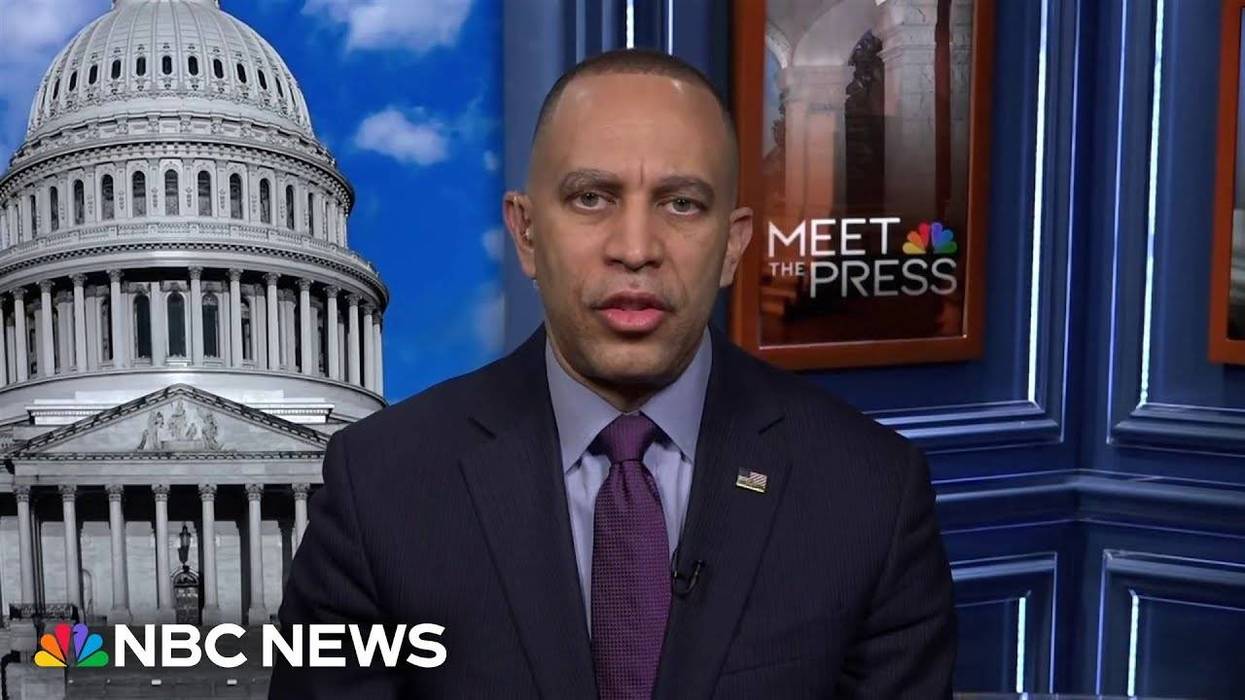
But pressed by Welker if he "personally" supports Medicare for All at this time, Jeffries said, "No," explaining that "it’s not legislation that I currently am co-sponsoring or that I support."
The remarks were hardly surprising, but landed hard for critics, who quickly pointed out that a new CBS/YouGov poll released Sunday showed—as survey after survey has also documented—that hunger for Medicare for All among Democratic voters is remarkably high.
As Common Dreams reported last week, a recent Yale University study found that Medicare for All, as drafted in a bill by Sen. Bernie Sanders (I-Vt.), would save over 114,000 lives annually and $1 trillion per year in US healthcare spending.
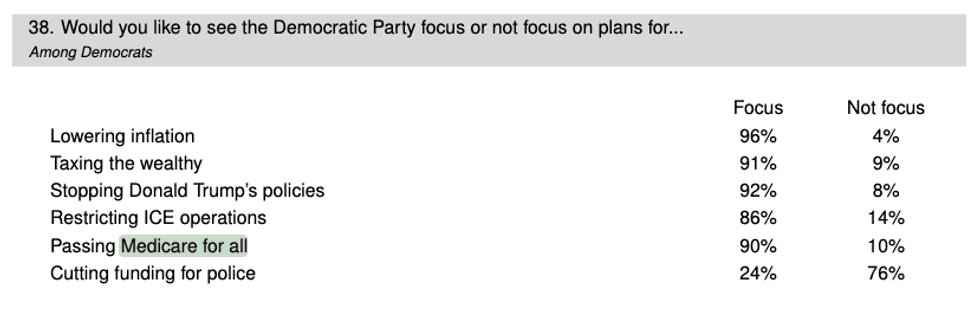
In the poll, conducted between Aug. 12-14, a full 90% of Democratic voters said they would "like to see the Democratic Party focus on plans for passing Medicare for All," compared to just 10% who said it should not be a focus.
"A reminder that the vast majority of Democrats across the country support Medicare for All," said progressive journalist Mehdi Hasan in response to Jeffries' answer on the question. "This man is so out of touch with his party. How is he their leader?"
The Lever's David Sirota also issued a rebuke, explaining that Jeffries' comments, juxtaposed with the CBS/YouGov poll, show exactly "why Democratic voters are so enraged."
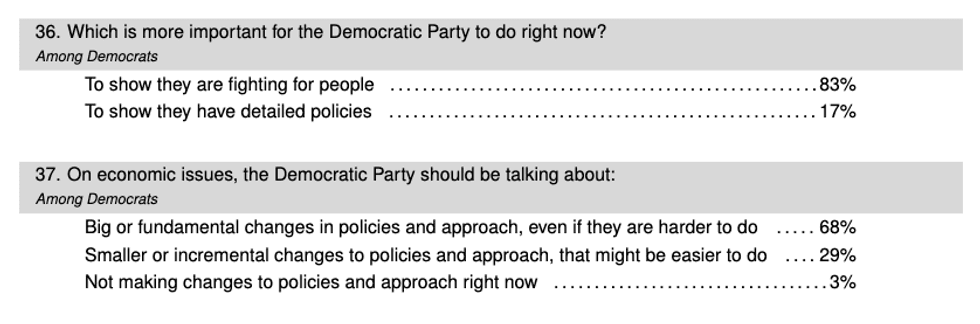
Also notable from the poll were responses to two questions that preceded the question about the specific policies Democrats should focus on.
Asked if it was more important for the Democratic Party to "show they are fighting for people" or that "they have detailed policies," 83% said it was more important for Democrats to show they are fighting, while just 17% said detailed policies were more important. Similarly, when it came to economic issues, voters—by a 68% to 29% margin—said they'd prefer "big or fundamental changes in policies and approach, even if they are harder to do" compared to those who wanted "smaller or incremental changes to policies and approach, that might be easier to do."
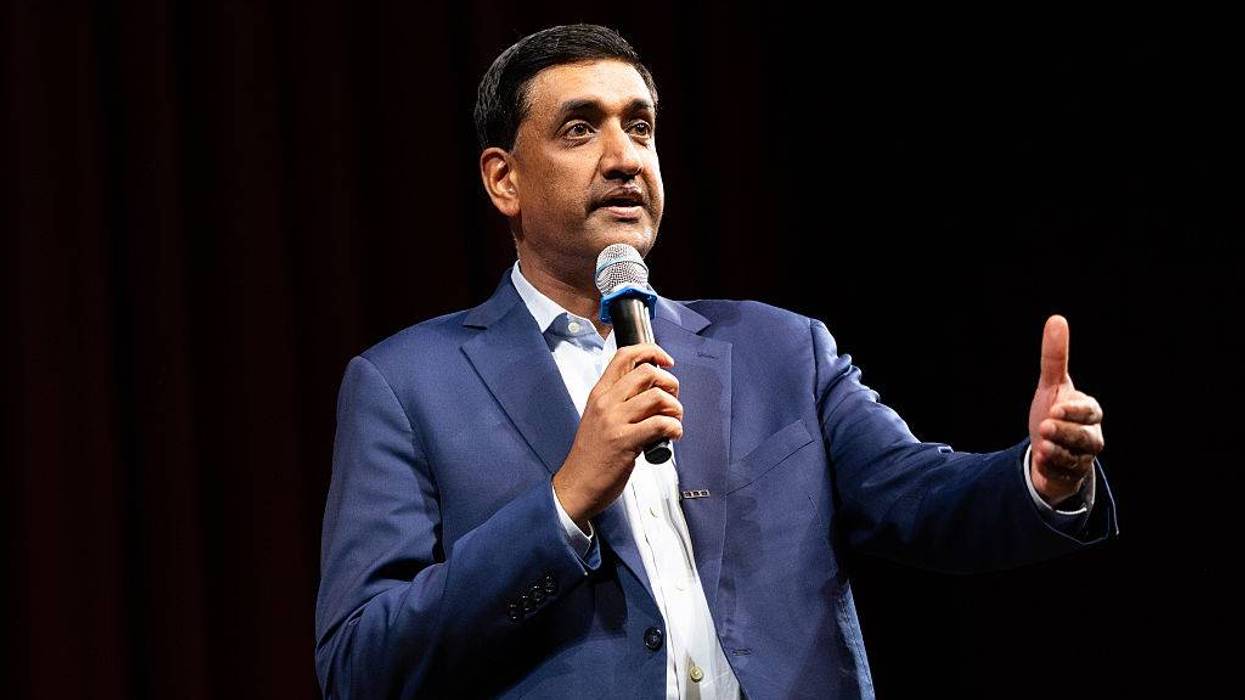
Appearing after Jeffries on "Meet the Press," Rep. Ro Khanna (D-Calif.), a top ally of Sanders and a current co-sponsor of the Medicare for All Bill introduced earlier this year in the House, disagreed with the Minority Leader's position.
"Medicare for All is arguably the most important priority," Khanna said. "It would save money, and it would save lives. Look, there was just a Yale study that came out. It would save $1 trillion in terms of costs, in terms of health care."
Asked by Welker if he was "disappointed" in Jeffries' remarks, Khanna said that while "I respect the difference" of opinion, "I will say this: it needs to have a vote on the House floor."
"The majority of the House Democrats are going to support it," he continued. "It is one of the most important policies if you actually believe in saving lives and in helping increase wages for working-class Americans. You talk to folks, and they’ll say, 'The biggest thing that pushes me into bankruptcy is if someone gets cancer. And I can’t afford the bills.' And even people who have insurance, look at how many premiums have been increasing. This would save money for ordinary Americans. And it would increase their wages. It’s the single biggest roadblock in our economic system hurting working families."
In a social media post on Sunday, Sanders—while not mentioning the latest comments by Jeffries—said, "Our current healthcare system is broken. Progressives understand healthcare must be a human right, guaranteed to all, not a source of billions in profits for insurance and drug companies.
"A recent poll showed 64% of Americans want Medicare for All," added Sanders. "They’re right. Let’s do it."