SUBSCRIBE TO OUR FREE NEWSLETTER
Daily news & progressive opinion—funded by the people, not the corporations—delivered straight to your inbox.
5
#000000
#FFFFFF
To donate by check, phone, or other method, see our More Ways to Give page.
Daily news & progressive opinion—funded by the people, not the corporations—delivered straight to your inbox.
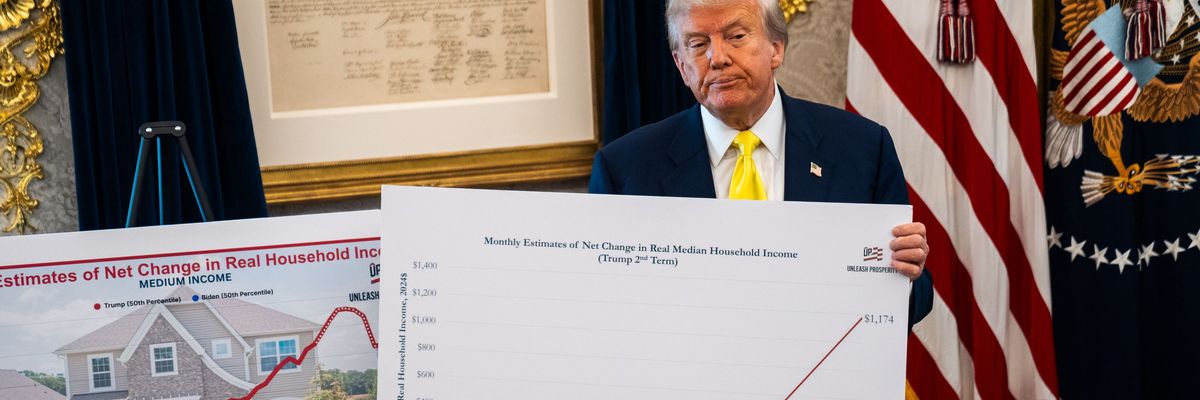
US President Donald Trump holds up an economic data chart in the Oval Office of the White House on August 7, 2025.
"We’re collecting all data we can to assess the economy’s health in this time when the gold standard data are under attack,” said the Economic Policy Institute's senior economist.
Amid President Donald Trump's efforts to conceal the harmful consequences of his economic policies by hiding key data and replacing economists who tell harsh truths with partisan yes-people, a leading US think tank on Monday announced a new digital dashboard "to provide an accountability check" against attempts to manipulate and mislead the public.
The Economic Policy Institute (EPI) says its new data accountability dashboard "serves as a one-stop shop" for economic data as federal statistic agencies (FSAs), once the "gold standard" for information, "face historically unprecedented threats from the Trump administration to their capacity and even their independence."
"This raises the specter of a future where FSA data cannot be relied upon to honestly report whether the US economy is experiencing dysfunction," EPI said.
In a bid to circumvent this, the EPI dashboard "displays a range of data not collected or disseminated by FSAs to shed some light on the economy during the pause in government data collection during the shutdown and—even more importantly—to provide an accountability check against efforts to manipulate FSA data in the future."
The federal statistical agencies (FSAs) that produce the gold standard economic data employers/investors/job seekers/workers/policymakers rely on to assess the health of the U.S. economy face unprecedented threats.We've pulled next-best data from non-FSA sources to help keep an eye on things. 1/
[image or embed]
— Economic Policy Institute (@epi.org) November 18, 2025 at 7:19 AM
As EPI senior economist Elise Gould explained in a statement: “The data collected by the federal statistical agencies are an incredibly valuable public good. While there would never be a good time to squander it, the absolute worst time to degrade data quality is when the economy is facing policy shocks that threaten to cause either a recession or an uptick of inflation."
"Given this urgency, we’re collecting all data we can to assess the economy’s health in this time when the gold standard data are under attack,” she added.
Trump's attempts to hide unfavorable economic data date back to his first administration, when he blocked or delayed economic analyses on the projected impacts of his tariffs. For example, half a dozen economists at the US Department of Agriculture (USDA) quit en masse in April 2019, claiming they suffered retaliation for publishing reports that shed negative light on the president's trade and taxation policies.
In a related move that year, the USDA abruptly relocated its Economic Research Service main office from Washington, DC to Kansas City, Missouri, prompting another wave of resignations. ERS publications—including reports on farm income, rural economies, and trade impacts—dropped sharply, with key analyses delayed or blocked. Critics, including former agency officials, argued that the move to Kansas City was intended to conceal negative impacts of Trump's trade policies from the public.
During Trump's second administration, Commerce Secretary Howard Lutnick disbanded the Federal Economic Statistics Advisory Committee (FESAC), a key body that worked under the Commerce Department’s Bureau of Economic Analysis to ensure that the federal government produces accurate data on economic indicators.
Trump also gutted the Bureau of Labor Statistics’ Technical Advisory Committee, which had advised the Department of Labor about how economic changes can impact data collection. In August, Trump fired BLS Commissioner Erika McEntarfer, baselessly accusing her of manipulating economic data to harm him politically by publishing a jobs report showing weak employment growth.
Two weeks later, the president nominated EJ Antoni, a senior economist at the Heritage Foundation described as a "partisan bomb thrower" who helped write Project 2025, a blueprint for a far-right overhaul of the federal government, to replace McEntarfer. Antoni stunned critics with suggestions including eliminating federal monthly jobs reports, and with his overall lack of data management experience. His nomination was later withdrawn amid mounting controversy.
Additionally, the Trump administration has summarily fired dozens of independent agency leaders, required every federal agency to have a White House liaison, and required ostensibly independent agencies to submit draft regulations to the Office of Management and Budget—headed by Project 2025 architect Russell Vought—for review before publication.
As Common Dreams reported, an analysis published in September by the Center on Budget and Policy Priorities detailed how the Trump administration's politicization of data, combined with funding cuts, is making it more difficult for experts to determine how the president's policies are impacting US households.
From ending tracking of the impacts of climate-driven extreme weather, to removing a study from the Department of Justice website that showed violent attacks by far-right extremists outpaced those committed by the left, to removing questions about gender identity from key crime surveys, the Trump administration's attacks on information transcend economic data.
"The assault on data, research, and facts is fundamental to Trump and his authoritarian regime," Liza Featherstone, a contributing editor at The New Republic, recently wrote. "He seems to understand that data provides the basis for arguments, and he does not want any arguments. He also understands that facts and knowledge can only be nourished and sustained by institutions and experts, so he is destroying those institutions and pink-slipping those experts."
"We must appreciate their importance and their stakes as well as he does, and remain as committed to the institutions, the data, the facts, and the experts as Trump is to their eradication," Featherstone added. "He has brought sincere zeal to their destruction, and we must bring an even greater passion to their restoration and renaissance. We will need it, as ours is the harder job."
Dear Common Dreams reader, It’s been nearly 30 years since I co-founded Common Dreams with my late wife, Lina Newhouser. We had the radical notion that journalism should serve the public good, not corporate profits. It was clear to us from the outset what it would take to build such a project. No paid advertisements. No corporate sponsors. No millionaire publisher telling us what to think or do. Many people said we wouldn't last a year, but we proved those doubters wrong. Together with a tremendous team of journalists and dedicated staff, we built an independent media outlet free from the constraints of profits and corporate control. Our mission has always been simple: To inform. To inspire. To ignite change for the common good. Building Common Dreams was not easy. Our survival was never guaranteed. When you take on the most powerful forces—Wall Street greed, fossil fuel industry destruction, Big Tech lobbyists, and uber-rich oligarchs who have spent billions upon billions rigging the economy and democracy in their favor—the only bulwark you have is supporters who believe in your work. But here’s the urgent message from me today. It's never been this bad out there. And it's never been this hard to keep us going. At the very moment Common Dreams is most needed, the threats we face are intensifying. We need your support now more than ever. We don't accept corporate advertising and never will. We don't have a paywall because we don't think people should be blocked from critical news based on their ability to pay. Everything we do is funded by the donations of readers like you. When everyone does the little they can afford, we are strong. But if that support retreats or dries up, so do we. Will you donate now to make sure Common Dreams not only survives but thrives? —Craig Brown, Co-founder |
Amid President Donald Trump's efforts to conceal the harmful consequences of his economic policies by hiding key data and replacing economists who tell harsh truths with partisan yes-people, a leading US think tank on Monday announced a new digital dashboard "to provide an accountability check" against attempts to manipulate and mislead the public.
The Economic Policy Institute (EPI) says its new data accountability dashboard "serves as a one-stop shop" for economic data as federal statistic agencies (FSAs), once the "gold standard" for information, "face historically unprecedented threats from the Trump administration to their capacity and even their independence."
"This raises the specter of a future where FSA data cannot be relied upon to honestly report whether the US economy is experiencing dysfunction," EPI said.
In a bid to circumvent this, the EPI dashboard "displays a range of data not collected or disseminated by FSAs to shed some light on the economy during the pause in government data collection during the shutdown and—even more importantly—to provide an accountability check against efforts to manipulate FSA data in the future."
The federal statistical agencies (FSAs) that produce the gold standard economic data employers/investors/job seekers/workers/policymakers rely on to assess the health of the U.S. economy face unprecedented threats.We've pulled next-best data from non-FSA sources to help keep an eye on things. 1/
[image or embed]
— Economic Policy Institute (@epi.org) November 18, 2025 at 7:19 AM
As EPI senior economist Elise Gould explained in a statement: “The data collected by the federal statistical agencies are an incredibly valuable public good. While there would never be a good time to squander it, the absolute worst time to degrade data quality is when the economy is facing policy shocks that threaten to cause either a recession or an uptick of inflation."
"Given this urgency, we’re collecting all data we can to assess the economy’s health in this time when the gold standard data are under attack,” she added.
Trump's attempts to hide unfavorable economic data date back to his first administration, when he blocked or delayed economic analyses on the projected impacts of his tariffs. For example, half a dozen economists at the US Department of Agriculture (USDA) quit en masse in April 2019, claiming they suffered retaliation for publishing reports that shed negative light on the president's trade and taxation policies.
In a related move that year, the USDA abruptly relocated its Economic Research Service main office from Washington, DC to Kansas City, Missouri, prompting another wave of resignations. ERS publications—including reports on farm income, rural economies, and trade impacts—dropped sharply, with key analyses delayed or blocked. Critics, including former agency officials, argued that the move to Kansas City was intended to conceal negative impacts of Trump's trade policies from the public.
During Trump's second administration, Commerce Secretary Howard Lutnick disbanded the Federal Economic Statistics Advisory Committee (FESAC), a key body that worked under the Commerce Department’s Bureau of Economic Analysis to ensure that the federal government produces accurate data on economic indicators.
Trump also gutted the Bureau of Labor Statistics’ Technical Advisory Committee, which had advised the Department of Labor about how economic changes can impact data collection. In August, Trump fired BLS Commissioner Erika McEntarfer, baselessly accusing her of manipulating economic data to harm him politically by publishing a jobs report showing weak employment growth.
Two weeks later, the president nominated EJ Antoni, a senior economist at the Heritage Foundation described as a "partisan bomb thrower" who helped write Project 2025, a blueprint for a far-right overhaul of the federal government, to replace McEntarfer. Antoni stunned critics with suggestions including eliminating federal monthly jobs reports, and with his overall lack of data management experience. His nomination was later withdrawn amid mounting controversy.
Additionally, the Trump administration has summarily fired dozens of independent agency leaders, required every federal agency to have a White House liaison, and required ostensibly independent agencies to submit draft regulations to the Office of Management and Budget—headed by Project 2025 architect Russell Vought—for review before publication.
As Common Dreams reported, an analysis published in September by the Center on Budget and Policy Priorities detailed how the Trump administration's politicization of data, combined with funding cuts, is making it more difficult for experts to determine how the president's policies are impacting US households.
From ending tracking of the impacts of climate-driven extreme weather, to removing a study from the Department of Justice website that showed violent attacks by far-right extremists outpaced those committed by the left, to removing questions about gender identity from key crime surveys, the Trump administration's attacks on information transcend economic data.
"The assault on data, research, and facts is fundamental to Trump and his authoritarian regime," Liza Featherstone, a contributing editor at The New Republic, recently wrote. "He seems to understand that data provides the basis for arguments, and he does not want any arguments. He also understands that facts and knowledge can only be nourished and sustained by institutions and experts, so he is destroying those institutions and pink-slipping those experts."
"We must appreciate their importance and their stakes as well as he does, and remain as committed to the institutions, the data, the facts, and the experts as Trump is to their eradication," Featherstone added. "He has brought sincere zeal to their destruction, and we must bring an even greater passion to their restoration and renaissance. We will need it, as ours is the harder job."
Amid President Donald Trump's efforts to conceal the harmful consequences of his economic policies by hiding key data and replacing economists who tell harsh truths with partisan yes-people, a leading US think tank on Monday announced a new digital dashboard "to provide an accountability check" against attempts to manipulate and mislead the public.
The Economic Policy Institute (EPI) says its new data accountability dashboard "serves as a one-stop shop" for economic data as federal statistic agencies (FSAs), once the "gold standard" for information, "face historically unprecedented threats from the Trump administration to their capacity and even their independence."
"This raises the specter of a future where FSA data cannot be relied upon to honestly report whether the US economy is experiencing dysfunction," EPI said.
In a bid to circumvent this, the EPI dashboard "displays a range of data not collected or disseminated by FSAs to shed some light on the economy during the pause in government data collection during the shutdown and—even more importantly—to provide an accountability check against efforts to manipulate FSA data in the future."
The federal statistical agencies (FSAs) that produce the gold standard economic data employers/investors/job seekers/workers/policymakers rely on to assess the health of the U.S. economy face unprecedented threats.We've pulled next-best data from non-FSA sources to help keep an eye on things. 1/
[image or embed]
— Economic Policy Institute (@epi.org) November 18, 2025 at 7:19 AM
As EPI senior economist Elise Gould explained in a statement: “The data collected by the federal statistical agencies are an incredibly valuable public good. While there would never be a good time to squander it, the absolute worst time to degrade data quality is when the economy is facing policy shocks that threaten to cause either a recession or an uptick of inflation."
"Given this urgency, we’re collecting all data we can to assess the economy’s health in this time when the gold standard data are under attack,” she added.
Trump's attempts to hide unfavorable economic data date back to his first administration, when he blocked or delayed economic analyses on the projected impacts of his tariffs. For example, half a dozen economists at the US Department of Agriculture (USDA) quit en masse in April 2019, claiming they suffered retaliation for publishing reports that shed negative light on the president's trade and taxation policies.
In a related move that year, the USDA abruptly relocated its Economic Research Service main office from Washington, DC to Kansas City, Missouri, prompting another wave of resignations. ERS publications—including reports on farm income, rural economies, and trade impacts—dropped sharply, with key analyses delayed or blocked. Critics, including former agency officials, argued that the move to Kansas City was intended to conceal negative impacts of Trump's trade policies from the public.
During Trump's second administration, Commerce Secretary Howard Lutnick disbanded the Federal Economic Statistics Advisory Committee (FESAC), a key body that worked under the Commerce Department’s Bureau of Economic Analysis to ensure that the federal government produces accurate data on economic indicators.
Trump also gutted the Bureau of Labor Statistics’ Technical Advisory Committee, which had advised the Department of Labor about how economic changes can impact data collection. In August, Trump fired BLS Commissioner Erika McEntarfer, baselessly accusing her of manipulating economic data to harm him politically by publishing a jobs report showing weak employment growth.
Two weeks later, the president nominated EJ Antoni, a senior economist at the Heritage Foundation described as a "partisan bomb thrower" who helped write Project 2025, a blueprint for a far-right overhaul of the federal government, to replace McEntarfer. Antoni stunned critics with suggestions including eliminating federal monthly jobs reports, and with his overall lack of data management experience. His nomination was later withdrawn amid mounting controversy.
Additionally, the Trump administration has summarily fired dozens of independent agency leaders, required every federal agency to have a White House liaison, and required ostensibly independent agencies to submit draft regulations to the Office of Management and Budget—headed by Project 2025 architect Russell Vought—for review before publication.
As Common Dreams reported, an analysis published in September by the Center on Budget and Policy Priorities detailed how the Trump administration's politicization of data, combined with funding cuts, is making it more difficult for experts to determine how the president's policies are impacting US households.
From ending tracking of the impacts of climate-driven extreme weather, to removing a study from the Department of Justice website that showed violent attacks by far-right extremists outpaced those committed by the left, to removing questions about gender identity from key crime surveys, the Trump administration's attacks on information transcend economic data.
"The assault on data, research, and facts is fundamental to Trump and his authoritarian regime," Liza Featherstone, a contributing editor at The New Republic, recently wrote. "He seems to understand that data provides the basis for arguments, and he does not want any arguments. He also understands that facts and knowledge can only be nourished and sustained by institutions and experts, so he is destroying those institutions and pink-slipping those experts."
"We must appreciate their importance and their stakes as well as he does, and remain as committed to the institutions, the data, the facts, and the experts as Trump is to their eradication," Featherstone added. "He has brought sincere zeal to their destruction, and we must bring an even greater passion to their restoration and renaissance. We will need it, as ours is the harder job."