SUBSCRIBE TO OUR FREE NEWSLETTER
Daily news & progressive opinion—funded by the people, not the corporations—delivered straight to your inbox.
5
#000000
#FFFFFF
To donate by check, phone, or other method, see our More Ways to Give page.
Daily news & progressive opinion—funded by the people, not the corporations—delivered straight to your inbox.
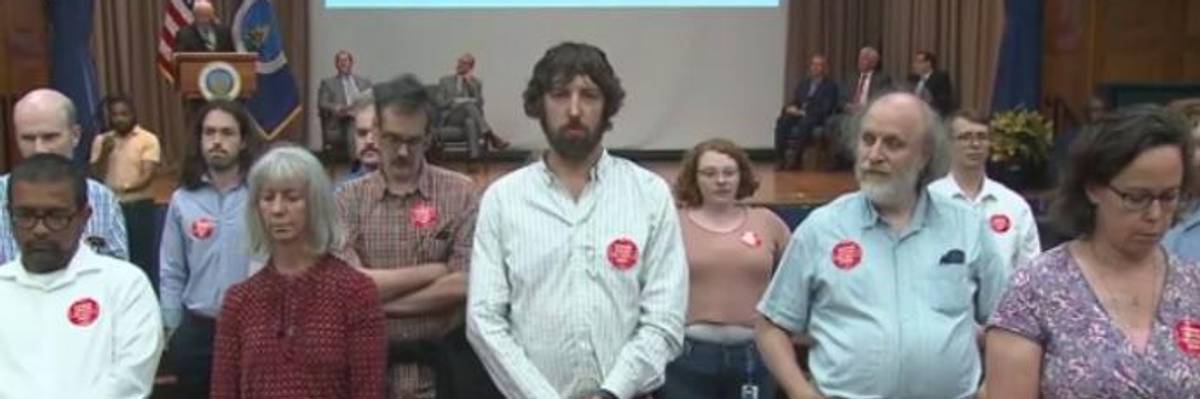
Employees stood and turned their backs to Sonny Perdue on Thursday as the agriculture secretary detailed the move of two of USDA's key research agencies out of Washington, D.C. (Screengrab/CNN video)
Over a dozen USDA employees stood and turned their backs on Sonny Perdue Thursday as the U.S. agriculture secretary detailed the relocation of two of the federal agency's key research offices out of Washington, D.C.
Purdue was speaking at an "all hands meeting" of employees of the two agencies in question: the Economic Research Service (ERS) and the National Institute of Food and Agriculture (NIFA), which both recently unionized to protest the reorganization. ERS and NIFA, as Union of Concerned Scientists economist Rebecca Boehm recently wrote, perform work "which directly supports farmers while protecting our food."
At least three agency employees, a video of the protest from CNN shows, shook their heads when Perdue said their primary concern about the imminent move was how it would be a "personal disruption." The Hill has video of a portion of the protest as well.
While the move out of Washington, D.C.--seen as a move to sideline science--was expected for nearly a year, employees found out only earlier in the morning through a letter (pdf) that their new location would be the Kansas City Region.
The heart of the problem isn't the choice of city. As Mike Lavender of UCS's food and environment program said on Twitter, it is "Anti-farmer, anti-science, and anti-research no matter the selected location." He also noted its widespread opposition, including by over 70 bipartisan agriculture leaders, over 100 organizations, and over 1,000 scientists.
Thursday's quiet protest elicited expressions of solidarity with the workers from UCS and Farm Aid.
The booting of the agencies out of D.C.--which the Institute for Agriculture and Trade Policy previously called "an insult to world class researchers"--also sparked renewed statements of outrage.
"This is an unacceptable attack on agricultural research and science that is likely to push experienced researchers out of public service," said Sen. Jeff Merkley (D-Ore.) on Twitter. "This not only hurts these workers and their families, but could have devastating impacts on America's farmers as well."
Another Democrat, Rep. Chellie Pingree of Maine, said the relocation is politically motivated.
The National Sustainable Agriculture Coalition (NSAC) warned that the move would unleash "significant collateral damage."
"Despite claims that this relocation will better serve American agriculture, the truth is that USDA's decision has led to a mass exodus of highly trained experts from both ERS and NIFA," NSAC said in a statement. "The resulting agency brain drain will ultimately cripple both agencies' research functions, an effect that will be further exacerbated by isolating the offices more than a thousand miles away from key partners and collaborators in the nation's capital."
As for Perdue's framing of the relocation as one that would generate "savings of nearly $300 million nominally over a 15-year lease term on employment costs and rent or about $20 million per year," the American Statistical Association (ASA) said that's a "post-hoc justification" that doesn't hold water.
"We all pay for a dismantled Economic Research Service that will never get back to its current number-three ranking in the world for agricultural economics research," the group said.
"We will also pay for USDA's research funding agency being dissociated from the planning and collaborations that happen in person in Washington," the group added, "with funding agencies for health, energy, international development, basic research and more."
UCS analyst Karen Perry Stillerman put the matter in stark terms.
"Our overarching concern," she told the Washington Post, "is what happens to the important scientific work that these two agencies perform at USDA on behalf of the public, on behalf of farmers and rural communities, and everyone who eats."
Dear Common Dreams reader, It’s been nearly 30 years since I co-founded Common Dreams with my late wife, Lina Newhouser. We had the radical notion that journalism should serve the public good, not corporate profits. It was clear to us from the outset what it would take to build such a project. No paid advertisements. No corporate sponsors. No millionaire publisher telling us what to think or do. Many people said we wouldn't last a year, but we proved those doubters wrong. Together with a tremendous team of journalists and dedicated staff, we built an independent media outlet free from the constraints of profits and corporate control. Our mission has always been simple: To inform. To inspire. To ignite change for the common good. Building Common Dreams was not easy. Our survival was never guaranteed. When you take on the most powerful forces—Wall Street greed, fossil fuel industry destruction, Big Tech lobbyists, and uber-rich oligarchs who have spent billions upon billions rigging the economy and democracy in their favor—the only bulwark you have is supporters who believe in your work. But here’s the urgent message from me today. It's never been this bad out there. And it's never been this hard to keep us going. At the very moment Common Dreams is most needed, the threats we face are intensifying. We need your support now more than ever. We don't accept corporate advertising and never will. We don't have a paywall because we don't think people should be blocked from critical news based on their ability to pay. Everything we do is funded by the donations of readers like you. When everyone does the little they can afford, we are strong. But if that support retreats or dries up, so do we. Will you donate now to make sure Common Dreams not only survives but thrives? —Craig Brown, Co-founder |
Over a dozen USDA employees stood and turned their backs on Sonny Perdue Thursday as the U.S. agriculture secretary detailed the relocation of two of the federal agency's key research offices out of Washington, D.C.
Purdue was speaking at an "all hands meeting" of employees of the two agencies in question: the Economic Research Service (ERS) and the National Institute of Food and Agriculture (NIFA), which both recently unionized to protest the reorganization. ERS and NIFA, as Union of Concerned Scientists economist Rebecca Boehm recently wrote, perform work "which directly supports farmers while protecting our food."
At least three agency employees, a video of the protest from CNN shows, shook their heads when Perdue said their primary concern about the imminent move was how it would be a "personal disruption." The Hill has video of a portion of the protest as well.
While the move out of Washington, D.C.--seen as a move to sideline science--was expected for nearly a year, employees found out only earlier in the morning through a letter (pdf) that their new location would be the Kansas City Region.
The heart of the problem isn't the choice of city. As Mike Lavender of UCS's food and environment program said on Twitter, it is "Anti-farmer, anti-science, and anti-research no matter the selected location." He also noted its widespread opposition, including by over 70 bipartisan agriculture leaders, over 100 organizations, and over 1,000 scientists.
Thursday's quiet protest elicited expressions of solidarity with the workers from UCS and Farm Aid.
The booting of the agencies out of D.C.--which the Institute for Agriculture and Trade Policy previously called "an insult to world class researchers"--also sparked renewed statements of outrage.
"This is an unacceptable attack on agricultural research and science that is likely to push experienced researchers out of public service," said Sen. Jeff Merkley (D-Ore.) on Twitter. "This not only hurts these workers and their families, but could have devastating impacts on America's farmers as well."
Another Democrat, Rep. Chellie Pingree of Maine, said the relocation is politically motivated.
The National Sustainable Agriculture Coalition (NSAC) warned that the move would unleash "significant collateral damage."
"Despite claims that this relocation will better serve American agriculture, the truth is that USDA's decision has led to a mass exodus of highly trained experts from both ERS and NIFA," NSAC said in a statement. "The resulting agency brain drain will ultimately cripple both agencies' research functions, an effect that will be further exacerbated by isolating the offices more than a thousand miles away from key partners and collaborators in the nation's capital."
As for Perdue's framing of the relocation as one that would generate "savings of nearly $300 million nominally over a 15-year lease term on employment costs and rent or about $20 million per year," the American Statistical Association (ASA) said that's a "post-hoc justification" that doesn't hold water.
"We all pay for a dismantled Economic Research Service that will never get back to its current number-three ranking in the world for agricultural economics research," the group said.
"We will also pay for USDA's research funding agency being dissociated from the planning and collaborations that happen in person in Washington," the group added, "with funding agencies for health, energy, international development, basic research and more."
UCS analyst Karen Perry Stillerman put the matter in stark terms.
"Our overarching concern," she told the Washington Post, "is what happens to the important scientific work that these two agencies perform at USDA on behalf of the public, on behalf of farmers and rural communities, and everyone who eats."
Over a dozen USDA employees stood and turned their backs on Sonny Perdue Thursday as the U.S. agriculture secretary detailed the relocation of two of the federal agency's key research offices out of Washington, D.C.
Purdue was speaking at an "all hands meeting" of employees of the two agencies in question: the Economic Research Service (ERS) and the National Institute of Food and Agriculture (NIFA), which both recently unionized to protest the reorganization. ERS and NIFA, as Union of Concerned Scientists economist Rebecca Boehm recently wrote, perform work "which directly supports farmers while protecting our food."
At least three agency employees, a video of the protest from CNN shows, shook their heads when Perdue said their primary concern about the imminent move was how it would be a "personal disruption." The Hill has video of a portion of the protest as well.
While the move out of Washington, D.C.--seen as a move to sideline science--was expected for nearly a year, employees found out only earlier in the morning through a letter (pdf) that their new location would be the Kansas City Region.
The heart of the problem isn't the choice of city. As Mike Lavender of UCS's food and environment program said on Twitter, it is "Anti-farmer, anti-science, and anti-research no matter the selected location." He also noted its widespread opposition, including by over 70 bipartisan agriculture leaders, over 100 organizations, and over 1,000 scientists.
Thursday's quiet protest elicited expressions of solidarity with the workers from UCS and Farm Aid.
The booting of the agencies out of D.C.--which the Institute for Agriculture and Trade Policy previously called "an insult to world class researchers"--also sparked renewed statements of outrage.
"This is an unacceptable attack on agricultural research and science that is likely to push experienced researchers out of public service," said Sen. Jeff Merkley (D-Ore.) on Twitter. "This not only hurts these workers and their families, but could have devastating impacts on America's farmers as well."
Another Democrat, Rep. Chellie Pingree of Maine, said the relocation is politically motivated.
The National Sustainable Agriculture Coalition (NSAC) warned that the move would unleash "significant collateral damage."
"Despite claims that this relocation will better serve American agriculture, the truth is that USDA's decision has led to a mass exodus of highly trained experts from both ERS and NIFA," NSAC said in a statement. "The resulting agency brain drain will ultimately cripple both agencies' research functions, an effect that will be further exacerbated by isolating the offices more than a thousand miles away from key partners and collaborators in the nation's capital."
As for Perdue's framing of the relocation as one that would generate "savings of nearly $300 million nominally over a 15-year lease term on employment costs and rent or about $20 million per year," the American Statistical Association (ASA) said that's a "post-hoc justification" that doesn't hold water.
"We all pay for a dismantled Economic Research Service that will never get back to its current number-three ranking in the world for agricultural economics research," the group said.
"We will also pay for USDA's research funding agency being dissociated from the planning and collaborations that happen in person in Washington," the group added, "with funding agencies for health, energy, international development, basic research and more."
UCS analyst Karen Perry Stillerman put the matter in stark terms.
"Our overarching concern," she told the Washington Post, "is what happens to the important scientific work that these two agencies perform at USDA on behalf of the public, on behalf of farmers and rural communities, and everyone who eats."