SUBSCRIBE TO OUR FREE NEWSLETTER
Daily news & progressive opinion—funded by the people, not the corporations—delivered straight to your inbox.
5
#000000
#FFFFFF
To donate by check, phone, or other method, see our More Ways to Give page.
Daily news & progressive opinion—funded by the people, not the corporations—delivered straight to your inbox.
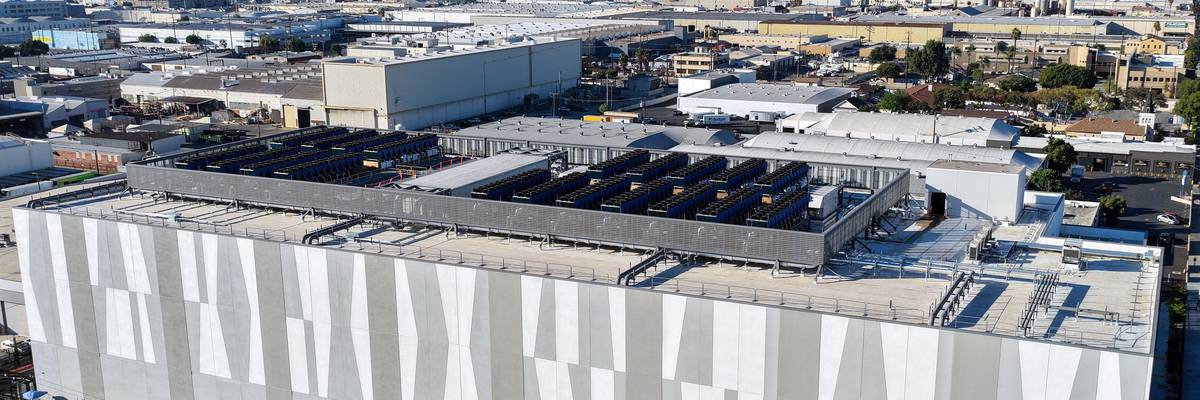
An aerial view of a 33 megawatt data center with closed-loop cooling system on October 20, 2025 in Vernon, California.
"The result will be some of the dirtiest power sources rushed into neighborhoods without giving communities any opportunity to weigh in," said one critic.
Critics are warning that President Donald Trump's Environmental Protection Agency is pushing through a rule that would let artificial intelligence data center builders off the hook for making public disclosures ahead of construction.
The rule, which first came to light during an EPA meeting last month, would delegate power to states over public participation in the permitting process for specific sources of air pollution, such as diesel generators that are frequently used by data centers.
According to a July report in Mother Jones, the proposed rule "could have major consequences for how ordinary people are given notice about new or expanded polluting facilities coming into their neighborhoods."
Late last week, a coalition of more than 200 environmental groups filed objections to the rule change, which they warned would make public notice for certain polluting projects entirely optional, depending on the whims of state and local governments.
Dori Jaffe, managing attorney at Sierra Club, said on Monday that the rule change would "help data center developers evade more health standards and do so secretly."
"We demand that the EPA rescind this attempt to further cut the public out of decisions made in their own backyards," said Jaffe. "We deserve to have a say about developments in our community that would impact our air quality and the health of our families."
Sheena Patel, attorney for the Natural Resources Defense Council, noted that the administration was attempting to limit public input into polluting projects at a time when opposition to AI data center construction has hit a record high among US voters.
If the rule change goes through, Patel added, "the result will be some of the dirtiest power sources rushed into neighborhoods without giving communities any opportunity to weigh in."
Brandon Jones-Cobb, senior attorney at the Center for Biological Diversity, said it was "beyond cruel" that the EPA seems determined to "silence front-line communities who bear the brunt of unhealthy air" generated by polluting industries.
"The agency has already turned its back on science, cut enforcement against industrial polluters and eliminated life-saving air pollution measures," said Jones-Cobb. "Now it wants to shut the public out of decisions to build or expand facilities that expose communities to dangerous air pollution, including data centers. This EPA is so out of touch with Americans and only focuses on making polluters happy."
In an interview with The Guardian published Tuesday, Joe Goffman, former assistant administrator for the EPA’s office of air and radiation, said the rule change would dismantle what he described as an "ironclad promise" made in the 1963 Clean Air Act to give ordinary citizens voices in where, how, and whether potential centers of air pollution are built.
"The administration is basically saying: 'You all may have thought this was an ironclad promise, but it no longer is,'" Goffman emphasized.
Dear Common Dreams reader, It’s been nearly 30 years since I co-founded Common Dreams with my late wife, Lina Newhouser. We had the radical notion that journalism should serve the public good, not corporate profits. It was clear to us from the outset what it would take to build such a project. No paid advertisements. No corporate sponsors. No millionaire publisher telling us what to think or do. Many people said we wouldn't last a year, but we proved those doubters wrong. Together with a tremendous team of journalists and dedicated staff, we built an independent media outlet free from the constraints of profits and corporate control. Our mission has always been simple: To inform. To inspire. To ignite change for the common good. Building Common Dreams was not easy. Our survival was never guaranteed. When you take on the most powerful forces—Wall Street greed, fossil fuel industry destruction, Big Tech lobbyists, and uber-rich oligarchs who have spent billions upon billions rigging the economy and democracy in their favor—the only bulwark you have is supporters who believe in your work. But here’s the urgent message from me today. It's never been this bad out there. And it's never been this hard to keep us going. At the very moment Common Dreams is most needed, the threats we face are intensifying. We need your support now more than ever. We don't accept corporate advertising and never will. We don't have a paywall because we don't think people should be blocked from critical news based on their ability to pay. Everything we do is funded by the donations of readers like you. When everyone does the little they can afford, we are strong. But if that support retreats or dries up, so do we. Will you donate now to make sure Common Dreams not only survives but thrives? —Craig Brown, Co-founder |
Critics are warning that President Donald Trump's Environmental Protection Agency is pushing through a rule that would let artificial intelligence data center builders off the hook for making public disclosures ahead of construction.
The rule, which first came to light during an EPA meeting last month, would delegate power to states over public participation in the permitting process for specific sources of air pollution, such as diesel generators that are frequently used by data centers.
According to a July report in Mother Jones, the proposed rule "could have major consequences for how ordinary people are given notice about new or expanded polluting facilities coming into their neighborhoods."
Late last week, a coalition of more than 200 environmental groups filed objections to the rule change, which they warned would make public notice for certain polluting projects entirely optional, depending on the whims of state and local governments.
Dori Jaffe, managing attorney at Sierra Club, said on Monday that the rule change would "help data center developers evade more health standards and do so secretly."
"We demand that the EPA rescind this attempt to further cut the public out of decisions made in their own backyards," said Jaffe. "We deserve to have a say about developments in our community that would impact our air quality and the health of our families."
Sheena Patel, attorney for the Natural Resources Defense Council, noted that the administration was attempting to limit public input into polluting projects at a time when opposition to AI data center construction has hit a record high among US voters.
If the rule change goes through, Patel added, "the result will be some of the dirtiest power sources rushed into neighborhoods without giving communities any opportunity to weigh in."
Brandon Jones-Cobb, senior attorney at the Center for Biological Diversity, said it was "beyond cruel" that the EPA seems determined to "silence front-line communities who bear the brunt of unhealthy air" generated by polluting industries.
"The agency has already turned its back on science, cut enforcement against industrial polluters and eliminated life-saving air pollution measures," said Jones-Cobb. "Now it wants to shut the public out of decisions to build or expand facilities that expose communities to dangerous air pollution, including data centers. This EPA is so out of touch with Americans and only focuses on making polluters happy."
In an interview with The Guardian published Tuesday, Joe Goffman, former assistant administrator for the EPA’s office of air and radiation, said the rule change would dismantle what he described as an "ironclad promise" made in the 1963 Clean Air Act to give ordinary citizens voices in where, how, and whether potential centers of air pollution are built.
"The administration is basically saying: 'You all may have thought this was an ironclad promise, but it no longer is,'" Goffman emphasized.
Critics are warning that President Donald Trump's Environmental Protection Agency is pushing through a rule that would let artificial intelligence data center builders off the hook for making public disclosures ahead of construction.
The rule, which first came to light during an EPA meeting last month, would delegate power to states over public participation in the permitting process for specific sources of air pollution, such as diesel generators that are frequently used by data centers.
According to a July report in Mother Jones, the proposed rule "could have major consequences for how ordinary people are given notice about new or expanded polluting facilities coming into their neighborhoods."
Late last week, a coalition of more than 200 environmental groups filed objections to the rule change, which they warned would make public notice for certain polluting projects entirely optional, depending on the whims of state and local governments.
Dori Jaffe, managing attorney at Sierra Club, said on Monday that the rule change would "help data center developers evade more health standards and do so secretly."
"We demand that the EPA rescind this attempt to further cut the public out of decisions made in their own backyards," said Jaffe. "We deserve to have a say about developments in our community that would impact our air quality and the health of our families."
Sheena Patel, attorney for the Natural Resources Defense Council, noted that the administration was attempting to limit public input into polluting projects at a time when opposition to AI data center construction has hit a record high among US voters.
If the rule change goes through, Patel added, "the result will be some of the dirtiest power sources rushed into neighborhoods without giving communities any opportunity to weigh in."
Brandon Jones-Cobb, senior attorney at the Center for Biological Diversity, said it was "beyond cruel" that the EPA seems determined to "silence front-line communities who bear the brunt of unhealthy air" generated by polluting industries.
"The agency has already turned its back on science, cut enforcement against industrial polluters and eliminated life-saving air pollution measures," said Jones-Cobb. "Now it wants to shut the public out of decisions to build or expand facilities that expose communities to dangerous air pollution, including data centers. This EPA is so out of touch with Americans and only focuses on making polluters happy."
In an interview with The Guardian published Tuesday, Joe Goffman, former assistant administrator for the EPA’s office of air and radiation, said the rule change would dismantle what he described as an "ironclad promise" made in the 1963 Clean Air Act to give ordinary citizens voices in where, how, and whether potential centers of air pollution are built.
"The administration is basically saying: 'You all may have thought this was an ironclad promise, but it no longer is,'" Goffman emphasized.