SUBSCRIBE TO OUR FREE NEWSLETTER
Daily news & progressive opinion—funded by the people, not the corporations—delivered straight to your inbox.
5
#000000
#FFFFFF
To donate by check, phone, or other method, see our More Ways to Give page.
Daily news & progressive opinion—funded by the people, not the corporations—delivered straight to your inbox.
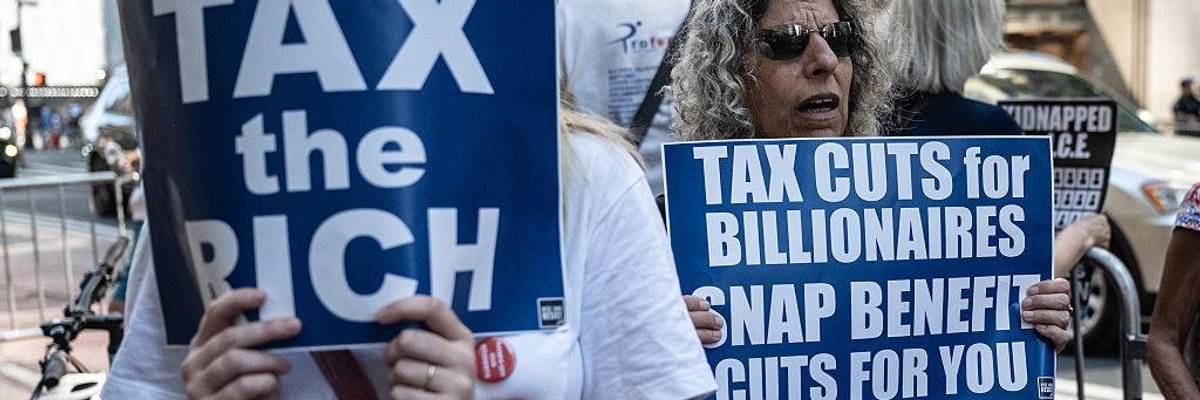
A coalition of activist groups participates in a demonstration in front of Trump Tower on July 4, 2025 in New York City.
"A billionaire tax is not radical. It is a necessary response to a crisis made worse by federal decisions."
A broad coalition of labor organizations and community advocates are coming together to launch a campaign aimed at raising taxes on the ultrawealthy.
In a press briefing on Thursday, organizers outlined their plan to pressure state governments to enact a "Tax the Rich" agenda aimed at mitigating the harms done by the Republicans' One Big Beautiful Bill Act, which in the coming years is set to take an axe to funding for programs such as Medicaid and the Supplemental Nutrition Assistance Program (SNAP), while showering corporations and the wealthy with more tax cuts.
The coalition is planning to lobby states to pass laws similar to the so-called "millionaires tax" in Massachusetts that has raised billions in revenue to fund schools, mass transit, and other important public goods.
Max Page, president of the Massachusetts Teachers Association, said during the press briefing that the Bay State's law has proven to be such a success that it should be a model for states across the US.
"In 2022 we won a constitutional amendment that allows a four penny surtax on annual income over $1 million," said Page. "This past year alone, Fair Share brought in $3 billion from just 25,000 households in a state of 8 million people. That is how concentrated wealth is in the state of Massachusetts."
Campaigners noted that laws similar to the Massachusetts law are now being proposed in Rhode Island, Michigan, and California, and they planned to push other states to follow their lead in the coming year to avoid facing major revenue shortages caused by the GOP's budget law.
Liz Perlman, executive cirector of AFSCME 3299, argued that California in particular could benefit from such a law, which has drawn opposition from Democratic California Gov. Gavin Newsom.
"California has about 200 people who hold roughly $2.1 trillion in wealth," said Perlman. "That is about a quarter of all billionaire wealth in the United States, concentrated in a single state. A billionaire tax is not radical. It is a necessary response to a crisis made worse by federal decisions."
Vonda McDaniel, President of the Central Labor Council of Nashville and Middle Tennessee, argued that Democratic strongholds such as California and Massachusetts shouldn't be the only ones pushing for tax hikes on the ultrawealthy, arguing that GOP-led states such as Tennessee should be adopting them as well.
"A working mother in Memphis faces a combined sales tax on groceries that can approach or exceed 9%," McDaniel explained. "Meanwhile, the Tennessee Department of Revenue has reported more than 60% of corporations are paying zero in state corporate income tax."
Democratic US Senate candidate Graham Platner on Tuesday held a town hall event in Portland, Maine to help promote legislation written by Democratic state Rep. Ann Matlack (43) to change the state's income brackets to place more burden on the wealthiest households.
“For us to build the future that we want, it begins with a more equitable tax system," Platner said during the event, according to local news station WMTW. "And it begins with us thinking about healthcare as a public good and not as something that deserves the profit motive."
Dear Common Dreams reader, It’s been nearly 30 years since I co-founded Common Dreams with my late wife, Lina Newhouser. We had the radical notion that journalism should serve the public good, not corporate profits. It was clear to us from the outset what it would take to build such a project. No paid advertisements. No corporate sponsors. No millionaire publisher telling us what to think or do. Many people said we wouldn't last a year, but we proved those doubters wrong. Together with a tremendous team of journalists and dedicated staff, we built an independent media outlet free from the constraints of profits and corporate control. Our mission has always been simple: To inform. To inspire. To ignite change for the common good. Building Common Dreams was not easy. Our survival was never guaranteed. When you take on the most powerful forces—Wall Street greed, fossil fuel industry destruction, Big Tech lobbyists, and uber-rich oligarchs who have spent billions upon billions rigging the economy and democracy in their favor—the only bulwark you have is supporters who believe in your work. But here’s the urgent message from me today. It's never been this bad out there. And it's never been this hard to keep us going. At the very moment Common Dreams is most needed, the threats we face are intensifying. We need your support now more than ever. We don't accept corporate advertising and never will. We don't have a paywall because we don't think people should be blocked from critical news based on their ability to pay. Everything we do is funded by the donations of readers like you. When everyone does the little they can afford, we are strong. But if that support retreats or dries up, so do we. Will you donate now to make sure Common Dreams not only survives but thrives? —Craig Brown, Co-founder |
A broad coalition of labor organizations and community advocates are coming together to launch a campaign aimed at raising taxes on the ultrawealthy.
In a press briefing on Thursday, organizers outlined their plan to pressure state governments to enact a "Tax the Rich" agenda aimed at mitigating the harms done by the Republicans' One Big Beautiful Bill Act, which in the coming years is set to take an axe to funding for programs such as Medicaid and the Supplemental Nutrition Assistance Program (SNAP), while showering corporations and the wealthy with more tax cuts.
The coalition is planning to lobby states to pass laws similar to the so-called "millionaires tax" in Massachusetts that has raised billions in revenue to fund schools, mass transit, and other important public goods.
Max Page, president of the Massachusetts Teachers Association, said during the press briefing that the Bay State's law has proven to be such a success that it should be a model for states across the US.
"In 2022 we won a constitutional amendment that allows a four penny surtax on annual income over $1 million," said Page. "This past year alone, Fair Share brought in $3 billion from just 25,000 households in a state of 8 million people. That is how concentrated wealth is in the state of Massachusetts."
Campaigners noted that laws similar to the Massachusetts law are now being proposed in Rhode Island, Michigan, and California, and they planned to push other states to follow their lead in the coming year to avoid facing major revenue shortages caused by the GOP's budget law.
Liz Perlman, executive cirector of AFSCME 3299, argued that California in particular could benefit from such a law, which has drawn opposition from Democratic California Gov. Gavin Newsom.
"California has about 200 people who hold roughly $2.1 trillion in wealth," said Perlman. "That is about a quarter of all billionaire wealth in the United States, concentrated in a single state. A billionaire tax is not radical. It is a necessary response to a crisis made worse by federal decisions."
Vonda McDaniel, President of the Central Labor Council of Nashville and Middle Tennessee, argued that Democratic strongholds such as California and Massachusetts shouldn't be the only ones pushing for tax hikes on the ultrawealthy, arguing that GOP-led states such as Tennessee should be adopting them as well.
"A working mother in Memphis faces a combined sales tax on groceries that can approach or exceed 9%," McDaniel explained. "Meanwhile, the Tennessee Department of Revenue has reported more than 60% of corporations are paying zero in state corporate income tax."
Democratic US Senate candidate Graham Platner on Tuesday held a town hall event in Portland, Maine to help promote legislation written by Democratic state Rep. Ann Matlack (43) to change the state's income brackets to place more burden on the wealthiest households.
“For us to build the future that we want, it begins with a more equitable tax system," Platner said during the event, according to local news station WMTW. "And it begins with us thinking about healthcare as a public good and not as something that deserves the profit motive."
A broad coalition of labor organizations and community advocates are coming together to launch a campaign aimed at raising taxes on the ultrawealthy.
In a press briefing on Thursday, organizers outlined their plan to pressure state governments to enact a "Tax the Rich" agenda aimed at mitigating the harms done by the Republicans' One Big Beautiful Bill Act, which in the coming years is set to take an axe to funding for programs such as Medicaid and the Supplemental Nutrition Assistance Program (SNAP), while showering corporations and the wealthy with more tax cuts.
The coalition is planning to lobby states to pass laws similar to the so-called "millionaires tax" in Massachusetts that has raised billions in revenue to fund schools, mass transit, and other important public goods.
Max Page, president of the Massachusetts Teachers Association, said during the press briefing that the Bay State's law has proven to be such a success that it should be a model for states across the US.
"In 2022 we won a constitutional amendment that allows a four penny surtax on annual income over $1 million," said Page. "This past year alone, Fair Share brought in $3 billion from just 25,000 households in a state of 8 million people. That is how concentrated wealth is in the state of Massachusetts."
Campaigners noted that laws similar to the Massachusetts law are now being proposed in Rhode Island, Michigan, and California, and they planned to push other states to follow their lead in the coming year to avoid facing major revenue shortages caused by the GOP's budget law.
Liz Perlman, executive cirector of AFSCME 3299, argued that California in particular could benefit from such a law, which has drawn opposition from Democratic California Gov. Gavin Newsom.
"California has about 200 people who hold roughly $2.1 trillion in wealth," said Perlman. "That is about a quarter of all billionaire wealth in the United States, concentrated in a single state. A billionaire tax is not radical. It is a necessary response to a crisis made worse by federal decisions."
Vonda McDaniel, President of the Central Labor Council of Nashville and Middle Tennessee, argued that Democratic strongholds such as California and Massachusetts shouldn't be the only ones pushing for tax hikes on the ultrawealthy, arguing that GOP-led states such as Tennessee should be adopting them as well.
"A working mother in Memphis faces a combined sales tax on groceries that can approach or exceed 9%," McDaniel explained. "Meanwhile, the Tennessee Department of Revenue has reported more than 60% of corporations are paying zero in state corporate income tax."
Democratic US Senate candidate Graham Platner on Tuesday held a town hall event in Portland, Maine to help promote legislation written by Democratic state Rep. Ann Matlack (43) to change the state's income brackets to place more burden on the wealthiest households.
“For us to build the future that we want, it begins with a more equitable tax system," Platner said during the event, according to local news station WMTW. "And it begins with us thinking about healthcare as a public good and not as something that deserves the profit motive."