SUBSCRIBE TO OUR FREE NEWSLETTER
Daily news & progressive opinion—funded by the people, not the corporations—delivered straight to your inbox.
5
#000000
#FFFFFF
To donate by check, phone, or other method, see our More Ways to Give page.
Daily news & progressive opinion—funded by the people, not the corporations—delivered straight to your inbox.

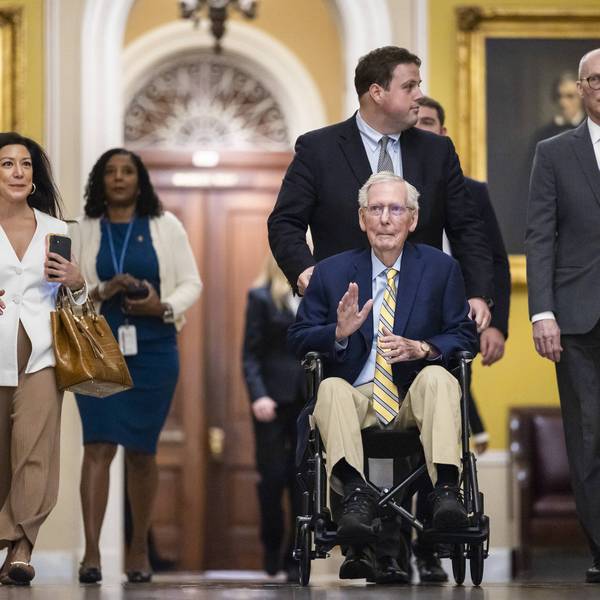
Mitt Romney, then a Republican US senator from Utah, rode the chamber's subway in the Capitol in Washington, DC on May 21, 2024.
"When Romney had real power," noted journalist David Sirota, "he fortified the rigged tax system that he's only now criticizing from the sidelines."
In a leaked fundraiser footage from the 2012 US presidential campaign, Republican candidate Mitt Romney infamously claimed that 47% of Americans are people "who believe that they are victims, who believe that government has a responsibility to care for them, who believe that they are entitled to healthcare, to food, to housing, to you name it." On Friday, the former US senator from Utah published a New York Times opinion piece titled, "Tax the Rich, Like Me."
"In 2012, political ads suggested that some of my policy proposals, if enacted, would amount to pushing grandma off a cliff. Actually, my proposals were intended to prevent that very thing from happening," Romney began the article, which was met with a range of reactions. "Today, all of us, including our grandmas, truly are headed for a cliff: If, as projected, the Social Security Trust Fund runs out in the 2034 fiscal year, benefits will be cut by about 23%."
"Typically, Democrats insist on higher taxes, and Republicans insist on lower spending. But given the magnitude of our national debt as well as the proximity of the cliff, both are necessary," he argued. "On the spending-cut front... Social Security and Medicare benefits for future retirees should be means-tested—need-based, that is to say—and the starting age for entitlement payments should be linked to American life expectancy."
"And on the tax front, it's time for rich people like me to pay more," wrote Romney, whose estimated net worth last year, when he announced his January 2025 retirement from the Senate, was $235 million. "I long opposed increasing the income level on which FICA employment taxes are applied (this year, the cap is $176,100). No longer; the consequences of the cliff have changed my mind."
"The largest source of additional tax revenues is also probably the most compelling for fairness and social stability. Some call it closing tax code loopholes, but the term 'loopholes' grossly understates their scale. 'Caverns' or 'caves' would be more fitting," he continued, calling for rewriting capital gains tax treatment rules for "mega-estates over $100 million."
"Sealing the real estate caverns would also raise more revenue," Romney noted. "There are more loopholes and caverns to be explored and sealed for the very wealthy, including state and local tax deductions, the tax rate on carried interest, and charity limits on the largest estates at death."
Some welcomed or even praised Romney's piece. Iowa state Rep. JD Scholten (D-1), a progressive who has previously run for both chambers of Congress, declared on social media: "Tax the rich! Welcome to the coalition, Mitt!"
US House Committee on the Budget Ranking Member Brendan Boyle (D-Pa.), who is part of the New Democrat Coalition, said: "I welcome this op-ed by Mitt Romney and encourage people to read it. As the next chair of the House Budget Committee, increasing revenue by closing loopholes exploited by the wealthiest Americans will be a top priority."
Progressive Saikat Chakrabarti, who is reportedly worth at least $167 million and is one of the candidates running to replace retiring former House Speaker Nancy Pelosi (D-Calif.), responded: "Even Mitt Romney now agrees that we need to tax the wealthiest. I call for a wealth tax on our billionaires and centimillionaires."
Michael Linden, a senior policy fellow at the Washington Center for Equitable Growth, said: "Kudos to Mitt Romney for changing his mind and calling for higher taxes on the rich. I'm not going to nitpick his op-ed (though there are a few things I disagree with), because the gist of it is right: We need real tax reform to make the rich pay more."
Others pointed to Romney's record, including the impactful 47% remarks. The Lever's David Sirota wondered, "Why is it that powerful people typically wait until they have no power to take the right position and effectively admit they were wrong when they had more power to do something about it?"
According to Sirota:
The obvious news of the op-ed is that we've reached a point in which even American politics' very own Gordon Gekko—a private equity mogul-turned-Republican politician—is now admitting the tax system has been rigged for his fellow oligarchs.
And, hey, that's good. I believe in the politics of addition. I believe in welcoming converts to good causes in the spirit of "better late than never." I believe there should be space for people to change their views for the better. And I appreciate Romney offering at least some pro forma explanation about what allegedly changed his thinking (sidenote: I say "allegedly" because it's not like Romney only just now learned that the tax system was rigged—he was literally a co-founder of Bain Capital!).
"And yet, these kinds of reversals (without explicit apologies, of course) often come off as both long overdue but also vaguely inauthentic, or at least not as courageous and principled as they seem," Sirota continued, stressing that "when Romney had real power, he fortified the rigged tax system that he's only now criticizing from the sidelines."
Dear Common Dreams reader, It’s been nearly 30 years since I co-founded Common Dreams with my late wife, Lina Newhouser. We had the radical notion that journalism should serve the public good, not corporate profits. It was clear to us from the outset what it would take to build such a project. No paid advertisements. No corporate sponsors. No millionaire publisher telling us what to think or do. Many people said we wouldn't last a year, but we proved those doubters wrong. Together with a tremendous team of journalists and dedicated staff, we built an independent media outlet free from the constraints of profits and corporate control. Our mission has always been simple: To inform. To inspire. To ignite change for the common good. Building Common Dreams was not easy. Our survival was never guaranteed. When you take on the most powerful forces—Wall Street greed, fossil fuel industry destruction, Big Tech lobbyists, and uber-rich oligarchs who have spent billions upon billions rigging the economy and democracy in their favor—the only bulwark you have is supporters who believe in your work. But here’s the urgent message from me today. It's never been this bad out there. And it's never been this hard to keep us going. At the very moment Common Dreams is most needed, the threats we face are intensifying. We need your support now more than ever. We don't accept corporate advertising and never will. We don't have a paywall because we don't think people should be blocked from critical news based on their ability to pay. Everything we do is funded by the donations of readers like you. When everyone does the little they can afford, we are strong. But if that support retreats or dries up, so do we. Will you donate now to make sure Common Dreams not only survives but thrives? —Craig Brown, Co-founder |
In a leaked fundraiser footage from the 2012 US presidential campaign, Republican candidate Mitt Romney infamously claimed that 47% of Americans are people "who believe that they are victims, who believe that government has a responsibility to care for them, who believe that they are entitled to healthcare, to food, to housing, to you name it." On Friday, the former US senator from Utah published a New York Times opinion piece titled, "Tax the Rich, Like Me."
"In 2012, political ads suggested that some of my policy proposals, if enacted, would amount to pushing grandma off a cliff. Actually, my proposals were intended to prevent that very thing from happening," Romney began the article, which was met with a range of reactions. "Today, all of us, including our grandmas, truly are headed for a cliff: If, as projected, the Social Security Trust Fund runs out in the 2034 fiscal year, benefits will be cut by about 23%."
"Typically, Democrats insist on higher taxes, and Republicans insist on lower spending. But given the magnitude of our national debt as well as the proximity of the cliff, both are necessary," he argued. "On the spending-cut front... Social Security and Medicare benefits for future retirees should be means-tested—need-based, that is to say—and the starting age for entitlement payments should be linked to American life expectancy."
"And on the tax front, it's time for rich people like me to pay more," wrote Romney, whose estimated net worth last year, when he announced his January 2025 retirement from the Senate, was $235 million. "I long opposed increasing the income level on which FICA employment taxes are applied (this year, the cap is $176,100). No longer; the consequences of the cliff have changed my mind."
"The largest source of additional tax revenues is also probably the most compelling for fairness and social stability. Some call it closing tax code loopholes, but the term 'loopholes' grossly understates their scale. 'Caverns' or 'caves' would be more fitting," he continued, calling for rewriting capital gains tax treatment rules for "mega-estates over $100 million."
"Sealing the real estate caverns would also raise more revenue," Romney noted. "There are more loopholes and caverns to be explored and sealed for the very wealthy, including state and local tax deductions, the tax rate on carried interest, and charity limits on the largest estates at death."
Some welcomed or even praised Romney's piece. Iowa state Rep. JD Scholten (D-1), a progressive who has previously run for both chambers of Congress, declared on social media: "Tax the rich! Welcome to the coalition, Mitt!"
US House Committee on the Budget Ranking Member Brendan Boyle (D-Pa.), who is part of the New Democrat Coalition, said: "I welcome this op-ed by Mitt Romney and encourage people to read it. As the next chair of the House Budget Committee, increasing revenue by closing loopholes exploited by the wealthiest Americans will be a top priority."
Progressive Saikat Chakrabarti, who is reportedly worth at least $167 million and is one of the candidates running to replace retiring former House Speaker Nancy Pelosi (D-Calif.), responded: "Even Mitt Romney now agrees that we need to tax the wealthiest. I call for a wealth tax on our billionaires and centimillionaires."
Michael Linden, a senior policy fellow at the Washington Center for Equitable Growth, said: "Kudos to Mitt Romney for changing his mind and calling for higher taxes on the rich. I'm not going to nitpick his op-ed (though there are a few things I disagree with), because the gist of it is right: We need real tax reform to make the rich pay more."
Others pointed to Romney's record, including the impactful 47% remarks. The Lever's David Sirota wondered, "Why is it that powerful people typically wait until they have no power to take the right position and effectively admit they were wrong when they had more power to do something about it?"
According to Sirota:
The obvious news of the op-ed is that we've reached a point in which even American politics' very own Gordon Gekko—a private equity mogul-turned-Republican politician—is now admitting the tax system has been rigged for his fellow oligarchs.
And, hey, that's good. I believe in the politics of addition. I believe in welcoming converts to good causes in the spirit of "better late than never." I believe there should be space for people to change their views for the better. And I appreciate Romney offering at least some pro forma explanation about what allegedly changed his thinking (sidenote: I say "allegedly" because it's not like Romney only just now learned that the tax system was rigged—he was literally a co-founder of Bain Capital!).
"And yet, these kinds of reversals (without explicit apologies, of course) often come off as both long overdue but also vaguely inauthentic, or at least not as courageous and principled as they seem," Sirota continued, stressing that "when Romney had real power, he fortified the rigged tax system that he's only now criticizing from the sidelines."
In a leaked fundraiser footage from the 2012 US presidential campaign, Republican candidate Mitt Romney infamously claimed that 47% of Americans are people "who believe that they are victims, who believe that government has a responsibility to care for them, who believe that they are entitled to healthcare, to food, to housing, to you name it." On Friday, the former US senator from Utah published a New York Times opinion piece titled, "Tax the Rich, Like Me."
"In 2012, political ads suggested that some of my policy proposals, if enacted, would amount to pushing grandma off a cliff. Actually, my proposals were intended to prevent that very thing from happening," Romney began the article, which was met with a range of reactions. "Today, all of us, including our grandmas, truly are headed for a cliff: If, as projected, the Social Security Trust Fund runs out in the 2034 fiscal year, benefits will be cut by about 23%."
"Typically, Democrats insist on higher taxes, and Republicans insist on lower spending. But given the magnitude of our national debt as well as the proximity of the cliff, both are necessary," he argued. "On the spending-cut front... Social Security and Medicare benefits for future retirees should be means-tested—need-based, that is to say—and the starting age for entitlement payments should be linked to American life expectancy."
"And on the tax front, it's time for rich people like me to pay more," wrote Romney, whose estimated net worth last year, when he announced his January 2025 retirement from the Senate, was $235 million. "I long opposed increasing the income level on which FICA employment taxes are applied (this year, the cap is $176,100). No longer; the consequences of the cliff have changed my mind."
"The largest source of additional tax revenues is also probably the most compelling for fairness and social stability. Some call it closing tax code loopholes, but the term 'loopholes' grossly understates their scale. 'Caverns' or 'caves' would be more fitting," he continued, calling for rewriting capital gains tax treatment rules for "mega-estates over $100 million."
"Sealing the real estate caverns would also raise more revenue," Romney noted. "There are more loopholes and caverns to be explored and sealed for the very wealthy, including state and local tax deductions, the tax rate on carried interest, and charity limits on the largest estates at death."
Some welcomed or even praised Romney's piece. Iowa state Rep. JD Scholten (D-1), a progressive who has previously run for both chambers of Congress, declared on social media: "Tax the rich! Welcome to the coalition, Mitt!"
US House Committee on the Budget Ranking Member Brendan Boyle (D-Pa.), who is part of the New Democrat Coalition, said: "I welcome this op-ed by Mitt Romney and encourage people to read it. As the next chair of the House Budget Committee, increasing revenue by closing loopholes exploited by the wealthiest Americans will be a top priority."
Progressive Saikat Chakrabarti, who is reportedly worth at least $167 million and is one of the candidates running to replace retiring former House Speaker Nancy Pelosi (D-Calif.), responded: "Even Mitt Romney now agrees that we need to tax the wealthiest. I call for a wealth tax on our billionaires and centimillionaires."
Michael Linden, a senior policy fellow at the Washington Center for Equitable Growth, said: "Kudos to Mitt Romney for changing his mind and calling for higher taxes on the rich. I'm not going to nitpick his op-ed (though there are a few things I disagree with), because the gist of it is right: We need real tax reform to make the rich pay more."
Others pointed to Romney's record, including the impactful 47% remarks. The Lever's David Sirota wondered, "Why is it that powerful people typically wait until they have no power to take the right position and effectively admit they were wrong when they had more power to do something about it?"
According to Sirota:
The obvious news of the op-ed is that we've reached a point in which even American politics' very own Gordon Gekko—a private equity mogul-turned-Republican politician—is now admitting the tax system has been rigged for his fellow oligarchs.
And, hey, that's good. I believe in the politics of addition. I believe in welcoming converts to good causes in the spirit of "better late than never." I believe there should be space for people to change their views for the better. And I appreciate Romney offering at least some pro forma explanation about what allegedly changed his thinking (sidenote: I say "allegedly" because it's not like Romney only just now learned that the tax system was rigged—he was literally a co-founder of Bain Capital!).
"And yet, these kinds of reversals (without explicit apologies, of course) often come off as both long overdue but also vaguely inauthentic, or at least not as courageous and principled as they seem," Sirota continued, stressing that "when Romney had real power, he fortified the rigged tax system that he's only now criticizing from the sidelines."