
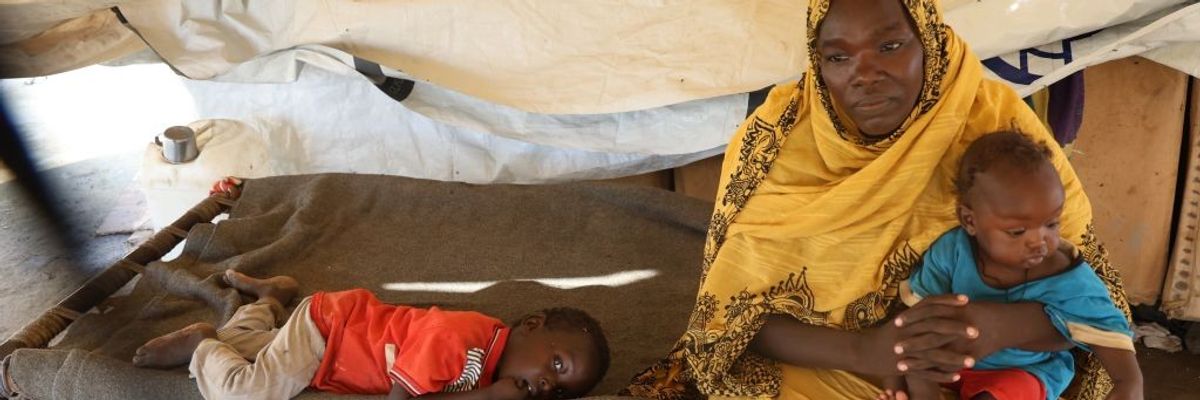
People are seen in a tent at a center for displaced people fleeing from conflict between the Sudanese Armed Forces and the paramilitary Rapid Support Forces in Port Sudan, Sudan on November 12, 2024.
Global Inaction Decried as Sudan Suffers World's 'Largest Humanitarian Crisis'
"Amid the rising tide of hate speech and ethnically driven violence and reprisals, we fear the darkest chapters of this conflict have yet to unfold," said the head of one U.N. mission.
Human rights groups on Tuesday marked two years of civil war in Sudan by decrying "international neglect" and urging the international community do more to end the conflict, while one United Nations official warned that the worst of the conflict may be still to come.
"The world has witnessed two years of ruthless conflict which has trapped millions of civilians in harrowing situations, subjecting them to violations and suffering with no end in sight," said Mohamed Chande Othman, chair of the U.N.'s Independent International Fact-Finding Mission for the Sudan, on Monday. "Amid the rising tide of hate speech and ethnically driven violence and reprisals, we fear the darkest chapters of this conflict have yet to unfold."
Sudan has been racked by violence since fighting erupted between the between the Sudanese Armed Forces (SAF)—the nation's official military—and the paramilitary Rapid Support Forces (RSF) in April 2023. The civil war has also led to famine in certain areas of the country and mass displacement.
The head of the U.N. Children's Fund warned that Sudan is experiencing the world's largest and most devastating humanitarian crisis, according to a statement from last month.
"Sudan is now worse off than ever before," Elise Nalbandian, a regional advocacy and communications manager for Oxfam International, told The Guardian. "The largest humanitarian crisis, largest displacement crisis, largest hunger crisis... It's breaking all sorts of wrong records."
The two year mark of the start of the civil war comes on the heels of a wave of attacks in displacement camps and around the city of El Fasher carried out by paramilitary forces, according to The Guardian. Nine workers with Relief International were killed as part of the attacks.
"Today is a day of shame. Shame on the perpetrators on both sides of this terrible conflict who have inflicted unimaginable suffering on civilians. Shame on the world for turning away while Sudan burns. Shame on the countries that continue to add fuel to the fire," said Amnesty International's senior director for research, advocacy, policy, and campaigns Erika Guevara Rosas in a statement on Tuesday.
According to Rosas, both the Sudan Armed Forces, Rapid Support Forces, and their allies have committed atrocities, such as sexual violence against women and girls and tortute, that amount to war crimes. "Despite these atrocities, the world has largely chosen to remain passive. Alarmingly, the U.N. Security Council has failed to implement a comprehensive arms embargo on Sudan to halt the constant flow of weapons fueling these heinous crimes," she said.
In an opinion piece published Tuesday, two directors at Human Rights Watch highlighted both the anniversary of the crisis and a conference focused on Sudan that was held Tuesday and hosted by the United Kingdom with the African Union, the European Union, France, and Germany, per Reuters.
"As the U.K. convenes an international gathering on Sudan today, the stakes couldn't be higher for civilians there," the two wrote. "It is essential for the conference to deliver concrete actions designed to stop unfolding atrocities in Darfur and rally high-level support for protecting civilians."
The U.K. must use the conference to "rally global action to prevent more atrocities, starting with the creation of a coalition of states willing to work urgently to protect civilians. It also needs to move ahead with sanctions against commanders," they added.
According to Reuters, the European Union and the U.K. pledged at the conference to increase aid to Sudan.
We are at a crossroads
This country and this world are at a monumental crossroads. In a few short weeks, US voters will have an opportunity to beat back the forces of fascism and confront the billionaires who are rigging the economy, our media system, and our democracy, making it increasingly impossible for ordinary people to get by. We’re not just talking about the election. We’re talking about what must be done once these fascist elements are vanquished from power. We need a bolder set of solutions than what either major party has so far been willing to offer and a working-class movement ready to fight like hell for it. Trump didn't emerge from nowhere. The conditions that fueled MAGA authoritarianism were created by decades of radical neoliberal economic policies and a corrupt political system dominated by corporate interests. They slashed taxes on the super-rich, promising that the benefits would trickle down. They said giveaways to the corporate titans would make life more affordable for the rest of us. It was all bullshit. And when a bitter, betrayed populace searches for someone to blame, right-wing demagogues have little trouble finding scapegoats. People know when they're being lied to, but you won't hear any of this from the corporate media. Only independent journalism—powered and funded by people who believe in building a better world—can deliver truly trustworthy daily news. Our Fall Campaign is underway, and we need your help. To power our newsroom through the rest of the year, we need to raise $125,000 by midnight on October 31. So if you share our vision, please contribute whatever you can to sustain our work. |
Human rights groups on Tuesday marked two years of civil war in Sudan by decrying "international neglect" and urging the international community do more to end the conflict, while one United Nations official warned that the worst of the conflict may be still to come.
"The world has witnessed two years of ruthless conflict which has trapped millions of civilians in harrowing situations, subjecting them to violations and suffering with no end in sight," said Mohamed Chande Othman, chair of the U.N.'s Independent International Fact-Finding Mission for the Sudan, on Monday. "Amid the rising tide of hate speech and ethnically driven violence and reprisals, we fear the darkest chapters of this conflict have yet to unfold."
Sudan has been racked by violence since fighting erupted between the between the Sudanese Armed Forces (SAF)—the nation's official military—and the paramilitary Rapid Support Forces (RSF) in April 2023. The civil war has also led to famine in certain areas of the country and mass displacement.
The head of the U.N. Children's Fund warned that Sudan is experiencing the world's largest and most devastating humanitarian crisis, according to a statement from last month.
"Sudan is now worse off than ever before," Elise Nalbandian, a regional advocacy and communications manager for Oxfam International, told The Guardian. "The largest humanitarian crisis, largest displacement crisis, largest hunger crisis... It's breaking all sorts of wrong records."
The two year mark of the start of the civil war comes on the heels of a wave of attacks in displacement camps and around the city of El Fasher carried out by paramilitary forces, according to The Guardian. Nine workers with Relief International were killed as part of the attacks.
"Today is a day of shame. Shame on the perpetrators on both sides of this terrible conflict who have inflicted unimaginable suffering on civilians. Shame on the world for turning away while Sudan burns. Shame on the countries that continue to add fuel to the fire," said Amnesty International's senior director for research, advocacy, policy, and campaigns Erika Guevara Rosas in a statement on Tuesday.
According to Rosas, both the Sudan Armed Forces, Rapid Support Forces, and their allies have committed atrocities, such as sexual violence against women and girls and tortute, that amount to war crimes. "Despite these atrocities, the world has largely chosen to remain passive. Alarmingly, the U.N. Security Council has failed to implement a comprehensive arms embargo on Sudan to halt the constant flow of weapons fueling these heinous crimes," she said.
In an opinion piece published Tuesday, two directors at Human Rights Watch highlighted both the anniversary of the crisis and a conference focused on Sudan that was held Tuesday and hosted by the United Kingdom with the African Union, the European Union, France, and Germany, per Reuters.
"As the U.K. convenes an international gathering on Sudan today, the stakes couldn't be higher for civilians there," the two wrote. "It is essential for the conference to deliver concrete actions designed to stop unfolding atrocities in Darfur and rally high-level support for protecting civilians."
The U.K. must use the conference to "rally global action to prevent more atrocities, starting with the creation of a coalition of states willing to work urgently to protect civilians. It also needs to move ahead with sanctions against commanders," they added.
According to Reuters, the European Union and the U.K. pledged at the conference to increase aid to Sudan.