SUBSCRIBE TO OUR FREE NEWSLETTER
Daily news & progressive opinion—funded by the people, not the corporations—delivered straight to your inbox.
5
#000000
#FFFFFF
To donate by check, phone, or other method, see our More Ways to Give page.
Daily news & progressive opinion—funded by the people, not the corporations—delivered straight to your inbox.
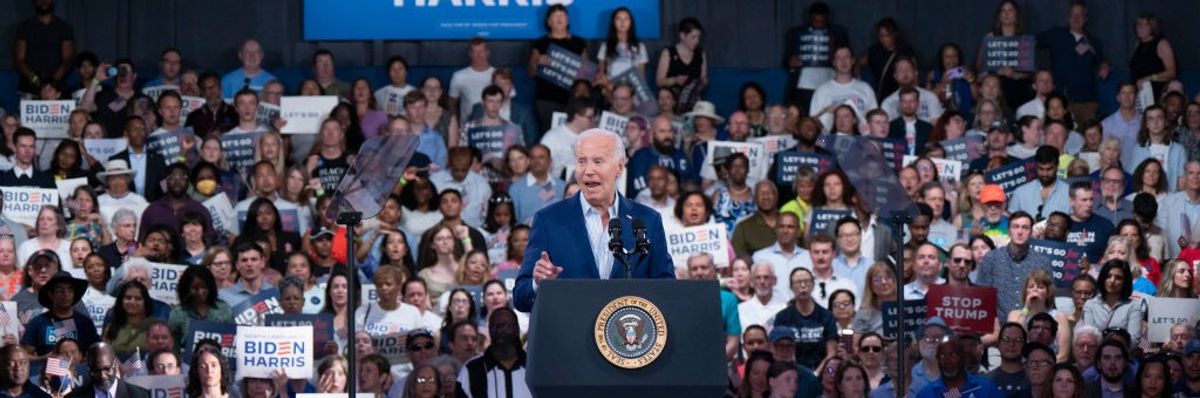
U.S. President Joe Biden speaks at a campaign rally on June 28, 2024 in Raleigh, North Carolina.
"The rent is too damn high—and rent control is a real fix," one group said, praising the proposal.
As former U.S. President Donald Trump secured the Republican nomination and announced his running mate on Monday, Democratic President Joe Biden prepared to unveil a proposal that would cap annual rent increases at 5% for tenants of major landlords.
After Biden briefly previewed the proposal during a press conference last week, The Washington Post reported on the planned announcement Monday, citing three people familiar with the matter. The Associated Press separately confirmed the plan.
Biden is set to formally introduce the proposal on Tuesday in Nevada, which "has seen among the biggest explosions of housing costs in the country," the Post noted. "Democrats have grown increasingly concerned that Trump could win the state in November."
The president, who is seeking reelection, will propose taking a tax benefit away from landlords who hike rents by more than 5% annually, according to the reporting. The plan would only apply to the existing housing stock of landlords who own more than 50 units and would require congressional approval—so it is not expected to go anywhere unless Biden wins in November and Democrats secure majorities in both chambers of Congress.
As the newspaper detailed:
The Biden administration is also pushing numerous policies to increase housing construction, through incentives to local governments to change their zoning codes and new federal financial incentives for builders. If implemented, they could bring 2 million new units to the market in addition to the 1.6 million already in the pipeline.
"It would make little sense to make this move by itself. But you have to look at it in the context of the moves they propose to make to expand supply," said Jim Parrott, nonresident fellow at the Urban Institute and co-owner of Parrott Ryan Advisors. "The question is: Even if we get all these new units built, what do we do about rising rents in the meantime? Coming up with a relatively targeted bridge to help renters while new supply is coming online makes a fair amount of sense."
While housing industry representatives criticized the reported proposal, Diane Yentel, president and CEO of the National Low Income Housing Coalition, told The Associated Press that having it in effect in recent years could have helped renters.
"The recent unprecedented increases in homelessness in communities across the country are the result of those equally unprecedented—and unjustified—rent hikes of a couple years ago," she said. "Had such protections against rent gouging been in place then, many families could have avoided homelessness and stayed stably housed."
Other rent control advocates and progressive officials also welcomed the plan, with Kendra Brooks—the first Working Families Party member ever elected to Philadelphia City Council—declaring that "this is exactly the kind of leadership that working families need!"
Jacobin's Branko Marcetic said that "this is huge," particularly considering that "housing has rapidly climbed as a cost-of-living concern (and is also under 30s' most important issue)."
Multiple campaigners and organizations credited housing advocates for pushing rent control at the national level.
"It's amazing how rapidly the conversation around rent caps has changed," noted Shamus Roller, executive director of the National Housing Law Project. "Tenant organizing has created this change. It's a proposal for Congress which will face serious headwinds but the president just called for rent caps (even if only temporarily)."
The Debt Collective said, "We will say it over and over again: The rent is too damn high—and rent control is a real fix."
"Rent caps wouldn't be a national policy proposal without tenants unions across the country making it possible through organizing," the group added. "On our way to land without landlords, remember that rent control works. The 99%'s need for a roof over our head should not be 1% profits."
This country and this world are at a monumental crossroads. US voters have an opportunity to beat back the forces of fascism and confront the billionaires who are rigging the economy, our media system, and our democracy, making it increasingly impossible for ordinary people to get by. We’re not just talking about the election. We’re talking about what must be done once these fascist elements are vanquished from power. We need a bolder set of solutions than what either major party has so far been willing to offer and a working-class movement ready to fight like hell for it. Trump didn't emerge from nowhere. The conditions that fueled MAGA authoritarianism were created by decades of radical neoliberal economic policies and a corrupt political system dominated by corporate interests. They slashed taxes on the super-rich, promising that the benefits would trickle down. They said giveaways to the corporate titans would make life more affordable for the rest of us. It was all bullshit. And when a bitter, betrayed populace searches for someone to blame, right-wing demagogues have little trouble finding scapegoats. People know when they're being lied to, but you won't hear any of this from the corporate media. Only independent journalism—powered and funded by people who believe in building a better world—can deliver truly trustworthy daily news. If you share our vision, please contribute whatever you can to sustain our work. |
As former U.S. President Donald Trump secured the Republican nomination and announced his running mate on Monday, Democratic President Joe Biden prepared to unveil a proposal that would cap annual rent increases at 5% for tenants of major landlords.
After Biden briefly previewed the proposal during a press conference last week, The Washington Post reported on the planned announcement Monday, citing three people familiar with the matter. The Associated Press separately confirmed the plan.
Biden is set to formally introduce the proposal on Tuesday in Nevada, which "has seen among the biggest explosions of housing costs in the country," the Post noted. "Democrats have grown increasingly concerned that Trump could win the state in November."
The president, who is seeking reelection, will propose taking a tax benefit away from landlords who hike rents by more than 5% annually, according to the reporting. The plan would only apply to the existing housing stock of landlords who own more than 50 units and would require congressional approval—so it is not expected to go anywhere unless Biden wins in November and Democrats secure majorities in both chambers of Congress.
As the newspaper detailed:
The Biden administration is also pushing numerous policies to increase housing construction, through incentives to local governments to change their zoning codes and new federal financial incentives for builders. If implemented, they could bring 2 million new units to the market in addition to the 1.6 million already in the pipeline.
"It would make little sense to make this move by itself. But you have to look at it in the context of the moves they propose to make to expand supply," said Jim Parrott, nonresident fellow at the Urban Institute and co-owner of Parrott Ryan Advisors. "The question is: Even if we get all these new units built, what do we do about rising rents in the meantime? Coming up with a relatively targeted bridge to help renters while new supply is coming online makes a fair amount of sense."
While housing industry representatives criticized the reported proposal, Diane Yentel, president and CEO of the National Low Income Housing Coalition, told The Associated Press that having it in effect in recent years could have helped renters.
"The recent unprecedented increases in homelessness in communities across the country are the result of those equally unprecedented—and unjustified—rent hikes of a couple years ago," she said. "Had such protections against rent gouging been in place then, many families could have avoided homelessness and stayed stably housed."
Other rent control advocates and progressive officials also welcomed the plan, with Kendra Brooks—the first Working Families Party member ever elected to Philadelphia City Council—declaring that "this is exactly the kind of leadership that working families need!"
Jacobin's Branko Marcetic said that "this is huge," particularly considering that "housing has rapidly climbed as a cost-of-living concern (and is also under 30s' most important issue)."
Multiple campaigners and organizations credited housing advocates for pushing rent control at the national level.
"It's amazing how rapidly the conversation around rent caps has changed," noted Shamus Roller, executive director of the National Housing Law Project. "Tenant organizing has created this change. It's a proposal for Congress which will face serious headwinds but the president just called for rent caps (even if only temporarily)."
The Debt Collective said, "We will say it over and over again: The rent is too damn high—and rent control is a real fix."
"Rent caps wouldn't be a national policy proposal without tenants unions across the country making it possible through organizing," the group added. "On our way to land without landlords, remember that rent control works. The 99%'s need for a roof over our head should not be 1% profits."