

SUBSCRIBE TO OUR FREE NEWSLETTER
Daily news & progressive opinion—funded by the people, not the corporations—delivered straight to your inbox.
5
#000000
#FFFFFF
To donate by check, phone, or other method, see our More Ways to Give page.
Daily news & progressive opinion—funded by the people, not the corporations—delivered straight to your inbox.
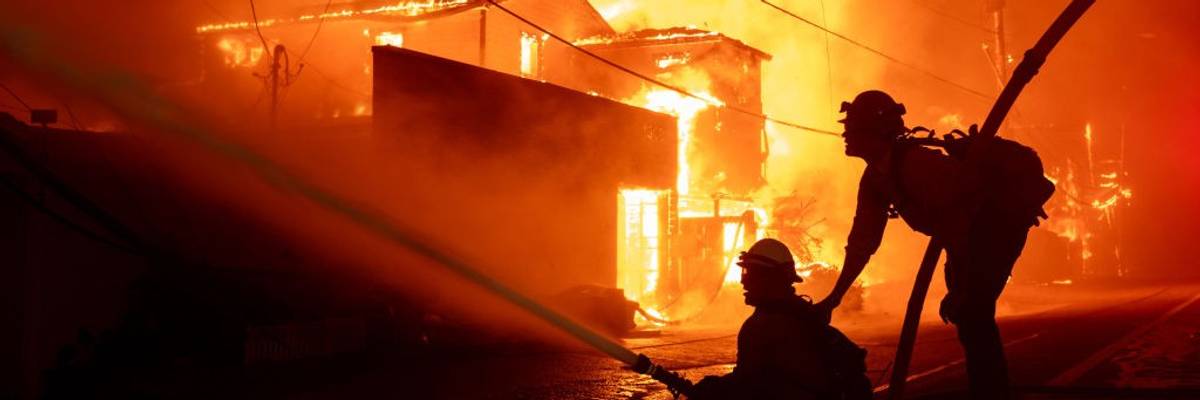
Firefighters battle wind-driven fire as multiple beachfront homes go up in flames along Pacific Coast Highway in Malibu on January 7, 2025.
"These markets risk creating perverse incentives, undermining public trust, and commodifying human suffering in ways that warrant careful scrutiny."
As wildfires ravaged large swaths of the Western US, a group of Democratic senators on Monday called on federal regulators to rein in prediction markets offering contracts tied to such disasters, warning that turning climate-fueled extreme weather into financial wagers creates "perverse incentives" that could motivate arson and other crimes.
In a letter to Commodity Futures Trading Commission (CFTC) Chair Michael Selig, Sens. Jeff Merkley (Ore.), Alex Padilla (Calif.), Jeanne Shaheen (NH), Adam Schiff (Calif.), Jacky Rosen (Nevada), Catherine Cortez Masto (Nevada), Martin Heinrich (NM), Ron Wyden (Ore.), and Amy Klobuchar (Minn.) wrote that "prediction markets have been enabled to expand rapidly, increasingly inviting speculation on war, political violence, disasters, and public emergencies that raise ethical and public policy concerns."
"These markets risk creating perverse incentives, undermining public trust, and commodifying human suffering in ways that warrant careful scrutiny," the lawmakers continued. "Recent public reports have highlighted how Polymarket—the largest prediction market platform in the world—accepted more than $1.2 million in bets surrounding the Palisades and Eaton fires in January 2025. These fires devastated the Los Angeles area, claiming the lives of 31 people and destroying more than 16,000 structures."
"Offering bets on destructive wildfires threatens to minimize communities’ suffering all so the rich and powerful can profit," the letter argues. "There’s also the heightened risk—according to state and local fire officials—that individuals could be tempted to commit arson in order to make sure their bets are successful."
"By offering contracts on fires, prediction market sites run the risk of encouraging people to influence fires that have already started, creating additional concerns around public safety and insider trading," the senators added.
The CFTC controversially considers Polymarket and Kalshi designated contract markets (DCMs)—over which the federal agency has control versus state gambling regimes—and is currently developing nationwide rules.
The letter's signers asked Selig:
"As the United States faces yet another record-breaking fire season this year, the [CFTC] cannot allow these prediction markets to offer unrestricted betting on wildfires," the senators stressed. "While these bets appear to be offered only on the offshore Polymarket site, it is only a matter of time before other US-based designated contract markets try to offer these. The CFTC must lead the charge to rein in these contracts in the US and offshore and put in place commonsense guardrails to prevent people from profiting as wildfires threaten communities."
In addition to wildfires, Polymarket users can place wagers related to earthquakes, hurricanes, and volcanic eruptions.
Polymarket responded to the senators' letter in a statement to Claims Journal saying, "When tragedy unfolds, people turn to the news for commentary and to Polymarket for information.”
"While we recognize the risks associated with these markets, removing them does not prevent a tragedy," the company added. "It only makes timely, market-based information less accessible to those seeking to understand what may happen next.”
The senators' letter came days after Democratic New York Attorney General Letitia James announced a lawsuit targeting Polymarket competitor Kalshi for operating as “an illegal gambling operation" in "flagrant disregard” for the Empire State’s “Constitution, penal laws, and other statutes.”
Last month, a coalition of consumer advocacy groups condemned the CFTC's attempt to allow platforms like Kalshi and Polymarket “a green light to bypass state gambling regimes.”
“Calling a sports wager an ‘event contract’ does not transform it into a legitimate tool for managing economic risk,” said Eric Naing, communications director for Demand Progress Education Fund, one of the groups decrying the regulator's approach to such companies.
Dear Common Dreams reader, It’s been nearly 30 years since I co-founded Common Dreams with my late wife, Lina Newhouser. We had the radical notion that journalism should serve the public good, not corporate profits. It was clear to us from the outset what it would take to build such a project. No paid advertisements. No corporate sponsors. No millionaire publisher telling us what to think or do. Many people said we wouldn't last a year, but we proved those doubters wrong. Together with a tremendous team of journalists and dedicated staff, we built an independent media outlet free from the constraints of profits and corporate control. Our mission has always been simple: To inform. To inspire. To ignite change for the common good. Building Common Dreams was not easy. Our survival was never guaranteed. When you take on the most powerful forces—Wall Street greed, fossil fuel industry destruction, Big Tech lobbyists, and uber-rich oligarchs who have spent billions upon billions rigging the economy and democracy in their favor—the only bulwark you have is supporters who believe in your work. But here’s the urgent message from me today. It's never been this bad out there. And it's never been this hard to keep us going. At the very moment Common Dreams is most needed, the threats we face are intensifying. We need your support now more than ever. We don't accept corporate advertising and never will. We don't have a paywall because we don't think people should be blocked from critical news based on their ability to pay. Everything we do is funded by the donations of readers like you. When everyone does the little they can afford, we are strong. But if that support retreats or dries up, so do we. Will you donate now to make sure Common Dreams not only survives but thrives? —Craig Brown, Co-founder |
As wildfires ravaged large swaths of the Western US, a group of Democratic senators on Monday called on federal regulators to rein in prediction markets offering contracts tied to such disasters, warning that turning climate-fueled extreme weather into financial wagers creates "perverse incentives" that could motivate arson and other crimes.
In a letter to Commodity Futures Trading Commission (CFTC) Chair Michael Selig, Sens. Jeff Merkley (Ore.), Alex Padilla (Calif.), Jeanne Shaheen (NH), Adam Schiff (Calif.), Jacky Rosen (Nevada), Catherine Cortez Masto (Nevada), Martin Heinrich (NM), Ron Wyden (Ore.), and Amy Klobuchar (Minn.) wrote that "prediction markets have been enabled to expand rapidly, increasingly inviting speculation on war, political violence, disasters, and public emergencies that raise ethical and public policy concerns."
"These markets risk creating perverse incentives, undermining public trust, and commodifying human suffering in ways that warrant careful scrutiny," the lawmakers continued. "Recent public reports have highlighted how Polymarket—the largest prediction market platform in the world—accepted more than $1.2 million in bets surrounding the Palisades and Eaton fires in January 2025. These fires devastated the Los Angeles area, claiming the lives of 31 people and destroying more than 16,000 structures."
"Offering bets on destructive wildfires threatens to minimize communities’ suffering all so the rich and powerful can profit," the letter argues. "There’s also the heightened risk—according to state and local fire officials—that individuals could be tempted to commit arson in order to make sure their bets are successful."
"By offering contracts on fires, prediction market sites run the risk of encouraging people to influence fires that have already started, creating additional concerns around public safety and insider trading," the senators added.
The CFTC controversially considers Polymarket and Kalshi designated contract markets (DCMs)—over which the federal agency has control versus state gambling regimes—and is currently developing nationwide rules.
The letter's signers asked Selig:
"As the United States faces yet another record-breaking fire season this year, the [CFTC] cannot allow these prediction markets to offer unrestricted betting on wildfires," the senators stressed. "While these bets appear to be offered only on the offshore Polymarket site, it is only a matter of time before other US-based designated contract markets try to offer these. The CFTC must lead the charge to rein in these contracts in the US and offshore and put in place commonsense guardrails to prevent people from profiting as wildfires threaten communities."
In addition to wildfires, Polymarket users can place wagers related to earthquakes, hurricanes, and volcanic eruptions.
Polymarket responded to the senators' letter in a statement to Claims Journal saying, "When tragedy unfolds, people turn to the news for commentary and to Polymarket for information.”
"While we recognize the risks associated with these markets, removing them does not prevent a tragedy," the company added. "It only makes timely, market-based information less accessible to those seeking to understand what may happen next.”
The senators' letter came days after Democratic New York Attorney General Letitia James announced a lawsuit targeting Polymarket competitor Kalshi for operating as “an illegal gambling operation" in "flagrant disregard” for the Empire State’s “Constitution, penal laws, and other statutes.”
Last month, a coalition of consumer advocacy groups condemned the CFTC's attempt to allow platforms like Kalshi and Polymarket “a green light to bypass state gambling regimes.”
“Calling a sports wager an ‘event contract’ does not transform it into a legitimate tool for managing economic risk,” said Eric Naing, communications director for Demand Progress Education Fund, one of the groups decrying the regulator's approach to such companies.
As wildfires ravaged large swaths of the Western US, a group of Democratic senators on Monday called on federal regulators to rein in prediction markets offering contracts tied to such disasters, warning that turning climate-fueled extreme weather into financial wagers creates "perverse incentives" that could motivate arson and other crimes.
In a letter to Commodity Futures Trading Commission (CFTC) Chair Michael Selig, Sens. Jeff Merkley (Ore.), Alex Padilla (Calif.), Jeanne Shaheen (NH), Adam Schiff (Calif.), Jacky Rosen (Nevada), Catherine Cortez Masto (Nevada), Martin Heinrich (NM), Ron Wyden (Ore.), and Amy Klobuchar (Minn.) wrote that "prediction markets have been enabled to expand rapidly, increasingly inviting speculation on war, political violence, disasters, and public emergencies that raise ethical and public policy concerns."
"These markets risk creating perverse incentives, undermining public trust, and commodifying human suffering in ways that warrant careful scrutiny," the lawmakers continued. "Recent public reports have highlighted how Polymarket—the largest prediction market platform in the world—accepted more than $1.2 million in bets surrounding the Palisades and Eaton fires in January 2025. These fires devastated the Los Angeles area, claiming the lives of 31 people and destroying more than 16,000 structures."
"Offering bets on destructive wildfires threatens to minimize communities’ suffering all so the rich and powerful can profit," the letter argues. "There’s also the heightened risk—according to state and local fire officials—that individuals could be tempted to commit arson in order to make sure their bets are successful."
"By offering contracts on fires, prediction market sites run the risk of encouraging people to influence fires that have already started, creating additional concerns around public safety and insider trading," the senators added.
The CFTC controversially considers Polymarket and Kalshi designated contract markets (DCMs)—over which the federal agency has control versus state gambling regimes—and is currently developing nationwide rules.
The letter's signers asked Selig:
"As the United States faces yet another record-breaking fire season this year, the [CFTC] cannot allow these prediction markets to offer unrestricted betting on wildfires," the senators stressed. "While these bets appear to be offered only on the offshore Polymarket site, it is only a matter of time before other US-based designated contract markets try to offer these. The CFTC must lead the charge to rein in these contracts in the US and offshore and put in place commonsense guardrails to prevent people from profiting as wildfires threaten communities."
In addition to wildfires, Polymarket users can place wagers related to earthquakes, hurricanes, and volcanic eruptions.
Polymarket responded to the senators' letter in a statement to Claims Journal saying, "When tragedy unfolds, people turn to the news for commentary and to Polymarket for information.”
"While we recognize the risks associated with these markets, removing them does not prevent a tragedy," the company added. "It only makes timely, market-based information less accessible to those seeking to understand what may happen next.”
The senators' letter came days after Democratic New York Attorney General Letitia James announced a lawsuit targeting Polymarket competitor Kalshi for operating as “an illegal gambling operation" in "flagrant disregard” for the Empire State’s “Constitution, penal laws, and other statutes.”
Last month, a coalition of consumer advocacy groups condemned the CFTC's attempt to allow platforms like Kalshi and Polymarket “a green light to bypass state gambling regimes.”
“Calling a sports wager an ‘event contract’ does not transform it into a legitimate tool for managing economic risk,” said Eric Naing, communications director for Demand Progress Education Fund, one of the groups decrying the regulator's approach to such companies.

