5
#000000
#FFFFFF
To donate by check, phone, or other method, see our More Ways to Give page.
Daily news & progressive opinion—funded by the people, not the corporations—delivered straight to your inbox.
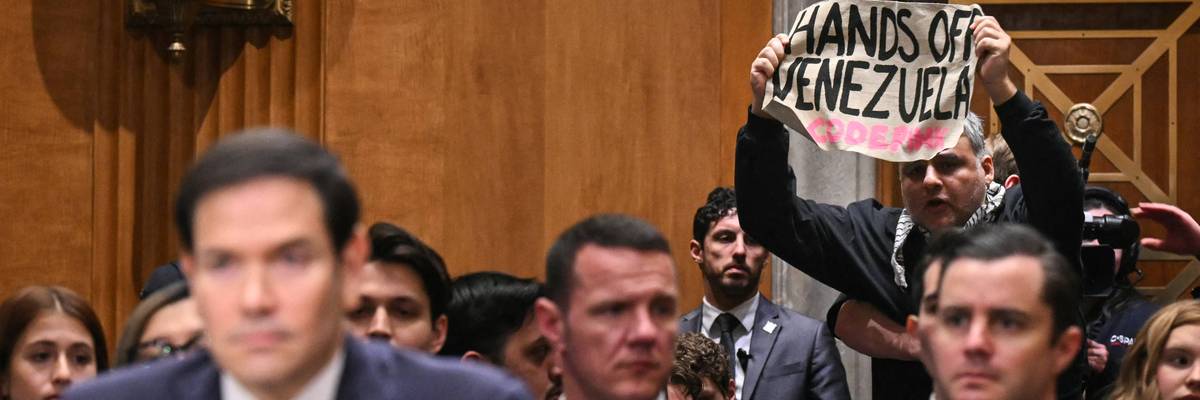
A protestor holds up a sign as US Secretary of State Marco Rubio testifies during a Senate Foreign Relations Committee hearing about US policy toward Venezuela on Capitol Hill in Washington, DC on January 28, 2026.
"Rubio's dangerously expansive vision to transform the United States into a colonizing power in the Americas must be challenged," one watchdog leader said of the US secretary of state.
In addition to asserting that "there is no war against Venezuela," despite US forces killing scores of people there while abducting its president earlier this month, Secretary of State Marco Rubio on Wednesday laid out for a Senate panel how the Trump administration intends to continue controlling the South American nation's oil and related profits.
Legal experts have argued that US President Donald Trump's blockade of Venezuela's oil, abduction of Venezuelan President Nicolás Maduro and his wife, Cilia Flores—who have both pleaded not guilty to federal narco-terrorism charges—and bombings of boats allegedly smuggling drugs in the Caribbean Sea and Pacific Ocean all violate international law.
"The ongoing military actions in the Caribbean and South America, including the abduction of Venezuela's president, are wrong, illegal under US and international law, and unconstitutional," Robert Weissman, co-president of the group Public Citizen, said before the Senate hearing. "Congressional Republicans have blocked war powers resolutions that would end the US aggression in Venezuela, an extremely dangerous abdication of congressional responsibility to check presidential unlawfulness."
"Marco Rubio's central role in the planning and execution of the scheme to violate the sovereignty of Venezuela and steal the country's oil merits a deep investigation by Congress, and potentially the removal of Rubio as secretary of state," Weissman continued. "Rubio's dangerously expansive vision to transform the United States into a colonizing power in the Americas must be challenged."
Testifying to the Senate Foreign Relations Committee—on which he previously served—Rubio said that "Maduro is an indicted drug trafficker, not a legal head of state," described his abduction as "an operation to aid law enforcement," and declared that "the United States is prepared to help oversee Venezuela's transition from a criminal state to a responsible partner."
Rubio, the acting national security adviser, insisted that Trump wasn't planning for any more military action in Venezuela—but also would not rule out such action, potentially without congressional authorization, in "self-defense" against an "imminent" threat.
Trump has repeatedly made clear through public statements that his Venezuela policy is focused on its petroleum reserves, seemingly to enrich the fossil fuel leaders who helped him return to power. American forces have seized several tankers in the Caribbean Sea linked to the country—which critics have condemned as "piracy"—and the first US sale of Venezuelan oil went to the company of a trader who donated millions to the president's 2024 campaign, which Sen. Cory Booker (D-NJ) last week called "yet another example of his unchecked corruption."
Describing US control of Venezuela's nationalized petroleum industry, Rubio told the committee:
Objective number one was stability... And one of the tools that's available to us is the fact that we have sanctions on oil. There is oil that is sanctioned that cannot move from Venezuela because of our quarantine. And so what we did is we entered into an arrangement with them, and the arrangement is this: On the oil that is sanctioned and quarantined, we will allow you to move it to market. We will allow you to move it to market at market prices—not at the discount China was getting. In return, the funds from that will be deposited into an account that we will have oversight over, and you will spend that money for the benefit of the Venezuelan people...
This is not going to be the permanent mechanism, but this is a short-term mechanism in which the needs of the Venezuelan people can be met through a process that we've created, where they will submit every month a budget of this is what we need funded. We will provide for them at the front end what that money cannot be used for. And they have been very cooperative in this regard. In fact, they have pledged to use a substantial amount of those funds to purchase medicine and equipment directly from the United States.
In an exchange with Senate Foreign Relations Committee Ranking Member Jeanne Shaheen (D-NH), Rubio said that an "audit process" has not yet been set up but will be, adding that "we've only made one payment" and it "retrospectively will be audited, but it was important we made that payment because they had to meet payroll. They had to keep sanitation workers, police officers, government workers on staff."
Shaheen noted that the oil reportedly sold for $500 million, but only $300 million went to Venezuela's government, now led by Maduro's former deputy, Delcy Rodríguez, and asked Rubio about the remaining $200 million. The secretary said that the rest of the money was in a temporary account in Qatar that will ultimately become a US Treasury blocked account.
Summarizing the Trump administration's plans, Sen. Chris Murphy (D-Conn.) said: "I think the scope of the project that you are undertaking in Venezuela is without precedent. You are taking their oil at gunpoint; you are holding and selling that oil; putting, for now, the receipts in an offshore Middle Eastern account; you're deciding how and for what purposes that money is gonna be used in a country of 30 million people. I think a lot of us believe that that is destined for failure."
Highlighting that "a month later, we have no information on a timetable for a democratic transition, Maduro's people are still in charge, most of the political prisoners are in jail—and by the way, those that have been let out have a gag order on them from the government—the opposition leader is still in exile," Murphy added, "this looks, already, like it is a failure."
At one point during the nearly three-hour hearing, Leonardo Flores, a Venezuelan-American with the anti-war group CodePink, shouted, "Marco Rubio, you and Trump are thugs!"
US Capitol Police removed Flores from the hearing. As he was being led away, the protester said that "sanctions are a form of collective punishment of Venezuelan citizens. That's a war crime. Hands off Venezuela! Hands off Cuba!"
Asked by Sen. Brian Schatz (D-Hawaii) on Wednesday, "Will you make a public commitment today to rule out US regime change in Cuba," Rubio—the son of Cuban immigrants—replied: "Regime change? Oh no, I think we would like to see the regime there change. That doesn't mean that we're gonna to make a change, but we would love to see a change. There's no doubt about the fact that it would be of great benefit to the United States if Cuba was no longer governed by an autocratic regime."
Since the abduction operation, there have been "free Maduro" protests in both Venezuela and Cuba, which lost 32 citizens in the Trump administration's attack on Caracas. Speaking to thousands of people gathered outside the US Embassy in Havana earlier this month, Cuban President Miguel Díaz-Canel said that "the current US administration has opened the door to an era of barbarism, plunder, and neo-fascism."
"No one here surrenders," he continued, taking aim at not only Trump but also Rubio. "The current emperor of the White House and his infamous secretary of state haven't stopped threatening me."
Dear Common Dreams reader, It’s been nearly 30 years since I co-founded Common Dreams with my late wife, Lina Newhouser. We had the radical notion that journalism should serve the public good, not corporate profits. It was clear to us from the outset what it would take to build such a project. No paid advertisements. No corporate sponsors. No millionaire publisher telling us what to think or do. Many people said we wouldn't last a year, but we proved those doubters wrong. Together with a tremendous team of journalists and dedicated staff, we built an independent media outlet free from the constraints of profits and corporate control. Our mission has always been simple: To inform. To inspire. To ignite change for the common good. Building Common Dreams was not easy. Our survival was never guaranteed. When you take on the most powerful forces—Wall Street greed, fossil fuel industry destruction, Big Tech lobbyists, and uber-rich oligarchs who have spent billions upon billions rigging the economy and democracy in their favor—the only bulwark you have is supporters who believe in your work. But here’s the urgent message from me today. It's never been this bad out there. And it's never been this hard to keep us going. At the very moment Common Dreams is most needed, the threats we face are intensifying. We need your support now more than ever. We don't accept corporate advertising and never will. We don't have a paywall because we don't think people should be blocked from critical news based on their ability to pay. Everything we do is funded by the donations of readers like you. When everyone does the little they can afford, we are strong. But if that support retreats or dries up, so do we. Will you donate now to make sure Common Dreams not only survives but thrives? —Craig Brown, Co-founder |
In addition to asserting that "there is no war against Venezuela," despite US forces killing scores of people there while abducting its president earlier this month, Secretary of State Marco Rubio on Wednesday laid out for a Senate panel how the Trump administration intends to continue controlling the South American nation's oil and related profits.
Legal experts have argued that US President Donald Trump's blockade of Venezuela's oil, abduction of Venezuelan President Nicolás Maduro and his wife, Cilia Flores—who have both pleaded not guilty to federal narco-terrorism charges—and bombings of boats allegedly smuggling drugs in the Caribbean Sea and Pacific Ocean all violate international law.
"The ongoing military actions in the Caribbean and South America, including the abduction of Venezuela's president, are wrong, illegal under US and international law, and unconstitutional," Robert Weissman, co-president of the group Public Citizen, said before the Senate hearing. "Congressional Republicans have blocked war powers resolutions that would end the US aggression in Venezuela, an extremely dangerous abdication of congressional responsibility to check presidential unlawfulness."
"Marco Rubio's central role in the planning and execution of the scheme to violate the sovereignty of Venezuela and steal the country's oil merits a deep investigation by Congress, and potentially the removal of Rubio as secretary of state," Weissman continued. "Rubio's dangerously expansive vision to transform the United States into a colonizing power in the Americas must be challenged."
Testifying to the Senate Foreign Relations Committee—on which he previously served—Rubio said that "Maduro is an indicted drug trafficker, not a legal head of state," described his abduction as "an operation to aid law enforcement," and declared that "the United States is prepared to help oversee Venezuela's transition from a criminal state to a responsible partner."
Rubio, the acting national security adviser, insisted that Trump wasn't planning for any more military action in Venezuela—but also would not rule out such action, potentially without congressional authorization, in "self-defense" against an "imminent" threat.
Trump has repeatedly made clear through public statements that his Venezuela policy is focused on its petroleum reserves, seemingly to enrich the fossil fuel leaders who helped him return to power. American forces have seized several tankers in the Caribbean Sea linked to the country—which critics have condemned as "piracy"—and the first US sale of Venezuelan oil went to the company of a trader who donated millions to the president's 2024 campaign, which Sen. Cory Booker (D-NJ) last week called "yet another example of his unchecked corruption."
Describing US control of Venezuela's nationalized petroleum industry, Rubio told the committee:
Objective number one was stability... And one of the tools that's available to us is the fact that we have sanctions on oil. There is oil that is sanctioned that cannot move from Venezuela because of our quarantine. And so what we did is we entered into an arrangement with them, and the arrangement is this: On the oil that is sanctioned and quarantined, we will allow you to move it to market. We will allow you to move it to market at market prices—not at the discount China was getting. In return, the funds from that will be deposited into an account that we will have oversight over, and you will spend that money for the benefit of the Venezuelan people...
This is not going to be the permanent mechanism, but this is a short-term mechanism in which the needs of the Venezuelan people can be met through a process that we've created, where they will submit every month a budget of this is what we need funded. We will provide for them at the front end what that money cannot be used for. And they have been very cooperative in this regard. In fact, they have pledged to use a substantial amount of those funds to purchase medicine and equipment directly from the United States.
In an exchange with Senate Foreign Relations Committee Ranking Member Jeanne Shaheen (D-NH), Rubio said that an "audit process" has not yet been set up but will be, adding that "we've only made one payment" and it "retrospectively will be audited, but it was important we made that payment because they had to meet payroll. They had to keep sanitation workers, police officers, government workers on staff."
Shaheen noted that the oil reportedly sold for $500 million, but only $300 million went to Venezuela's government, now led by Maduro's former deputy, Delcy Rodríguez, and asked Rubio about the remaining $200 million. The secretary said that the rest of the money was in a temporary account in Qatar that will ultimately become a US Treasury blocked account.
Summarizing the Trump administration's plans, Sen. Chris Murphy (D-Conn.) said: "I think the scope of the project that you are undertaking in Venezuela is without precedent. You are taking their oil at gunpoint; you are holding and selling that oil; putting, for now, the receipts in an offshore Middle Eastern account; you're deciding how and for what purposes that money is gonna be used in a country of 30 million people. I think a lot of us believe that that is destined for failure."
Highlighting that "a month later, we have no information on a timetable for a democratic transition, Maduro's people are still in charge, most of the political prisoners are in jail—and by the way, those that have been let out have a gag order on them from the government—the opposition leader is still in exile," Murphy added, "this looks, already, like it is a failure."
At one point during the nearly three-hour hearing, Leonardo Flores, a Venezuelan-American with the anti-war group CodePink, shouted, "Marco Rubio, you and Trump are thugs!"
US Capitol Police removed Flores from the hearing. As he was being led away, the protester said that "sanctions are a form of collective punishment of Venezuelan citizens. That's a war crime. Hands off Venezuela! Hands off Cuba!"
Asked by Sen. Brian Schatz (D-Hawaii) on Wednesday, "Will you make a public commitment today to rule out US regime change in Cuba," Rubio—the son of Cuban immigrants—replied: "Regime change? Oh no, I think we would like to see the regime there change. That doesn't mean that we're gonna to make a change, but we would love to see a change. There's no doubt about the fact that it would be of great benefit to the United States if Cuba was no longer governed by an autocratic regime."
Since the abduction operation, there have been "free Maduro" protests in both Venezuela and Cuba, which lost 32 citizens in the Trump administration's attack on Caracas. Speaking to thousands of people gathered outside the US Embassy in Havana earlier this month, Cuban President Miguel Díaz-Canel said that "the current US administration has opened the door to an era of barbarism, plunder, and neo-fascism."
"No one here surrenders," he continued, taking aim at not only Trump but also Rubio. "The current emperor of the White House and his infamous secretary of state haven't stopped threatening me."
In addition to asserting that "there is no war against Venezuela," despite US forces killing scores of people there while abducting its president earlier this month, Secretary of State Marco Rubio on Wednesday laid out for a Senate panel how the Trump administration intends to continue controlling the South American nation's oil and related profits.
Legal experts have argued that US President Donald Trump's blockade of Venezuela's oil, abduction of Venezuelan President Nicolás Maduro and his wife, Cilia Flores—who have both pleaded not guilty to federal narco-terrorism charges—and bombings of boats allegedly smuggling drugs in the Caribbean Sea and Pacific Ocean all violate international law.
"The ongoing military actions in the Caribbean and South America, including the abduction of Venezuela's president, are wrong, illegal under US and international law, and unconstitutional," Robert Weissman, co-president of the group Public Citizen, said before the Senate hearing. "Congressional Republicans have blocked war powers resolutions that would end the US aggression in Venezuela, an extremely dangerous abdication of congressional responsibility to check presidential unlawfulness."
"Marco Rubio's central role in the planning and execution of the scheme to violate the sovereignty of Venezuela and steal the country's oil merits a deep investigation by Congress, and potentially the removal of Rubio as secretary of state," Weissman continued. "Rubio's dangerously expansive vision to transform the United States into a colonizing power in the Americas must be challenged."
Testifying to the Senate Foreign Relations Committee—on which he previously served—Rubio said that "Maduro is an indicted drug trafficker, not a legal head of state," described his abduction as "an operation to aid law enforcement," and declared that "the United States is prepared to help oversee Venezuela's transition from a criminal state to a responsible partner."
Rubio, the acting national security adviser, insisted that Trump wasn't planning for any more military action in Venezuela—but also would not rule out such action, potentially without congressional authorization, in "self-defense" against an "imminent" threat.
Trump has repeatedly made clear through public statements that his Venezuela policy is focused on its petroleum reserves, seemingly to enrich the fossil fuel leaders who helped him return to power. American forces have seized several tankers in the Caribbean Sea linked to the country—which critics have condemned as "piracy"—and the first US sale of Venezuelan oil went to the company of a trader who donated millions to the president's 2024 campaign, which Sen. Cory Booker (D-NJ) last week called "yet another example of his unchecked corruption."
Describing US control of Venezuela's nationalized petroleum industry, Rubio told the committee:
Objective number one was stability... And one of the tools that's available to us is the fact that we have sanctions on oil. There is oil that is sanctioned that cannot move from Venezuela because of our quarantine. And so what we did is we entered into an arrangement with them, and the arrangement is this: On the oil that is sanctioned and quarantined, we will allow you to move it to market. We will allow you to move it to market at market prices—not at the discount China was getting. In return, the funds from that will be deposited into an account that we will have oversight over, and you will spend that money for the benefit of the Venezuelan people...
This is not going to be the permanent mechanism, but this is a short-term mechanism in which the needs of the Venezuelan people can be met through a process that we've created, where they will submit every month a budget of this is what we need funded. We will provide for them at the front end what that money cannot be used for. And they have been very cooperative in this regard. In fact, they have pledged to use a substantial amount of those funds to purchase medicine and equipment directly from the United States.
In an exchange with Senate Foreign Relations Committee Ranking Member Jeanne Shaheen (D-NH), Rubio said that an "audit process" has not yet been set up but will be, adding that "we've only made one payment" and it "retrospectively will be audited, but it was important we made that payment because they had to meet payroll. They had to keep sanitation workers, police officers, government workers on staff."
Shaheen noted that the oil reportedly sold for $500 million, but only $300 million went to Venezuela's government, now led by Maduro's former deputy, Delcy Rodríguez, and asked Rubio about the remaining $200 million. The secretary said that the rest of the money was in a temporary account in Qatar that will ultimately become a US Treasury blocked account.
Summarizing the Trump administration's plans, Sen. Chris Murphy (D-Conn.) said: "I think the scope of the project that you are undertaking in Venezuela is without precedent. You are taking their oil at gunpoint; you are holding and selling that oil; putting, for now, the receipts in an offshore Middle Eastern account; you're deciding how and for what purposes that money is gonna be used in a country of 30 million people. I think a lot of us believe that that is destined for failure."
Highlighting that "a month later, we have no information on a timetable for a democratic transition, Maduro's people are still in charge, most of the political prisoners are in jail—and by the way, those that have been let out have a gag order on them from the government—the opposition leader is still in exile," Murphy added, "this looks, already, like it is a failure."
At one point during the nearly three-hour hearing, Leonardo Flores, a Venezuelan-American with the anti-war group CodePink, shouted, "Marco Rubio, you and Trump are thugs!"
US Capitol Police removed Flores from the hearing. As he was being led away, the protester said that "sanctions are a form of collective punishment of Venezuelan citizens. That's a war crime. Hands off Venezuela! Hands off Cuba!"
Asked by Sen. Brian Schatz (D-Hawaii) on Wednesday, "Will you make a public commitment today to rule out US regime change in Cuba," Rubio—the son of Cuban immigrants—replied: "Regime change? Oh no, I think we would like to see the regime there change. That doesn't mean that we're gonna to make a change, but we would love to see a change. There's no doubt about the fact that it would be of great benefit to the United States if Cuba was no longer governed by an autocratic regime."
Since the abduction operation, there have been "free Maduro" protests in both Venezuela and Cuba, which lost 32 citizens in the Trump administration's attack on Caracas. Speaking to thousands of people gathered outside the US Embassy in Havana earlier this month, Cuban President Miguel Díaz-Canel said that "the current US administration has opened the door to an era of barbarism, plunder, and neo-fascism."
"No one here surrenders," he continued, taking aim at not only Trump but also Rubio. "The current emperor of the White House and his infamous secretary of state haven't stopped threatening me."