SUBSCRIBE TO OUR FREE NEWSLETTER
Daily news & progressive opinion—funded by the people, not the corporations—delivered straight to your inbox.
5
#000000
#FFFFFF
To donate by check, phone, or other method, see our More Ways to Give page.
Daily news & progressive opinion—funded by the people, not the corporations—delivered straight to your inbox.
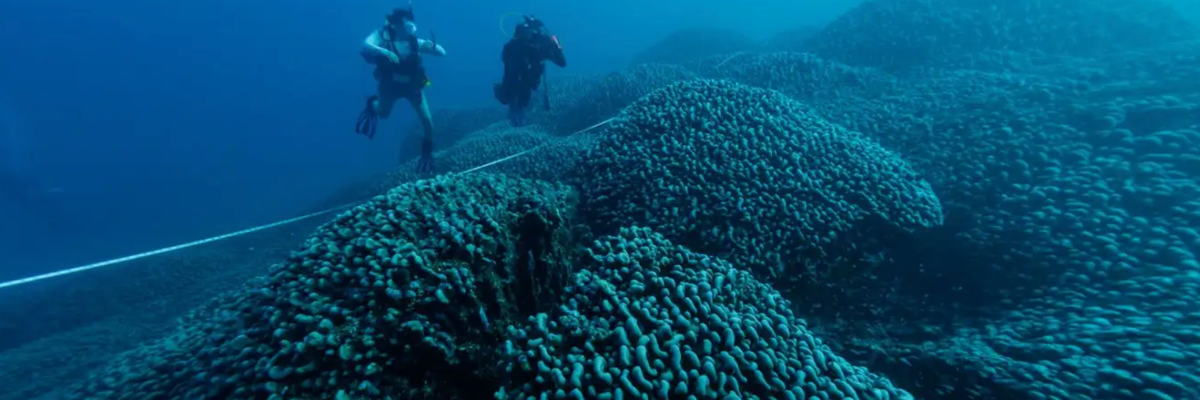
Scientists measure the world's largest coral off the coast of the Solomon Islands in the South Pacific Ocean.
"While the nearby shallow reefs were degraded due to warmer seas, witnessing this large healthy coral oasis in slightly deeper waters is a beacon of hope."
Scientists announced on Thursday their discovery of the largest coral ever documented off the coast of the Solomon Islands in the South Pacific Ocean and celebrated the fact that the massive underwater ecosystem appears to be unharmed by planetary heating—but said the discovery underscores the need to urgently protect marine environments.
Scientists and filmmakers from National Geographic's Pristine Seas research program, which aims to push governments to protect the oceans, visited a remote site near the Solomon Islands in mid-October, and initially thought the large object just below the ocean's surface was part of a shipwreck.
Cinematographer Manu San Félix dove into the water to examine the object and found that it was actually a huge network of coral polyps.
The coral was found to be 34 meters (111 feet) wide and more than five meters (16 feet) high—larger than a blue whale and big enough to be viewed from space.
The mega coral, or pavona clavus, is thought to be about 300 years old, and scientists said it could provide insight into historical conditions in the world's oceans.
"Protecting the reef cannot make the water cooler, cannot prevent the warming of the ocean. We need to fix that, we need to reduce carbon emissions."
Enric Sala of the Pristine Seas project compared the discovery to "a big patch of old growth forest," telling New Scientist that the coral, which is not showing signs of the bleaching observed in a growing number of reefs around the world, is providing shelter and sustenance to fish, shrimp, worms, and crabs.
"Large adult coral colonies like this contribute significantly to the recovery of coral reef ecosystems due to their high reproductive potential," Eric Brown, a coral scientist told Euronews. "While the nearby shallow reefs were degraded due to warmer seas, witnessing this large healthy coral oasis in slightly deeper waters is a beacon of hope."
But Sala told Euronews that the coral is not necessarily "safe from global warming and other human threats."
Record-breaking ocean temperatures have caused coral bleaching events across the planet over the past two years, impacting biodiversity in the world's oceans as well as increasing the risk of sea-level rise and impacting tourism industries in coastal areas.
Sala said the discovery should push governments to protect more of the world's oceans. About 8.4% of the Earth's ocean is under a marine protected area (MPA) designation, and the Biodiversity Beyond National Jurisdiction treaty was finalized in 2023, pledging to protect the biodiversity of the oceans.
Establishing more MPAs alongside climate action, Sala said, will help shield coral like the one found near the Solomon Islands from pollution and the effects of planetary heating.
"Protecting the reef cannot make the water cooler, cannot prevent the warming of the ocean," Sala told New Scientist. "We need to fix that, we need to reduce carbon emissions. But MPAs can help us buy time by making the reefs more resilient."
Dear Common Dreams reader, It’s been nearly 30 years since I co-founded Common Dreams with my late wife, Lina Newhouser. We had the radical notion that journalism should serve the public good, not corporate profits. It was clear to us from the outset what it would take to build such a project. No paid advertisements. No corporate sponsors. No millionaire publisher telling us what to think or do. Many people said we wouldn't last a year, but we proved those doubters wrong. Together with a tremendous team of journalists and dedicated staff, we built an independent media outlet free from the constraints of profits and corporate control. Our mission has always been simple: To inform. To inspire. To ignite change for the common good. Building Common Dreams was not easy. Our survival was never guaranteed. When you take on the most powerful forces—Wall Street greed, fossil fuel industry destruction, Big Tech lobbyists, and uber-rich oligarchs who have spent billions upon billions rigging the economy and democracy in their favor—the only bulwark you have is supporters who believe in your work. But here’s the urgent message from me today. It's never been this bad out there. And it's never been this hard to keep us going. At the very moment Common Dreams is most needed, the threats we face are intensifying. We need your support now more than ever. We don't accept corporate advertising and never will. We don't have a paywall because we don't think people should be blocked from critical news based on their ability to pay. Everything we do is funded by the donations of readers like you. When everyone does the little they can afford, we are strong. But if that support retreats or dries up, so do we. Will you donate now to make sure Common Dreams not only survives but thrives? —Craig Brown, Co-founder |
Scientists announced on Thursday their discovery of the largest coral ever documented off the coast of the Solomon Islands in the South Pacific Ocean and celebrated the fact that the massive underwater ecosystem appears to be unharmed by planetary heating—but said the discovery underscores the need to urgently protect marine environments.
Scientists and filmmakers from National Geographic's Pristine Seas research program, which aims to push governments to protect the oceans, visited a remote site near the Solomon Islands in mid-October, and initially thought the large object just below the ocean's surface was part of a shipwreck.
Cinematographer Manu San Félix dove into the water to examine the object and found that it was actually a huge network of coral polyps.
The coral was found to be 34 meters (111 feet) wide and more than five meters (16 feet) high—larger than a blue whale and big enough to be viewed from space.
The mega coral, or pavona clavus, is thought to be about 300 years old, and scientists said it could provide insight into historical conditions in the world's oceans.
"Protecting the reef cannot make the water cooler, cannot prevent the warming of the ocean. We need to fix that, we need to reduce carbon emissions."
Enric Sala of the Pristine Seas project compared the discovery to "a big patch of old growth forest," telling New Scientist that the coral, which is not showing signs of the bleaching observed in a growing number of reefs around the world, is providing shelter and sustenance to fish, shrimp, worms, and crabs.
"Large adult coral colonies like this contribute significantly to the recovery of coral reef ecosystems due to their high reproductive potential," Eric Brown, a coral scientist told Euronews. "While the nearby shallow reefs were degraded due to warmer seas, witnessing this large healthy coral oasis in slightly deeper waters is a beacon of hope."
But Sala told Euronews that the coral is not necessarily "safe from global warming and other human threats."
Record-breaking ocean temperatures have caused coral bleaching events across the planet over the past two years, impacting biodiversity in the world's oceans as well as increasing the risk of sea-level rise and impacting tourism industries in coastal areas.
Sala said the discovery should push governments to protect more of the world's oceans. About 8.4% of the Earth's ocean is under a marine protected area (MPA) designation, and the Biodiversity Beyond National Jurisdiction treaty was finalized in 2023, pledging to protect the biodiversity of the oceans.
Establishing more MPAs alongside climate action, Sala said, will help shield coral like the one found near the Solomon Islands from pollution and the effects of planetary heating.
"Protecting the reef cannot make the water cooler, cannot prevent the warming of the ocean," Sala told New Scientist. "We need to fix that, we need to reduce carbon emissions. But MPAs can help us buy time by making the reefs more resilient."
Scientists announced on Thursday their discovery of the largest coral ever documented off the coast of the Solomon Islands in the South Pacific Ocean and celebrated the fact that the massive underwater ecosystem appears to be unharmed by planetary heating—but said the discovery underscores the need to urgently protect marine environments.
Scientists and filmmakers from National Geographic's Pristine Seas research program, which aims to push governments to protect the oceans, visited a remote site near the Solomon Islands in mid-October, and initially thought the large object just below the ocean's surface was part of a shipwreck.
Cinematographer Manu San Félix dove into the water to examine the object and found that it was actually a huge network of coral polyps.
The coral was found to be 34 meters (111 feet) wide and more than five meters (16 feet) high—larger than a blue whale and big enough to be viewed from space.
The mega coral, or pavona clavus, is thought to be about 300 years old, and scientists said it could provide insight into historical conditions in the world's oceans.
"Protecting the reef cannot make the water cooler, cannot prevent the warming of the ocean. We need to fix that, we need to reduce carbon emissions."
Enric Sala of the Pristine Seas project compared the discovery to "a big patch of old growth forest," telling New Scientist that the coral, which is not showing signs of the bleaching observed in a growing number of reefs around the world, is providing shelter and sustenance to fish, shrimp, worms, and crabs.
"Large adult coral colonies like this contribute significantly to the recovery of coral reef ecosystems due to their high reproductive potential," Eric Brown, a coral scientist told Euronews. "While the nearby shallow reefs were degraded due to warmer seas, witnessing this large healthy coral oasis in slightly deeper waters is a beacon of hope."
But Sala told Euronews that the coral is not necessarily "safe from global warming and other human threats."
Record-breaking ocean temperatures have caused coral bleaching events across the planet over the past two years, impacting biodiversity in the world's oceans as well as increasing the risk of sea-level rise and impacting tourism industries in coastal areas.
Sala said the discovery should push governments to protect more of the world's oceans. About 8.4% of the Earth's ocean is under a marine protected area (MPA) designation, and the Biodiversity Beyond National Jurisdiction treaty was finalized in 2023, pledging to protect the biodiversity of the oceans.
Establishing more MPAs alongside climate action, Sala said, will help shield coral like the one found near the Solomon Islands from pollution and the effects of planetary heating.
"Protecting the reef cannot make the water cooler, cannot prevent the warming of the ocean," Sala told New Scientist. "We need to fix that, we need to reduce carbon emissions. But MPAs can help us buy time by making the reefs more resilient."