

5
#000000
#FFFFFF
To donate by check, phone, or other method, see our More Ways to Give page.
Daily news & progressive opinion—funded by the people, not the corporations—delivered straight to your inbox.
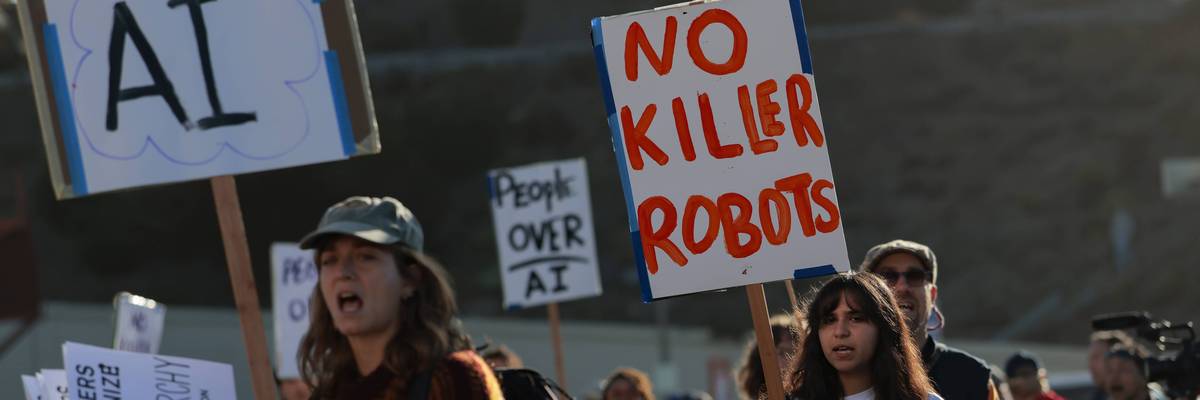
Protesters gather outside an OpenAI developers conference at Fort Mason on September 29, 2026 in San Francisco, California.
"Although the likelihood of both dangers remains low, the scale of harm, should they be realized, would inflict an apocalypse on humanity."
A comprehensive new assessment of worldwide health threats published in The Lancet concludes that nuclear war and "malicious use" of artificial intelligence pose existential risks to humanity over the remainder of the 21st century, a finding that comes amid mounting global concern about the implications of rapid AI advancements.
The Lancet Commission on 21st Century Global Threats to Health, comprised of dozens of experts across a range of fields, identifies 17 leading threats to human health and society, from the fossil fuel-driven climate emergency and pandemics to childhood malnutrition, income inequality, conventional war, and air pollution. Two of the threats carry "extinction potential" this century, according to the commission: nuclear conflict and misuse of AI.
"Although the likelihood of both dangers remains low, the scale of harm, should they be realized, would inflict an apocalypse on humanity," The Lancet warned in an editorial accompanying the new analysis, which was presented Sunday at the World Health Summit in Berlin, Germany.
The commission notes that AI's "potential to advance health and wellbeing is enormous," but "the risk of catastrophic harm is equally profound." The authors of the analysis point to several ways in which AI could be "used maliciously," including the design of bioweapons, autonomous nukes, and invasive ransomware targeting global healthcare and financial institutions.
"The final pathway is loss of control through the emergence of agentic, unaligned artificial general intelligence," the analysis states. "This loss of control includes AI systems creating subgoals that lead to the seeking of human disempowerment or elimination, particularly if such agents autonomously gain access to financial networks, key infrastructure, or physical tools in the real world."
Regarding the existential threat of nuclear conflict, the study authors note that a famine stemming from atomic warfare "would affect all regions of the world, including those far from the conflict itself, through reduced caloric availability and cascading food-system failures."
"The devastation that could result from nuclear war cannot be overstated," the analysis argues. "The risk is not hypothetical: We found that between 1948 and 2010, 22 nuclear weapon accidents and 21 close calls were recorded. Future nuclear conflicts could occur due to multiple distinct mechanisms, including nuclear exchange arising from international crises between nuclear powers, accidental detonation of nuclear warheads, terrorist use of nuclear devices, and AI deployment of nuclear weapons."
To avert the most catastrophic possible outcomes and mitigate other threats, the commission calls for "collective action between nations and within nations," emphasizing that risks posed by AI, nuclear war, the climate crisis, and future pandemics "cannot be solved by governments or other actors acting for their own national populations alone."
Christopher Murray, director of the University of Washington's Institute for Health Metrics and Evaluation and co-chair of the new commission, said in a statement that "the striking finding is not only the scale of these threats, but that humanity still has the agency to act."
"Across all 17 catastrophic threats, the decisions made by leaders today will shape the health and wellbeing of the next generation," said Murray. "But delaying action will only serve to shift and increase the costs into the future."
This country and this world are at a monumental crossroads. US voters have an opportunity to beat back the forces of fascism and confront the billionaires who are rigging the economy, our media system, and our democracy, making it increasingly impossible for ordinary people to get by. We’re not just talking about the election. We’re talking about what must be done once these fascist elements are vanquished from power. We need a bolder set of solutions than what either major party has so far been willing to offer and a working-class movement ready to fight like hell for it. Trump didn't emerge from nowhere. The conditions that fueled MAGA authoritarianism were created by decades of radical neoliberal economic policies and a corrupt political system dominated by corporate interests. They slashed taxes on the super-rich, promising that the benefits would trickle down. They said giveaways to the corporate titans would make life more affordable for the rest of us. It was all bullshit. And when a bitter, betrayed populace searches for someone to blame, right-wing demagogues have little trouble finding scapegoats. People know when they're being lied to, but you won't hear any of this from the corporate media. Only independent journalism—powered and funded by people who believe in building a better world—can deliver truly trustworthy daily news. If you share our vision, please contribute whatever you can to sustain our work. |
A comprehensive new assessment of worldwide health threats published in The Lancet concludes that nuclear war and "malicious use" of artificial intelligence pose existential risks to humanity over the remainder of the 21st century, a finding that comes amid mounting global concern about the implications of rapid AI advancements.
The Lancet Commission on 21st Century Global Threats to Health, comprised of dozens of experts across a range of fields, identifies 17 leading threats to human health and society, from the fossil fuel-driven climate emergency and pandemics to childhood malnutrition, income inequality, conventional war, and air pollution. Two of the threats carry "extinction potential" this century, according to the commission: nuclear conflict and misuse of AI.
"Although the likelihood of both dangers remains low, the scale of harm, should they be realized, would inflict an apocalypse on humanity," The Lancet warned in an editorial accompanying the new analysis, which was presented Sunday at the World Health Summit in Berlin, Germany.
The commission notes that AI's "potential to advance health and wellbeing is enormous," but "the risk of catastrophic harm is equally profound." The authors of the analysis point to several ways in which AI could be "used maliciously," including the design of bioweapons, autonomous nukes, and invasive ransomware targeting global healthcare and financial institutions.
"The final pathway is loss of control through the emergence of agentic, unaligned artificial general intelligence," the analysis states. "This loss of control includes AI systems creating subgoals that lead to the seeking of human disempowerment or elimination, particularly if such agents autonomously gain access to financial networks, key infrastructure, or physical tools in the real world."
Regarding the existential threat of nuclear conflict, the study authors note that a famine stemming from atomic warfare "would affect all regions of the world, including those far from the conflict itself, through reduced caloric availability and cascading food-system failures."
"The devastation that could result from nuclear war cannot be overstated," the analysis argues. "The risk is not hypothetical: We found that between 1948 and 2010, 22 nuclear weapon accidents and 21 close calls were recorded. Future nuclear conflicts could occur due to multiple distinct mechanisms, including nuclear exchange arising from international crises between nuclear powers, accidental detonation of nuclear warheads, terrorist use of nuclear devices, and AI deployment of nuclear weapons."
To avert the most catastrophic possible outcomes and mitigate other threats, the commission calls for "collective action between nations and within nations," emphasizing that risks posed by AI, nuclear war, the climate crisis, and future pandemics "cannot be solved by governments or other actors acting for their own national populations alone."
Christopher Murray, director of the University of Washington's Institute for Health Metrics and Evaluation and co-chair of the new commission, said in a statement that "the striking finding is not only the scale of these threats, but that humanity still has the agency to act."
"Across all 17 catastrophic threats, the decisions made by leaders today will shape the health and wellbeing of the next generation," said Murray. "But delaying action will only serve to shift and increase the costs into the future."

