SUBSCRIBE TO OUR FREE NEWSLETTER
Daily news & progressive opinion—funded by the people, not the corporations—delivered straight to your inbox.
5
#000000
#FFFFFF
To donate by check, phone, or other method, see our More Ways to Give page.
Daily news & progressive opinion—funded by the people, not the corporations—delivered straight to your inbox.
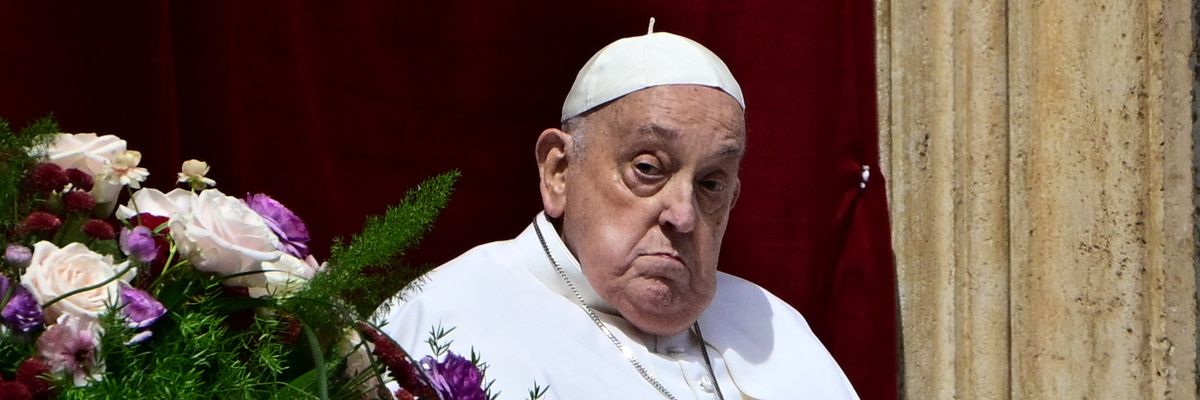
Pope Francis stands on the main balcony of St. Peter's basilica at St Peter's Square in the Vatican on April 20, 2025.
"How much contempt is stirred up at times towards the vulnerable, the marginalized, and migrants," the pope's speech read.
After a brief meeting with U.S. Vice President JD Vance on Sunday morning, Pope Francis' annual Easter speech included a condemnation of unnamed political leaders who use "fear" to oppress marginalized people including immigrants and refugees.
Pope Francis, who is recovering from a bout of pneumonia that kept him in a hospital for five weeks, met for a few minutes in the papal residence with the vice president, a Catholic convert who has drawn criticism from the Vatican for his claims that Catholic teachings support the Trump administration's mass deportation campaign.
The pope, who is 88, said little during the encounter, thanking Vance for his visit through a translator and overseeing a presentation of several Easter gifts to the vice president.
After the meeting, the pope was wheeled out to the Loggia of Blessings overlooking St. Peter's Square, where 35,000 congregants had just heard the Easter Mass delivered by Cardinal Angelo Comastri, the archpriest emeritus of St. Peter's Basilica, who filled in for Pope Francis due to his fragile health.
The pope gave a brief greeting to the crowd before another surrogate, Archbishop Diego Ravelli, read aloud Francis' Easter speech.
"How much contempt is stirred up at times towards the vulnerable, the marginalized, and migrants," the speech read. "I appeal to all those in positions of political responsibility in our world not to yield to the logic of fear which only leads to isolation from others, but rather to use the resources available to help the needy, to fight hunger, and to encourage initiatives that promote development. These are the 'weapons' of peace: weapons that build the future, instead of sowing seeds of death."
"May the principle of humanity never fail to be the hallmark of our daily actions," the pope's speech continued before condemning military attacks that violate international law: "In the face of the cruelty of conflicts that involve defenseless civilians and attack schools, hospitals, and humanitarian workers, we cannot allow ourselves to forget that it is not targets that are struck, but persons, each possessed of a soul and human dignity."
"I appeal to all those in positions of political responsibility in our world not to yield to the logic of fear which only leads to isolation from others, but rather to use the resources available to help the needy, to fight hunger and to encourage initiatives that promote development."
The Daily Beast reported that on Saturday, the pope did not attend the Vatican's official meeting with Vance, instead having Cardinal Pietro Parolin "deliver a lecture on compassion."
The Vatican released a statement saying that the meeting included "an exchange of opinions on the international situation, especially regarding countries affected by war, political tensions, and difficult humanitarian situations, with particular attention to migrants, refugees, and prisoners."
A statement from the vice president's office about the discussion omitted the topic of migration, saying Vance discussed "the plight of persecuted Christian communities around the world" and President Donald Trump's "commitment to restoring world peace" with the cardinal.
The pope has been open about his disapproval of Trump's anti-immigrant agenda and mass deportation operation, in which international students who have exercised their free speech rights as well as immigrants and asylum-seekers have been detained in recent weeks. The administration has accused hundreds of migrants of being gang members—with little to no evidence in many cases and without providing due process as required by the U.S. Constitution—and has sent them to El Salvador's Terrorist Confinement Center under a $6 million deal with Salvadoran President Nayib Bukele.
In February, Pope Francis wrote a letter to U.S. bishops condemning Trump's deportation operation and specifically referenced the Catholic concept of "ordo amoris"—order of love—which Vance has pointed to in defense of mass deportations.
The vice president cited the concept when he said in January, "You love your family, and then you love your neighbor, and then you love your community, and then you love your fellow citizens in your own country. And then after that, you can focus and prioritize the rest of the world."
Francis wrote in his letter to the bishops that "Christians know very well that it is only by affirming the infinite dignity of all that our own identity as persons and as communities reaches its maturity."
"Christian love is not a concentric expansion of interests that little by little extend to other persons and groups. In other words: the human person is not a mere individual, relatively expansive, with some philanthropic feelings!" he added. "The true ordo amoris that must be promoted is that which we discover by meditating constantly on the parable of the 'Good Samaritan,' that is, by meditating on the love that builds a fraternity open to all, without exception."
This country and this world are at a monumental crossroads. US voters have an opportunity to beat back the forces of fascism and confront the billionaires who are rigging the economy, our media system, and our democracy, making it increasingly impossible for ordinary people to get by. We’re not just talking about the election. We’re talking about what must be done once these fascist elements are vanquished from power. We need a bolder set of solutions than what either major party has so far been willing to offer and a working-class movement ready to fight like hell for it. Trump didn't emerge from nowhere. The conditions that fueled MAGA authoritarianism were created by decades of radical neoliberal economic policies and a corrupt political system dominated by corporate interests. They slashed taxes on the super-rich, promising that the benefits would trickle down. They said giveaways to the corporate titans would make life more affordable for the rest of us. It was all bullshit. And when a bitter, betrayed populace searches for someone to blame, right-wing demagogues have little trouble finding scapegoats. People know when they're being lied to, but you won't hear any of this from the corporate media. Only independent journalism—powered and funded by people who believe in building a better world—can deliver truly trustworthy daily news. If you share our vision, please contribute whatever you can to sustain our work. |
After a brief meeting with U.S. Vice President JD Vance on Sunday morning, Pope Francis' annual Easter speech included a condemnation of unnamed political leaders who use "fear" to oppress marginalized people including immigrants and refugees.
Pope Francis, who is recovering from a bout of pneumonia that kept him in a hospital for five weeks, met for a few minutes in the papal residence with the vice president, a Catholic convert who has drawn criticism from the Vatican for his claims that Catholic teachings support the Trump administration's mass deportation campaign.
The pope, who is 88, said little during the encounter, thanking Vance for his visit through a translator and overseeing a presentation of several Easter gifts to the vice president.
After the meeting, the pope was wheeled out to the Loggia of Blessings overlooking St. Peter's Square, where 35,000 congregants had just heard the Easter Mass delivered by Cardinal Angelo Comastri, the archpriest emeritus of St. Peter's Basilica, who filled in for Pope Francis due to his fragile health.
The pope gave a brief greeting to the crowd before another surrogate, Archbishop Diego Ravelli, read aloud Francis' Easter speech.
"How much contempt is stirred up at times towards the vulnerable, the marginalized, and migrants," the speech read. "I appeal to all those in positions of political responsibility in our world not to yield to the logic of fear which only leads to isolation from others, but rather to use the resources available to help the needy, to fight hunger, and to encourage initiatives that promote development. These are the 'weapons' of peace: weapons that build the future, instead of sowing seeds of death."
"May the principle of humanity never fail to be the hallmark of our daily actions," the pope's speech continued before condemning military attacks that violate international law: "In the face of the cruelty of conflicts that involve defenseless civilians and attack schools, hospitals, and humanitarian workers, we cannot allow ourselves to forget that it is not targets that are struck, but persons, each possessed of a soul and human dignity."
"I appeal to all those in positions of political responsibility in our world not to yield to the logic of fear which only leads to isolation from others, but rather to use the resources available to help the needy, to fight hunger and to encourage initiatives that promote development."
The Daily Beast reported that on Saturday, the pope did not attend the Vatican's official meeting with Vance, instead having Cardinal Pietro Parolin "deliver a lecture on compassion."
The Vatican released a statement saying that the meeting included "an exchange of opinions on the international situation, especially regarding countries affected by war, political tensions, and difficult humanitarian situations, with particular attention to migrants, refugees, and prisoners."
A statement from the vice president's office about the discussion omitted the topic of migration, saying Vance discussed "the plight of persecuted Christian communities around the world" and President Donald Trump's "commitment to restoring world peace" with the cardinal.
The pope has been open about his disapproval of Trump's anti-immigrant agenda and mass deportation operation, in which international students who have exercised their free speech rights as well as immigrants and asylum-seekers have been detained in recent weeks. The administration has accused hundreds of migrants of being gang members—with little to no evidence in many cases and without providing due process as required by the U.S. Constitution—and has sent them to El Salvador's Terrorist Confinement Center under a $6 million deal with Salvadoran President Nayib Bukele.
In February, Pope Francis wrote a letter to U.S. bishops condemning Trump's deportation operation and specifically referenced the Catholic concept of "ordo amoris"—order of love—which Vance has pointed to in defense of mass deportations.
The vice president cited the concept when he said in January, "You love your family, and then you love your neighbor, and then you love your community, and then you love your fellow citizens in your own country. And then after that, you can focus and prioritize the rest of the world."
Francis wrote in his letter to the bishops that "Christians know very well that it is only by affirming the infinite dignity of all that our own identity as persons and as communities reaches its maturity."
"Christian love is not a concentric expansion of interests that little by little extend to other persons and groups. In other words: the human person is not a mere individual, relatively expansive, with some philanthropic feelings!" he added. "The true ordo amoris that must be promoted is that which we discover by meditating constantly on the parable of the 'Good Samaritan,' that is, by meditating on the love that builds a fraternity open to all, without exception."