5
#000000
#FFFFFF
To donate by check, phone, or other method, see our More Ways to Give page.
Daily news & progressive opinion—funded by the people, not the corporations—delivered straight to your inbox.
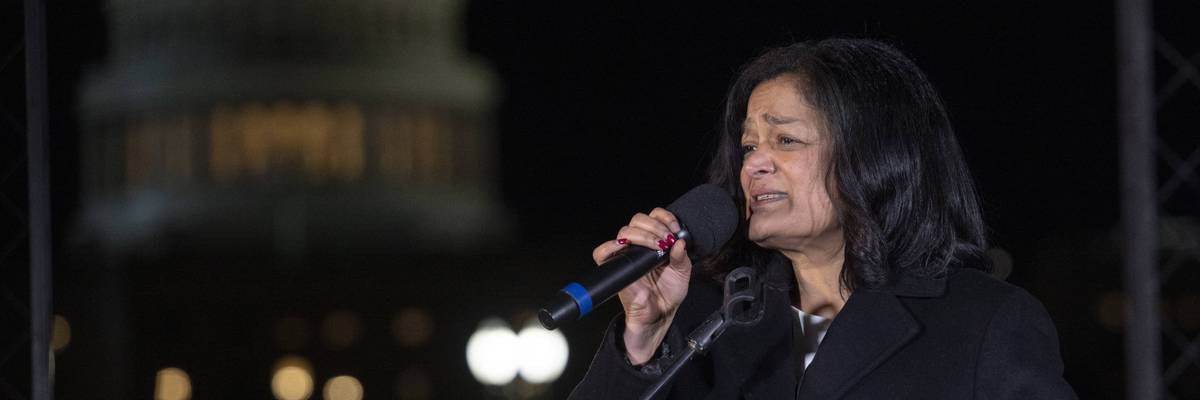
US Rep. Pramila Jayapal speaks during The People's State of the Union rally at the National Mall in Washington, DC on February 24, 2026.
Reps. Pramila Jayapal and Jonathan Jackson described Trump's blockade of the island as "effectively an economic bombing of the infrastructure of the country that has produced permanent damage."
After returning from a delegation trip to Cuba, US Reps. Pramila Jayapal and Jonathan Jackson on Sunday renewed calls for President Donald Trump to end his illegal fuel blockade of the island, which they described as "cruel collective punishment."
The pair of progressive lawmakers were the first to visit the island since Trump imposed the blockade in January in a bid to cripple the island's economy as part of an effort to overthrow its government, or, in the president's words, "take" the island.
Almost no oil has been allowed to enter for more than three months, which Jayapal (D-Wash.) and Jackson (D-Ill.) described as "effectively an economic bombing of the infrastructure of the country—that has produced permanent damage."
"We witnessed firsthand premature babies in incubators, weighing just two pounds, who are at tremendous risk because their ventilators and incubators cannot function without electricity," they said. "Children cannot attend school because there is no fuel for them or their teachers to travel. Cancer patients cannot receive lifesaving treatments because of a lack of medications."
"There is a water shortage because there is little electricity to pump water," they continued. "Businesses have closed. Families cannot keep food refrigerated, and food production on the island has dropped to just 10% of the people’s needs."
The oil blockade is an escalation of more than 60 years of punitive economic warfare by the US against Cuba, imposed through an embargo that has limited Cuba's ability to trade with the rest of the world and hampered its economic development to the tune of trillions of dollars.
Jayapal had previously visited Cuba in February 2024 on a trip with other members of the Congressional Progressive Caucus. Since her last time in Havana, she said, "There's such a big difference."
"So many of the streets of this beautiful city were deserted. People were already lining up for food," she said in an interview with the Cuban outlet Belly of the Beast. "I don't think that any American wants to create this kind of devastation for the Cuban children, for the babies, for the moms, for the people."
She said the phrase "collective punishment," while accurate, almost felt "too technocratic" to describe what she witnessed.
"We are strangling the Cuban people," Jayapal said.
The United Nations General Assembly has voted 33 times to call for the end of the embargo since 1993.
In February, a group of UN experts condemned Trump's fuel blockade as "a serious violation of international law and a grave threat to a democratic and equitable international order" and an "extreme form of unilateral economic coercion."
Cuban President Miguel Diaz-Canel has acknowledged having talks with Trump in recent weeks in order to negotiate an end to the embargo and threats of further aggression.
The Cuban government has taken actions that the lawmakers described as "signs that Cuba is changing." It has released more than 2,000 prisoners, announced economic reforms to allow more involvement of American businesses, and allowed the FBI to investigate Cuban troops' lethal shooting of five armed Cuban exiles as they approached in a speedboat in February.
While hardly softening his threats to Cuba, which he continued to insist was “finished,” Trump last week allowed a Russian oil tanker to dock on the island without incident and deliver around 700,000 barrels of much-needed oil.
But the lawmakers said it's not enough. Jackson, noting the "generosity" of Cuba as a provider of medical treatment around the world, said the US must allow food and fuel to be allowed to return to the island "so that the Cuban people can continue to rise."
Jayapal said that when they spoke with Diaz-Canel, he expressed "a real desire for a real negotiation" with the US, but that he also expressed "sadness" and "frustration" at what was being done to his country.
"These kinds of sanctions, embargoes, they don't get to the government. They hurt the people," Jayapal said. "Perhaps the American people don't understand the violence of an economic sanction versus the violence of dropping a bomb."
Jackson—whose father, the late Rev. Jesse Jackson, took many trips to Cuba during his life—described America's treatment of the nation’s people as a “crucifixion.”
"Americans would not want to see what I saw in that hospital," Jackson said, describing a malnourished baby named Alejandro, whom he said was "fighting for life."
Due to the intermittent power surges caused by the lack of fuel, he said, "We didn't know when the incubator was going to start working."
"That's an act of war," he said. "We have to put an end to that."
He added that Secretary of State Marco Rubio, himself a Cuban-American who has long sought to bring about regime change, "should come before the Congress and explain his policy."
In late March, Jayapal introduced legislation that would block Trump from conducting military action against Cuba without congressional authorization. She said she'd continue to push for bills to block Trump from launching a war and to push for sanctions relief.
The Trump administration has portrayed its economic warfare as part of an effort to "liberate" the Cuban people from an oppressive government.
But the lawmakers, who met with wide swaths of Cuban society—including business and religious leaders, humanitarian groups, and civil society organizations—said that "Cubans across the political spectrum," including anti-government dissidents, expressed similar feelings.
"Across all sectors, there is agreement," they said. "This illegal blockade must end immediately."
Dear Common Dreams reader, It’s been nearly 30 years since I co-founded Common Dreams with my late wife, Lina Newhouser. We had the radical notion that journalism should serve the public good, not corporate profits. It was clear to us from the outset what it would take to build such a project. No paid advertisements. No corporate sponsors. No millionaire publisher telling us what to think or do. Many people said we wouldn't last a year, but we proved those doubters wrong. Together with a tremendous team of journalists and dedicated staff, we built an independent media outlet free from the constraints of profits and corporate control. Our mission has always been simple: To inform. To inspire. To ignite change for the common good. Building Common Dreams was not easy. Our survival was never guaranteed. When you take on the most powerful forces—Wall Street greed, fossil fuel industry destruction, Big Tech lobbyists, and uber-rich oligarchs who have spent billions upon billions rigging the economy and democracy in their favor—the only bulwark you have is supporters who believe in your work. But here’s the urgent message from me today. It's never been this bad out there. And it's never been this hard to keep us going. At the very moment Common Dreams is most needed, the threats we face are intensifying. We need your support now more than ever. We don't accept corporate advertising and never will. We don't have a paywall because we don't think people should be blocked from critical news based on their ability to pay. Everything we do is funded by the donations of readers like you. When everyone does the little they can afford, we are strong. But if that support retreats or dries up, so do we. Will you donate now to make sure Common Dreams not only survives but thrives? —Craig Brown, Co-founder |
After returning from a delegation trip to Cuba, US Reps. Pramila Jayapal and Jonathan Jackson on Sunday renewed calls for President Donald Trump to end his illegal fuel blockade of the island, which they described as "cruel collective punishment."
The pair of progressive lawmakers were the first to visit the island since Trump imposed the blockade in January in a bid to cripple the island's economy as part of an effort to overthrow its government, or, in the president's words, "take" the island.
Almost no oil has been allowed to enter for more than three months, which Jayapal (D-Wash.) and Jackson (D-Ill.) described as "effectively an economic bombing of the infrastructure of the country—that has produced permanent damage."
"We witnessed firsthand premature babies in incubators, weighing just two pounds, who are at tremendous risk because their ventilators and incubators cannot function without electricity," they said. "Children cannot attend school because there is no fuel for them or their teachers to travel. Cancer patients cannot receive lifesaving treatments because of a lack of medications."
"There is a water shortage because there is little electricity to pump water," they continued. "Businesses have closed. Families cannot keep food refrigerated, and food production on the island has dropped to just 10% of the people’s needs."
The oil blockade is an escalation of more than 60 years of punitive economic warfare by the US against Cuba, imposed through an embargo that has limited Cuba's ability to trade with the rest of the world and hampered its economic development to the tune of trillions of dollars.
Jayapal had previously visited Cuba in February 2024 on a trip with other members of the Congressional Progressive Caucus. Since her last time in Havana, she said, "There's such a big difference."
"So many of the streets of this beautiful city were deserted. People were already lining up for food," she said in an interview with the Cuban outlet Belly of the Beast. "I don't think that any American wants to create this kind of devastation for the Cuban children, for the babies, for the moms, for the people."
She said the phrase "collective punishment," while accurate, almost felt "too technocratic" to describe what she witnessed.
"We are strangling the Cuban people," Jayapal said.
The United Nations General Assembly has voted 33 times to call for the end of the embargo since 1993.
In February, a group of UN experts condemned Trump's fuel blockade as "a serious violation of international law and a grave threat to a democratic and equitable international order" and an "extreme form of unilateral economic coercion."
Cuban President Miguel Diaz-Canel has acknowledged having talks with Trump in recent weeks in order to negotiate an end to the embargo and threats of further aggression.
The Cuban government has taken actions that the lawmakers described as "signs that Cuba is changing." It has released more than 2,000 prisoners, announced economic reforms to allow more involvement of American businesses, and allowed the FBI to investigate Cuban troops' lethal shooting of five armed Cuban exiles as they approached in a speedboat in February.
While hardly softening his threats to Cuba, which he continued to insist was “finished,” Trump last week allowed a Russian oil tanker to dock on the island without incident and deliver around 700,000 barrels of much-needed oil.
But the lawmakers said it's not enough. Jackson, noting the "generosity" of Cuba as a provider of medical treatment around the world, said the US must allow food and fuel to be allowed to return to the island "so that the Cuban people can continue to rise."
Jayapal said that when they spoke with Diaz-Canel, he expressed "a real desire for a real negotiation" with the US, but that he also expressed "sadness" and "frustration" at what was being done to his country.
"These kinds of sanctions, embargoes, they don't get to the government. They hurt the people," Jayapal said. "Perhaps the American people don't understand the violence of an economic sanction versus the violence of dropping a bomb."
Jackson—whose father, the late Rev. Jesse Jackson, took many trips to Cuba during his life—described America's treatment of the nation’s people as a “crucifixion.”
"Americans would not want to see what I saw in that hospital," Jackson said, describing a malnourished baby named Alejandro, whom he said was "fighting for life."
Due to the intermittent power surges caused by the lack of fuel, he said, "We didn't know when the incubator was going to start working."
"That's an act of war," he said. "We have to put an end to that."
He added that Secretary of State Marco Rubio, himself a Cuban-American who has long sought to bring about regime change, "should come before the Congress and explain his policy."
In late March, Jayapal introduced legislation that would block Trump from conducting military action against Cuba without congressional authorization. She said she'd continue to push for bills to block Trump from launching a war and to push for sanctions relief.
The Trump administration has portrayed its economic warfare as part of an effort to "liberate" the Cuban people from an oppressive government.
But the lawmakers, who met with wide swaths of Cuban society—including business and religious leaders, humanitarian groups, and civil society organizations—said that "Cubans across the political spectrum," including anti-government dissidents, expressed similar feelings.
"Across all sectors, there is agreement," they said. "This illegal blockade must end immediately."
After returning from a delegation trip to Cuba, US Reps. Pramila Jayapal and Jonathan Jackson on Sunday renewed calls for President Donald Trump to end his illegal fuel blockade of the island, which they described as "cruel collective punishment."
The pair of progressive lawmakers were the first to visit the island since Trump imposed the blockade in January in a bid to cripple the island's economy as part of an effort to overthrow its government, or, in the president's words, "take" the island.
Almost no oil has been allowed to enter for more than three months, which Jayapal (D-Wash.) and Jackson (D-Ill.) described as "effectively an economic bombing of the infrastructure of the country—that has produced permanent damage."
"We witnessed firsthand premature babies in incubators, weighing just two pounds, who are at tremendous risk because their ventilators and incubators cannot function without electricity," they said. "Children cannot attend school because there is no fuel for them or their teachers to travel. Cancer patients cannot receive lifesaving treatments because of a lack of medications."
"There is a water shortage because there is little electricity to pump water," they continued. "Businesses have closed. Families cannot keep food refrigerated, and food production on the island has dropped to just 10% of the people’s needs."
The oil blockade is an escalation of more than 60 years of punitive economic warfare by the US against Cuba, imposed through an embargo that has limited Cuba's ability to trade with the rest of the world and hampered its economic development to the tune of trillions of dollars.
Jayapal had previously visited Cuba in February 2024 on a trip with other members of the Congressional Progressive Caucus. Since her last time in Havana, she said, "There's such a big difference."
"So many of the streets of this beautiful city were deserted. People were already lining up for food," she said in an interview with the Cuban outlet Belly of the Beast. "I don't think that any American wants to create this kind of devastation for the Cuban children, for the babies, for the moms, for the people."
She said the phrase "collective punishment," while accurate, almost felt "too technocratic" to describe what she witnessed.
"We are strangling the Cuban people," Jayapal said.
The United Nations General Assembly has voted 33 times to call for the end of the embargo since 1993.
In February, a group of UN experts condemned Trump's fuel blockade as "a serious violation of international law and a grave threat to a democratic and equitable international order" and an "extreme form of unilateral economic coercion."
Cuban President Miguel Diaz-Canel has acknowledged having talks with Trump in recent weeks in order to negotiate an end to the embargo and threats of further aggression.
The Cuban government has taken actions that the lawmakers described as "signs that Cuba is changing." It has released more than 2,000 prisoners, announced economic reforms to allow more involvement of American businesses, and allowed the FBI to investigate Cuban troops' lethal shooting of five armed Cuban exiles as they approached in a speedboat in February.
While hardly softening his threats to Cuba, which he continued to insist was “finished,” Trump last week allowed a Russian oil tanker to dock on the island without incident and deliver around 700,000 barrels of much-needed oil.
But the lawmakers said it's not enough. Jackson, noting the "generosity" of Cuba as a provider of medical treatment around the world, said the US must allow food and fuel to be allowed to return to the island "so that the Cuban people can continue to rise."
Jayapal said that when they spoke with Diaz-Canel, he expressed "a real desire for a real negotiation" with the US, but that he also expressed "sadness" and "frustration" at what was being done to his country.
"These kinds of sanctions, embargoes, they don't get to the government. They hurt the people," Jayapal said. "Perhaps the American people don't understand the violence of an economic sanction versus the violence of dropping a bomb."
Jackson—whose father, the late Rev. Jesse Jackson, took many trips to Cuba during his life—described America's treatment of the nation’s people as a “crucifixion.”
"Americans would not want to see what I saw in that hospital," Jackson said, describing a malnourished baby named Alejandro, whom he said was "fighting for life."
Due to the intermittent power surges caused by the lack of fuel, he said, "We didn't know when the incubator was going to start working."
"That's an act of war," he said. "We have to put an end to that."
He added that Secretary of State Marco Rubio, himself a Cuban-American who has long sought to bring about regime change, "should come before the Congress and explain his policy."
In late March, Jayapal introduced legislation that would block Trump from conducting military action against Cuba without congressional authorization. She said she'd continue to push for bills to block Trump from launching a war and to push for sanctions relief.
The Trump administration has portrayed its economic warfare as part of an effort to "liberate" the Cuban people from an oppressive government.
But the lawmakers, who met with wide swaths of Cuban society—including business and religious leaders, humanitarian groups, and civil society organizations—said that "Cubans across the political spectrum," including anti-government dissidents, expressed similar feelings.
"Across all sectors, there is agreement," they said. "This illegal blockade must end immediately."