SUBSCRIBE TO OUR FREE NEWSLETTER
Daily news & progressive opinion—funded by the people, not the corporations—delivered straight to your inbox.
5
#000000
#FFFFFF
To donate by check, phone, or other method, see our More Ways to Give page.
Daily news & progressive opinion—funded by the people, not the corporations—delivered straight to your inbox.
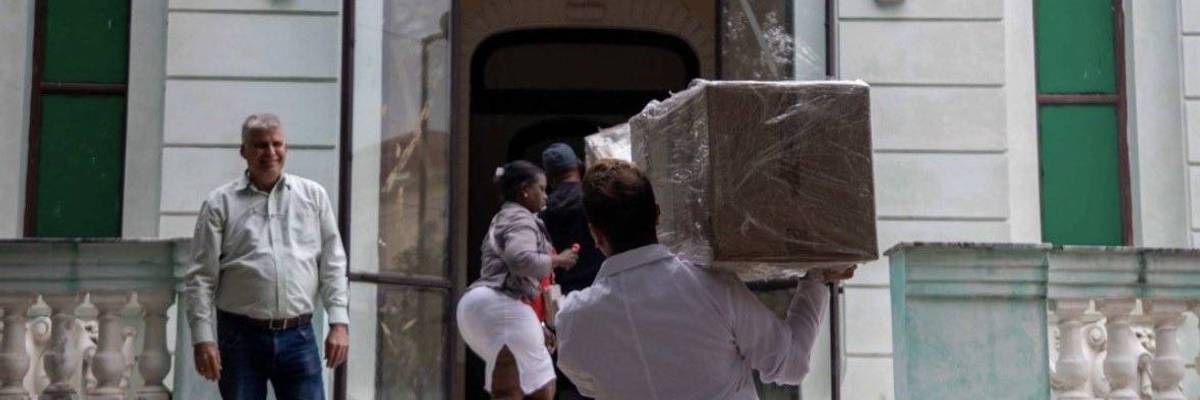
A medical worker carries a box of aid supplies delivered by the Nuestra America Convoy on March 18, 2026 in Havana, Cuba.
What I witnessed over those days was not the Cuba of Western propaganda. It was a country enduring a 66-year siege, and a people who, against all odds, continue to build, create, and care for one another.
I traveled to Cuba this month. As a Cuban American, that sentence carries the weight of longing born of an estrangement from my roots. For much of my life, Cuba existed as a distant story, a place I knew only through descriptions from my father.
I was there as part of an international solidarity convoy; over 500 representatives from more than 30 countries, united by a simple conviction: No country has the right to strangle another simply because it chose a different path. I cannot stand by while the island of my family’s heritage is suffocated.
What I witnessed over those days was not the Cuba of Western propaganda. It was a country enduring a 66-year siege, and a people who, against all odds, continue to build, create, and care for one another.
One of the most profound visits was to a neighborhood polyclinic in Havana. These clinics are the backbone of Cuba’s public health system. Doctors live on the second floor, above where they work. They know every patient in their community by name. They treat physical and psychological health alike, and they embody a model of care that prioritizes people over profit.
I saw a people who are already free—free to define their own destiny, even under the weight of a siege designed to break them.
But the doctors I met face heartbreaking constraints. They are highly trained professionals who know exactly what their patients need, and they know those treatments exist. Due to the US embargo, they cannot access them. Imagine living every day with the skill to heal and being blocked by a political and economic siege.
We brought what we could: 6,300 pounds of medical supplies delivered by our delegation, including neonatal equipment, analgesics, catheters, and other critical materials, valued at $433,000 and more still in unquantifiable amounts stuffed into carry-on and personal bags, sacrificing space for our own clothing and toiletries. Cuban doctors told us about nights when the power goes out, and medical students rush to respirators, manually pumping air for hours until electricity is restored. They save lives with their bare hands.
Everywhere we went, I saw people organizing to survive. In a central Havana neighborhood, we helped refurbish a crumbling playground. We brought paint and new swings. A local man who maintains the park offered to take the swings down each night so they wouldn’t be taken, then put them back up each morning for the children. That kind of mutual care was everywhere.
We met an artist named Lázaro, who collects garbage and old newspapers to create recycled art. He teaches neighborhood kids to do the same. His studio walls are covered in vibrant works that double as expressions of resistance and creativity.
On another day, we set up a table outside Lázaro’s studio with construction paper, markers, and glue. Children from the neighborhood gathered to write letters to pen pals in Singapore. I translated letters from English to Spanish, helping each child respond in Spanish and illustrate their replies. Parents played drums and danced while the kids painted and wrote. It was a profound moment of cross-border connection—kids building relationships through art and translation, across continents, across the blockade.
For Cuban Americans, there is something like a spiritual cost that is paid for quietly going along with the status quo in the face of the many injustices we have grown up with for decades, which seem to us to have intensified in these recent years. But the children I saw in Havana had their spirit intact.
The blockade is not an abstraction. Poverty is real. I gave what I could, but as individuals, we cannot meet that scale of need brought upon by a systemic crisis created by US policy.
I came back with a deeper sense of what solidarity looks like: showing up, listening, sharing what we can, and staying connected to the work.
Rolling blackouts on the island are the result of a strategy of siege warfare intensified in January. Cuba has gone months without fuel imports due to sanctions and naval pressure aimed at stopping oil shipments to the island. Power plants cannot run consistently. Hospitals cannot perform necessary surgeries. Water pumping infrastructure fails. This is not a natural disaster. It is man-made violence; it is a silent war.
And yet, the Cuban people do not wait for rescue. They organize. They adapt. They invent.
As a Cuban American, I have heard all my life that Cuba is a country ruled by capricious autocrats. That the Cuban people are waiting to be liberated. That their strangulation is meant to help them. But standing on that island, talking to doctors and artists and children and families, I saw something else entirely. I saw a people who are already free—free to define their own destiny, even under the weight of a siege designed to break them.
Cuba is open to dialogue and investment with respect for its sovereignty. But the US continues to enforce a policy that even much of the world condemns. Year after year, the United Nations General Assembly votes overwhelmingly to end the embargo. Year after year, the US ignores it.
I came back with a deeper sense of what solidarity looks like: showing up, listening, sharing what we can, and staying connected to the work. But solidarity cannot end after a single delegation. We need to break the siege. We need to end this decades-long economic warfare.
Cubans have a right to self-governance. They have a right to medicine, to electricity, to water, to dignity. My father chose to leave Cuba in the face of poverty brought on by a cruel sanctions regime. I chose to return for the same reason.
Let Cuba live.
Dear Common Dreams reader, It’s been nearly 30 years since I co-founded Common Dreams with my late wife, Lina Newhouser. We had the radical notion that journalism should serve the public good, not corporate profits. It was clear to us from the outset what it would take to build such a project. No paid advertisements. No corporate sponsors. No millionaire publisher telling us what to think or do. Many people said we wouldn't last a year, but we proved those doubters wrong. Together with a tremendous team of journalists and dedicated staff, we built an independent media outlet free from the constraints of profits and corporate control. Our mission has always been simple: To inform. To inspire. To ignite change for the common good. Building Common Dreams was not easy. Our survival was never guaranteed. When you take on the most powerful forces—Wall Street greed, fossil fuel industry destruction, Big Tech lobbyists, and uber-rich oligarchs who have spent billions upon billions rigging the economy and democracy in their favor—the only bulwark you have is supporters who believe in your work. But here’s the urgent message from me today. It's never been this bad out there. And it's never been this hard to keep us going. At the very moment Common Dreams is most needed, the threats we face are intensifying. We need your support now more than ever. We don't accept corporate advertising and never will. We don't have a paywall because we don't think people should be blocked from critical news based on their ability to pay. Everything we do is funded by the donations of readers like you. When everyone does the little they can afford, we are strong. But if that support retreats or dries up, so do we. Will you donate now to make sure Common Dreams not only survives but thrives? —Craig Brown, Co-founder |
I traveled to Cuba this month. As a Cuban American, that sentence carries the weight of longing born of an estrangement from my roots. For much of my life, Cuba existed as a distant story, a place I knew only through descriptions from my father.
I was there as part of an international solidarity convoy; over 500 representatives from more than 30 countries, united by a simple conviction: No country has the right to strangle another simply because it chose a different path. I cannot stand by while the island of my family’s heritage is suffocated.
What I witnessed over those days was not the Cuba of Western propaganda. It was a country enduring a 66-year siege, and a people who, against all odds, continue to build, create, and care for one another.
One of the most profound visits was to a neighborhood polyclinic in Havana. These clinics are the backbone of Cuba’s public health system. Doctors live on the second floor, above where they work. They know every patient in their community by name. They treat physical and psychological health alike, and they embody a model of care that prioritizes people over profit.
I saw a people who are already free—free to define their own destiny, even under the weight of a siege designed to break them.
But the doctors I met face heartbreaking constraints. They are highly trained professionals who know exactly what their patients need, and they know those treatments exist. Due to the US embargo, they cannot access them. Imagine living every day with the skill to heal and being blocked by a political and economic siege.
We brought what we could: 6,300 pounds of medical supplies delivered by our delegation, including neonatal equipment, analgesics, catheters, and other critical materials, valued at $433,000 and more still in unquantifiable amounts stuffed into carry-on and personal bags, sacrificing space for our own clothing and toiletries. Cuban doctors told us about nights when the power goes out, and medical students rush to respirators, manually pumping air for hours until electricity is restored. They save lives with their bare hands.
Everywhere we went, I saw people organizing to survive. In a central Havana neighborhood, we helped refurbish a crumbling playground. We brought paint and new swings. A local man who maintains the park offered to take the swings down each night so they wouldn’t be taken, then put them back up each morning for the children. That kind of mutual care was everywhere.
We met an artist named Lázaro, who collects garbage and old newspapers to create recycled art. He teaches neighborhood kids to do the same. His studio walls are covered in vibrant works that double as expressions of resistance and creativity.
On another day, we set up a table outside Lázaro’s studio with construction paper, markers, and glue. Children from the neighborhood gathered to write letters to pen pals in Singapore. I translated letters from English to Spanish, helping each child respond in Spanish and illustrate their replies. Parents played drums and danced while the kids painted and wrote. It was a profound moment of cross-border connection—kids building relationships through art and translation, across continents, across the blockade.
For Cuban Americans, there is something like a spiritual cost that is paid for quietly going along with the status quo in the face of the many injustices we have grown up with for decades, which seem to us to have intensified in these recent years. But the children I saw in Havana had their spirit intact.
The blockade is not an abstraction. Poverty is real. I gave what I could, but as individuals, we cannot meet that scale of need brought upon by a systemic crisis created by US policy.
I came back with a deeper sense of what solidarity looks like: showing up, listening, sharing what we can, and staying connected to the work.
Rolling blackouts on the island are the result of a strategy of siege warfare intensified in January. Cuba has gone months without fuel imports due to sanctions and naval pressure aimed at stopping oil shipments to the island. Power plants cannot run consistently. Hospitals cannot perform necessary surgeries. Water pumping infrastructure fails. This is not a natural disaster. It is man-made violence; it is a silent war.
And yet, the Cuban people do not wait for rescue. They organize. They adapt. They invent.
As a Cuban American, I have heard all my life that Cuba is a country ruled by capricious autocrats. That the Cuban people are waiting to be liberated. That their strangulation is meant to help them. But standing on that island, talking to doctors and artists and children and families, I saw something else entirely. I saw a people who are already free—free to define their own destiny, even under the weight of a siege designed to break them.
Cuba is open to dialogue and investment with respect for its sovereignty. But the US continues to enforce a policy that even much of the world condemns. Year after year, the United Nations General Assembly votes overwhelmingly to end the embargo. Year after year, the US ignores it.
I came back with a deeper sense of what solidarity looks like: showing up, listening, sharing what we can, and staying connected to the work. But solidarity cannot end after a single delegation. We need to break the siege. We need to end this decades-long economic warfare.
Cubans have a right to self-governance. They have a right to medicine, to electricity, to water, to dignity. My father chose to leave Cuba in the face of poverty brought on by a cruel sanctions regime. I chose to return for the same reason.
Let Cuba live.
I traveled to Cuba this month. As a Cuban American, that sentence carries the weight of longing born of an estrangement from my roots. For much of my life, Cuba existed as a distant story, a place I knew only through descriptions from my father.
I was there as part of an international solidarity convoy; over 500 representatives from more than 30 countries, united by a simple conviction: No country has the right to strangle another simply because it chose a different path. I cannot stand by while the island of my family’s heritage is suffocated.
What I witnessed over those days was not the Cuba of Western propaganda. It was a country enduring a 66-year siege, and a people who, against all odds, continue to build, create, and care for one another.
One of the most profound visits was to a neighborhood polyclinic in Havana. These clinics are the backbone of Cuba’s public health system. Doctors live on the second floor, above where they work. They know every patient in their community by name. They treat physical and psychological health alike, and they embody a model of care that prioritizes people over profit.
I saw a people who are already free—free to define their own destiny, even under the weight of a siege designed to break them.
But the doctors I met face heartbreaking constraints. They are highly trained professionals who know exactly what their patients need, and they know those treatments exist. Due to the US embargo, they cannot access them. Imagine living every day with the skill to heal and being blocked by a political and economic siege.
We brought what we could: 6,300 pounds of medical supplies delivered by our delegation, including neonatal equipment, analgesics, catheters, and other critical materials, valued at $433,000 and more still in unquantifiable amounts stuffed into carry-on and personal bags, sacrificing space for our own clothing and toiletries. Cuban doctors told us about nights when the power goes out, and medical students rush to respirators, manually pumping air for hours until electricity is restored. They save lives with their bare hands.
Everywhere we went, I saw people organizing to survive. In a central Havana neighborhood, we helped refurbish a crumbling playground. We brought paint and new swings. A local man who maintains the park offered to take the swings down each night so they wouldn’t be taken, then put them back up each morning for the children. That kind of mutual care was everywhere.
We met an artist named Lázaro, who collects garbage and old newspapers to create recycled art. He teaches neighborhood kids to do the same. His studio walls are covered in vibrant works that double as expressions of resistance and creativity.
On another day, we set up a table outside Lázaro’s studio with construction paper, markers, and glue. Children from the neighborhood gathered to write letters to pen pals in Singapore. I translated letters from English to Spanish, helping each child respond in Spanish and illustrate their replies. Parents played drums and danced while the kids painted and wrote. It was a profound moment of cross-border connection—kids building relationships through art and translation, across continents, across the blockade.
For Cuban Americans, there is something like a spiritual cost that is paid for quietly going along with the status quo in the face of the many injustices we have grown up with for decades, which seem to us to have intensified in these recent years. But the children I saw in Havana had their spirit intact.
The blockade is not an abstraction. Poverty is real. I gave what I could, but as individuals, we cannot meet that scale of need brought upon by a systemic crisis created by US policy.
I came back with a deeper sense of what solidarity looks like: showing up, listening, sharing what we can, and staying connected to the work.
Rolling blackouts on the island are the result of a strategy of siege warfare intensified in January. Cuba has gone months without fuel imports due to sanctions and naval pressure aimed at stopping oil shipments to the island. Power plants cannot run consistently. Hospitals cannot perform necessary surgeries. Water pumping infrastructure fails. This is not a natural disaster. It is man-made violence; it is a silent war.
And yet, the Cuban people do not wait for rescue. They organize. They adapt. They invent.
As a Cuban American, I have heard all my life that Cuba is a country ruled by capricious autocrats. That the Cuban people are waiting to be liberated. That their strangulation is meant to help them. But standing on that island, talking to doctors and artists and children and families, I saw something else entirely. I saw a people who are already free—free to define their own destiny, even under the weight of a siege designed to break them.
Cuba is open to dialogue and investment with respect for its sovereignty. But the US continues to enforce a policy that even much of the world condemns. Year after year, the United Nations General Assembly votes overwhelmingly to end the embargo. Year after year, the US ignores it.
I came back with a deeper sense of what solidarity looks like: showing up, listening, sharing what we can, and staying connected to the work. But solidarity cannot end after a single delegation. We need to break the siege. We need to end this decades-long economic warfare.
Cubans have a right to self-governance. They have a right to medicine, to electricity, to water, to dignity. My father chose to leave Cuba in the face of poverty brought on by a cruel sanctions regime. I chose to return for the same reason.
Let Cuba live.