SUBSCRIBE TO OUR FREE NEWSLETTER
Daily news & progressive opinion—funded by the people, not the corporations—delivered straight to your inbox.
5
#000000
#FFFFFF
To donate by check, phone, or other method, see our More Ways to Give page.
Daily news & progressive opinion—funded by the people, not the corporations—delivered straight to your inbox.
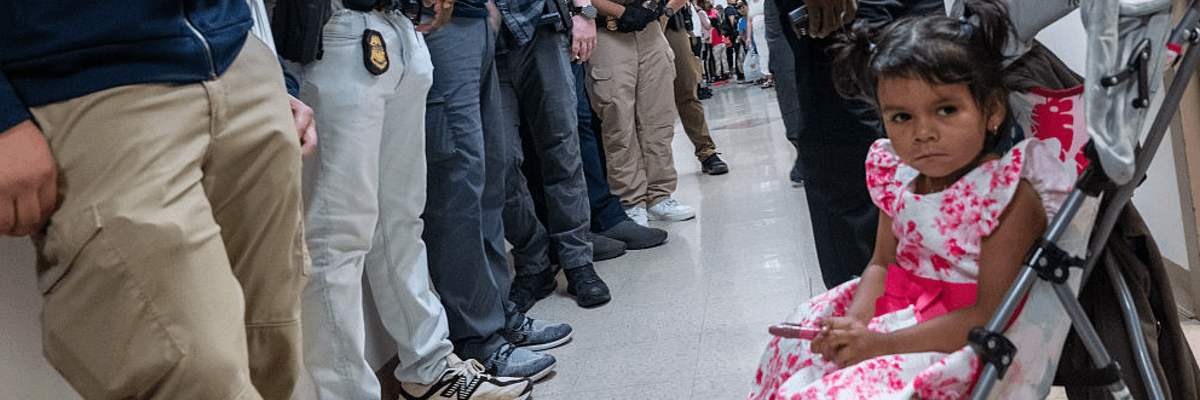
Federal agents, including US Immigration and Customs Enforcement officers, patrol the halls of immigration court at the Jacob K. Javitz Federal Building in New York City on July 24, 2025.
"Abandoning children to meet deportation targets is immoral. This must stop. These children deserve legal representation."
Thousands of unaccompanied immigrant children could lose their lawyers beginning Friday as federally funded contracts supporting them are set to expire, prompting advocates to warn that the move will leave vulnerable minors to face deportation proceedings frightened and alone.
Since 2003, the US Department of Health and Human Services (HHS) has funded a nationwide network of around 100 advocacy groups that have offered legal services to unaccompanied minors who arrived in the United States without their parents or legal guardians, as well as children already in immigration custody.
The Trump administration's move to withhold over $65 million in congressionally appropriated funding starting late last year forced dozens of nonprofit advocacy groups to trim operations, refuse new clients, or end vital programs altogether. There is no apparent plan for continuing representation for roughly 20,000 children currently receiving legal assistance as they navigate the US immigration courts and deportation process.
"This is a five-alarm fire," Sen. Jeff Merkley said Thursday on social media. "It’s wrong under every moral code."
Shaina Aber, executive director of Acacia Center for Justice—one of the nonprofits that received funding through the program—told El País' Patricia Clarembaux on Thursday, "We don’t know what’s going to happen on August 1 because the government has not informed us of the transition plan for the 20,000 children who have representation under this contract."
“It will really depend on whether the attorneys have alternative funding that allows them to continue," she added.
A child cannot be expected to navigate immigration court alone, yet that is exactly what will happen starting this Saturday if the Trump administration succeeds in dismantling these legal services.Tell Congress to honor its promise to protect unaccompanied children: tinyurl.com/protect-kids
[image or embed]
— Acacia Center for Justice (@acaciajustice.org) July 29, 2026 at 2:51 PM
HHS told El País that its Office of Refugee Resettlement—which is responsible for looking after immigrant minors—“remains fully compliant with legal and regulatory obligations and does not act in any way that could dissuade a child from seeking appropriate legal relief.”
However, as Acacia Center noted, "without legal representation, fewer than 1% of immigrant children are granted immigration relief. Without access to counsel, tens of thousands of vulnerable children could be forced to navigate life-changing legal proceedings with fewer protections, fewer advocates, and less time."
"HHS must honor its commitment and fulfill its obligation to pay for legal services already provided to prevent unaccompanied children from being stripped of their lawyers and deported without due process," the group argued.
Critics also point to President Donald Trump's record of mistreating unauthorized immigrants, especially children, over the course of his two terms. During his first term (2017–21), "zero tolerance" policies, including family separation and expanded use of what many observers call concentration camps, left thousands of children traumatized. Detention in overcrowded and often squalid facilities reportedly plagued by abuse has harmed many children since Trump's return to the White House last year.
Katie, a member of the group Women of Welcome and sponsor of immigrant children, responded to the imminent HHS funding cutoff last week, saying, “I have worked with immigrants in my professional life and have a lot of immigrant friends, but seeing the journey through the eyes of these kids was very new."
"The little girl I am adopting has been through a lot of trauma, and I may never know what she has gone through," Katie added. "She is resilient and funny, but she is 6, and she shouldn’t have to fight this system alone. This experience has not only deepened my faith, but I have learned more and more about how important the work of advocacy and loving people is. For these children, it is difficult to fight a system that isn’t built to protect them.”
Anna Devereaux, senior managing attorney at the Michigan Immigrant Rights Center, said that “children are children, regardless of their nationality, and our law and our values require us to act in their best interest."
"But the government’s failure to provide long-term funding has made it challenging to sustain a legal program for children," she added. "If this funding ends now, the future for these children is uncertain.”
Aber said: “These children are not leverage in a political negotiation. They are human beings—many of whom fled violence, trafficking, and abuse—who have a legally and morally recognized right to have their cases heard with a lawyer by their side."
"Abandoning children to meet deportation targets is immoral," she asserted. "This must stop. These children deserve legal representation."
Dear Common Dreams reader, It’s been nearly 30 years since I co-founded Common Dreams with my late wife, Lina Newhouser. We had the radical notion that journalism should serve the public good, not corporate profits. It was clear to us from the outset what it would take to build such a project. No paid advertisements. No corporate sponsors. No millionaire publisher telling us what to think or do. Many people said we wouldn't last a year, but we proved those doubters wrong. Together with a tremendous team of journalists and dedicated staff, we built an independent media outlet free from the constraints of profits and corporate control. Our mission has always been simple: To inform. To inspire. To ignite change for the common good. Building Common Dreams was not easy. Our survival was never guaranteed. When you take on the most powerful forces—Wall Street greed, fossil fuel industry destruction, Big Tech lobbyists, and uber-rich oligarchs who have spent billions upon billions rigging the economy and democracy in their favor—the only bulwark you have is supporters who believe in your work. But here’s the urgent message from me today. It's never been this bad out there. And it's never been this hard to keep us going. At the very moment Common Dreams is most needed, the threats we face are intensifying. We need your support now more than ever. We don't accept corporate advertising and never will. We don't have a paywall because we don't think people should be blocked from critical news based on their ability to pay. Everything we do is funded by the donations of readers like you. When everyone does the little they can afford, we are strong. But if that support retreats or dries up, so do we. Will you donate now to make sure Common Dreams not only survives but thrives? —Craig Brown, Co-founder |
Thousands of unaccompanied immigrant children could lose their lawyers beginning Friday as federally funded contracts supporting them are set to expire, prompting advocates to warn that the move will leave vulnerable minors to face deportation proceedings frightened and alone.
Since 2003, the US Department of Health and Human Services (HHS) has funded a nationwide network of around 100 advocacy groups that have offered legal services to unaccompanied minors who arrived in the United States without their parents or legal guardians, as well as children already in immigration custody.
The Trump administration's move to withhold over $65 million in congressionally appropriated funding starting late last year forced dozens of nonprofit advocacy groups to trim operations, refuse new clients, or end vital programs altogether. There is no apparent plan for continuing representation for roughly 20,000 children currently receiving legal assistance as they navigate the US immigration courts and deportation process.
"This is a five-alarm fire," Sen. Jeff Merkley said Thursday on social media. "It’s wrong under every moral code."
Shaina Aber, executive director of Acacia Center for Justice—one of the nonprofits that received funding through the program—told El País' Patricia Clarembaux on Thursday, "We don’t know what’s going to happen on August 1 because the government has not informed us of the transition plan for the 20,000 children who have representation under this contract."
“It will really depend on whether the attorneys have alternative funding that allows them to continue," she added.
A child cannot be expected to navigate immigration court alone, yet that is exactly what will happen starting this Saturday if the Trump administration succeeds in dismantling these legal services.Tell Congress to honor its promise to protect unaccompanied children: tinyurl.com/protect-kids
[image or embed]
— Acacia Center for Justice (@acaciajustice.org) July 29, 2026 at 2:51 PM
HHS told El País that its Office of Refugee Resettlement—which is responsible for looking after immigrant minors—“remains fully compliant with legal and regulatory obligations and does not act in any way that could dissuade a child from seeking appropriate legal relief.”
However, as Acacia Center noted, "without legal representation, fewer than 1% of immigrant children are granted immigration relief. Without access to counsel, tens of thousands of vulnerable children could be forced to navigate life-changing legal proceedings with fewer protections, fewer advocates, and less time."
"HHS must honor its commitment and fulfill its obligation to pay for legal services already provided to prevent unaccompanied children from being stripped of their lawyers and deported without due process," the group argued.
Critics also point to President Donald Trump's record of mistreating unauthorized immigrants, especially children, over the course of his two terms. During his first term (2017–21), "zero tolerance" policies, including family separation and expanded use of what many observers call concentration camps, left thousands of children traumatized. Detention in overcrowded and often squalid facilities reportedly plagued by abuse has harmed many children since Trump's return to the White House last year.
Katie, a member of the group Women of Welcome and sponsor of immigrant children, responded to the imminent HHS funding cutoff last week, saying, “I have worked with immigrants in my professional life and have a lot of immigrant friends, but seeing the journey through the eyes of these kids was very new."
"The little girl I am adopting has been through a lot of trauma, and I may never know what she has gone through," Katie added. "She is resilient and funny, but she is 6, and she shouldn’t have to fight this system alone. This experience has not only deepened my faith, but I have learned more and more about how important the work of advocacy and loving people is. For these children, it is difficult to fight a system that isn’t built to protect them.”
Anna Devereaux, senior managing attorney at the Michigan Immigrant Rights Center, said that “children are children, regardless of their nationality, and our law and our values require us to act in their best interest."
"But the government’s failure to provide long-term funding has made it challenging to sustain a legal program for children," she added. "If this funding ends now, the future for these children is uncertain.”
Aber said: “These children are not leverage in a political negotiation. They are human beings—many of whom fled violence, trafficking, and abuse—who have a legally and morally recognized right to have their cases heard with a lawyer by their side."
"Abandoning children to meet deportation targets is immoral," she asserted. "This must stop. These children deserve legal representation."
Thousands of unaccompanied immigrant children could lose their lawyers beginning Friday as federally funded contracts supporting them are set to expire, prompting advocates to warn that the move will leave vulnerable minors to face deportation proceedings frightened and alone.
Since 2003, the US Department of Health and Human Services (HHS) has funded a nationwide network of around 100 advocacy groups that have offered legal services to unaccompanied minors who arrived in the United States without their parents or legal guardians, as well as children already in immigration custody.
The Trump administration's move to withhold over $65 million in congressionally appropriated funding starting late last year forced dozens of nonprofit advocacy groups to trim operations, refuse new clients, or end vital programs altogether. There is no apparent plan for continuing representation for roughly 20,000 children currently receiving legal assistance as they navigate the US immigration courts and deportation process.
"This is a five-alarm fire," Sen. Jeff Merkley said Thursday on social media. "It’s wrong under every moral code."
Shaina Aber, executive director of Acacia Center for Justice—one of the nonprofits that received funding through the program—told El País' Patricia Clarembaux on Thursday, "We don’t know what’s going to happen on August 1 because the government has not informed us of the transition plan for the 20,000 children who have representation under this contract."
“It will really depend on whether the attorneys have alternative funding that allows them to continue," she added.
A child cannot be expected to navigate immigration court alone, yet that is exactly what will happen starting this Saturday if the Trump administration succeeds in dismantling these legal services.Tell Congress to honor its promise to protect unaccompanied children: tinyurl.com/protect-kids
[image or embed]
— Acacia Center for Justice (@acaciajustice.org) July 29, 2026 at 2:51 PM
HHS told El País that its Office of Refugee Resettlement—which is responsible for looking after immigrant minors—“remains fully compliant with legal and regulatory obligations and does not act in any way that could dissuade a child from seeking appropriate legal relief.”
However, as Acacia Center noted, "without legal representation, fewer than 1% of immigrant children are granted immigration relief. Without access to counsel, tens of thousands of vulnerable children could be forced to navigate life-changing legal proceedings with fewer protections, fewer advocates, and less time."
"HHS must honor its commitment and fulfill its obligation to pay for legal services already provided to prevent unaccompanied children from being stripped of their lawyers and deported without due process," the group argued.
Critics also point to President Donald Trump's record of mistreating unauthorized immigrants, especially children, over the course of his two terms. During his first term (2017–21), "zero tolerance" policies, including family separation and expanded use of what many observers call concentration camps, left thousands of children traumatized. Detention in overcrowded and often squalid facilities reportedly plagued by abuse has harmed many children since Trump's return to the White House last year.
Katie, a member of the group Women of Welcome and sponsor of immigrant children, responded to the imminent HHS funding cutoff last week, saying, “I have worked with immigrants in my professional life and have a lot of immigrant friends, but seeing the journey through the eyes of these kids was very new."
"The little girl I am adopting has been through a lot of trauma, and I may never know what she has gone through," Katie added. "She is resilient and funny, but she is 6, and she shouldn’t have to fight this system alone. This experience has not only deepened my faith, but I have learned more and more about how important the work of advocacy and loving people is. For these children, it is difficult to fight a system that isn’t built to protect them.”
Anna Devereaux, senior managing attorney at the Michigan Immigrant Rights Center, said that “children are children, regardless of their nationality, and our law and our values require us to act in their best interest."
"But the government’s failure to provide long-term funding has made it challenging to sustain a legal program for children," she added. "If this funding ends now, the future for these children is uncertain.”
Aber said: “These children are not leverage in a political negotiation. They are human beings—many of whom fled violence, trafficking, and abuse—who have a legally and morally recognized right to have their cases heard with a lawyer by their side."
"Abandoning children to meet deportation targets is immoral," she asserted. "This must stop. These children deserve legal representation."