5
#000000
#FFFFFF
To donate by check, phone, or other method, see our More Ways to Give page.
Daily news & progressive opinion—funded by the people, not the corporations—delivered straight to your inbox.
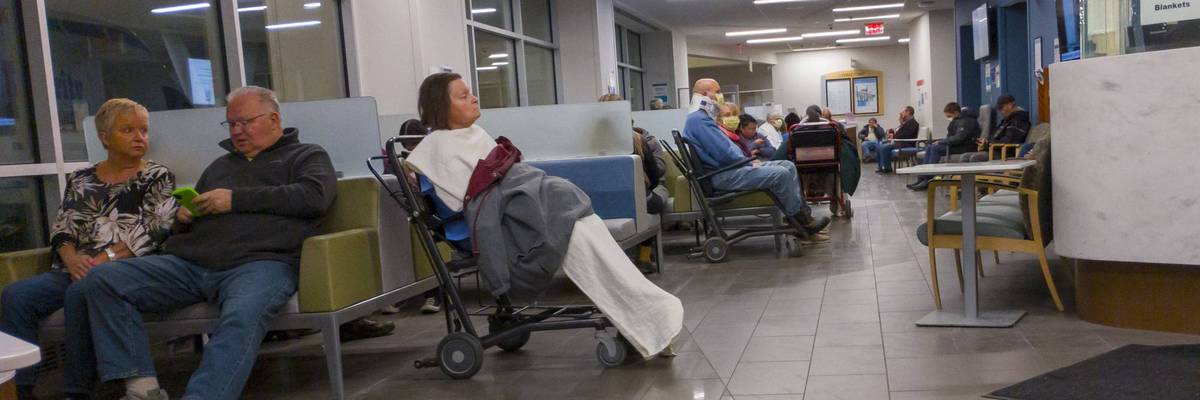
People wait for care in an over crowded hospital emergency room in Coon Rapids, Minnesota on December 18, 2025.
Republicans' cuts to Medicaid and their refusal to extend enhanced Affordable Care Act subsidies are key factors in the coverage drop.
Independent healthcare analyst Charles Gaba on Thursday published an updated analysis estimating that up to 12 million Americans have lost their insurance coverage since the start of President Donald Trump's second term.
Gaba based his new estimate on updated data he compiled from recent reports for Medicare, Medicaid, and the Children's Health Insurance Program (CHIP), as well as some state enrollment data for Affordable Care Act (ACA) insurance exchanges.
In total, Gaba found that enrollment in Medicaid and CHIP has dropped by 6.2 million people since the start of Trump's second term, while enrollment in ACA exchanges is down by anywhere from 4.6 million to 6.1 million people, and enrollment in Basic Health Plans (BHP) is down by nearly 275,000 people over the same period.
While there are around 1.8 million more people enrolled in Medicare now than there were at the start of Trump's term, Gaba noted that this isn't nearly enough to make up for the loss of enrollment in other programs.
Adding everything up, Gaba estimated that "between 10.88 million and 12.40 million fewer Americans enrolled in a public healthcare coverage program as of June 2026 than in were as of January 2025."
As in prior analyses, Gaba examined the possibility that some of the people who lost coverage through these programs transitioned to employer-sponsored insurance, but deemed it "extremely unlikely... since unemployment is higher than it was in January 2025."
Over the last two years, Trump and congressional Republicans have taken a number of actions that have made healthcare less affordable and pushed people off coverage.
First, they cut spending on Medicaid by an estimated $900 billion over a 10-year period when they enacted the One Big Beautiful Bill Act in 2025. The Congressional Budget Office projects these cuts will leave more than 10 million fewer people enrolled in the program by 2034.
GOP lawmakers last year also refused to extend enhanced subsidies for insurance plans purchased through the ACA, even as insurers raised premiums on those plans by an average of 26% this year, according to an analysis published by KFF.
In a Thursday article published by Time, scholars Neale Mahoney and Abigail Sanchez of the Stanford Institute for Economic Research warned that the costs of private health insurance are set to spike even further in 2027.
"Employer health plan costs are projected to rise 8 to 10% next year," Mahoney and Sanchez explained, "the largest increase in more than 20 years and double the average increase of the 2010s."
The two researchers said there are three major reasons for the surge in insurance costs: The expiration of the enhanced ACA subsidies, an increase in premiums and out-of-pocket costs for employer-based insurance plans, and the upcoming Medicaid work requirements projected to push millions of people off the program.
This country and this world are at a monumental crossroads. US voters have an opportunity to beat back the forces of fascism and confront the billionaires who are rigging the economy, our media system, and our democracy, making it increasingly impossible for ordinary people to get by. We’re not just talking about the election. We’re talking about what must be done once these fascist elements are vanquished from power. We need a bolder set of solutions than what either major party has so far been willing to offer and a working-class movement ready to fight like hell for it. Trump didn't emerge from nowhere. The conditions that fueled MAGA authoritarianism were created by decades of radical neoliberal economic policies and a corrupt political system dominated by corporate interests. They slashed taxes on the super-rich, promising that the benefits would trickle down. They said giveaways to the corporate titans would make life more affordable for the rest of us. It was all bullshit. And when a bitter, betrayed populace searches for someone to blame, right-wing demagogues have little trouble finding scapegoats. People know when they're being lied to, but you won't hear any of this from the corporate media. Only independent journalism—powered and funded by people who believe in building a better world—can deliver truly trustworthy daily news. If you share our vision, please contribute whatever you can to sustain our work. |
Independent healthcare analyst Charles Gaba on Thursday published an updated analysis estimating that up to 12 million Americans have lost their insurance coverage since the start of President Donald Trump's second term.
Gaba based his new estimate on updated data he compiled from recent reports for Medicare, Medicaid, and the Children's Health Insurance Program (CHIP), as well as some state enrollment data for Affordable Care Act (ACA) insurance exchanges.
In total, Gaba found that enrollment in Medicaid and CHIP has dropped by 6.2 million people since the start of Trump's second term, while enrollment in ACA exchanges is down by anywhere from 4.6 million to 6.1 million people, and enrollment in Basic Health Plans (BHP) is down by nearly 275,000 people over the same period.
While there are around 1.8 million more people enrolled in Medicare now than there were at the start of Trump's term, Gaba noted that this isn't nearly enough to make up for the loss of enrollment in other programs.
Adding everything up, Gaba estimated that "between 10.88 million and 12.40 million fewer Americans enrolled in a public healthcare coverage program as of June 2026 than in were as of January 2025."
As in prior analyses, Gaba examined the possibility that some of the people who lost coverage through these programs transitioned to employer-sponsored insurance, but deemed it "extremely unlikely... since unemployment is higher than it was in January 2025."
Over the last two years, Trump and congressional Republicans have taken a number of actions that have made healthcare less affordable and pushed people off coverage.
First, they cut spending on Medicaid by an estimated $900 billion over a 10-year period when they enacted the One Big Beautiful Bill Act in 2025. The Congressional Budget Office projects these cuts will leave more than 10 million fewer people enrolled in the program by 2034.
GOP lawmakers last year also refused to extend enhanced subsidies for insurance plans purchased through the ACA, even as insurers raised premiums on those plans by an average of 26% this year, according to an analysis published by KFF.
In a Thursday article published by Time, scholars Neale Mahoney and Abigail Sanchez of the Stanford Institute for Economic Research warned that the costs of private health insurance are set to spike even further in 2027.
"Employer health plan costs are projected to rise 8 to 10% next year," Mahoney and Sanchez explained, "the largest increase in more than 20 years and double the average increase of the 2010s."
The two researchers said there are three major reasons for the surge in insurance costs: The expiration of the enhanced ACA subsidies, an increase in premiums and out-of-pocket costs for employer-based insurance plans, and the upcoming Medicaid work requirements projected to push millions of people off the program.