SUBSCRIBE TO OUR FREE NEWSLETTER
Daily news & progressive opinion—funded by the people, not the corporations—delivered straight to your inbox.
5
#000000
#FFFFFF
To donate by check, phone, or other method, see our More Ways to Give page.
Daily news & progressive opinion—funded by the people, not the corporations—delivered straight to your inbox.
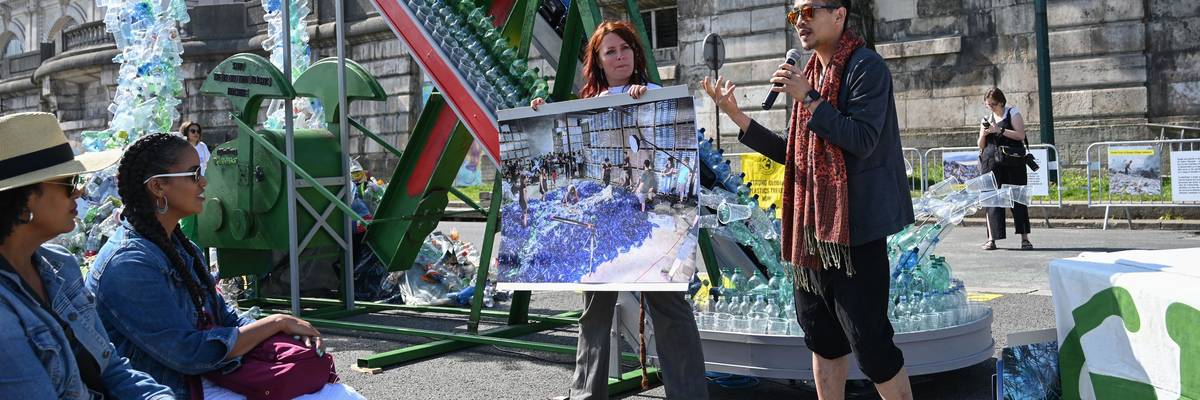
Canadian artist and activist Benjamin Von Wong (R) addresses media as he participates in the unveiling ceremony of a 5-meter tall art installation the "PerpetualPlastic Machine" on the banks of the Seine River in Paris on May 27, 2023, for the Global Plastics Treaty.
"It is clear from this week's negotiations that oil-producing countries and the fossil fuel industry will do everything in their power to weaken the treaty and delay the process," said one Greenpeace USA campaigner.
As the second session of the Intergovernmental Negotiating Committee wrapped up in Paris with an agreement to develop the first draft of a Global Plastics Treaty by November, climate, environmental, and other advocacy groups on Friday urged governments not to allow fossil fuel and other corporate interests to water down the landmark accord.
"Time is running out and it is clear from this week's negotiations that oil-producing countries and the fossil fuel industry will do everything in their power to weaken the treaty and delay the process," Graham Forbes, Greenpeace USA's global plastics campaign lead, said in a statement. "While some substantive discussions have taken place, there is still a huge amount of work ahead of us."
"Plastic pollution and the climate crisis are two sides of the same coin," Forbes added. "The Global Plastics Treaty must tackle plastic production head-on. This will align with the need to stay within 1.5℃ and move the world away from its plastic addiction. Anything else less than that, and the treaty will fail."
Governments from around 170 nations, NGOs, and plastics industry lobbyists spent the week at the United Nations Educational, Scientific, and Cultural Organization (UNESCO) headquarters in the French capital hammering out the framework for the world's first treaty aimed at reducing plastic pollution.
As Reuters reports:
Though the first half of the five-day negotiations was spent arguing over procedural issues, delegations split into two groups to discuss the range of control measures that can be taken to stop plastic pollution as well as whether countries should develop national plans or set global targets to tackle the problem.
By the session's close on Friday, countries agreed to prepare a "zero draft" text of what would become a legally binding plastics treaty and to work between negotiation sessions on key questions such as the scope and principles of the future treaty.
The "zero draft" text would reflect options from the wide-ranging positions of different countries by the start of the next round of talks to be held in Nairobi, Kenya, in November.
Ana Rocha, who directs the Global Plastics Program at GAIA, lamented that the conference "hosted at least 190 industry lobbyists, who used their access and infinite resources to promote tech-fixes like chemical 'recycling,' and plastic credits, while fenceline communities, waste pickers, Indigenous peoples, youth, and other members of civil society most impacted by plastic pollution had very limited opportunity to hold the mic."
"If we are to achieve a strong plastics treaty, member states must listen to and represent their people, not the very industry that is profiting from this crisis," Rocha added.
Julie Teel Simmonds, a senior attorney at the Center for Biological Diversity, praised the United States for helping to "jumpstart substantive talks in Paris," however, she added that the U.S. "must come to the next session with a bold commitment to cut plastic production."
"The U.S. hasn't yet been willing to put the reduction of plastic production front and center in this treaty, and we can't curb pollution without drastically scaling back its creation," she asserted. "At the next negotiations, the United States should take direct aim at the pervasive plastic that's infiltrating every corner of our planet by hitting hard on production."
Dear Common Dreams reader, It’s been nearly 30 years since I co-founded Common Dreams with my late wife, Lina Newhouser. We had the radical notion that journalism should serve the public good, not corporate profits. It was clear to us from the outset what it would take to build such a project. No paid advertisements. No corporate sponsors. No millionaire publisher telling us what to think or do. Many people said we wouldn't last a year, but we proved those doubters wrong. Together with a tremendous team of journalists and dedicated staff, we built an independent media outlet free from the constraints of profits and corporate control. Our mission has always been simple: To inform. To inspire. To ignite change for the common good. Building Common Dreams was not easy. Our survival was never guaranteed. When you take on the most powerful forces—Wall Street greed, fossil fuel industry destruction, Big Tech lobbyists, and uber-rich oligarchs who have spent billions upon billions rigging the economy and democracy in their favor—the only bulwark you have is supporters who believe in your work. But here’s the urgent message from me today. It's never been this bad out there. And it's never been this hard to keep us going. At the very moment Common Dreams is most needed, the threats we face are intensifying. We need your support now more than ever. We don't accept corporate advertising and never will. We don't have a paywall because we don't think people should be blocked from critical news based on their ability to pay. Everything we do is funded by the donations of readers like you. When everyone does the little they can afford, we are strong. But if that support retreats or dries up, so do we. Will you donate now to make sure Common Dreams not only survives but thrives? —Craig Brown, Co-founder |
As the second session of the Intergovernmental Negotiating Committee wrapped up in Paris with an agreement to develop the first draft of a Global Plastics Treaty by November, climate, environmental, and other advocacy groups on Friday urged governments not to allow fossil fuel and other corporate interests to water down the landmark accord.
"Time is running out and it is clear from this week's negotiations that oil-producing countries and the fossil fuel industry will do everything in their power to weaken the treaty and delay the process," Graham Forbes, Greenpeace USA's global plastics campaign lead, said in a statement. "While some substantive discussions have taken place, there is still a huge amount of work ahead of us."
"Plastic pollution and the climate crisis are two sides of the same coin," Forbes added. "The Global Plastics Treaty must tackle plastic production head-on. This will align with the need to stay within 1.5℃ and move the world away from its plastic addiction. Anything else less than that, and the treaty will fail."
Governments from around 170 nations, NGOs, and plastics industry lobbyists spent the week at the United Nations Educational, Scientific, and Cultural Organization (UNESCO) headquarters in the French capital hammering out the framework for the world's first treaty aimed at reducing plastic pollution.
As Reuters reports:
Though the first half of the five-day negotiations was spent arguing over procedural issues, delegations split into two groups to discuss the range of control measures that can be taken to stop plastic pollution as well as whether countries should develop national plans or set global targets to tackle the problem.
By the session's close on Friday, countries agreed to prepare a "zero draft" text of what would become a legally binding plastics treaty and to work between negotiation sessions on key questions such as the scope and principles of the future treaty.
The "zero draft" text would reflect options from the wide-ranging positions of different countries by the start of the next round of talks to be held in Nairobi, Kenya, in November.
Ana Rocha, who directs the Global Plastics Program at GAIA, lamented that the conference "hosted at least 190 industry lobbyists, who used their access and infinite resources to promote tech-fixes like chemical 'recycling,' and plastic credits, while fenceline communities, waste pickers, Indigenous peoples, youth, and other members of civil society most impacted by plastic pollution had very limited opportunity to hold the mic."
"If we are to achieve a strong plastics treaty, member states must listen to and represent their people, not the very industry that is profiting from this crisis," Rocha added.
Julie Teel Simmonds, a senior attorney at the Center for Biological Diversity, praised the United States for helping to "jumpstart substantive talks in Paris," however, she added that the U.S. "must come to the next session with a bold commitment to cut plastic production."
"The U.S. hasn't yet been willing to put the reduction of plastic production front and center in this treaty, and we can't curb pollution without drastically scaling back its creation," she asserted. "At the next negotiations, the United States should take direct aim at the pervasive plastic that's infiltrating every corner of our planet by hitting hard on production."
As the second session of the Intergovernmental Negotiating Committee wrapped up in Paris with an agreement to develop the first draft of a Global Plastics Treaty by November, climate, environmental, and other advocacy groups on Friday urged governments not to allow fossil fuel and other corporate interests to water down the landmark accord.
"Time is running out and it is clear from this week's negotiations that oil-producing countries and the fossil fuel industry will do everything in their power to weaken the treaty and delay the process," Graham Forbes, Greenpeace USA's global plastics campaign lead, said in a statement. "While some substantive discussions have taken place, there is still a huge amount of work ahead of us."
"Plastic pollution and the climate crisis are two sides of the same coin," Forbes added. "The Global Plastics Treaty must tackle plastic production head-on. This will align with the need to stay within 1.5℃ and move the world away from its plastic addiction. Anything else less than that, and the treaty will fail."
Governments from around 170 nations, NGOs, and plastics industry lobbyists spent the week at the United Nations Educational, Scientific, and Cultural Organization (UNESCO) headquarters in the French capital hammering out the framework for the world's first treaty aimed at reducing plastic pollution.
As Reuters reports:
Though the first half of the five-day negotiations was spent arguing over procedural issues, delegations split into two groups to discuss the range of control measures that can be taken to stop plastic pollution as well as whether countries should develop national plans or set global targets to tackle the problem.
By the session's close on Friday, countries agreed to prepare a "zero draft" text of what would become a legally binding plastics treaty and to work between negotiation sessions on key questions such as the scope and principles of the future treaty.
The "zero draft" text would reflect options from the wide-ranging positions of different countries by the start of the next round of talks to be held in Nairobi, Kenya, in November.
Ana Rocha, who directs the Global Plastics Program at GAIA, lamented that the conference "hosted at least 190 industry lobbyists, who used their access and infinite resources to promote tech-fixes like chemical 'recycling,' and plastic credits, while fenceline communities, waste pickers, Indigenous peoples, youth, and other members of civil society most impacted by plastic pollution had very limited opportunity to hold the mic."
"If we are to achieve a strong plastics treaty, member states must listen to and represent their people, not the very industry that is profiting from this crisis," Rocha added.
Julie Teel Simmonds, a senior attorney at the Center for Biological Diversity, praised the United States for helping to "jumpstart substantive talks in Paris," however, she added that the U.S. "must come to the next session with a bold commitment to cut plastic production."
"The U.S. hasn't yet been willing to put the reduction of plastic production front and center in this treaty, and we can't curb pollution without drastically scaling back its creation," she asserted. "At the next negotiations, the United States should take direct aim at the pervasive plastic that's infiltrating every corner of our planet by hitting hard on production."