SUBSCRIBE TO OUR FREE NEWSLETTER
Daily news & progressive opinion—funded by the people, not the corporations—delivered straight to your inbox.
5
#000000
#FFFFFF
To donate by check, phone, or other method, see our More Ways to Give page.
Daily news & progressive opinion—funded by the people, not the corporations—delivered straight to your inbox.
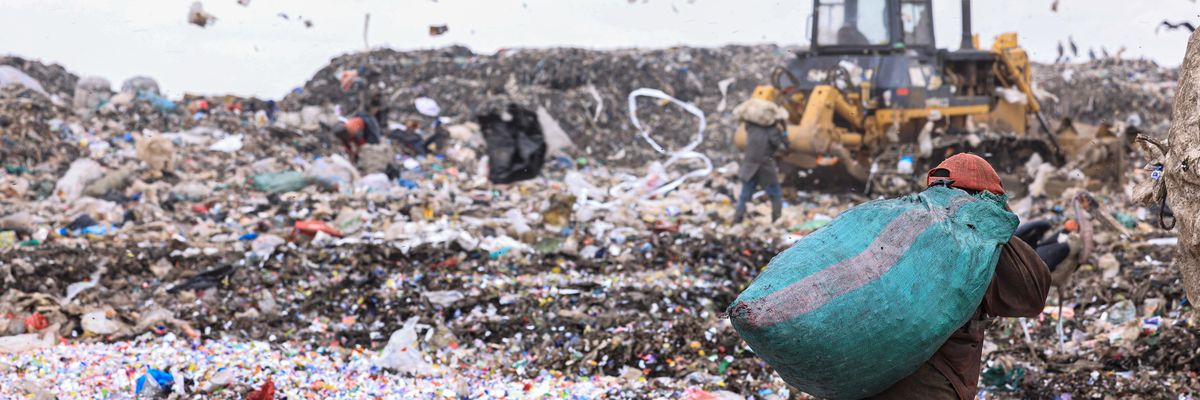
A man is seen carrying collected recyclables as plastic papers are blown by wind at a dump site in Nairobi, Kenya on July 14, 2023.
"Simply praying that we can recycle our way out of this problem will not cut it," said former Unilever CEO Paul Polman, an outspoken critic of plastic waste.
68,642,999 tons.
That's the amount of plastic expected to wind up in the environment across the globe this year as the amount of waste generated by humans and giant corporations continues to grow exponentially.
On Friday, according to the advocacy group Earth Action, the planet reached Plastic Overshoot Day, the point at which the amount of plastic waste overwhelms the world's capacity to manage it.
In a report released earlier this month, Earth Action noted that "in the first 208 days of 2023, plastic waste is well-managed, meaning it is collected and then either recycled, incinerated, or deposited in a sanitary landfill."
Beyond that point, waste management systems are swamped by the sheer volume of plastic, causing millions of tons to spill over into the natural environment—inundating communities, waterways, and oceans with toxic waste.
"Plastic pollution is a waste crisis, a climate nightmare, and a public health disaster in the making," Paul Polman, former CEO of Unilever and an outspoken critic of plastic waste, said in a statement. "Earth Action's report is a stark reminder that our current, linear plastic waste management systems are not fit for purpose and there is an urgent need for policymakers and industry to implement robust waste management policies and invest in the infrastructure fit for the 21st century."
"Simply praying that we can recycle our way out of this problem will not cut it," Polman added.
In early June, world leaders concluded talks in Paris with an agreement to develop a first draft of a Global Plastics Treaty before their November meeting in Kenya, a nation besieged by plastic waste.
Euronews observed Friday that "many of the highest plastic waste producers in the world are from the Global South—partly because they are also having to take in and process the waste of richer countries."
Earth Action found that "people living in Iceland are the top generators of plastic waste, with a yearly consumption of 128.9 kg per person," an amount that's "50 times higher than the yearly consumption per person in Bangladesh who consumes 2.59 kg."
"The amount of plastic produced is expected to double in the coming years, which will triple the volume of plastic pollution."
Environmental groups have long implored world leaders to act aggressively to curb plastic pollution, a push opposed by the fossil fuel industry and other corporate interests. More than 99% of plastic is made from chemicals sourced from fossil fuels, according to the Center for International Environmental Law.
Reuters reported last year that "publicly, plastic industry groups representing firms like ExxonMobil Corp., Royal Dutch Shell Plc, and Dow Inc. have expressed support for a global agreement to tackle this garbage."
"Behind the scenes, however, these trade organizations are devising strategies to persuade conference participants to reject any deal that would limit plastic manufacturing, according to emails and company presentations seen by Reuters, as well as interviews with a dozen officials involved in the negotiations," the outlet noted.
The Plastic Waste Makers Index estimates that 100 single-use plastic producers are responsible for close to 90% of global plastic waste.
Earth Action warned in its report that "the amount of plastic produced is expected to double in the coming years, which will triple the volume of plastic pollution."
"It's time for action," the group added. "Together, we can work towards reducing plastic consumption, improving waste management systems, promoting sustainable alternatives, and advocating for policy changes to combat plastic pollution and protect our oceans and the environment for future generations."
Dear Common Dreams reader, It’s been nearly 30 years since I co-founded Common Dreams with my late wife, Lina Newhouser. We had the radical notion that journalism should serve the public good, not corporate profits. It was clear to us from the outset what it would take to build such a project. No paid advertisements. No corporate sponsors. No millionaire publisher telling us what to think or do. Many people said we wouldn't last a year, but we proved those doubters wrong. Together with a tremendous team of journalists and dedicated staff, we built an independent media outlet free from the constraints of profits and corporate control. Our mission has always been simple: To inform. To inspire. To ignite change for the common good. Building Common Dreams was not easy. Our survival was never guaranteed. When you take on the most powerful forces—Wall Street greed, fossil fuel industry destruction, Big Tech lobbyists, and uber-rich oligarchs who have spent billions upon billions rigging the economy and democracy in their favor—the only bulwark you have is supporters who believe in your work. But here’s the urgent message from me today. It's never been this bad out there. And it's never been this hard to keep us going. At the very moment Common Dreams is most needed, the threats we face are intensifying. We need your support now more than ever. We don't accept corporate advertising and never will. We don't have a paywall because we don't think people should be blocked from critical news based on their ability to pay. Everything we do is funded by the donations of readers like you. When everyone does the little they can afford, we are strong. But if that support retreats or dries up, so do we. Will you donate now to make sure Common Dreams not only survives but thrives? —Craig Brown, Co-founder |
68,642,999 tons.
That's the amount of plastic expected to wind up in the environment across the globe this year as the amount of waste generated by humans and giant corporations continues to grow exponentially.
On Friday, according to the advocacy group Earth Action, the planet reached Plastic Overshoot Day, the point at which the amount of plastic waste overwhelms the world's capacity to manage it.
In a report released earlier this month, Earth Action noted that "in the first 208 days of 2023, plastic waste is well-managed, meaning it is collected and then either recycled, incinerated, or deposited in a sanitary landfill."
Beyond that point, waste management systems are swamped by the sheer volume of plastic, causing millions of tons to spill over into the natural environment—inundating communities, waterways, and oceans with toxic waste.
"Plastic pollution is a waste crisis, a climate nightmare, and a public health disaster in the making," Paul Polman, former CEO of Unilever and an outspoken critic of plastic waste, said in a statement. "Earth Action's report is a stark reminder that our current, linear plastic waste management systems are not fit for purpose and there is an urgent need for policymakers and industry to implement robust waste management policies and invest in the infrastructure fit for the 21st century."
"Simply praying that we can recycle our way out of this problem will not cut it," Polman added.
In early June, world leaders concluded talks in Paris with an agreement to develop a first draft of a Global Plastics Treaty before their November meeting in Kenya, a nation besieged by plastic waste.
Euronews observed Friday that "many of the highest plastic waste producers in the world are from the Global South—partly because they are also having to take in and process the waste of richer countries."
Earth Action found that "people living in Iceland are the top generators of plastic waste, with a yearly consumption of 128.9 kg per person," an amount that's "50 times higher than the yearly consumption per person in Bangladesh who consumes 2.59 kg."
"The amount of plastic produced is expected to double in the coming years, which will triple the volume of plastic pollution."
Environmental groups have long implored world leaders to act aggressively to curb plastic pollution, a push opposed by the fossil fuel industry and other corporate interests. More than 99% of plastic is made from chemicals sourced from fossil fuels, according to the Center for International Environmental Law.
Reuters reported last year that "publicly, plastic industry groups representing firms like ExxonMobil Corp., Royal Dutch Shell Plc, and Dow Inc. have expressed support for a global agreement to tackle this garbage."
"Behind the scenes, however, these trade organizations are devising strategies to persuade conference participants to reject any deal that would limit plastic manufacturing, according to emails and company presentations seen by Reuters, as well as interviews with a dozen officials involved in the negotiations," the outlet noted.
The Plastic Waste Makers Index estimates that 100 single-use plastic producers are responsible for close to 90% of global plastic waste.
Earth Action warned in its report that "the amount of plastic produced is expected to double in the coming years, which will triple the volume of plastic pollution."
"It's time for action," the group added. "Together, we can work towards reducing plastic consumption, improving waste management systems, promoting sustainable alternatives, and advocating for policy changes to combat plastic pollution and protect our oceans and the environment for future generations."
68,642,999 tons.
That's the amount of plastic expected to wind up in the environment across the globe this year as the amount of waste generated by humans and giant corporations continues to grow exponentially.
On Friday, according to the advocacy group Earth Action, the planet reached Plastic Overshoot Day, the point at which the amount of plastic waste overwhelms the world's capacity to manage it.
In a report released earlier this month, Earth Action noted that "in the first 208 days of 2023, plastic waste is well-managed, meaning it is collected and then either recycled, incinerated, or deposited in a sanitary landfill."
Beyond that point, waste management systems are swamped by the sheer volume of plastic, causing millions of tons to spill over into the natural environment—inundating communities, waterways, and oceans with toxic waste.
"Plastic pollution is a waste crisis, a climate nightmare, and a public health disaster in the making," Paul Polman, former CEO of Unilever and an outspoken critic of plastic waste, said in a statement. "Earth Action's report is a stark reminder that our current, linear plastic waste management systems are not fit for purpose and there is an urgent need for policymakers and industry to implement robust waste management policies and invest in the infrastructure fit for the 21st century."
"Simply praying that we can recycle our way out of this problem will not cut it," Polman added.
In early June, world leaders concluded talks in Paris with an agreement to develop a first draft of a Global Plastics Treaty before their November meeting in Kenya, a nation besieged by plastic waste.
Euronews observed Friday that "many of the highest plastic waste producers in the world are from the Global South—partly because they are also having to take in and process the waste of richer countries."
Earth Action found that "people living in Iceland are the top generators of plastic waste, with a yearly consumption of 128.9 kg per person," an amount that's "50 times higher than the yearly consumption per person in Bangladesh who consumes 2.59 kg."
"The amount of plastic produced is expected to double in the coming years, which will triple the volume of plastic pollution."
Environmental groups have long implored world leaders to act aggressively to curb plastic pollution, a push opposed by the fossil fuel industry and other corporate interests. More than 99% of plastic is made from chemicals sourced from fossil fuels, according to the Center for International Environmental Law.
Reuters reported last year that "publicly, plastic industry groups representing firms like ExxonMobil Corp., Royal Dutch Shell Plc, and Dow Inc. have expressed support for a global agreement to tackle this garbage."
"Behind the scenes, however, these trade organizations are devising strategies to persuade conference participants to reject any deal that would limit plastic manufacturing, according to emails and company presentations seen by Reuters, as well as interviews with a dozen officials involved in the negotiations," the outlet noted.
The Plastic Waste Makers Index estimates that 100 single-use plastic producers are responsible for close to 90% of global plastic waste.
Earth Action warned in its report that "the amount of plastic produced is expected to double in the coming years, which will triple the volume of plastic pollution."
"It's time for action," the group added. "Together, we can work towards reducing plastic consumption, improving waste management systems, promoting sustainable alternatives, and advocating for policy changes to combat plastic pollution and protect our oceans and the environment for future generations."