

SUBSCRIBE TO OUR FREE NEWSLETTER
Daily news & progressive opinion—funded by the people, not the corporations—delivered straight to your inbox.
5
#000000
#FFFFFF
To donate by check, phone, or other method, see our More Ways to Give page.
Daily news & progressive opinion—funded by the people, not the corporations—delivered straight to your inbox.
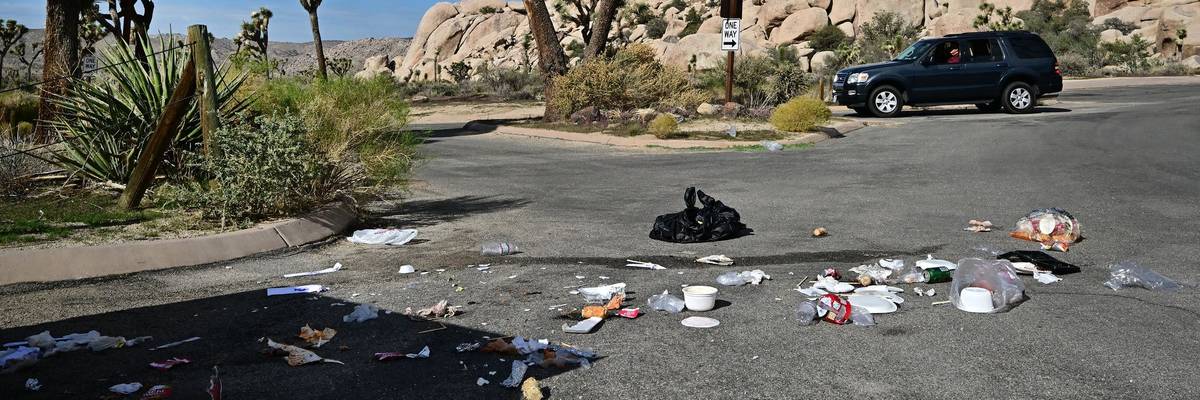
Trash is seen strewn along the road at Joshua Tree National Park in California, on October 10, 2025, on the 10th day of the federal government shutdown.
“Even in landscapes that appeared untouched,” volunteers found “thousands of plastic pellets and fragments that pose a clear threat to the environment, wildlife, and human health,” said a 5 Gyres Institute spokesperson.
More than half the trash polluting America's national parks and federal lands contains hazardous microplastics, according to a waste audit published Thursday.
As part of its annual "TrashBlitz" effort to document the scale of plastic pollution in national parks and federal lands across the US, volunteers with the 5 Gyres Institute collected nearly 24,000 pieces of garbage at 59 federally protected locations.
In each of the four years the group has done the audit, they've found that plastic has made up the vast majority of trash in the sites.
They found that, again this year, plastic made up 85% of the waste they logged, with 25% of it single-use plastics like bottle caps, food wrappers, bags, and cups.
But for the first time, they also broke down the plastics category to account for microplastics, the small fragments that can lodge permanently in the human body and cause numerous harmful health effects.
As a Stanford University report from January 2025 explained:
In the past year alone, headlines have sounded the alarm about particles in tea bags, seafood, meat, and bottled water. Scientists have estimated that adults ingest the equivalent of one credit card per week in microplastics. Studies in animals and human cells suggest microplastics exposure could be linked to cancer, heart attacks, reproductive problems, and a host of other harms.
Microplastics come in two main forms: pre-production plastic pellets, sometimes known as "nurdles," which are melted down to make other products; and fragments of larger plastic items that break down over time.
The volunteers found that microplastic pellets and fragments made up more than half the trash they found over the course of their survey.
"Even in landscapes that appeared untouched, a closer look at trails, riverbeds, and coastlines revealed thousands of plastic pellets and fragments that pose a clear threat to the environment, wildlife, and human health,” said Nick Kemble, programs manager at the 5 Gyres Institute.
Most of the microplastics they found came in the form of pellets, which the group's report notes often "spill in transit from boats and trains, entering waterways that carry them further into the environment or deposit them on shorelines."
The surveyors identified the Altria Group—a leading manufacturer of cigarettes—PepsiCo, Anheuser-Busch InBev, the Coca-Cola Company, and Mars as the top corporate polluters whose names appeared on branded trash.
But the vast majority of microplastic waste discovered was unbranded. According to the Coastal & Estuarine Research Federation, petrochemical companies such as Dow, ExxonMobil, Shell, and Formosa are among the leading manufacturers of pellets found strewn across America's bodies of water.
The 5 Gyres report notes that "at the federal level in the United States, there is no comprehensive regulatory framework that specifically holds these polluters accountable, resulting in widespread pollution that threatens ecosystems and wildlife."
The group called on Congress to pass the Reducing Waste in National Parks Act, introduced in 2023 by Sen. Jeff Merkley (D-Ore.), which would reduce the sale of single-use plastics in national parks. It also advocated for the Plastic Pellet Free Waters Act, introduced last year by Rep. Mike Levin (D-Calif.) and then-Rep. Mary Peltola (D-Alaska), which would prohibit the discharge of pre-production plastic pellets into waterways, storm drains, and sewers.
"It’s time that our elected officials act on the warnings we’ve raised for years—single-use plastics and microplastics pose an immediate threat to our environment and public health," said Paulita Bennett-Martin, senior strategist of policy initiatives at 5 Gyres. "TrashBlitz volunteers uncovered thousands of microplastics in our nation’s most protected spaces, and we’re urging decisive action that addresses this issue at the source."
Dear Common Dreams reader, It’s been nearly 30 years since I co-founded Common Dreams with my late wife, Lina Newhouser. We had the radical notion that journalism should serve the public good, not corporate profits. It was clear to us from the outset what it would take to build such a project. No paid advertisements. No corporate sponsors. No millionaire publisher telling us what to think or do. Many people said we wouldn't last a year, but we proved those doubters wrong. Together with a tremendous team of journalists and dedicated staff, we built an independent media outlet free from the constraints of profits and corporate control. Our mission has always been simple: To inform. To inspire. To ignite change for the common good. Building Common Dreams was not easy. Our survival was never guaranteed. When you take on the most powerful forces—Wall Street greed, fossil fuel industry destruction, Big Tech lobbyists, and uber-rich oligarchs who have spent billions upon billions rigging the economy and democracy in their favor—the only bulwark you have is supporters who believe in your work. But here’s the urgent message from me today. It's never been this bad out there. And it's never been this hard to keep us going. At the very moment Common Dreams is most needed, the threats we face are intensifying. We need your support now more than ever. We don't accept corporate advertising and never will. We don't have a paywall because we don't think people should be blocked from critical news based on their ability to pay. Everything we do is funded by the donations of readers like you. When everyone does the little they can afford, we are strong. But if that support retreats or dries up, so do we. Will you donate now to make sure Common Dreams not only survives but thrives? —Craig Brown, Co-founder |
More than half the trash polluting America's national parks and federal lands contains hazardous microplastics, according to a waste audit published Thursday.
As part of its annual "TrashBlitz" effort to document the scale of plastic pollution in national parks and federal lands across the US, volunteers with the 5 Gyres Institute collected nearly 24,000 pieces of garbage at 59 federally protected locations.
In each of the four years the group has done the audit, they've found that plastic has made up the vast majority of trash in the sites.
They found that, again this year, plastic made up 85% of the waste they logged, with 25% of it single-use plastics like bottle caps, food wrappers, bags, and cups.
But for the first time, they also broke down the plastics category to account for microplastics, the small fragments that can lodge permanently in the human body and cause numerous harmful health effects.
As a Stanford University report from January 2025 explained:
In the past year alone, headlines have sounded the alarm about particles in tea bags, seafood, meat, and bottled water. Scientists have estimated that adults ingest the equivalent of one credit card per week in microplastics. Studies in animals and human cells suggest microplastics exposure could be linked to cancer, heart attacks, reproductive problems, and a host of other harms.
Microplastics come in two main forms: pre-production plastic pellets, sometimes known as "nurdles," which are melted down to make other products; and fragments of larger plastic items that break down over time.
The volunteers found that microplastic pellets and fragments made up more than half the trash they found over the course of their survey.
"Even in landscapes that appeared untouched, a closer look at trails, riverbeds, and coastlines revealed thousands of plastic pellets and fragments that pose a clear threat to the environment, wildlife, and human health,” said Nick Kemble, programs manager at the 5 Gyres Institute.
Most of the microplastics they found came in the form of pellets, which the group's report notes often "spill in transit from boats and trains, entering waterways that carry them further into the environment or deposit them on shorelines."
The surveyors identified the Altria Group—a leading manufacturer of cigarettes—PepsiCo, Anheuser-Busch InBev, the Coca-Cola Company, and Mars as the top corporate polluters whose names appeared on branded trash.
But the vast majority of microplastic waste discovered was unbranded. According to the Coastal & Estuarine Research Federation, petrochemical companies such as Dow, ExxonMobil, Shell, and Formosa are among the leading manufacturers of pellets found strewn across America's bodies of water.
The 5 Gyres report notes that "at the federal level in the United States, there is no comprehensive regulatory framework that specifically holds these polluters accountable, resulting in widespread pollution that threatens ecosystems and wildlife."
The group called on Congress to pass the Reducing Waste in National Parks Act, introduced in 2023 by Sen. Jeff Merkley (D-Ore.), which would reduce the sale of single-use plastics in national parks. It also advocated for the Plastic Pellet Free Waters Act, introduced last year by Rep. Mike Levin (D-Calif.) and then-Rep. Mary Peltola (D-Alaska), which would prohibit the discharge of pre-production plastic pellets into waterways, storm drains, and sewers.
"It’s time that our elected officials act on the warnings we’ve raised for years—single-use plastics and microplastics pose an immediate threat to our environment and public health," said Paulita Bennett-Martin, senior strategist of policy initiatives at 5 Gyres. "TrashBlitz volunteers uncovered thousands of microplastics in our nation’s most protected spaces, and we’re urging decisive action that addresses this issue at the source."
More than half the trash polluting America's national parks and federal lands contains hazardous microplastics, according to a waste audit published Thursday.
As part of its annual "TrashBlitz" effort to document the scale of plastic pollution in national parks and federal lands across the US, volunteers with the 5 Gyres Institute collected nearly 24,000 pieces of garbage at 59 federally protected locations.
In each of the four years the group has done the audit, they've found that plastic has made up the vast majority of trash in the sites.
They found that, again this year, plastic made up 85% of the waste they logged, with 25% of it single-use plastics like bottle caps, food wrappers, bags, and cups.
But for the first time, they also broke down the plastics category to account for microplastics, the small fragments that can lodge permanently in the human body and cause numerous harmful health effects.
As a Stanford University report from January 2025 explained:
In the past year alone, headlines have sounded the alarm about particles in tea bags, seafood, meat, and bottled water. Scientists have estimated that adults ingest the equivalent of one credit card per week in microplastics. Studies in animals and human cells suggest microplastics exposure could be linked to cancer, heart attacks, reproductive problems, and a host of other harms.
Microplastics come in two main forms: pre-production plastic pellets, sometimes known as "nurdles," which are melted down to make other products; and fragments of larger plastic items that break down over time.
The volunteers found that microplastic pellets and fragments made up more than half the trash they found over the course of their survey.
"Even in landscapes that appeared untouched, a closer look at trails, riverbeds, and coastlines revealed thousands of plastic pellets and fragments that pose a clear threat to the environment, wildlife, and human health,” said Nick Kemble, programs manager at the 5 Gyres Institute.
Most of the microplastics they found came in the form of pellets, which the group's report notes often "spill in transit from boats and trains, entering waterways that carry them further into the environment or deposit them on shorelines."
The surveyors identified the Altria Group—a leading manufacturer of cigarettes—PepsiCo, Anheuser-Busch InBev, the Coca-Cola Company, and Mars as the top corporate polluters whose names appeared on branded trash.
But the vast majority of microplastic waste discovered was unbranded. According to the Coastal & Estuarine Research Federation, petrochemical companies such as Dow, ExxonMobil, Shell, and Formosa are among the leading manufacturers of pellets found strewn across America's bodies of water.
The 5 Gyres report notes that "at the federal level in the United States, there is no comprehensive regulatory framework that specifically holds these polluters accountable, resulting in widespread pollution that threatens ecosystems and wildlife."
The group called on Congress to pass the Reducing Waste in National Parks Act, introduced in 2023 by Sen. Jeff Merkley (D-Ore.), which would reduce the sale of single-use plastics in national parks. It also advocated for the Plastic Pellet Free Waters Act, introduced last year by Rep. Mike Levin (D-Calif.) and then-Rep. Mary Peltola (D-Alaska), which would prohibit the discharge of pre-production plastic pellets into waterways, storm drains, and sewers.
"It’s time that our elected officials act on the warnings we’ve raised for years—single-use plastics and microplastics pose an immediate threat to our environment and public health," said Paulita Bennett-Martin, senior strategist of policy initiatives at 5 Gyres. "TrashBlitz volunteers uncovered thousands of microplastics in our nation’s most protected spaces, and we’re urging decisive action that addresses this issue at the source."

