5
#000000
#FFFFFF
To donate by check, phone, or other method, see our More Ways to Give page.
Daily news & progressive opinion—funded by the people, not the corporations—delivered straight to your inbox.
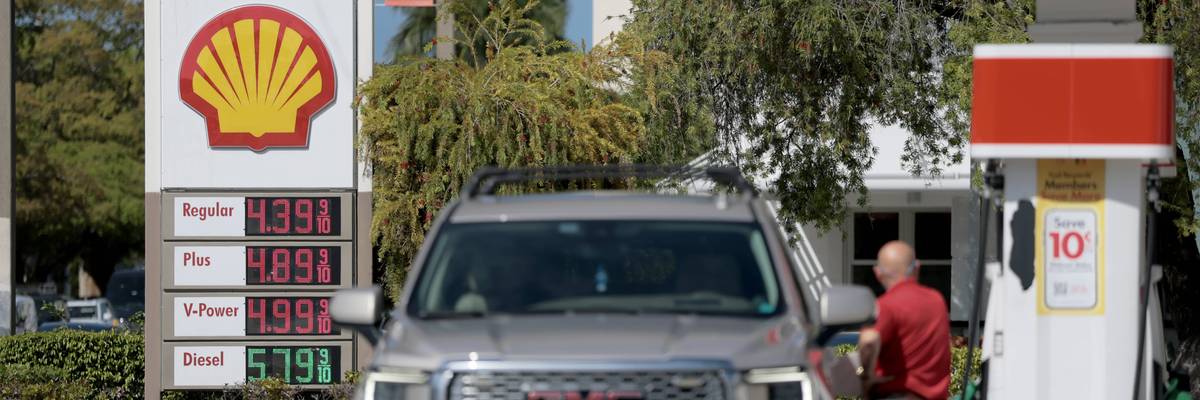
Fuel prices are displayed on a sign as a customer fills their vehicle at a gas station on April 13, 2026 in Miami, Florida.
"While Americans suffer from high prices and the Iran War imposes tens of billions of dollars of new costs on the American public, the oil industry wins big."
As President Donald Trump reached an interim peace deal with the Iranian government and Oxfam International revealed that 41 energy industry tycoons collectively increased their wealth by $23.5 billion since the war was launched in late February, a pair of US senators on Monday released their letters demanding answers from fossil fuel giants about their windfall profits and soaring gasoline prices during the conflict.
Senate Banking Committee Ranking Member Elizabeth Warren (D-Mass.) and Committee on Environment and Public Works Ranking Member Sheldon Whitehouse (D-RI) last Thursday wrote to BP America chair and president Orlando Alvarez, Chevron chair and CEO Mike Wirth, ConocoPhillips chair and CEO Ryan Lance, Continental Resources president and CEO Robert Lawler, ExxonMobil chair and CEO Darren Woods, Occidental Petroleum president and CEO Richard Jackson, and Shell USA president Colette Hirstius.
"We write to question why American families are paying egregiously high prices at the pump while the fossil fuel industry collects massive windfall profits thanks to the Trump administration's war in Iran," Warren and Whitehouse wrote amid peace talks last week, noting that Iran's closure of the Strait of Hormuz, a key shipping route for fossil fuels, led to what that the International Energy Agency (IEA) called "the largest supply disruption in the history of the global oil market."
"Gasoline prices rapidly increased by as much as 52%," the pair highlighted. "Before the Iran War, oil cost $71.32 per barrel. Since then, it has cost as much as $138.21 and currently sits at $98.29 per barrel. The Iran War has allowed 27 oil and gas companies to rake in over $40 billion in profit since the Iran War began."
Warren and Whitehouse also emphasized that "the opportunity to profit from high oil prices did not occur in a political vacuum. In April 2024, then-candidate Trump solicited a billion dollars from fossil fuel executives at a private dinner at Mar-a-Lago, promising in exchange to roll back environmental regulations, issue desired permits, and expand drilling opportunities."
Also pointing to Trump's invasion of Venezuela, abduction of President Nicolás Maduro, and takeover of the country's nationalized oil industry, the senators said that "the pattern is consistent: While Americans suffer from high prices and the Iran War imposes tens of billions of dollars of new costs on the American public, the oil industry wins big."
The pair requested answers to their questions on profits, pricing, federal policy, and communications with the Trump administration about the Iran War by June 25, They explained that the information "will aid our assessment of the appropriate scope, rate structure, and enforcement mechanisms as we actively consider the Big Oil Windfall Profits Tax Act," reintroduced by Whitehouse and Rep. Ro Khanna (D-Calif.) in March, just weeks in to the war.
The information will also assist with investigations into "the extent to which Trump administration military, regulatory, and policy decisions benefited the oil industry and the extent to which any of these were the product of quid pro quo solicitations," as well as "whether oil and gas companies had advance knowledge of or ability to shape the administration's decision to go to war in Iran."
"Congress has a constitutional duty to investigate each of these matters and to legislate as necessary to protect the American people," the pair added. Both chambers are controlled by the GOP and have refused—largely along party lines—to pass war powers resolutions intended to prevent or end Trump and Israeli Prime Minister Benjamin Netanyahu's illegal assault on Iran.
In response to Trump's new deal with Iran to extend a ceasefire reached in April and reopen the strait, oil prices dropped and the stock market rallied. Specifically, as The Associated Press detailed, "the S&P 500 rose 1.7%," while "the Dow Jones Industrial Average climbed 468 points, or 0.9%, to a record, and the Nasdaq composite jumped 3.1%."
Allie Rosenbluth, US program manager at the advocacy group Oil Change International, said Monday that "any agreement that reduces further violence is welcome. But this announcement should not be mistaken as the end to the crisis, given Israel has vowed to remain in occupied areas of southern Lebanon indefinitely, while violence continues in Gaza and the West Bank. As attention turns to the reopening of the Strait of Hormuz and falling oil prices, we should not lose sight of the devastating human toll this conflict has inflicted across the region, nor the profound economic disruption it continues to cause around the world."
Rosenbluth continued:
The rapid rise and fall of oil prices in response to military escalation and diplomatic announcements is a reminder of how exposed the global economy is to fossil fuel volatility. For millions of people, this crisis has meant loss, displacement, food insecurity, and higher cost of living. For fossil fuel companies, it has meant windfall profits.
Oil Change International estimates that if US oil prices average around $90 per barrel through the end of the year, US oil companies could make an additional $38 billion in windfall revenues from crude oil exports alone as a result of Trump and Netanyahu's war on Iran. While households around the world have been hit by higher fuel, energy, and food costs, oil companies are cashing in billions.
The Strait of Hormuz may be reopening, but this crisis has once again exposed fossil fuels as a source of conflict, chaos, volatility, and disruption. While communities bear the costs, oil companies profit from the instability. Once renewables are installed, sunlight or wind does not become more expensive because of geopolitical conflict. The most durable form of energy security is reducing exposure to fossil fuels altogether, and making a just transition to renewable energy.
As Group of Seven leaders, including Trump, gathered in France on Monday, and Oxfam International released its report about how G7 energy billionaires have pocketed $300 million per day since the start of the Iran War, the organization's executive director, Amitabh Behar, argued that representatives from the other six countries, or G6, "can't plead powerlessness."
"They can cancel debt. They can tax windfall profits and extreme wealth. They can advocate for a new issuance of special drawing rights. They can provide poorer countries with aid," Behar added. "Refusing to act simply because Washington will not join them is not diplomacy, it is cowardice. And it will only accelerate the G6's slide into global irrelevance."
Dear Common Dreams reader, It’s been nearly 30 years since I co-founded Common Dreams with my late wife, Lina Newhouser. We had the radical notion that journalism should serve the public good, not corporate profits. It was clear to us from the outset what it would take to build such a project. No paid advertisements. No corporate sponsors. No millionaire publisher telling us what to think or do. Many people said we wouldn't last a year, but we proved those doubters wrong. Together with a tremendous team of journalists and dedicated staff, we built an independent media outlet free from the constraints of profits and corporate control. Our mission has always been simple: To inform. To inspire. To ignite change for the common good. Building Common Dreams was not easy. Our survival was never guaranteed. When you take on the most powerful forces—Wall Street greed, fossil fuel industry destruction, Big Tech lobbyists, and uber-rich oligarchs who have spent billions upon billions rigging the economy and democracy in their favor—the only bulwark you have is supporters who believe in your work. But here’s the urgent message from me today. It's never been this bad out there. And it's never been this hard to keep us going. At the very moment Common Dreams is most needed, the threats we face are intensifying. We need your support now more than ever. We don't accept corporate advertising and never will. We don't have a paywall because we don't think people should be blocked from critical news based on their ability to pay. Everything we do is funded by the donations of readers like you. When everyone does the little they can afford, we are strong. But if that support retreats or dries up, so do we. Will you donate now to make sure Common Dreams not only survives but thrives? —Craig Brown, Co-founder |
As President Donald Trump reached an interim peace deal with the Iranian government and Oxfam International revealed that 41 energy industry tycoons collectively increased their wealth by $23.5 billion since the war was launched in late February, a pair of US senators on Monday released their letters demanding answers from fossil fuel giants about their windfall profits and soaring gasoline prices during the conflict.
Senate Banking Committee Ranking Member Elizabeth Warren (D-Mass.) and Committee on Environment and Public Works Ranking Member Sheldon Whitehouse (D-RI) last Thursday wrote to BP America chair and president Orlando Alvarez, Chevron chair and CEO Mike Wirth, ConocoPhillips chair and CEO Ryan Lance, Continental Resources president and CEO Robert Lawler, ExxonMobil chair and CEO Darren Woods, Occidental Petroleum president and CEO Richard Jackson, and Shell USA president Colette Hirstius.
"We write to question why American families are paying egregiously high prices at the pump while the fossil fuel industry collects massive windfall profits thanks to the Trump administration's war in Iran," Warren and Whitehouse wrote amid peace talks last week, noting that Iran's closure of the Strait of Hormuz, a key shipping route for fossil fuels, led to what that the International Energy Agency (IEA) called "the largest supply disruption in the history of the global oil market."
"Gasoline prices rapidly increased by as much as 52%," the pair highlighted. "Before the Iran War, oil cost $71.32 per barrel. Since then, it has cost as much as $138.21 and currently sits at $98.29 per barrel. The Iran War has allowed 27 oil and gas companies to rake in over $40 billion in profit since the Iran War began."
Warren and Whitehouse also emphasized that "the opportunity to profit from high oil prices did not occur in a political vacuum. In April 2024, then-candidate Trump solicited a billion dollars from fossil fuel executives at a private dinner at Mar-a-Lago, promising in exchange to roll back environmental regulations, issue desired permits, and expand drilling opportunities."
Also pointing to Trump's invasion of Venezuela, abduction of President Nicolás Maduro, and takeover of the country's nationalized oil industry, the senators said that "the pattern is consistent: While Americans suffer from high prices and the Iran War imposes tens of billions of dollars of new costs on the American public, the oil industry wins big."
The pair requested answers to their questions on profits, pricing, federal policy, and communications with the Trump administration about the Iran War by June 25, They explained that the information "will aid our assessment of the appropriate scope, rate structure, and enforcement mechanisms as we actively consider the Big Oil Windfall Profits Tax Act," reintroduced by Whitehouse and Rep. Ro Khanna (D-Calif.) in March, just weeks in to the war.
The information will also assist with investigations into "the extent to which Trump administration military, regulatory, and policy decisions benefited the oil industry and the extent to which any of these were the product of quid pro quo solicitations," as well as "whether oil and gas companies had advance knowledge of or ability to shape the administration's decision to go to war in Iran."
"Congress has a constitutional duty to investigate each of these matters and to legislate as necessary to protect the American people," the pair added. Both chambers are controlled by the GOP and have refused—largely along party lines—to pass war powers resolutions intended to prevent or end Trump and Israeli Prime Minister Benjamin Netanyahu's illegal assault on Iran.
In response to Trump's new deal with Iran to extend a ceasefire reached in April and reopen the strait, oil prices dropped and the stock market rallied. Specifically, as The Associated Press detailed, "the S&P 500 rose 1.7%," while "the Dow Jones Industrial Average climbed 468 points, or 0.9%, to a record, and the Nasdaq composite jumped 3.1%."
Allie Rosenbluth, US program manager at the advocacy group Oil Change International, said Monday that "any agreement that reduces further violence is welcome. But this announcement should not be mistaken as the end to the crisis, given Israel has vowed to remain in occupied areas of southern Lebanon indefinitely, while violence continues in Gaza and the West Bank. As attention turns to the reopening of the Strait of Hormuz and falling oil prices, we should not lose sight of the devastating human toll this conflict has inflicted across the region, nor the profound economic disruption it continues to cause around the world."
Rosenbluth continued:
The rapid rise and fall of oil prices in response to military escalation and diplomatic announcements is a reminder of how exposed the global economy is to fossil fuel volatility. For millions of people, this crisis has meant loss, displacement, food insecurity, and higher cost of living. For fossil fuel companies, it has meant windfall profits.
Oil Change International estimates that if US oil prices average around $90 per barrel through the end of the year, US oil companies could make an additional $38 billion in windfall revenues from crude oil exports alone as a result of Trump and Netanyahu's war on Iran. While households around the world have been hit by higher fuel, energy, and food costs, oil companies are cashing in billions.
The Strait of Hormuz may be reopening, but this crisis has once again exposed fossil fuels as a source of conflict, chaos, volatility, and disruption. While communities bear the costs, oil companies profit from the instability. Once renewables are installed, sunlight or wind does not become more expensive because of geopolitical conflict. The most durable form of energy security is reducing exposure to fossil fuels altogether, and making a just transition to renewable energy.
As Group of Seven leaders, including Trump, gathered in France on Monday, and Oxfam International released its report about how G7 energy billionaires have pocketed $300 million per day since the start of the Iran War, the organization's executive director, Amitabh Behar, argued that representatives from the other six countries, or G6, "can't plead powerlessness."
"They can cancel debt. They can tax windfall profits and extreme wealth. They can advocate for a new issuance of special drawing rights. They can provide poorer countries with aid," Behar added. "Refusing to act simply because Washington will not join them is not diplomacy, it is cowardice. And it will only accelerate the G6's slide into global irrelevance."
As President Donald Trump reached an interim peace deal with the Iranian government and Oxfam International revealed that 41 energy industry tycoons collectively increased their wealth by $23.5 billion since the war was launched in late February, a pair of US senators on Monday released their letters demanding answers from fossil fuel giants about their windfall profits and soaring gasoline prices during the conflict.
Senate Banking Committee Ranking Member Elizabeth Warren (D-Mass.) and Committee on Environment and Public Works Ranking Member Sheldon Whitehouse (D-RI) last Thursday wrote to BP America chair and president Orlando Alvarez, Chevron chair and CEO Mike Wirth, ConocoPhillips chair and CEO Ryan Lance, Continental Resources president and CEO Robert Lawler, ExxonMobil chair and CEO Darren Woods, Occidental Petroleum president and CEO Richard Jackson, and Shell USA president Colette Hirstius.
"We write to question why American families are paying egregiously high prices at the pump while the fossil fuel industry collects massive windfall profits thanks to the Trump administration's war in Iran," Warren and Whitehouse wrote amid peace talks last week, noting that Iran's closure of the Strait of Hormuz, a key shipping route for fossil fuels, led to what that the International Energy Agency (IEA) called "the largest supply disruption in the history of the global oil market."
"Gasoline prices rapidly increased by as much as 52%," the pair highlighted. "Before the Iran War, oil cost $71.32 per barrel. Since then, it has cost as much as $138.21 and currently sits at $98.29 per barrel. The Iran War has allowed 27 oil and gas companies to rake in over $40 billion in profit since the Iran War began."
Warren and Whitehouse also emphasized that "the opportunity to profit from high oil prices did not occur in a political vacuum. In April 2024, then-candidate Trump solicited a billion dollars from fossil fuel executives at a private dinner at Mar-a-Lago, promising in exchange to roll back environmental regulations, issue desired permits, and expand drilling opportunities."
Also pointing to Trump's invasion of Venezuela, abduction of President Nicolás Maduro, and takeover of the country's nationalized oil industry, the senators said that "the pattern is consistent: While Americans suffer from high prices and the Iran War imposes tens of billions of dollars of new costs on the American public, the oil industry wins big."
The pair requested answers to their questions on profits, pricing, federal policy, and communications with the Trump administration about the Iran War by June 25, They explained that the information "will aid our assessment of the appropriate scope, rate structure, and enforcement mechanisms as we actively consider the Big Oil Windfall Profits Tax Act," reintroduced by Whitehouse and Rep. Ro Khanna (D-Calif.) in March, just weeks in to the war.
The information will also assist with investigations into "the extent to which Trump administration military, regulatory, and policy decisions benefited the oil industry and the extent to which any of these were the product of quid pro quo solicitations," as well as "whether oil and gas companies had advance knowledge of or ability to shape the administration's decision to go to war in Iran."
"Congress has a constitutional duty to investigate each of these matters and to legislate as necessary to protect the American people," the pair added. Both chambers are controlled by the GOP and have refused—largely along party lines—to pass war powers resolutions intended to prevent or end Trump and Israeli Prime Minister Benjamin Netanyahu's illegal assault on Iran.
In response to Trump's new deal with Iran to extend a ceasefire reached in April and reopen the strait, oil prices dropped and the stock market rallied. Specifically, as The Associated Press detailed, "the S&P 500 rose 1.7%," while "the Dow Jones Industrial Average climbed 468 points, or 0.9%, to a record, and the Nasdaq composite jumped 3.1%."
Allie Rosenbluth, US program manager at the advocacy group Oil Change International, said Monday that "any agreement that reduces further violence is welcome. But this announcement should not be mistaken as the end to the crisis, given Israel has vowed to remain in occupied areas of southern Lebanon indefinitely, while violence continues in Gaza and the West Bank. As attention turns to the reopening of the Strait of Hormuz and falling oil prices, we should not lose sight of the devastating human toll this conflict has inflicted across the region, nor the profound economic disruption it continues to cause around the world."
Rosenbluth continued:
The rapid rise and fall of oil prices in response to military escalation and diplomatic announcements is a reminder of how exposed the global economy is to fossil fuel volatility. For millions of people, this crisis has meant loss, displacement, food insecurity, and higher cost of living. For fossil fuel companies, it has meant windfall profits.
Oil Change International estimates that if US oil prices average around $90 per barrel through the end of the year, US oil companies could make an additional $38 billion in windfall revenues from crude oil exports alone as a result of Trump and Netanyahu's war on Iran. While households around the world have been hit by higher fuel, energy, and food costs, oil companies are cashing in billions.
The Strait of Hormuz may be reopening, but this crisis has once again exposed fossil fuels as a source of conflict, chaos, volatility, and disruption. While communities bear the costs, oil companies profit from the instability. Once renewables are installed, sunlight or wind does not become more expensive because of geopolitical conflict. The most durable form of energy security is reducing exposure to fossil fuels altogether, and making a just transition to renewable energy.
As Group of Seven leaders, including Trump, gathered in France on Monday, and Oxfam International released its report about how G7 energy billionaires have pocketed $300 million per day since the start of the Iran War, the organization's executive director, Amitabh Behar, argued that representatives from the other six countries, or G6, "can't plead powerlessness."
"They can cancel debt. They can tax windfall profits and extreme wealth. They can advocate for a new issuance of special drawing rights. They can provide poorer countries with aid," Behar added. "Refusing to act simply because Washington will not join them is not diplomacy, it is cowardice. And it will only accelerate the G6's slide into global irrelevance."