SUBSCRIBE TO OUR FREE NEWSLETTER
Daily news & progressive opinion—funded by the people, not the corporations—delivered straight to your inbox.
5
#000000
#FFFFFF
To donate by check, phone, or other method, see our More Ways to Give page.
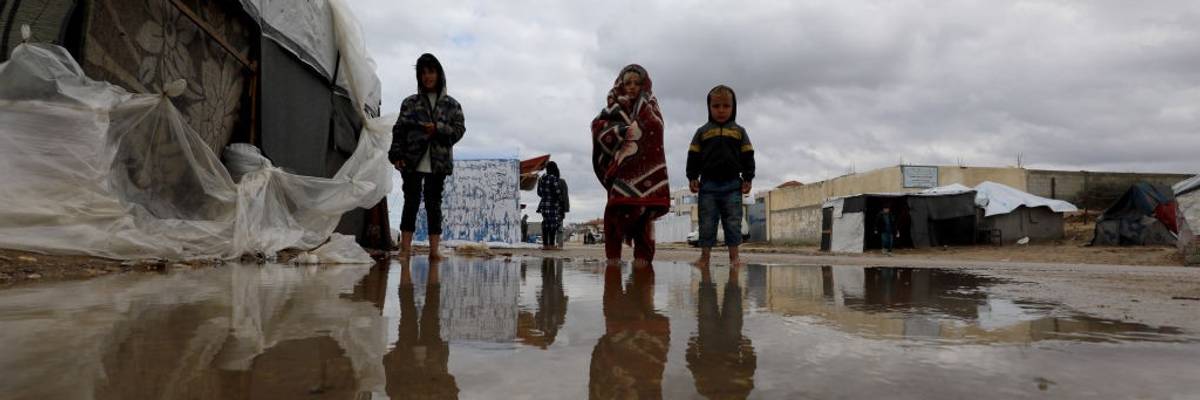
Flooding induced by heavy rainstorms in recent days has compounded the humanitarian crisis facing Palestinians in the besieged Gaza Strip, intensifying the already-high threat of disease as nearly two million displaced people struggle to survive Israel's U.S.-backed assault.
Save the Children, a humanitarian group working on the ground in Gaza, said Friday that torrential rainfall has transformed makeshift camps into swamps, impacting roughly 235,000 children who have been forced from their homes by Israeli attacks and displacement orders.
A Save the Children nutrition consultant who works in Gaza's flood-affected camps said that most of the tents "are uninhabitable" and wholly inadequate to withstand harsh winter weather. Makeshift tents that now run for miles along Gaza's coast have been badly damaged or completely destroyed in recent days by rising seawater.
"The tents are made of cloth and similar materials, and the ground is dust and mud, so tents get flooded within five minutes of rain," said the Save the Children consultant, identified as Mariam. "People's situation is miserable. A dire situation in terms of health, mental health, and immunity."
"A mother came in today and apologized for being late. Why? Because it was raining through the night and their tent was flooded," said Mariam. "The family had to go outside, and she had to carry the children until the rain stopped. Then they swept the water out and went back inside. Some people had to flee because big ponds were formed due to rain. It's a tragic situation."
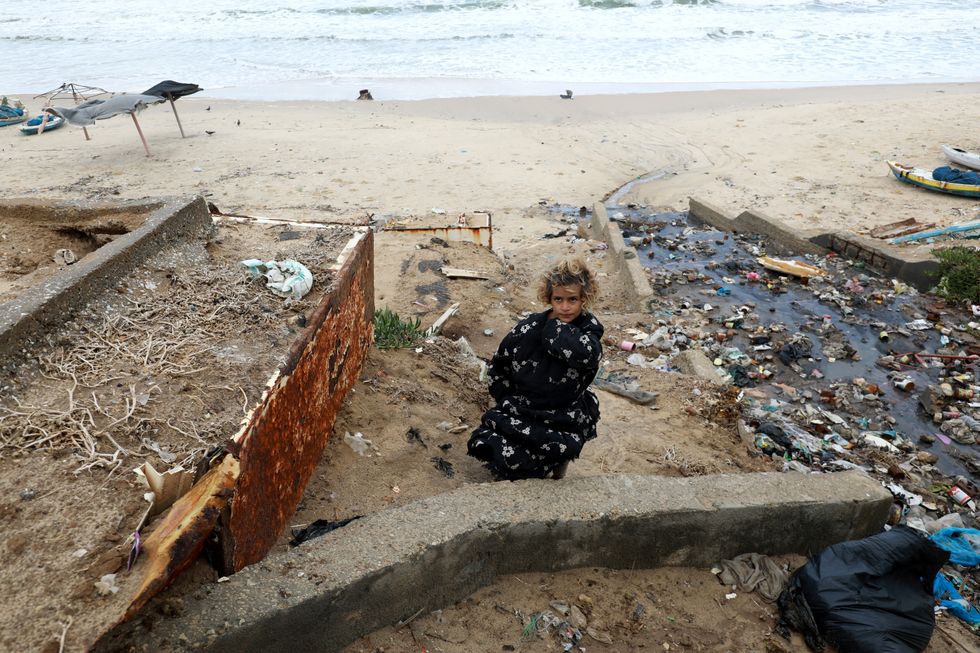 (Photo: Moiz Salhi/Anadolu via Getty Images)
Reuters reported earlier this week that downpours "inundated tents and in some places washed away the plastic and cloth shelters used by displaced Gazans." The United Nations estimates that around 1.6 million people live in makeshift shelters across Gaza.
"Some placed water buckets on the ground to protect mats from leaks and dug trenches to drain water away from their tents," according to Reuters. "Many tents used early in the war have now worn out and no longer offer protection, but the price of new tents and plastic sheeting has shot up beyond the means of displaced families."
Aid workers have warned for months of the threat stagnant water poses to public health in Gaza, whose sanitation infrastructure has been decimated by Israel's large-scale bombing campaign. One Oxfam campaigner recently described the bomb-ravaged enclave as "a nightmarish landscape of insect and disease-ridden swamps and poisoned wells."
In a report issued in September, the U.N. Children's Fund and other organizations noted that "flooding creates stagnant water pools which can become breeding sites for mosquitoes, increasing the risk of diseases such as West Nile Fever."
Jeremy Stoner, regional director for Save the Children, said Friday that "children in Gaza are not only losing their lives, their limbs, and their loved ones—they are also fleeing their bombed-out homes for camps with conditions less and less fit for human life, as we see more and more restrictions on aid."
"As this deadly war has shattered the lives and futures of children for over a year now, we have seen access to critical things like food, healthcare, and sanitation stripped away," Stoner added. "Now for many children, all they have is ruined bits of tent material swimming in swamp water in the camp they fled to for safety."
Gaza's health ministry said Friday that the official death toll in the enclave has risen to 44,363 following a series of Israeli attacks across the territory over the past 24 hours.
Since Thursday morning, as Al Jazeera reported Friday, Israeli attacks in central Gaza have killed dozens of people.
"Israeli fighter jets have carried out an intense bombing campaign in the Nuseirat area over the past day, targeting residential buildings and homes, as well as mosques and other public facilities," the outlet observed. "One Israeli attack on Thursday struck a home sheltering displaced Palestinians, resulting in nine members from one family being killed. Israeli fighter jets also bombed a house in the camp belonging to the Dahdouh family on Friday, killing at least five people."
Al Jazeera's Hani Mahmoud said Friday that as Israeli tanks and armored vehicles withdrew from areas of central Gaza that they attacked in the preceding 24 hours, "many displaced people made their way back to Nuseirat refugee camp to check on family members still inside."
"Many were shocked to find out that their family members were not able to leave due to quadcopters constantly shooting at them," Mahmoud said. "Many people have been killed either inside their homes or as they were making their way out of their residential buildings into the streets, they said. They are literally collecting bodies right now from the streets."
Flooding induced by heavy rainstorms in recent days has compounded the humanitarian crisis facing Palestinians in the besieged Gaza Strip, intensifying the already-high threat of disease as nearly two million displaced people struggle to survive Israel's U.S.-backed assault.
Save the Children, a humanitarian group working on the ground in Gaza, said Friday that torrential rainfall has transformed makeshift camps into swamps, impacting roughly 235,000 children who have been forced from their homes by Israeli attacks and displacement orders.
A Save the Children nutrition consultant who works in Gaza's flood-affected camps said that most of the tents "are uninhabitable" and wholly inadequate to withstand harsh winter weather. Makeshift tents that now run for miles along Gaza's coast have been badly damaged or completely destroyed in recent days by rising seawater.
"The tents are made of cloth and similar materials, and the ground is dust and mud, so tents get flooded within five minutes of rain," said the Save the Children consultant, identified as Mariam. "People's situation is miserable. A dire situation in terms of health, mental health, and immunity."
"A mother came in today and apologized for being late. Why? Because it was raining through the night and their tent was flooded," said Mariam. "The family had to go outside, and she had to carry the children until the rain stopped. Then they swept the water out and went back inside. Some people had to flee because big ponds were formed due to rain. It's a tragic situation."
(Photo: Moiz Salhi/Anadolu via Getty Images)
Reuters reported earlier this week that downpours "inundated tents and in some places washed away the plastic and cloth shelters used by displaced Gazans." The United Nations estimates that around 1.6 million people live in makeshift shelters across Gaza.
"Some placed water buckets on the ground to protect mats from leaks and dug trenches to drain water away from their tents," according to Reuters. "Many tents used early in the war have now worn out and no longer offer protection, but the price of new tents and plastic sheeting has shot up beyond the means of displaced families."
Aid workers have warned for months of the threat stagnant water poses to public health in Gaza, whose sanitation infrastructure has been decimated by Israel's large-scale bombing campaign. One Oxfam campaigner recently described the bomb-ravaged enclave as "a nightmarish landscape of insect and disease-ridden swamps and poisoned wells."
In a report issued in September, the U.N. Children's Fund and other organizations noted that "flooding creates stagnant water pools which can become breeding sites for mosquitoes, increasing the risk of diseases such as West Nile Fever."
Jeremy Stoner, regional director for Save the Children, said Friday that "children in Gaza are not only losing their lives, their limbs, and their loved ones—they are also fleeing their bombed-out homes for camps with conditions less and less fit for human life, as we see more and more restrictions on aid."
"As this deadly war has shattered the lives and futures of children for over a year now, we have seen access to critical things like food, healthcare, and sanitation stripped away," Stoner added. "Now for many children, all they have is ruined bits of tent material swimming in swamp water in the camp they fled to for safety."
Gaza's health ministry said Friday that the official death toll in the enclave has risen to 44,363 following a series of Israeli attacks across the territory over the past 24 hours.
Since Thursday morning, as Al Jazeera reported Friday, Israeli attacks in central Gaza have killed dozens of people.
"Israeli fighter jets have carried out an intense bombing campaign in the Nuseirat area over the past day, targeting residential buildings and homes, as well as mosques and other public facilities," the outlet observed. "One Israeli attack on Thursday struck a home sheltering displaced Palestinians, resulting in nine members from one family being killed. Israeli fighter jets also bombed a house in the camp belonging to the Dahdouh family on Friday, killing at least five people."
Al Jazeera's Hani Mahmoud said Friday that as Israeli tanks and armored vehicles withdrew from areas of central Gaza that they attacked in the preceding 24 hours, "many displaced people made their way back to Nuseirat refugee camp to check on family members still inside."
"Many were shocked to find out that their family members were not able to leave due to quadcopters constantly shooting at them," Mahmoud said. "Many people have been killed either inside their homes or as they were making their way out of their residential buildings into the streets, they said. They are literally collecting bodies right now from the streets."
Flooding induced by heavy rainstorms in recent days has compounded the humanitarian crisis facing Palestinians in the besieged Gaza Strip, intensifying the already-high threat of disease as nearly two million displaced people struggle to survive Israel's U.S.-backed assault.
Save the Children, a humanitarian group working on the ground in Gaza, said Friday that torrential rainfall has transformed makeshift camps into swamps, impacting roughly 235,000 children who have been forced from their homes by Israeli attacks and displacement orders.
A Save the Children nutrition consultant who works in Gaza's flood-affected camps said that most of the tents "are uninhabitable" and wholly inadequate to withstand harsh winter weather. Makeshift tents that now run for miles along Gaza's coast have been badly damaged or completely destroyed in recent days by rising seawater.
"The tents are made of cloth and similar materials, and the ground is dust and mud, so tents get flooded within five minutes of rain," said the Save the Children consultant, identified as Mariam. "People's situation is miserable. A dire situation in terms of health, mental health, and immunity."
"A mother came in today and apologized for being late. Why? Because it was raining through the night and their tent was flooded," said Mariam. "The family had to go outside, and she had to carry the children until the rain stopped. Then they swept the water out and went back inside. Some people had to flee because big ponds were formed due to rain. It's a tragic situation."
(Photo: Moiz Salhi/Anadolu via Getty Images)
Reuters reported earlier this week that downpours "inundated tents and in some places washed away the plastic and cloth shelters used by displaced Gazans." The United Nations estimates that around 1.6 million people live in makeshift shelters across Gaza.
"Some placed water buckets on the ground to protect mats from leaks and dug trenches to drain water away from their tents," according to Reuters. "Many tents used early in the war have now worn out and no longer offer protection, but the price of new tents and plastic sheeting has shot up beyond the means of displaced families."
Aid workers have warned for months of the threat stagnant water poses to public health in Gaza, whose sanitation infrastructure has been decimated by Israel's large-scale bombing campaign. One Oxfam campaigner recently described the bomb-ravaged enclave as "a nightmarish landscape of insect and disease-ridden swamps and poisoned wells."
In a report issued in September, the U.N. Children's Fund and other organizations noted that "flooding creates stagnant water pools which can become breeding sites for mosquitoes, increasing the risk of diseases such as West Nile Fever."
Jeremy Stoner, regional director for Save the Children, said Friday that "children in Gaza are not only losing their lives, their limbs, and their loved ones—they are also fleeing their bombed-out homes for camps with conditions less and less fit for human life, as we see more and more restrictions on aid."
"As this deadly war has shattered the lives and futures of children for over a year now, we have seen access to critical things like food, healthcare, and sanitation stripped away," Stoner added. "Now for many children, all they have is ruined bits of tent material swimming in swamp water in the camp they fled to for safety."
Gaza's health ministry said Friday that the official death toll in the enclave has risen to 44,363 following a series of Israeli attacks across the territory over the past 24 hours.
Since Thursday morning, as Al Jazeera reported Friday, Israeli attacks in central Gaza have killed dozens of people.
"Israeli fighter jets have carried out an intense bombing campaign in the Nuseirat area over the past day, targeting residential buildings and homes, as well as mosques and other public facilities," the outlet observed. "One Israeli attack on Thursday struck a home sheltering displaced Palestinians, resulting in nine members from one family being killed. Israeli fighter jets also bombed a house in the camp belonging to the Dahdouh family on Friday, killing at least five people."
Al Jazeera's Hani Mahmoud said Friday that as Israeli tanks and armored vehicles withdrew from areas of central Gaza that they attacked in the preceding 24 hours, "many displaced people made their way back to Nuseirat refugee camp to check on family members still inside."
"Many were shocked to find out that their family members were not able to leave due to quadcopters constantly shooting at them," Mahmoud said. "Many people have been killed either inside their homes or as they were making their way out of their residential buildings into the streets, they said. They are literally collecting bodies right now from the streets."