

SUBSCRIBE TO OUR FREE NEWSLETTER
Daily news & progressive opinion—funded by the people, not the corporations—delivered straight to your inbox.
5
#000000
#FFFFFF
To donate by check, phone, or other method, see our More Ways to Give page.
Daily news & progressive opinion—funded by the people, not the corporations—delivered straight to your inbox.
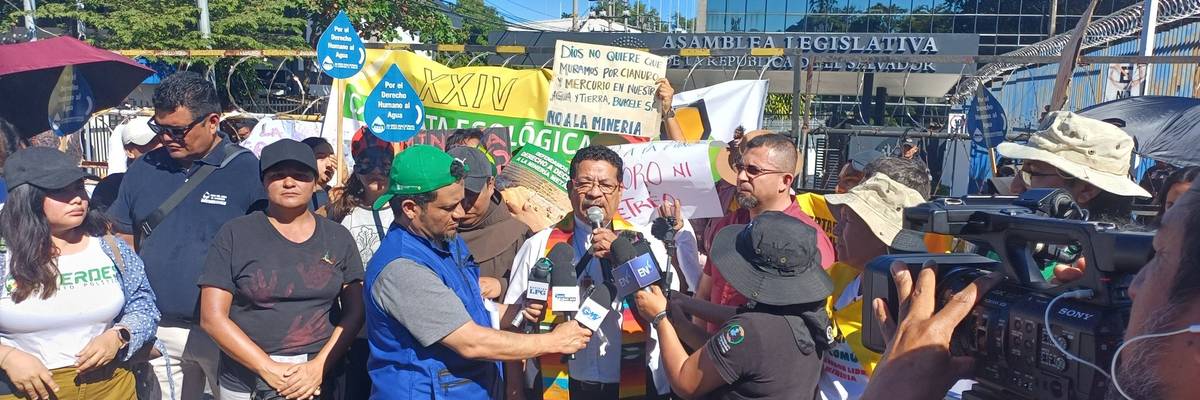
Opponents of overturning El Salvador's ban on metal mining gathered outside the Legislative Assembly on December 23, 2024.
One group called it "the biggest attack on water, health, and life in El Salvador," highlighting "opposition from churches, universities, social organizations, and the majority of the population."
In a win for Salvadoran President Nayib Bukele, who has dubbed himself "the world's coolest dictator," the Legislative Assembly of El Salvador on Monday overturned the Central American country's 2017 ban on metal mining.
Bukele has fought to reverse the historic ban since taking office in 2019. Despite a prohibition in the Salvadoran Constitution, he ran for and won a second term in February, after his Nueva Ideas (New Ideas) party purged the judiciary.
Reporting on Monday's mining reversal, the Financial Times noted that "Bukele's party and its allies hold 57 of 60 seats in the legislature, and all 57 voted to overturn the ban while giving the Salvadoran government sole authority over mining activities."
As the British newspaper detailed:
He has claimed that El Salvador sits on gold reserves potentially worth $3 trillion, citing an undisclosed study, although that has been treated with skepticism by experts.
There has been limited exploration in El Salvador. El Dorado, the most advanced of more than two dozen exploration projects prior to the ban, was once estimated to hold 1.4 million ounces of gold, which would be worth roughly $3.6 billion today, without considering production expenses.
El Salvador's gold belt runs across its northern provinces and the watershed of the Lempa River, which is the small and densely populated country's main source of water.
In a statement earlier this month, the Washington, D.C.-based Institute for Policy Studies (IPS) warned that "El Salvador's 2017 prohibition against metallic mining is a widely popular measure and overturning it would be a death sentence for the small and densely populated country with its scarce water sources, many of which are already contaminated."
"The historic ban, passed in a unanimous 70-0 vote by El Salvador's Legislative Assembly in 2017, was the result of a decadelong campaign to value life over transnational mining corporations' pursuit of profits," IPS explained. "The campaign was ultimately supported by a wide coalition of civil society organizations, educational institutions, some business sectors, legislators and ministers from across the political spectrum, as well as two archbishops. They were all persuaded by substantial evidence of gold mining's destructive effects, and the deleterious impacts of cyanide used in gold mining."
"The struggle also cost the lives of several beloved water defender activists who stood up to the mining companies in Cabañas: Marcelo Rivera, Ramiro Rivera, student Juan Francisco Durán Ayala, and Dora Alicia Recinos Sorto, who was eight months pregnant when murdered, and whose 2-year-old child witnessed and was wounded in the attack," the group added.
The IPS statement came in response to a November 26 ruling that ordered a retrial for the Economic and Social Development Association of Santa Marta (ADES) "Santa Marta Five" water defenders—Miguel Ángel Gámez, Alejandro Laínez García, Pedro Antonio Rivas Laínez, Teodoro Antonio Pacheco, and Saúl Agustín Rivas Ortega—a development the group denounced.
ADES forcefully condemned the mining ban reversal on social media Monday, calling it "the biggest attack on water, health, and life in El Salvador," and pointing to "opposition from churches, universities, social organizations, and the majority of the population."
The Salvadoran group also shared images of opponents who gathered outside the Legislative Assembly on Monday.
Luis Gonzalez, one of the environmentalists outside the building,
told Reuters, "We oppose metals mining because it has been technically and scientifically proven that mining is not viable in the country."
Dear Common Dreams reader, It’s been nearly 30 years since I co-founded Common Dreams with my late wife, Lina Newhouser. We had the radical notion that journalism should serve the public good, not corporate profits. It was clear to us from the outset what it would take to build such a project. No paid advertisements. No corporate sponsors. No millionaire publisher telling us what to think or do. Many people said we wouldn't last a year, but we proved those doubters wrong. Together with a tremendous team of journalists and dedicated staff, we built an independent media outlet free from the constraints of profits and corporate control. Our mission has always been simple: To inform. To inspire. To ignite change for the common good. Building Common Dreams was not easy. Our survival was never guaranteed. When you take on the most powerful forces—Wall Street greed, fossil fuel industry destruction, Big Tech lobbyists, and uber-rich oligarchs who have spent billions upon billions rigging the economy and democracy in their favor—the only bulwark you have is supporters who believe in your work. But here’s the urgent message from me today. It's never been this bad out there. And it's never been this hard to keep us going. At the very moment Common Dreams is most needed, the threats we face are intensifying. We need your support now more than ever. We don't accept corporate advertising and never will. We don't have a paywall because we don't think people should be blocked from critical news based on their ability to pay. Everything we do is funded by the donations of readers like you. When everyone does the little they can afford, we are strong. But if that support retreats or dries up, so do we. Will you donate now to make sure Common Dreams not only survives but thrives? —Craig Brown, Co-founder |
In a win for Salvadoran President Nayib Bukele, who has dubbed himself "the world's coolest dictator," the Legislative Assembly of El Salvador on Monday overturned the Central American country's 2017 ban on metal mining.
Bukele has fought to reverse the historic ban since taking office in 2019. Despite a prohibition in the Salvadoran Constitution, he ran for and won a second term in February, after his Nueva Ideas (New Ideas) party purged the judiciary.
Reporting on Monday's mining reversal, the Financial Times noted that "Bukele's party and its allies hold 57 of 60 seats in the legislature, and all 57 voted to overturn the ban while giving the Salvadoran government sole authority over mining activities."
As the British newspaper detailed:
He has claimed that El Salvador sits on gold reserves potentially worth $3 trillion, citing an undisclosed study, although that has been treated with skepticism by experts.
There has been limited exploration in El Salvador. El Dorado, the most advanced of more than two dozen exploration projects prior to the ban, was once estimated to hold 1.4 million ounces of gold, which would be worth roughly $3.6 billion today, without considering production expenses.
El Salvador's gold belt runs across its northern provinces and the watershed of the Lempa River, which is the small and densely populated country's main source of water.
In a statement earlier this month, the Washington, D.C.-based Institute for Policy Studies (IPS) warned that "El Salvador's 2017 prohibition against metallic mining is a widely popular measure and overturning it would be a death sentence for the small and densely populated country with its scarce water sources, many of which are already contaminated."
"The historic ban, passed in a unanimous 70-0 vote by El Salvador's Legislative Assembly in 2017, was the result of a decadelong campaign to value life over transnational mining corporations' pursuit of profits," IPS explained. "The campaign was ultimately supported by a wide coalition of civil society organizations, educational institutions, some business sectors, legislators and ministers from across the political spectrum, as well as two archbishops. They were all persuaded by substantial evidence of gold mining's destructive effects, and the deleterious impacts of cyanide used in gold mining."
"The struggle also cost the lives of several beloved water defender activists who stood up to the mining companies in Cabañas: Marcelo Rivera, Ramiro Rivera, student Juan Francisco Durán Ayala, and Dora Alicia Recinos Sorto, who was eight months pregnant when murdered, and whose 2-year-old child witnessed and was wounded in the attack," the group added.
The IPS statement came in response to a November 26 ruling that ordered a retrial for the Economic and Social Development Association of Santa Marta (ADES) "Santa Marta Five" water defenders—Miguel Ángel Gámez, Alejandro Laínez García, Pedro Antonio Rivas Laínez, Teodoro Antonio Pacheco, and Saúl Agustín Rivas Ortega—a development the group denounced.
ADES forcefully condemned the mining ban reversal on social media Monday, calling it "the biggest attack on water, health, and life in El Salvador," and pointing to "opposition from churches, universities, social organizations, and the majority of the population."
The Salvadoran group also shared images of opponents who gathered outside the Legislative Assembly on Monday.
Luis Gonzalez, one of the environmentalists outside the building,
told Reuters, "We oppose metals mining because it has been technically and scientifically proven that mining is not viable in the country."
In a win for Salvadoran President Nayib Bukele, who has dubbed himself "the world's coolest dictator," the Legislative Assembly of El Salvador on Monday overturned the Central American country's 2017 ban on metal mining.
Bukele has fought to reverse the historic ban since taking office in 2019. Despite a prohibition in the Salvadoran Constitution, he ran for and won a second term in February, after his Nueva Ideas (New Ideas) party purged the judiciary.
Reporting on Monday's mining reversal, the Financial Times noted that "Bukele's party and its allies hold 57 of 60 seats in the legislature, and all 57 voted to overturn the ban while giving the Salvadoran government sole authority over mining activities."
As the British newspaper detailed:
He has claimed that El Salvador sits on gold reserves potentially worth $3 trillion, citing an undisclosed study, although that has been treated with skepticism by experts.
There has been limited exploration in El Salvador. El Dorado, the most advanced of more than two dozen exploration projects prior to the ban, was once estimated to hold 1.4 million ounces of gold, which would be worth roughly $3.6 billion today, without considering production expenses.
El Salvador's gold belt runs across its northern provinces and the watershed of the Lempa River, which is the small and densely populated country's main source of water.
In a statement earlier this month, the Washington, D.C.-based Institute for Policy Studies (IPS) warned that "El Salvador's 2017 prohibition against metallic mining is a widely popular measure and overturning it would be a death sentence for the small and densely populated country with its scarce water sources, many of which are already contaminated."
"The historic ban, passed in a unanimous 70-0 vote by El Salvador's Legislative Assembly in 2017, was the result of a decadelong campaign to value life over transnational mining corporations' pursuit of profits," IPS explained. "The campaign was ultimately supported by a wide coalition of civil society organizations, educational institutions, some business sectors, legislators and ministers from across the political spectrum, as well as two archbishops. They were all persuaded by substantial evidence of gold mining's destructive effects, and the deleterious impacts of cyanide used in gold mining."
"The struggle also cost the lives of several beloved water defender activists who stood up to the mining companies in Cabañas: Marcelo Rivera, Ramiro Rivera, student Juan Francisco Durán Ayala, and Dora Alicia Recinos Sorto, who was eight months pregnant when murdered, and whose 2-year-old child witnessed and was wounded in the attack," the group added.
The IPS statement came in response to a November 26 ruling that ordered a retrial for the Economic and Social Development Association of Santa Marta (ADES) "Santa Marta Five" water defenders—Miguel Ángel Gámez, Alejandro Laínez García, Pedro Antonio Rivas Laínez, Teodoro Antonio Pacheco, and Saúl Agustín Rivas Ortega—a development the group denounced.
ADES forcefully condemned the mining ban reversal on social media Monday, calling it "the biggest attack on water, health, and life in El Salvador," and pointing to "opposition from churches, universities, social organizations, and the majority of the population."
The Salvadoran group also shared images of opponents who gathered outside the Legislative Assembly on Monday.
Luis Gonzalez, one of the environmentalists outside the building,
told Reuters, "We oppose metals mining because it has been technically and scientifically proven that mining is not viable in the country."

