SUBSCRIBE TO OUR FREE NEWSLETTER
Daily news & progressive opinion—funded by the people, not the corporations—delivered straight to your inbox.
5
#000000
#FFFFFF
To donate by check, phone, or other method, see our More Ways to Give page.
Daily news & progressive opinion—funded by the people, not the corporations—delivered straight to your inbox.
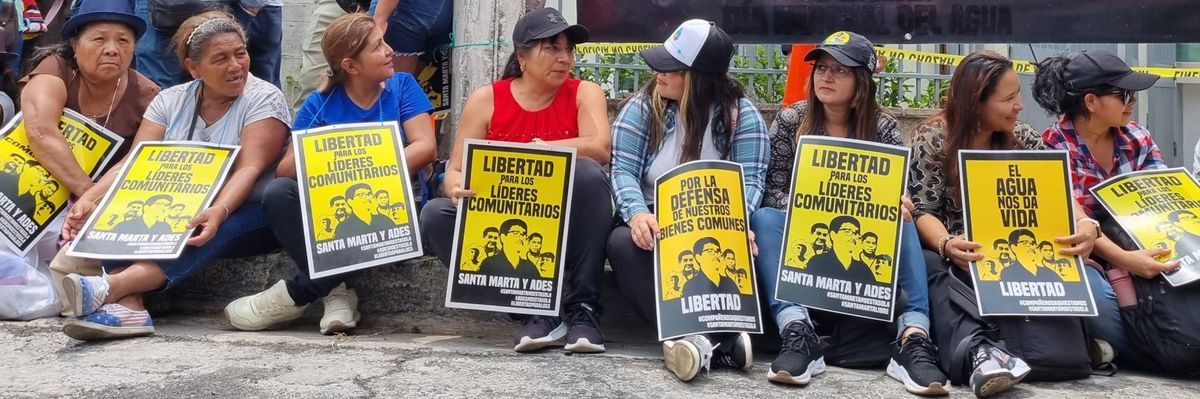
Supporters of the Santa Marta Five rally in San Salvador on April 10, 2024.
"It is outrageous that the judge is allowing this trial to go forward despite the lack of any evidence of a crime," said one observer.
Human rights defenders on Wednesday condemned a Salvadoran court's decision to uphold what critics say are politically motivated murder and illicit association charges against five environmental activists.
Miguel Ángel Gámez, Alejandro Laínez García, Pedro Antonio Rivas Laínez, Teodoro Antonio Pacheco, and Saúl Agustín Rivas Ortega were arrested in January 2023 and accused of murdering María Inés Alvarenga—an alleged collaborator with the U.S.-backed Salvadoran regime that killed approximately 75,000 civilians during a 1979-92 civil war—when the men were Farabundo Martí National Liberation Front (FMLN) rebels.
Defenders of the "Santa Marta Five" have highlighted not only the Salvadoran government's failure to show any proof of the men's guilt, but also the fact that perpetrators of civil war-related crimes are protected under a 1992 amnesty agreement between the government and FMLN.
"It is outrageous that the judge is allowing this trial to go forward despite the lack of any evidence of a crime," said John Cavanagh, a senior adviser at the Washington, D.C.-based Institute for Policy Studies.
"The international community stands strong with the five leaders of the successful fight against mining, and we will join Salvadoran water defenders to continue to fight with them for justice in this case," he added.
Advocates for the five defendants have also noted how a "state of exception" imposed as part of right-wing Salvadoran President Nayib Bukele's war on drug gangs has eroded due process and other rights. As Common Dreams has reported, tens of thousands of people have been arbitrarily arrested and imprisoned under the crackdown. More than 130 of them have died in state custody.
Some critics say it's no coincidence that the Santa Marta Five—who played a key role in winning a 2017 ban on metals mining in El Salvador—have been targeted by Bukele's government, which is taking steps to reverse the historic prohibition. Environmental activists have found themselves in the crosshairs.
Vidalina Morales, who heads the environmental and human rights group Association of Economic and Social Development (ADES)—where Santa Marta Five member Pacheco worked— told Atmos earlier this year that by arresting the Santa Marta Five, Bukele's administration is "sending us a message."
"They want to open the path for these mining projects to come back," she explained. "They want to criminalize the social movements in this country."
"This is the life we're living in El Salvador," Morales added. "We feel so much fear for our lives and the lives of our families."
Viviana Herrera, the Latin America program coordinator at MiningWatch Canada, said Wednesday that "there is a well-documented pattern of criminalization across the Americas, where environmental defenders are slapped with unfounded charges in an effort to silence their opposition to mining and prevent their life-affirming work protecting water for future generations."
"We firmly denounce today's Santa Marta case ruling," she continued. "All five water defenders played pivotal roles securing an historic ban on metal mining in El Salvador, and this ruling is a clear threat to the rights of all Salvadorans who are protecting their water and environment."
"We express our heartfelt sorrow with the five water defenders and their families," Herrera added, "and will continue to call for the charges to be dropped until they are free."
Dear Common Dreams reader, It’s been nearly 30 years since I co-founded Common Dreams with my late wife, Lina Newhouser. We had the radical notion that journalism should serve the public good, not corporate profits. It was clear to us from the outset what it would take to build such a project. No paid advertisements. No corporate sponsors. No millionaire publisher telling us what to think or do. Many people said we wouldn't last a year, but we proved those doubters wrong. Together with a tremendous team of journalists and dedicated staff, we built an independent media outlet free from the constraints of profits and corporate control. Our mission has always been simple: To inform. To inspire. To ignite change for the common good. Building Common Dreams was not easy. Our survival was never guaranteed. When you take on the most powerful forces—Wall Street greed, fossil fuel industry destruction, Big Tech lobbyists, and uber-rich oligarchs who have spent billions upon billions rigging the economy and democracy in their favor—the only bulwark you have is supporters who believe in your work. But here’s the urgent message from me today. It's never been this bad out there. And it's never been this hard to keep us going. At the very moment Common Dreams is most needed, the threats we face are intensifying. We need your support now more than ever. We don't accept corporate advertising and never will. We don't have a paywall because we don't think people should be blocked from critical news based on their ability to pay. Everything we do is funded by the donations of readers like you. When everyone does the little they can afford, we are strong. But if that support retreats or dries up, so do we. Will you donate now to make sure Common Dreams not only survives but thrives? —Craig Brown, Co-founder |
Human rights defenders on Wednesday condemned a Salvadoran court's decision to uphold what critics say are politically motivated murder and illicit association charges against five environmental activists.
Miguel Ángel Gámez, Alejandro Laínez García, Pedro Antonio Rivas Laínez, Teodoro Antonio Pacheco, and Saúl Agustín Rivas Ortega were arrested in January 2023 and accused of murdering María Inés Alvarenga—an alleged collaborator with the U.S.-backed Salvadoran regime that killed approximately 75,000 civilians during a 1979-92 civil war—when the men were Farabundo Martí National Liberation Front (FMLN) rebels.
Defenders of the "Santa Marta Five" have highlighted not only the Salvadoran government's failure to show any proof of the men's guilt, but also the fact that perpetrators of civil war-related crimes are protected under a 1992 amnesty agreement between the government and FMLN.
"It is outrageous that the judge is allowing this trial to go forward despite the lack of any evidence of a crime," said John Cavanagh, a senior adviser at the Washington, D.C.-based Institute for Policy Studies.
"The international community stands strong with the five leaders of the successful fight against mining, and we will join Salvadoran water defenders to continue to fight with them for justice in this case," he added.
Advocates for the five defendants have also noted how a "state of exception" imposed as part of right-wing Salvadoran President Nayib Bukele's war on drug gangs has eroded due process and other rights. As Common Dreams has reported, tens of thousands of people have been arbitrarily arrested and imprisoned under the crackdown. More than 130 of them have died in state custody.
Some critics say it's no coincidence that the Santa Marta Five—who played a key role in winning a 2017 ban on metals mining in El Salvador—have been targeted by Bukele's government, which is taking steps to reverse the historic prohibition. Environmental activists have found themselves in the crosshairs.
Vidalina Morales, who heads the environmental and human rights group Association of Economic and Social Development (ADES)—where Santa Marta Five member Pacheco worked— told Atmos earlier this year that by arresting the Santa Marta Five, Bukele's administration is "sending us a message."
"They want to open the path for these mining projects to come back," she explained. "They want to criminalize the social movements in this country."
"This is the life we're living in El Salvador," Morales added. "We feel so much fear for our lives and the lives of our families."
Viviana Herrera, the Latin America program coordinator at MiningWatch Canada, said Wednesday that "there is a well-documented pattern of criminalization across the Americas, where environmental defenders are slapped with unfounded charges in an effort to silence their opposition to mining and prevent their life-affirming work protecting water for future generations."
"We firmly denounce today's Santa Marta case ruling," she continued. "All five water defenders played pivotal roles securing an historic ban on metal mining in El Salvador, and this ruling is a clear threat to the rights of all Salvadorans who are protecting their water and environment."
"We express our heartfelt sorrow with the five water defenders and their families," Herrera added, "and will continue to call for the charges to be dropped until they are free."
Human rights defenders on Wednesday condemned a Salvadoran court's decision to uphold what critics say are politically motivated murder and illicit association charges against five environmental activists.
Miguel Ángel Gámez, Alejandro Laínez García, Pedro Antonio Rivas Laínez, Teodoro Antonio Pacheco, and Saúl Agustín Rivas Ortega were arrested in January 2023 and accused of murdering María Inés Alvarenga—an alleged collaborator with the U.S.-backed Salvadoran regime that killed approximately 75,000 civilians during a 1979-92 civil war—when the men were Farabundo Martí National Liberation Front (FMLN) rebels.
Defenders of the "Santa Marta Five" have highlighted not only the Salvadoran government's failure to show any proof of the men's guilt, but also the fact that perpetrators of civil war-related crimes are protected under a 1992 amnesty agreement between the government and FMLN.
"It is outrageous that the judge is allowing this trial to go forward despite the lack of any evidence of a crime," said John Cavanagh, a senior adviser at the Washington, D.C.-based Institute for Policy Studies.
"The international community stands strong with the five leaders of the successful fight against mining, and we will join Salvadoran water defenders to continue to fight with them for justice in this case," he added.
Advocates for the five defendants have also noted how a "state of exception" imposed as part of right-wing Salvadoran President Nayib Bukele's war on drug gangs has eroded due process and other rights. As Common Dreams has reported, tens of thousands of people have been arbitrarily arrested and imprisoned under the crackdown. More than 130 of them have died in state custody.
Some critics say it's no coincidence that the Santa Marta Five—who played a key role in winning a 2017 ban on metals mining in El Salvador—have been targeted by Bukele's government, which is taking steps to reverse the historic prohibition. Environmental activists have found themselves in the crosshairs.
Vidalina Morales, who heads the environmental and human rights group Association of Economic and Social Development (ADES)—where Santa Marta Five member Pacheco worked— told Atmos earlier this year that by arresting the Santa Marta Five, Bukele's administration is "sending us a message."
"They want to open the path for these mining projects to come back," she explained. "They want to criminalize the social movements in this country."
"This is the life we're living in El Salvador," Morales added. "We feel so much fear for our lives and the lives of our families."
Viviana Herrera, the Latin America program coordinator at MiningWatch Canada, said Wednesday that "there is a well-documented pattern of criminalization across the Americas, where environmental defenders are slapped with unfounded charges in an effort to silence their opposition to mining and prevent their life-affirming work protecting water for future generations."
"We firmly denounce today's Santa Marta case ruling," she continued. "All five water defenders played pivotal roles securing an historic ban on metal mining in El Salvador, and this ruling is a clear threat to the rights of all Salvadorans who are protecting their water and environment."
"We express our heartfelt sorrow with the five water defenders and their families," Herrera added, "and will continue to call for the charges to be dropped until they are free."