SUBSCRIBE TO OUR FREE NEWSLETTER
Daily news & progressive opinion—funded by the people, not the corporations—delivered straight to your inbox.
5
#000000
#FFFFFF
To donate by check, phone, or other method, see our More Ways to Give page.
Daily news & progressive opinion—funded by the people, not the corporations—delivered straight to your inbox.
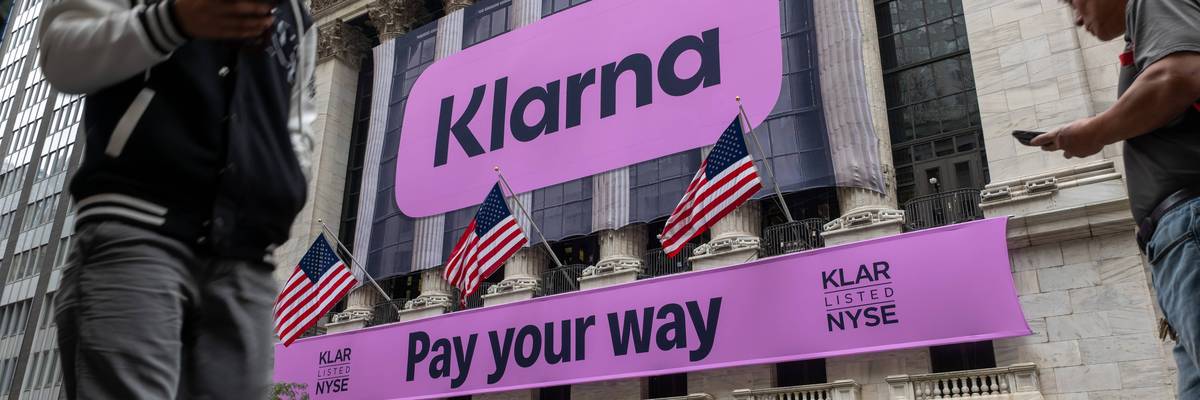
A banner for the online lender Klarna is displayed at the New York Stock Exchange on September 10, 2025 in New York City.
Lending apps are offering credit to consumers struggling to afford basic necessities, including electricity, broadband, groceries, and more as prices rise.
Companies that provide "buy now, pay later" loans are increasingly offering their products to Americans struggling to afford utilities and other necessities as costs rise across the US economy, with President Donald Trump's illegal war on Iran pushing up energy prices while wage growth slows.
The New York Times reported Monday that "the lending apps Flex and Zip allow customers to take out loans to pay for their broadband, electricity, health insurance, mobile phone service, mortgage, and water bills," while Affirm "has started providing some tenants loans to extend their monthly rent payment for a few weeks." On the homepage of its website, Affirm is currently promoting its product for school supplies as prices for basic items surge.
Despite Trump's pledge to cut household electricity costs in half and "bring down the prices of all goods," federal data shows electricity prices are up 18% since the start of the president's second White House term. On Monday, the average price for a gallon of gas in the US reached $4.06—the highest ever recorded for mid-August.
Recent polling by Data for Progress shows that 38% of "buy now, pay later" users have turned to the product to cover gasoline costs. Nearly half—46%—have used it for groceries, 42% for medical or dental care, 39% for utility bills, and 22% for childcare.
Last month, the advocacy group Protect Borrowers released a detailed report showing that buy now, pay later lenders are "touting shiny and oftentimes deceptive offers of zero-interest, fee-free installment loans to millions of Americans struggling with the rapidly rising costs of groceries, rent, utility bills, takeout, new clothes, medical care, and more."
"Leading BNPL lenders currently include Affirm, Klarna, Afterpay, PayPal, Synchrony, Splitit, Sezzle, and Zip, but more are popping up by the day, largely funded by private equity firms and venture capitalists looking to cash in on families’ financial desperation," the report states. "BNPL loans are packed to the brim with financing fees, late fees, and other junk fees. Many BNPL loans feature late fees of $7 to $8 per missed payment, up to an aggregate cap of 25% of the purchase price. Additional fees may be charged for financing, if the user does not set a bank account as the default method of payment, reschedules an upcoming payment, or has non-sufficient funds or a bounced payment."
The Times pointed to June Federal Reserve research showing that Americans collectively spent $160 billion through buy now, pay later programs last year, nearly twice what US consumers spent in 2023.
"That’s still a fraction of the more than $3 trillion US shoppers spend annually on consumer credit cards," the Times noted. "But the industry continues to expand by double-digit rates each year."
Jennifer Zhang, a policy analyst at Protect Borrowers, has called on the US Congress to enact "sweeping protections" that "end deceptive pricing, bring down the cost of BNPL debt, ban predatory practices that harm consumers, and empower Americans to enforce their rights under the law."
"BNPL loans are expensive and risky, and often worsen financial outcomes for borrowers who come to rely on them to make ends meet. However, millions of Americans are being driven into these debt products just as they’re trying to get by. Prices are soaring and show no signs of coming down anytime soon," Zhang wrote. "Americans need help."
Dear Common Dreams reader, It’s been nearly 30 years since I co-founded Common Dreams with my late wife, Lina Newhouser. We had the radical notion that journalism should serve the public good, not corporate profits. It was clear to us from the outset what it would take to build such a project. No paid advertisements. No corporate sponsors. No millionaire publisher telling us what to think or do. Many people said we wouldn't last a year, but we proved those doubters wrong. Together with a tremendous team of journalists and dedicated staff, we built an independent media outlet free from the constraints of profits and corporate control. Our mission has always been simple: To inform. To inspire. To ignite change for the common good. Building Common Dreams was not easy. Our survival was never guaranteed. When you take on the most powerful forces—Wall Street greed, fossil fuel industry destruction, Big Tech lobbyists, and uber-rich oligarchs who have spent billions upon billions rigging the economy and democracy in their favor—the only bulwark you have is supporters who believe in your work. But here’s the urgent message from me today. It's never been this bad out there. And it's never been this hard to keep us going. At the very moment Common Dreams is most needed, the threats we face are intensifying. We need your support now more than ever. We don't accept corporate advertising and never will. We don't have a paywall because we don't think people should be blocked from critical news based on their ability to pay. Everything we do is funded by the donations of readers like you. When everyone does the little they can afford, we are strong. But if that support retreats or dries up, so do we. Will you donate now to make sure Common Dreams not only survives but thrives? —Craig Brown, Co-founder |
Companies that provide "buy now, pay later" loans are increasingly offering their products to Americans struggling to afford utilities and other necessities as costs rise across the US economy, with President Donald Trump's illegal war on Iran pushing up energy prices while wage growth slows.
The New York Times reported Monday that "the lending apps Flex and Zip allow customers to take out loans to pay for their broadband, electricity, health insurance, mobile phone service, mortgage, and water bills," while Affirm "has started providing some tenants loans to extend their monthly rent payment for a few weeks." On the homepage of its website, Affirm is currently promoting its product for school supplies as prices for basic items surge.
Despite Trump's pledge to cut household electricity costs in half and "bring down the prices of all goods," federal data shows electricity prices are up 18% since the start of the president's second White House term. On Monday, the average price for a gallon of gas in the US reached $4.06—the highest ever recorded for mid-August.
Recent polling by Data for Progress shows that 38% of "buy now, pay later" users have turned to the product to cover gasoline costs. Nearly half—46%—have used it for groceries, 42% for medical or dental care, 39% for utility bills, and 22% for childcare.
Last month, the advocacy group Protect Borrowers released a detailed report showing that buy now, pay later lenders are "touting shiny and oftentimes deceptive offers of zero-interest, fee-free installment loans to millions of Americans struggling with the rapidly rising costs of groceries, rent, utility bills, takeout, new clothes, medical care, and more."
"Leading BNPL lenders currently include Affirm, Klarna, Afterpay, PayPal, Synchrony, Splitit, Sezzle, and Zip, but more are popping up by the day, largely funded by private equity firms and venture capitalists looking to cash in on families’ financial desperation," the report states. "BNPL loans are packed to the brim with financing fees, late fees, and other junk fees. Many BNPL loans feature late fees of $7 to $8 per missed payment, up to an aggregate cap of 25% of the purchase price. Additional fees may be charged for financing, if the user does not set a bank account as the default method of payment, reschedules an upcoming payment, or has non-sufficient funds or a bounced payment."
The Times pointed to June Federal Reserve research showing that Americans collectively spent $160 billion through buy now, pay later programs last year, nearly twice what US consumers spent in 2023.
"That’s still a fraction of the more than $3 trillion US shoppers spend annually on consumer credit cards," the Times noted. "But the industry continues to expand by double-digit rates each year."
Jennifer Zhang, a policy analyst at Protect Borrowers, has called on the US Congress to enact "sweeping protections" that "end deceptive pricing, bring down the cost of BNPL debt, ban predatory practices that harm consumers, and empower Americans to enforce their rights under the law."
"BNPL loans are expensive and risky, and often worsen financial outcomes for borrowers who come to rely on them to make ends meet. However, millions of Americans are being driven into these debt products just as they’re trying to get by. Prices are soaring and show no signs of coming down anytime soon," Zhang wrote. "Americans need help."
Companies that provide "buy now, pay later" loans are increasingly offering their products to Americans struggling to afford utilities and other necessities as costs rise across the US economy, with President Donald Trump's illegal war on Iran pushing up energy prices while wage growth slows.
The New York Times reported Monday that "the lending apps Flex and Zip allow customers to take out loans to pay for their broadband, electricity, health insurance, mobile phone service, mortgage, and water bills," while Affirm "has started providing some tenants loans to extend their monthly rent payment for a few weeks." On the homepage of its website, Affirm is currently promoting its product for school supplies as prices for basic items surge.
Despite Trump's pledge to cut household electricity costs in half and "bring down the prices of all goods," federal data shows electricity prices are up 18% since the start of the president's second White House term. On Monday, the average price for a gallon of gas in the US reached $4.06—the highest ever recorded for mid-August.
Recent polling by Data for Progress shows that 38% of "buy now, pay later" users have turned to the product to cover gasoline costs. Nearly half—46%—have used it for groceries, 42% for medical or dental care, 39% for utility bills, and 22% for childcare.
Last month, the advocacy group Protect Borrowers released a detailed report showing that buy now, pay later lenders are "touting shiny and oftentimes deceptive offers of zero-interest, fee-free installment loans to millions of Americans struggling with the rapidly rising costs of groceries, rent, utility bills, takeout, new clothes, medical care, and more."
"Leading BNPL lenders currently include Affirm, Klarna, Afterpay, PayPal, Synchrony, Splitit, Sezzle, and Zip, but more are popping up by the day, largely funded by private equity firms and venture capitalists looking to cash in on families’ financial desperation," the report states. "BNPL loans are packed to the brim with financing fees, late fees, and other junk fees. Many BNPL loans feature late fees of $7 to $8 per missed payment, up to an aggregate cap of 25% of the purchase price. Additional fees may be charged for financing, if the user does not set a bank account as the default method of payment, reschedules an upcoming payment, or has non-sufficient funds or a bounced payment."
The Times pointed to June Federal Reserve research showing that Americans collectively spent $160 billion through buy now, pay later programs last year, nearly twice what US consumers spent in 2023.
"That’s still a fraction of the more than $3 trillion US shoppers spend annually on consumer credit cards," the Times noted. "But the industry continues to expand by double-digit rates each year."
Jennifer Zhang, a policy analyst at Protect Borrowers, has called on the US Congress to enact "sweeping protections" that "end deceptive pricing, bring down the cost of BNPL debt, ban predatory practices that harm consumers, and empower Americans to enforce their rights under the law."
"BNPL loans are expensive and risky, and often worsen financial outcomes for borrowers who come to rely on them to make ends meet. However, millions of Americans are being driven into these debt products just as they’re trying to get by. Prices are soaring and show no signs of coming down anytime soon," Zhang wrote. "Americans need help."