SUBSCRIBE TO OUR FREE NEWSLETTER
Daily news & progressive opinion—funded by the people, not the corporations—delivered straight to your inbox.
5
#000000
#FFFFFF
To donate by check, phone, or other method, see our More Ways to Give page.
Daily news & progressive opinion—funded by the people, not the corporations—delivered straight to your inbox.
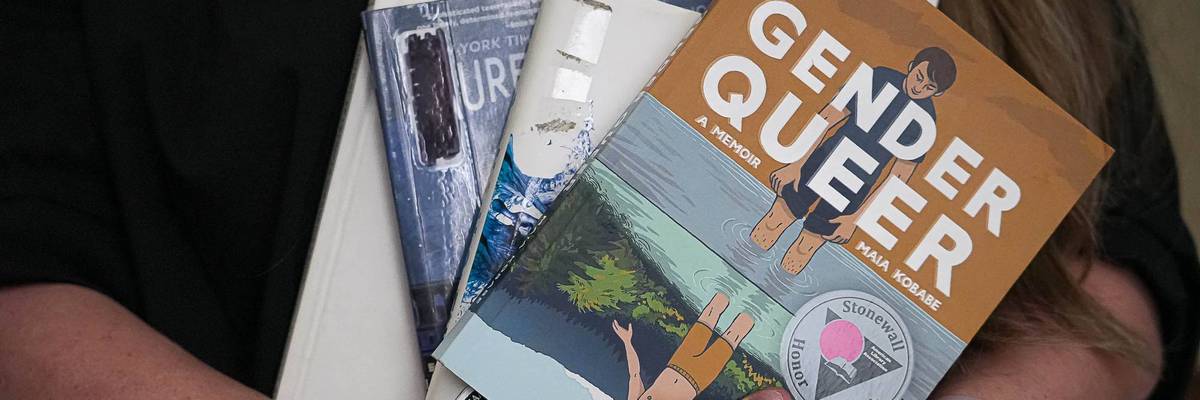
Suzette Baker, former head librarian at the Kingsland Branch Library in the Llano County Library System, holds some banned books at the Edwards Law office on March 4, 2024 in Austin, Texas.
"In several cases, AI recommended banning books that were banned elsewhere, creating a snowball effect for frequently banned books while the expertise of librarians and the communities they serve are ignored."
PEN America released a report on Monday documenting nearly 12,000 book bans involving more than 7,300 individual titles in US schools during the 2025-2026 school year, which the organization said were the largest censorship case numbers it had ever recorded.
The state of Texas accounted for more than 8,100 book bans—roughly three-fourths of the nationwide total and more than double that of Florida, which was the second-most censorious state with over 3,200 book bans.
PEN America said that the surge in Texas book bans came from SB 13, a state law passed in 2025 that banned a broad array of books that censorship proponents view as "profane" or "indecent."
According to PEN America, the Texas book bans carried out over the last year have been particularly broad because officials in the state used artificial intelligence to make a recommended list of banned books.
"In several cases, AI recommended banning books that were banned elsewhere," the report notes, "creating a snowball effect for frequently banned books while the expertise of librarians and the communities they serve are ignored."
Sold, a 2006 young adult novel by journalist Patricia McCormick about a teenage girl in Nepal who gets sold into sexual slavery, was the most frequently banned book in the US.
Popular horror writer Stephen King was the most banned individual author, according to the report.
Kasey Meehan, director of PEN America’s Freedom to Read program, said that banning popular young adult titles was a particularly harmful policy given the broad decline in reading throughout the US.
"Schools should be doing everything possible to connect kids with reading by introducing them to engaging stories and formats," Meehan said. "Instead, many are doing the opposite, banning books that help kids see themselves in literature, deepen their understanding and empathy of others, and develop their imaginations."
Philomena Polefrone, senior manager of the Freedom to Read program, said the broad books bans documented by the PEN America report are due to "chilling directives from state politicians" that "have created chaos and fear."
"Unsure how to comply, districts are removing books en masse, sometimes with the ‘help’ of crude AI tools that only make the problem worse," Polefrone said. "Increasingly, these bans are invisible. Thousands of these cases are only recorded because of public information requests by Florida Freedom to Read and Texas Freedom to Read. Books paid for by taxpayers are being removed from shelves and the local community may not even know about it."
This country and this world are at a monumental crossroads. US voters have an opportunity to beat back the forces of fascism and confront the billionaires who are rigging the economy, our media system, and our democracy, making it increasingly impossible for ordinary people to get by. We’re not just talking about the election. We’re talking about what must be done once these fascist elements are vanquished from power. We need a bolder set of solutions than what either major party has so far been willing to offer and a working-class movement ready to fight like hell for it. Trump didn't emerge from nowhere. The conditions that fueled MAGA authoritarianism were created by decades of radical neoliberal economic policies and a corrupt political system dominated by corporate interests. They slashed taxes on the super-rich, promising that the benefits would trickle down. They said giveaways to the corporate titans would make life more affordable for the rest of us. It was all bullshit. And when a bitter, betrayed populace searches for someone to blame, right-wing demagogues have little trouble finding scapegoats. People know when they're being lied to, but you won't hear any of this from the corporate media. Only independent journalism—powered and funded by people who believe in building a better world—can deliver truly trustworthy daily news. If you share our vision, please contribute whatever you can to sustain our work. |
PEN America released a report on Monday documenting nearly 12,000 book bans involving more than 7,300 individual titles in US schools during the 2025-2026 school year, which the organization said were the largest censorship case numbers it had ever recorded.
The state of Texas accounted for more than 8,100 book bans—roughly three-fourths of the nationwide total and more than double that of Florida, which was the second-most censorious state with over 3,200 book bans.
PEN America said that the surge in Texas book bans came from SB 13, a state law passed in 2025 that banned a broad array of books that censorship proponents view as "profane" or "indecent."
According to PEN America, the Texas book bans carried out over the last year have been particularly broad because officials in the state used artificial intelligence to make a recommended list of banned books.
"In several cases, AI recommended banning books that were banned elsewhere," the report notes, "creating a snowball effect for frequently banned books while the expertise of librarians and the communities they serve are ignored."
Sold, a 2006 young adult novel by journalist Patricia McCormick about a teenage girl in Nepal who gets sold into sexual slavery, was the most frequently banned book in the US.
Popular horror writer Stephen King was the most banned individual author, according to the report.
Kasey Meehan, director of PEN America’s Freedom to Read program, said that banning popular young adult titles was a particularly harmful policy given the broad decline in reading throughout the US.
"Schools should be doing everything possible to connect kids with reading by introducing them to engaging stories and formats," Meehan said. "Instead, many are doing the opposite, banning books that help kids see themselves in literature, deepen their understanding and empathy of others, and develop their imaginations."
Philomena Polefrone, senior manager of the Freedom to Read program, said the broad books bans documented by the PEN America report are due to "chilling directives from state politicians" that "have created chaos and fear."
"Unsure how to comply, districts are removing books en masse, sometimes with the ‘help’ of crude AI tools that only make the problem worse," Polefrone said. "Increasingly, these bans are invisible. Thousands of these cases are only recorded because of public information requests by Florida Freedom to Read and Texas Freedom to Read. Books paid for by taxpayers are being removed from shelves and the local community may not even know about it."